Dining Table Size Guide India: 4/6/8-Seater Dimensions
Dining Table Size Guide for Indian Homes: 4, 6 & 8-Seater Dimensions, Spacing & Layouts
Quick Answer:
Key Takeaways (Before You Start Measuring)
- 4-seater = 120–130 cm long
- 6-seater = 150–180 cm long
- 8-seater = 200–240 cm long
- 90 cm minimum wall clearance on every side
- Standard table height = 75–76 cm
- Chair seat height = 44–46 cm
Updated: June 2026. A family in a Prestige Bengaluru apartment orders a 6-seater table online. Looks perfect on the website. It arrives, gets assembled – and now there is barely 40 cm between the chair back and the kitchen counter. Nobody can sit at the head end without squeezing in sideways.
This happens more than it should. The dimensions on the product page are accurate. The problem is the room, and nobody told them how much space a dining table actually needs once people sit down.
This dining table size guide for India covers the exact numbers – 4, 6, 8, and 10-seater dimensions in cm, room clearance rules, chair height, shape selection, and specific guidance for 2BHK flats, 3BHK apartments, and villas. Indian apartment dining spaces are often more compact than the room sizes assumed in many Western buying guides.
How Do I Calculate the Right Dining Table Size for My Room?
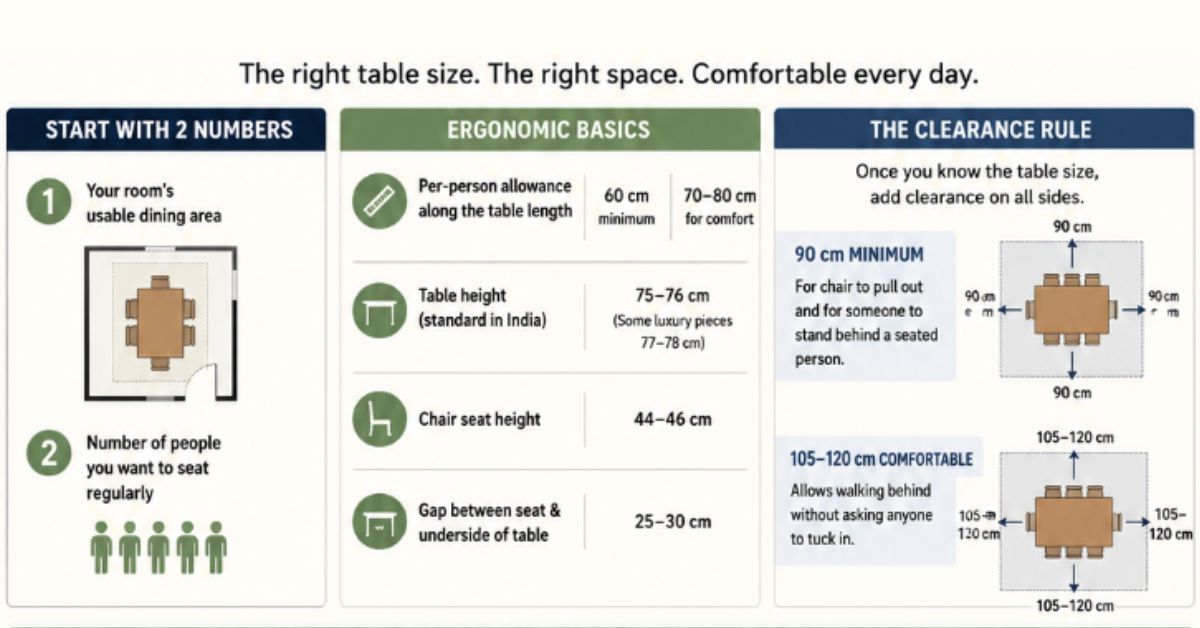
Start with two numbers: the room's usable dining area and the number of people you want to seat regularly.
The standard per-person allowance along a table's length is 60 cm minimum, 70–80 cm for comfort. Table height is consistent at 75–76 cm across the Indian market (some luxury pieces go to 77–78 cm). Chair seat height should land between 44–46 cm, leaving a 25–30 cm gap between the seat and the table underside.
The critical measurement most buyers miss: once you know the table size, add 90 cm clearance on all sides. That is the minimum for a chair to pull out and for someone to stand behind a seated person. 105–120 cm is comfortable – it allows walking behind without asking anyone to tuck in.
The dimensions below align with commonly accepted ergonomic ranges used across the Indian furniture industry. The National Building Code of India 2016 emphasises adequate circulation space around furniture and occupied areas, which is why clearance around the dining table is as important as the table dimensions themselves.
Standard Dining Table Dimensions – India Reference
Seater Count | Table Length (cm) | Table Width (cm) | Table Height (cm) | Min Room Size Needed |
4-Seater | 120–130 | 75–80 | 75–76 | 10 x 10 ft (3 x 3 m) |
6-Seater | 150–180 | 85–90 | 75–76 | 10 x 12 ft (3 x 3.6 m) |
8-Seater | 200–240 | 90–100 | 75–76 | 11 x 14 ft (3.4 x 4.3 m) |
10-Seater | 240–280 | 100–110 | 75–76 | 12 x 16 ft (3.7 x 4.9 m) |
12-Seater | 300–366 | 107–137 | 75–76 | 14 x 18 ft (4.3 x 5.5 m) |
Round 4-Seater | Dia: 90–100 cm | – | 75–76 | 10 x 10 ft (3 x 3 m) |
Round 6-Seater | Dia: 120–130 cm | – | 75–76 | 11 x 11 ft (3.4 x 3.4 m) |
Check whether your preferred dining table will fit before you order.
The checklist includes a full dining room verification sheet that helps identify clearance issues before furniture is ordered or manufactured.
Quick Reference: Indian Home Type vs Recommended Table Size
Need | Dining Area | Recommendation |
Standard 2BHK | 8 x 9 ft | 4-seater max |
Premium 2BHK | 9 x 10 ft | 4–6 seater extendable |
3BHK | 10 x 11 ft | 6-seater rectangular |
Premium 3BHK | 11 x 12 ft | 6–8 seater |
Villa / independent house | 12 x 14 ft+ | 8–10 seater custom |
Open-plan kitchen-dining | Merged layout | 6-seater minimum |
Dining Table Size Calculator
Dining Table Size Calculator
Enter your room dimensions to get the right table size and seating count
Room doesn't fit a standard size? Arcedior sources and custom manufactures dining tables to exact dimensions.
Get a quoteDining Table Sizing by Indian Home Type: 2BHK, 3BHK, and Villa
This is the section no competitor covers. Generic dining table guides use Western room sizes. A 2BHK in Mumbai or Pune has a dining area of roughly 8 x 9 feet. A "standard 6-seater" table at 180 cm long will not fit comfortably in that space once chairs and clearance are factored in.
2BHK Apartments (650–1100 sqft)
Typical dining area: 8 x 9 ft in a standard 2BHK, up to 9 x 10 ft in premium configurations.
For a standard 2BHK, a 4-seater table is the practical maximum. A 4-to-6-seater extendable table is the smartest buy here – it stays compact daily and extends when needed. Mumbai and Thane buyers, and compact Pune apartments in areas like Kothrud or Wakad, consistently need this approach.
Avoid rectangular 6-seater tables at full length – they leave under 60 cm clearance on at least one side.
3BHK Apartments (1100–1500 sqft+)
Typical dining area: 10 x 11 ft standard, 11 x 12 ft in premium configurations.
A 6-seater rectangular table is the standard fit. In a premium 3BHK – DLF Gurgaon layouts, Godrej developments in Bengaluru – an 8-seater becomes viable if the dining room is dedicated (not open-plan merged with the living area).
Villas and Independent Houses
Dining area: 12 x 14 ft and above.
This is where 8-seater and 10-seater tables belong. In Ahmedabad, Hyderabad villa developments, and independent bungalows in Delhi NCR, a 10-seater or custom-format statement table is appropriate. Joint families in these spaces regularly need seating for 10–14, which pushes toward custom sizing – standard catalogue products stop at 10.
For joint families needing 12-seater capacity, a rectangular table at 300–366 cm length is the practical choice. A round 12-seater at 244 cm diameter seats the numbers but makes conversation across the table difficult and demands a near-square room of at least 18 x 18 ft, rare even in large villas. An oval table at this scale is a good middle ground: it softens the visual weight of a long rectangular slab and eliminates the sharp corners that make end seating feel isolated.
Open-Plan Kitchen-Dining Layouts
Most apartments built from 2022 onwards in metro India – particularly in Bengaluru, Hyderabad, and Noida – use merged kitchen-dining layouts. According to the Houzz India 2024 Renovation Trends Report, open-plan kitchen-dining is now the dominant configuration in new-build premium apartments.
In these layouts, the table needs to work harder: it defines the dining zone visually without walls. A minimum 6-seater is advisable. An island extension (where the kitchen island doubles as a bar-height breakfast counter) can supplement seating without expanding the table footprint.
Home Type | Typical Dining Area | Recommended Table | Best Option |
2BHK (650–900 sqft) | 8 x 9 ft | 4-seater max | Extendable 4-to-6-seater |
2BHK Premium (900–1100 sqft) | 9 x 10 ft | 4–6 seater | Rectangular 6-seater |
3BHK (1100–1500 sqft) | 10 x 11 ft | 6-seater | Rectangular or oval 6-seater |
3BHK Premium (1500+ sqft) | 11 x 12 ft | 6–8 seater | Rectangular 8-seater |
Villa / Independent House | 12 x 14 ft+ | 8–10+ seater | Custom statement table |
Open-Plan Kitchen-Dining | Merged layout | 6-seater min | Dedicated table or island extension |
If your room does not fit a standard size – or you are planning a statement dining space for a villa, show flat, or hospitality project – Arcedior sources and custom manufactures dining tables to your exact specifications: size, material, finish, and base design.
Share your room dimensions, seating count, and material reference. We confirm sizing, manufacturing options, lead time, and delivery to your location.
Chair Spacing & Room Clearance: Where Most Buyers Go Wrong
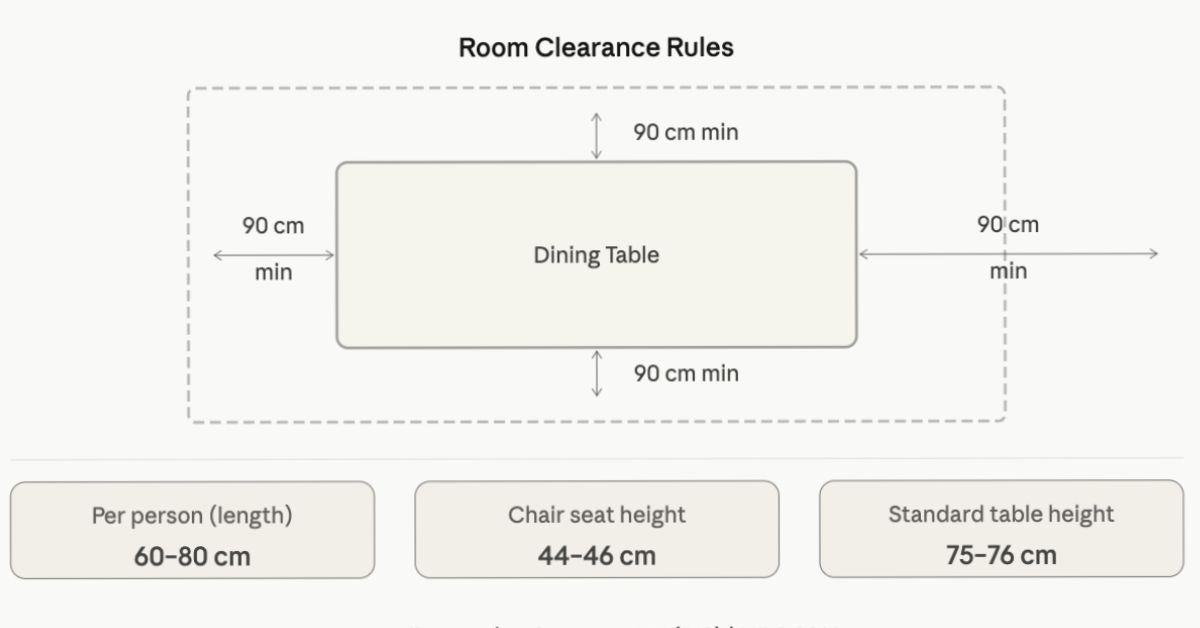
The table dimensions are only half the equation. Here are the three clearance numbers that matter:
- Minimum clearance from table edge to wall: 90 cm. This allows the chair to pull out and seat a person.
- Comfortable clearance: 105–120 cm. This allows someone to walk behind a seated person.
- Per-person table length: 60 cm minimum, 70–80 cm for comfort.
And for chairs:
- Standard dining chair seat height: 44–46 cm
- Gap between chair seat and table underside: 25–30 cm minimum (per IS 2455 for upholstered furniture)
- Standard table height in India: 75–76 cm; luxury tables sometimes run to 77–78 cm
A 90 cm clearance sounds generous until you realise that a chair pulled out occupies about 50 cm of depth, and the seated person adds another 20–25 cm. The 90 cm number accounts for both.
What Designers Commonly Get Wrong. The most common sizing mistake is not the table length. It is failing to account for chair pull-out clearance combined with circulation behind occupied chairs. A table that looks fine on a floor plan can leave under 40 cm of usable walkway once people sit down, which means no one can move behind seated guests without asking them to stand up.
Is a Round or Rectangular Dining Table Better for a Small Indian Apartment?
For small apartments, a round table feels more open. For most Indian dining rooms (which are rectangular), a rectangular table uses space more efficiently.
Round tables on a pedestal base have no legs at the corners – chairs can be placed freely, and nobody sits at an awkward corner position. A round 4-seater at 90–100 cm diameter fits the same 10 x 10 ft room as a rectangular 4-seater, but the round version tends to allow slightly better circulation.
For 6-seater needs and above, rectangular wins in most Indian apartment layouts. An oval table is a reasonable compromise – no sharp corners, better circulation, and it accommodates 6–8 people without needing the length of a full rectangular 8-seater.
Shape | Best For | Avoid If | Space Feel |
Rectangular | Rectangular dining rooms, large families, 6–10 seater needs | Very small square rooms | Structured, formal |
Round | Square rooms, compact spaces, 4-seater, cozy settings | Long rooms, large families | Open, conversational |
Oval | Long rooms, 6–8 seater without sharp corners | Very small spaces | Elegant, transitional |
Square | Small 4-seater spaces, breakfast nooks | Groups larger than 4 | Intimate, balanced |
What About Extendable Dining Tables?
This option gets mentioned in most guides and then dropped. It deserves more than a passing reference.
An extendable dining table – butterfly extension, drop leaf, or pull-out leaf – is genuinely the right solution for a large share of Indian buyers. The reason is that most Indian homes host guests sporadically. You do not need a 6-seater table every day, but you do need one during Diwali, a birthday, or a family visit.
Butterfly extension tables are the most practical. The leaf folds inside the table when not in use. No storage problem, no separate piece to manage. A 4-seater extends to a 6-seater; a 6-seater extends to an 8-seater. The dimensions when extended are the same as a fixed table of that size, so all the clearance rules still apply; the table just stores less.
Things to check before buying an extendable table:
- How long does the extension take? Under 30 seconds is practical. Anything more complex gets left folded.
- Does the mechanism add height variation at the leaf join? Some low-cost mechanisms create a 2–3 mm step at the seam. Fine for everyday use, not ideal for guests.
- What is the leg clearance at the extended length? Some extension mechanisms shift the legs outward, which can block corner seating.
For most 2BHK and premium 2BHK buyers, an extendable 4-to-6-seater table at 120–150 cm (base) extending to 165–180 cm is the right answer.
Dining Table Materials and When Standard Sizes Stop Working
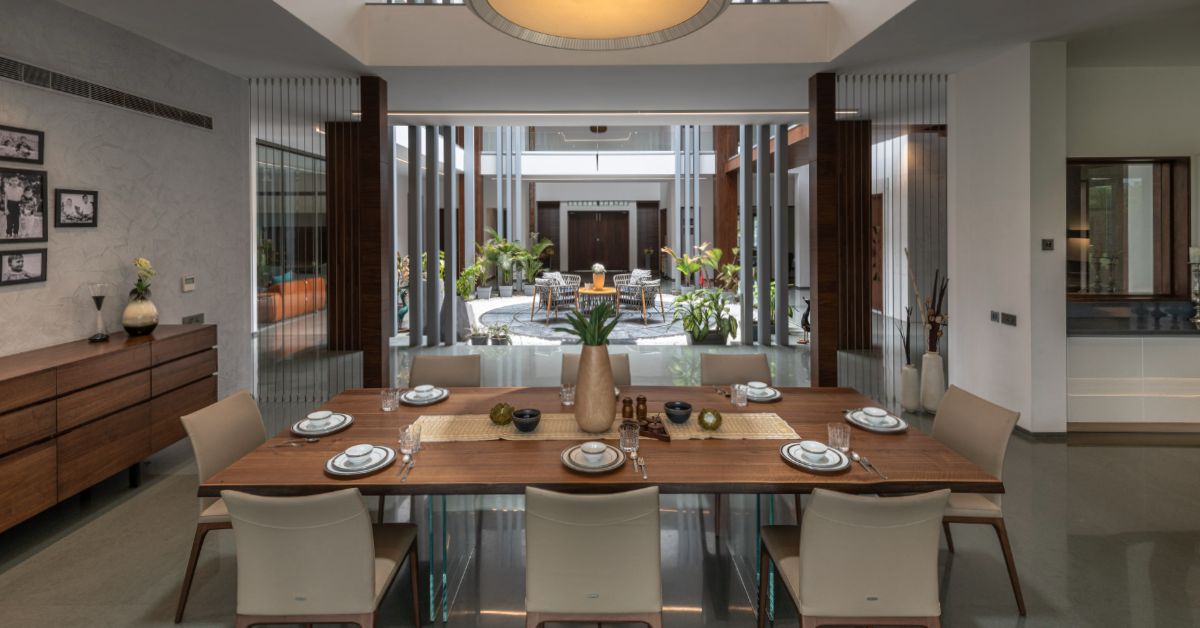
Material affects the table's footprint, weight, and whether standard sizes apply.
Solid wood tables – teak, sheesham, acacia – are often available in larger formats: 200 x 90 cm or 240 x 100 cm for 8 and 10-seater configurations. They are heavier and need a stable base, which adds to the overall visual weight of the piece. Standard dining table height in India, at 75–76 cm, applies here.
Engineered wood and laminate tables follow standard catalogue dimensions closely. HPL finish is now used in commercial-grade dining for hospitality applications – it resists heat, moisture, and surface wear better than most veneers.
Marble and stone tops are statement pieces. A marble dining table at standard height with a 180 x 90 cm top can weigh 80–120 kg, depending on the stone thickness. The base needs to be sized accordingly – thin metal legs on a heavy marble top are a structural mismatch. Standard height is 75–76 cm, though some luxury marble-top pieces are specified at 77 cm.
Avoid one of the six dining table mistakes that commonly lead to expensive replacements.
Before you order, download the free Dining Table Pre-Order Verification Checklist. It covers room measurement, table specification, material fit by Indian climate, and a red flags list – the six mistakes that cost the most to fix after delivery. One page, printable, designed to use in a showroom or when briefing a vendor.
Best Dining Table Materials for the Indian Climate
This is a gap most competitor articles leave completely unaddressed. India's climate varies dramatically, and material choice has real-world consequences.
Coastal cities (Mumbai, Chennai, Kochi, Visakhapatnam): High humidity year-round. Solid wood without proper treatment will absorb moisture and warp over 2–3 monsoon cycles. Teak with a marine-grade finish, HPL surfaces, or sintered stone tops are better choices. Avoid bare MDF near the coast, it swells.
Humid inland regions (Bengaluru, Kolkata, Pune): Less severe than the coast but still a factor. Sheesham and acacia with proper lacquer finishing hold up well. Engineered wood with a moisture-resistant core is acceptable for dining use.
Dry climates (Ahmedabad, Jodhpur, Delhi in summer): Dry air can cause solid wood to crack if the grain runs across a wide slab. Quarter-sawn cuts or tables with a veneer-over-ply construction handle dimensional change better. Marble and stone tops are excellent here; they do not expand or contract with humidity.
When Standard Sizes Do Not Work
If your room measures 10.5 x 11.5 ft and you want to seat 8, a standard 200 cm table is borderline. A custom 180 x 95 cm table seats 8 comfortably with better clearance. That 20 cm difference is exactly the kind of specification that catalogue products cannot address.
Arcedior sources and custom manufactures dining tables for residential projects, developer show flats, and hospitality applications – any size, material, and finish combination, with QC and logistics handled to your location across India and internationally.
Vastu Placement for Dining Tables in Indian Homes
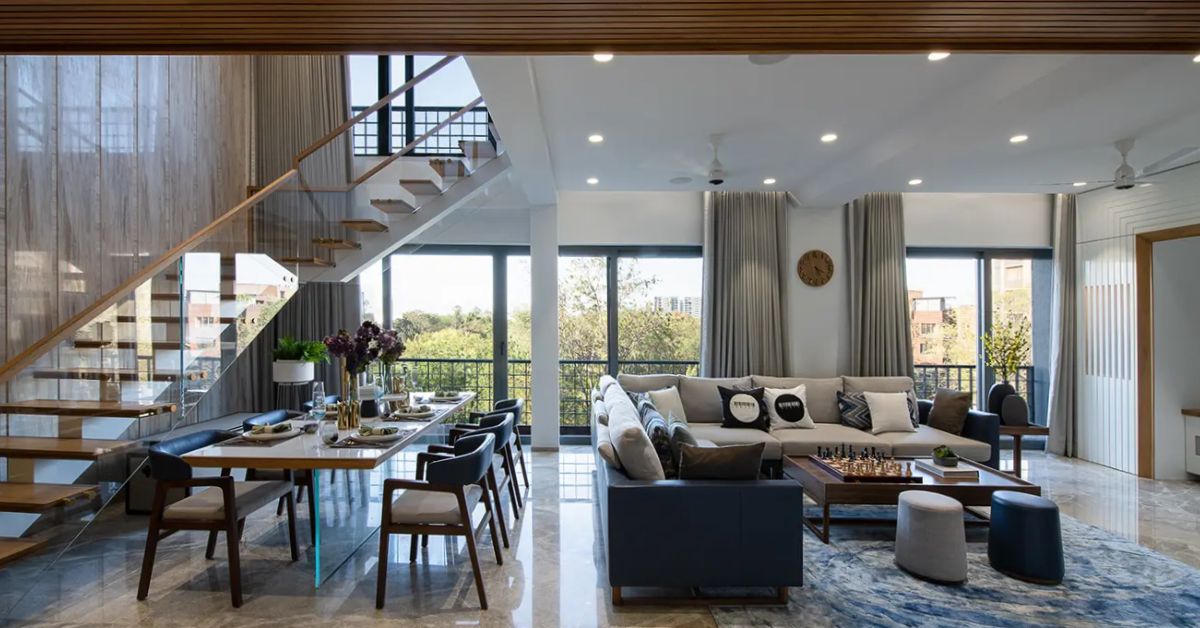
Vastu placement for the dining area is a real consideration in pre-purchase planning – particularly for homeowners in Ahmedabad, Surat, and joint family households across Gujarat and Rajasthan.
According to classical Vastu references (Manasara and guidance generally consistent with contemporary Vastu architecture practice):
- The dining area is best placed in the west or east of the home
- A square or rectangular table is preferred over irregular shapes
- Placement directly under a ceiling beam is considered unfavourable – it creates a sense of pressure above diners
- Natural light in the dining area is considered positive
Practical points for any home, regardless of Vastu preference:
- Avoid placing the table on a split-level or uneven floor, as it affects seating comfort across the full table length
- Leave clearance between dining chair backs and any wall-mounted unit so chairs can move freely
These are planning-stage decisions. Raise them with a designer early; they affect furniture placement before walls are finalised.
Conclusion: Five Rules Before You Order
- Room first – measure your dining area and subtract 90 cm clearance on all sides before calculating the maximum table size
- Per-person space – 60 cm minimum per person along the length, 70–80 cm for comfort
- Height consistency – 75–76 cm table, 44–46 cm chair seat, 25–30 cm gap in between
- Shape by room – rectangular tables for rectangular rooms, round for square rooms, or compact 4-seater needs
- Indian typology – use Indian apartment dimensions, not Western size charts
Planning furniture for a villa, developer show flat, or hospitality project in India, GCC, US OR UK?
Arcedior supports sourcing, custom manufacturing, QC, logistics, and installation coordination for dining furniture at scale. Share your brief – seating count, material preference, location, and target date – and we respond with product options, lead time, and a sourcing plan.