GREENGUARD Furniture Certification Guide

GREENGUARD Certification Furniture Guide: How to Choose and Verify Low-VOC Pieces
GREENGUARD certification is a third-party standard by UL that tests furniture and other products for low chemical emissions (VOCs). GREENGUARD Gold certified furniture has been laboratory-tested to meet strict limits for indoor air pollutants, helping you specify pieces with cleaner indoor air for homes, offices, and public spaces.
This matters because we spend approximately 90% of our time indoors, and furniture is one of the largest sources of volatile organic compounds in our living and working environments. Off-gassing from adhesives, finishes, upholstery, and composite materials can affect air quality for months or even years after installation.
GREENGUARD and GREENGUARD Gold are widely used in North America and increasingly referenced in specifications for global projects, especially in offices, hospitality, and education, where indoor air quality is a formal requirement.
By the end of this guide, you'll have a simple GREENGUARD furniture checklist to use in specs, RFQs, and site visits, plus a clear understanding of when GREENGUARD certification for furniture makes sense for your projects.
What Is GREENGUARD Certification for Furniture?
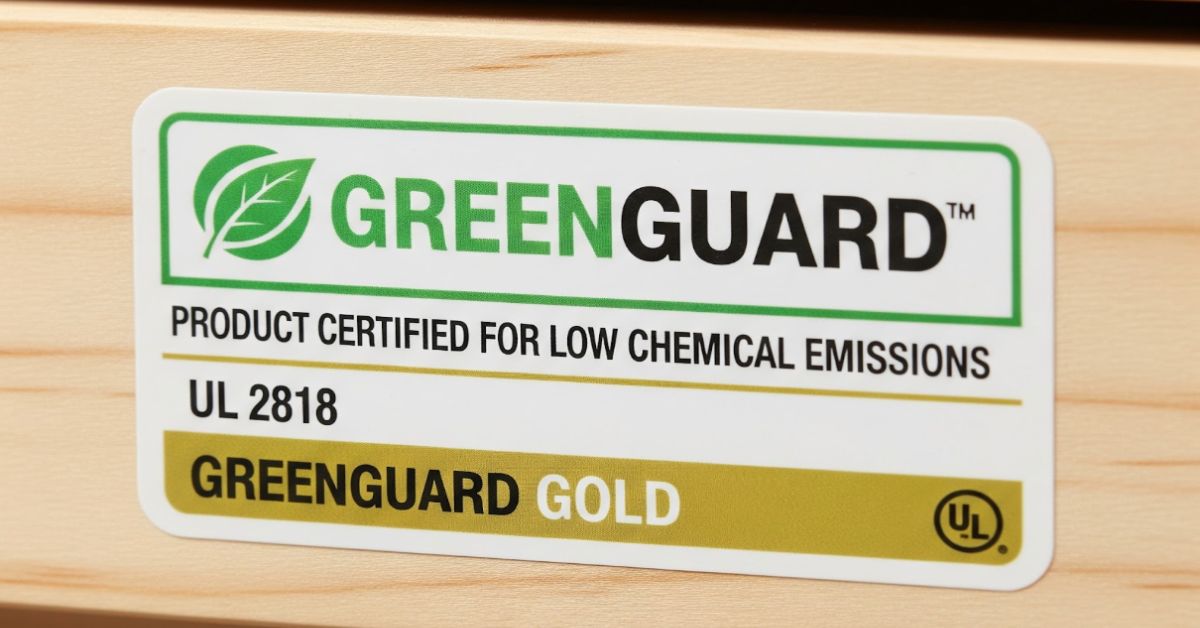
GREENGUARD certification verifies that furniture has been tested by UL Solutions and meets strict VOC emission limits for healthier indoor air quality.GREENGUARD certification is a testing and verification program for products that emit chemicals into indoor air. It's run by UL Solutions, a global safety science company that acquired the original Greenguard Environmental Institute program. Furniture with GREENGUARD certification reduces indoor pollution and supports global building standards such as LEED, WELL, BREEAM, and corporate ESG requirements.
What it tests: The certification measures VOC emissions by placing products in sealed environmental chambers and testing the air for specific chemicals over time. In simple terms, it checks how much "off-gassing" a piece of furniture releases into the room.
What products it covers: While GREENGUARD started with building materials and flooring, it now covers a wide range of products, including furniture, office systems, mattresses, textiles, electronics, paints, adhesives, and cleaning products.
Why furniture matters: Furniture presents a particular challenge for indoor air quality furniture standards because of its large surface area and the variety of materials involved. Adhesives bond wood panels together, finishes coat surfaces, foam cushioning releases compounds, and upholstery fabrics can harbor treatments and dyes. All of these components can contribute to VOC emissions.
Understanding the Two Certification Levels
Understanding GREENGUARD vs GREENGUARD Gold is essential for choosing the right standard:
Level | What it means in simple words | Typical use cases |
GREENGUARD | Meets strict VOC limits for general indoor use | Homes, offices, commercial spaces |
GREENGUARD Gold | Even lower VOC limits add extra health-based criteria for sensitive populations | Schools, healthcare facilities, nurseries, kids rooms, spaces for chemically sensitive individuals |
Both certifications test for over 360 VOCs and 10,000 total chemicals, but Gold uses stricter concentration limits and adds additional requirements based on California's specifications for schools and health facilities.
GREENGUARD vs GREENGUARD Gold: Which Do You Need?

Feature photo: Tesla Properties Dubai; Architect/Designer: Mr. Saif Zaidi
GREENGUARD Gold is a stricter version of GREENGUARD with lower VOC emission limits and extra health-based criteria. It’s usually recommended for schools, healthcare spaces, and kids’ rooms, while standard GREENGUARD is suitable for most offices, hotels, and general residential furniture.
Choose based on your project type:
GREENGUARD Gold recommended:
- Nurseries and children's bedrooms (GREENGUARD Gold kids furniture)
- Schools, daycare centers, and university dormitories (GREENGUARD Gold school furniture)
- Healthcare facilities (patient rooms, waiting areas, clinics) (GREENGUARD Gold hospital furniture)
- Senior living and assisted care facilities
- Spaces designed for individuals with chemical sensitivities
GREENGUARD (standard) appropriate:
- Corporate offices and co-working spaces (GREENGUARD certified office furniture)
- Hotels, restaurants, and hospitality venues
- Retail and commercial interiors
- General residential furniture for adult spaces
Either works (choose based on client preferences or internal policies):
- Multi-family residential projects
- Government and civic buildings
- Libraries and community centers
If your project pursues green building certifications or has internal wellness goals, Gold may be preferred even in general office environments. Many corporate sustainability policies now default to Gold certification for all furniture purchases.
Benefits of GREENGUARD-Certified Furniture
GREENGUARD-certified furniture helps reduce VOC emissions, improving indoor air quality and supporting health and sustainability objectives across residential and commercial projects. Selecting GREENGUARD furniture or GREENGUARD Gold furniture provides:
- Cleaner indoor air for occupants
Lower VOC emissions mean reduced exposure to chemicals that can cause headaches, eye irritation, respiratory issues, and that "new furniture smell" many people find unpleasant. This low-VOC furniture certification approach ensures healthier indoor environments. - Supports wellness and ESG goals
Organizations increasingly track environmental, social, and governance metrics. Specifying low-emission furniture demonstrates commitment to occupant health and can be documented in sustainability reports and wellness program communications. - Helps with green building credits
GREENGUARD certification requirements for furniture align with several green building rating systems. The certification can contribute to LEED v4 and v4.1 credits for low-emitting materials. Many building codes and voluntary guidelines reference GREENGUARD standards when setting requirements for furniture in public buildings. - Simplifies procurement
A recognised third-party non-toxic furniture certification reduces the need for additional testing or laboratory reports. You can specify GREENGUARD certification in your RFQ and request proof of compliance, streamlining the vetting process across multiple vendors.
*Important note: GREENGUARD ≠ total sustainability. GREENGUARD certification focuses specifically on indoor air emissions. It doesn't evaluate other aspects of sustainability, such as responsibly sourced wood, recycled content, manufacturing energy use, worker conditions, or end-of-life recyclability. Think of it as one important piece of a larger sustainability puzzle, not a comprehensive environmental label.
GREENGUARD Certification vs Other Furniture Standards (CARB, FloorScore, OEKO-TEX)
GREENGUARD focuses on VOC emissions from complete furniture pieces, while other standards address specific materials or chemicals such as formaldehyde, textiles, or wood sourcing. Understanding how GREENGUARD relates to other certifications helps you build complete specifications that address multiple project goals.
GREENGUARD Gold vs CARB / TSCA Title VI (formaldehyde rules)
CARB (California Air Resources Board) Phase 2 and TSCA (Toxic Substances Control Act) Title VI are regulatory standards that set legal limits specifically for formaldehyde emissions from composite wood products like plywood, particleboard, and MDF.
Key difference: GREENGUARD Gold vs CARB comparisons show that GREENGUARD Gold is more comprehensive. CARB/TSCA are mandatory compliance standards for composite wood sold in the U.S., focused on one chemical (formaldehyde). GREENGUARD is a voluntary certification covering a much broader range of VOCs and finished products beyond just wood panels.
In practice: Quality furniture made for the U.S. market should already meet CARB/TSCA requirements for any composite wood components. GREENGUARD certification goes several steps further by testing the assembled furniture piece for total VOC emissions from all materials (wood, adhesives, finishes, fabrics, foam).
GREENGUARD vs FloorScore
FloorScore is a certification program specifically for hard-surface flooring products and adhesives. It was developed by the Resilient Floor Covering Institute and is now administered by SCS Global Services.
Key difference: FloorScore is tailored to flooring materials. GREENGUARD covers flooring but also furniture, panels, textiles, and many other product categories.
When buying flooring and furniture together: You may see flooring specified with FloorScore and furniture with GREENGUARD. Both certifications use similar testing methods and criteria. Some products carry both certifications. For furniture specifically, GREENGUARD is the more relevant and widely used standard. Understanding GREENGUARD Gold vs FloorScore helps you specify the right certification for each application.
GREENGUARD vs Textile and Foam Labels
Other certifications focus on specific furniture components:
OEKO-TEX Standard 100: Tests textiles and fabrics for harmful substances, including heavy metals, pesticides, and certain VOCs. Widely used for upholstery fabrics.
CertiPUR-US: Certifies flexible polyurethane foam used in furniture cushioning for low emissions, no prohibited flame retardants, and no heavy metals.
Global Organic Textile Standard (GOTS): Covers organic fiber content and processing for textiles.
Key difference: These certifications apply to materials and components. GREENGUARD certifies the finished, assembled furniture piece after all materials are combined and any final treatments are applied. This whole-product approach captures interactions between different materials and coatings.
In practice: High-quality, low-VOC furniture certification often carries multiple certifications. You might see a sofa with GREENGUARD Gold for the complete piece, CertiPUR-US for the foam, and OEKO-TEX for the upholstery fabric. Each certification adds a layer of verification for different aspects of the product.
Rule of Thumb: Use GREENGUARD (preferably Gold) for complete furniture pieces and complement it with FSC for wood, OEKO-TEX for fabrics, or Cradle to Cradle for circular design. No single certification addresses every aspect of furniture sustainability or health.
How to Verify GREENGUARD Certified Furniture (Step-by-Step)
To verify if furniture is truly GREENGUARD certified, ask for the exact product model and UL certificate number, then search for it in the UL SPOT database. Check that the listing is active, the model matches, and the level (GREENGUARD or GREENGUARD Gold) matches your spec before you place the order.
Certificate verification is critical because certifications only matter if they're legitimate and current. Here's your verification process:
1. Ask for the exact product name and model
Not just the range name. Certification is issued per model or grouped models.
2. Request the UL certificate number or a direct UL SPOT link
Every certified product has a unique certificate number. The vendor should be able to provide either the certificate number or a direct link to the product listing in UL's SPOT database.
3. Go to the UL SPOT database and search
Visit the official UL Solutions Product Certification Database (often called UL SPOT). You can search by:
- Product name
- Brand or manufacturer name
- Certificate number
4. Check the following details
- Status: Must show "Certified" (not expired, not withdrawn)
- Product model/SKU: Must exactly match what you're purchasing, not just a similar product
- Certification level: Confirm whether it's GREENGUARD or GREENGUARD Gold, and that it matches your specification
- Scope: Check the product description to ensure it covers the configuration you're buying (some certifications apply only to specific finishes, fabrics, or configurations)
5. Check the certification date and renewal status
GREENGUARD certifications must be renewed annually. Look for the certification date and check that it's current. Products typically maintain continuous certification as long as they pass annual testing, but certifications can lapse if the manufacturer doesn't renew.
6. Save documentation
Screenshot or download the SPOT listing and attach it to your project spec file or RFQ. Include the direct URL to the certification page in your records.
Red Flags to Watch For
- Only a PDF brochure showing the logo with no UL link
- Certificate under a different product line
- "Made with certified materials" wording, but no finished furniture certification
- Old or expired certificates
- Certificate doesn't specify the configuration you're buying
GREENGUARD Furniture Checklist for Specs & RFQs
This table is used to track the necessary requirements and status for furniture items specified for a project, ensuring compliance with relevant certifications and project needs.
Item | Requirement | Status / Notes |
|---|---|---|
Furniture type (chair, sofa, bed, etc.) | Furniture: ……………. | |
Required certification level | ☐ GREENGUARD | |
Product identification | Exact model number/SKU | |
UL SPOT verification | Valid listing in UL SPOT database | |
Certification status | ☐ Status shows "Certified" | |
Configuration details | Finish: | |
Project type | ☐ Office/commercial | |
Additional requirements | ☐ FSC-certified wood | |
Documentation delivery | Who provides certification proof? | |
Approval & sign-off | Reviewed by: ………………….. |
Download the GREENGUARD Furniture Checklist to simplify your specs, verify certificates faster, and avoid costly product mismatches across projects.
On multi-city or multi-country projects, working with a single global sourcing partner experienced in certified furniture can simplify documentation and maintain consistency across locations.
Where Does GREENGUARD Certified Furniture Matter Most?

Feature photo: Four Points by Sheraton, Columbus, US
GREENGUARD certification is most critical in schools, healthcare facilities, corporate offices, hospitality projects, and residential spaces where occupants spend extended time and indoor air quality directly impacts health and comfort.
GREENGUARD certification provides value across many project types, but it's especially important in these applications:
- Schools & universities: Classrooms, libraries, student housing, cafeterias, and administrative offices benefit from GREENGUARD Gold nursery furniture and low VOC furniture certification standards.
- Healthcare & wellness facilities: Patient rooms, exam rooms, waiting areas, clinics, physical therapy centers, and wellness studios require the strictest non-toxic furniture standards.
- Corporate offices & co-working spaces: Workstations, private offices, conference rooms, focus rooms, and collaborative areas increasingly specify GREENGUARD certified office furniture to support employee wellness.
- Hospitality projects: Hotel guest rooms, lobbies, restaurants, and particularly family-friendly zones like kids' clubs and play areas.
- Homes: Nurseries, children's bedrooms, home offices, and master bedrooms benefit from indoor air quality furniture standards.
Global clients often choose GREENGUARD Gold for spaces involving children, patient care, or long occupancy periods. If the project spans several cities or countries, a coordinated sourcing approach helps maintain consistency in certifications.
Limitations of GREENGUARD Furniture Certification
GREENGUARD certifies low VOC emissions for indoor air quality but doesn't evaluate sustainability factors like wood sourcing, manufacturing energy, recyclability, or labor conditions.
GREENGUARD certification provides valuable third-party verification of low emissions, but it's important to understand what it does and doesn't cover.
- GREENGUARD focuses on indoor air emissions only. The certification tests for VOCs and other chemicals released into the air. It doesn't evaluate water quality impacts, solid waste, energy use in manufacturing, or other environmental aspects of production. "GREENGUARD certified" doesn't mean "zero VOC," "completely non-toxic," or "perfectly sustainable."
- No assessment of raw materials or sourcing. GREENGUARD doesn't verify whether wood comes from responsibly managed forests, whether fabrics are organic, whether materials are recycled, or how far materials traveled. If these factors matter to your project, look for complementary certifications like FSC, Cradle to Cradle, or Environmental Product Declarations (EPDs).
- No coverage of end-of-life or circularity. The certification doesn't address whether furniture can be disassembled for repair, whether materials can be recycled, or what happens when the product reaches the end of its life. Durability, repairability, and recyclability require separate evaluation.
- No social or labor standards. GREENGUARD testing focuses on product emissions, not on worker safety, fair wages, or labor conditions in manufacturing facilities. If supply chain ethics matter to your organization, consider certifications like B Corp, Fair Trade, or SA8000, or conduct separate vendor audits.
- Limited to specific tested configurations. A furniture line might have one finish certified, but not others, or certification might apply to specific upholstery options but not custom fabrics. Always verify that the exact product configuration you're purchasing carries certification.
- Annual renewal required. Certifications must be renewed yearly with new testing. A product certified three years ago might no longer carry a valid certification if the manufacturer changed materials or didn't maintain renewal. Always check the current status.
GREENGUARD certification excels at what it's designed to do: verify low chemical emissions for better indoor air quality. For comprehensive sustainability goals, combine GREENGUARD with other third-party certifications and vendor transparency about sourcing, manufacturing, and end-of-life considerations. No single label addresses every environmental or health concern.
Conclusion
Understanding what is GREENGUARD certification for furniture is gives you the knowledge to make informed decisions about furniture for healthier indoor spaces. Start with the checklist provided in this guide, adapt it to your organization's specific needs, and make certification verification a standard step in your furniture selection workflow.
The investment in GREENGUARD Certified furniture and other low-VOC furniture certification standards pays dividends in occupant well-being, regulatory compliance, and alignment with sustainability goals. Having systems in place to track certificates, verify current status, and maintain records will save significant time during procurement and project closeout.
FAQs
1. What does GREENGUARD Certified furniture mean?
GREENGUARD Certified furniture means the product has been tested by UL and meets strict limits for VOC emissions that affect indoor air quality. This non-toxic furniture certification ensures cleaner air in your spaces.
2. Is GREENGUARD Gold better than GREENGUARD for furniture?
Yes. GREENGUARD Gold-certified furniture uses more stringent emission limits and includes additional health-based criteria. It is recommended for schools, hospitals, and spaces with sensitive users. Understanding GREENGUARD vs GREENGUARD Gold differences helps you choose the right level.
3. Does GREENGUARD certification mean zero VOCs?
No. GREENGUARD certification means a product’s VOC emissions are tested and kept below strict limits that support good indoor air quality. It does not mean “zero VOC”; all furniture emits some chemicals, but GREENGUARD-certified pieces emit significantly less than typical products.
4. How do I verify if a sofa or chair is GREENGUARD certified?
Get the exact model number, then search the UL SPOT Product Certification Database on the UL Solutions website. Verify the status shows "Certified," the model matches your purchase, and the certification is current. Save the certificate number and URL.
5. Is GREENGUARD certification mandatory for office furniture?
No. GREENGUARD certification is voluntary in most jurisdictions. However, some government agencies, school districts, and corporate organizations have internal policies requiring GREENGUARD certified office furniture (often Gold level) for all furniture purchases.
6. Does GREENGUARD furniture help with LEED or green building points?
Yes. GREENGUARD certification requirements for furniture align with LEED v4 and v4.1 requirements for low-emitting materials. So, GREENGUARD and GREENGUARD Gold are recognised pathways for low-emitting furniture credits.
7. How long does GREENGUARD certification last on furniture?
GREENGUARD certifications are valid for one year and must be renewed annually. Manufacturers submit products for retesting each year to maintain certification. Check the expiry or recertification date in the UL SPOT listing.
8. Are GREENGUARD-certified products always sustainable overall?
No. GREENGUARD specifically certifies low chemical emissions to indoor air. It doesn't evaluate overall sustainability factors like sustainably sourced materials, manufacturing energy use, water consumption, worker conditions, recyclability, or carbon footprint.