Hotel FF&E Sourcing Partner in Riyadh | India to KSA

Hotel FF&E Sourcing Partner in Riyadh: How to Procure, QC, Ship, and Deliver On Time
Riyadh hotel projects run on tight timelines. Your opening date is locked, phased handovers are scheduled, and every delay compounds. The biggest risks? Vendor chaos, finish mismatches, QC failures, compliance holdups at customs, shipping damage, and last-mile delivery confusion that stalls your entire site schedule.
You need a hotel FF&E sourcing partner in Riyadh who keeps you in control while managing the entire execution chain: sourcing from vetted factories, procurement coordination, quality checkpoints, SABER compliance preparation, shipping logistics into KSA, and delivery sequencing to your Riyadh site. This guide walks you through exactly how to make that happen.
Quick Answer: How do I handle hotel FF&E sourcing for a Riyadh project?
What "hotel FF&E sourcing partner in Riyadh" really means
What "hotel FF&E sourcing partner in Riyadh" really means

A hotel FF&E sourcing partner connects your BOQ/specs to vetted factories and brands (often India-based for custom/contract manufacturing capability), then manages execution end-to-end so you hit your opening date without vendor overwhelm.
What they handle
- RFQs + quote comparison: Send your specs to multiple manufacturers, compare pricing, lead times, and capabilities across categories (casegoods, seating, loose furniture, lighting).
- PO + production tracking: Issue purchase orders, monitor factory schedules, flag delays early, and keep you updated on progress.
- QC checks + evidence: Run inspections at key production stages, document finish accuracy, dimensional tolerances, and hardware function with photo/video proof before dispatch.
- Compliance paperwork coordination: Prepare SABER/SASO documentation, arrange pre-shipment inspections if required, and organize import paperwork (commercial invoice, bill of lading, certificate of origin).
- Shipping + delivery sequencing into Riyadh: Plan consolidation, coordinate sea freight to KSA (typically via Dammam or Jeddah), manage inland movement to Riyadh, and sequence deliveries by floor/zone to match your site readiness.
- Installation coordination support: Align delivery schedules with your contractor/site supervisor so FF&E arrivals don't block other trades or create storage bottlenecks.
What they don't do
- They are not interior designers
- They are not turnkey interior contractors
- They are not limited to a single furniture brand
This execution focused role fills a major gap that designers, contractors, and single-brand suppliers usually cannot cover fully.
Hotel FF&E Sourcing Partner vs Local Suppliers in Riyadh
Understanding the difference between a specialized FF&E sourcing partner and traditional local suppliers helps you make the right choice for your Riyadh hospitality project.
Feature | FF&E Sourcing Partner | Local Reseller/Single Supplier |
Sourcing Approach | Multi-factory sourcing across categories | Single-brand or limited catalog |
Pricing Model | Factory-direct pricing with transparent margins | Retail pricing with hidden markups |
Quality Control | Documented factory inspections with photo/video evidence | Limited or no pre-shipment QC process |
India Capability | Full India to KSA execution, including compliance and logistics | No direct India manufacturing access |
This comparison helps you choose the best FF&E partner for Riyadh projects needing flexibility, cost control, and execution reliability.
The typical India to Riyadh FF&E route (simple explanation)
Why India is a common sourcing base
India offers strong capability for custom/contract manufacturing across hotel categories. Whether you need casegoods with specific veneers, upholstered seating in custom fabrics, or loose furniture in commercial-grade finishes, Indian manufacturers handle mid-to-high volume production with flexibility on customization. This makes India a practical sourcing base for Riyadh hospitality projects that need both quality and cost efficiency.
Common logistics flow
India factories → port shipment → KSA entry port → inland movement → Riyadh delivery sequencing to site
Cargo typically ships from Indian ports (Nhava Sheva, Mundra) via sea freight to Saudi entry points. For Riyadh hotel developments, Dammam (King Abdulaziz Port) serves as a key gateway for eastern and central region hotel projects. Containers then move inland to Riyadh Dry Port, a rail-linked clearance hub that handles customs processing and inland distribution. Some shipments route via Jeddah, depending on consolidation plans and service schedules, then move by road to Riyadh.
Dammam vs Jeddah for Riyadh Sites: Which Port Makes Sense?
When Dammam tends to work better for the central region sequencing:
- Direct rail connection to Riyadh Dry Port reduces inland transit time
- Shorter road distance from port to Riyadh (approximately 400 km vs 950 km from Jeddah)
- Better for projects with tight delivery windows and phased handovers
- Often preferred when consolidating multiple shipments for central/eastern region sites
When Jeddah might be practical:
- More frequent shipping line schedules from certain origin ports
- Better consolidation opportunities if combining with the Western region deliveries
- Occasionally, lower freight rates depending on route and carrier availability
- Viable if the inland transit time is less critical to your project timeline
Why inland movement + site readiness matters more than port choice: Regardless of entry port, your delivery success depends on customs clearance speed, inland haulage coordination, and site readiness. A Jeddah shipment with efficient clearance and coordinated inland movement can outperform a poorly planned Dammam route. Focus on your partner's ability to sequence deliveries to match your construction handover schedule; that's what protects your opening date.
Riyadh Logistics Reality
Port entry ≠ site delivery: Just because your containers arrive at Dammam doesn't mean they're at your Riyadh site. Inland clearance and haulage are separate stages that need careful planning.
Inland clearance at Riyadh Dry Port: This rail-linked facility processes customs inspections and documentation closer to your destination. It reduces dwell time at coastal ports and speeds up delivery to central region sites.
Why sequencing matters for Riyadh opening-date driven projects: If your floors aren't ready or storage is limited, early deliveries cause site congestion. Coordinating FF&E arrival with construction handover prevents bottlenecks and keeps your timeline on track.
What You Get in 48 Hours
When you share your BOQ, Riyadh location, and target opening date, we respond with:
Sourcing route options
- India factories (primary) + Vietnam/China/Turkey alternates by category
- Factory capability matches your quality tier and customization needs
Quote comparison format
- Apples-to-apples pricing across shortlisted suppliers
- Lead time ranges, payment terms, and MOQ requirements per category
Lead time plan
- Stage-wise breakdown: Sampling → Production → QC → Shipping → Site delivery
- Buffer allocation for customs and inland sequencing
QC checkpoint schedule + evidence plan
- When inspections happen (raw material, mid-production, pre-packing)
- Photo/video documentation process and approval workflow
Compliance flags
- SABER requirements by HS code and product category
- Shipment documentation checklist (invoice, packing list, BoL, CoO)
- Pre-shipment inspection triggers (if applicable)
Delivery sequencing plan
- Floor/zone phasing aligned with your site handover schedule
- Storage and installation coordination approach
This roadmap reduces hesitation and gives you a clear execution plan before you commit.
8-step execution process
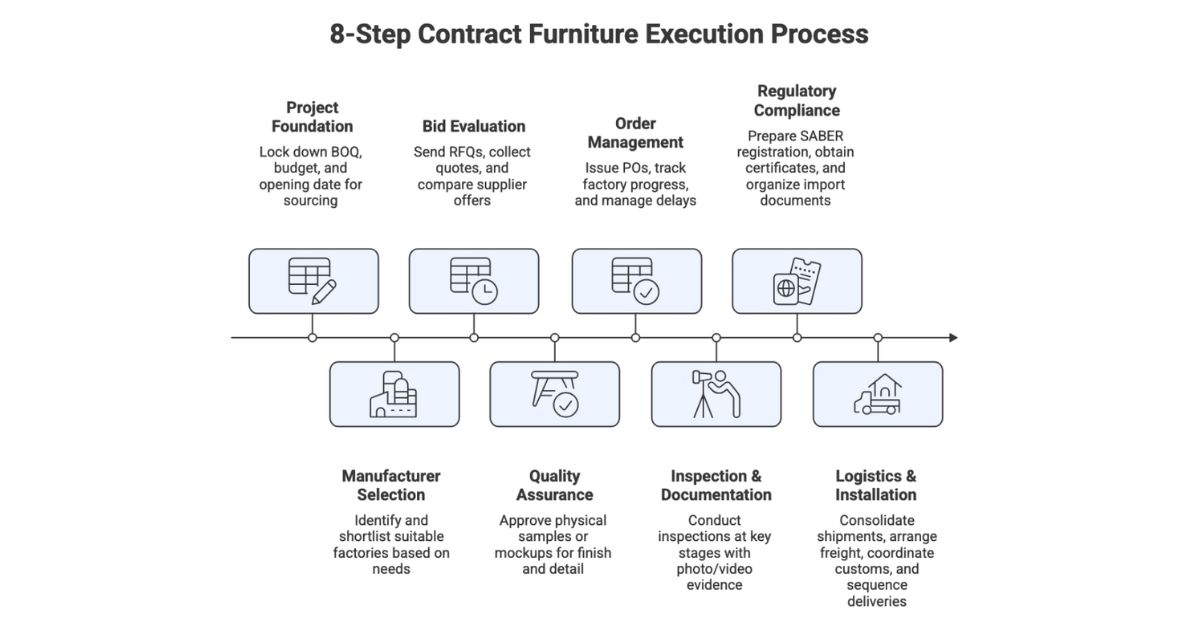
1. BOQ/spec freeze + budget bands + target opening date
Lock down your BOQ with dimensions, finishes, quantities, and room-wise split. Set budget bands per category (casegoods, seating, lighting, loose furniture) and confirm your target opening date. This gives your contract furniture sourcing partner the framework to shortlist factories and plan lead times backward from delivery.
2. Supplier shortlist (India + alternates)
Your partner identifies manufacturers who match your quality tier, customization needs, and volume. India-based factories often handle custom hotel casegoods and upholstery, while alternates in China, Vietnam, or Turkey may cover specific categories like lighting or metal furniture.
3. RFQs + quote comparison
Send specs to shortlisted suppliers, collect quotes, and compare on price, lead time, customization capability, and payment terms. Your partner consolidates this into a clear comparison so you can make informed PO decisions.
4. Samples/mockups + approvals
Before full production, approve physical samples or mockups for finish accuracy (veneer shade, fabric match, stitch detail, hardware operation). Sign off on these samples; they become the reference standard for QC checkpoints.
5. POs + production tracking
Issue purchase orders with clear specs, delivery dates, and payment milestones. Your FF&E procurement partner tracks factory progress weekly, flags any delays, and coordinates adjustments if opening dates shift.
6. QC checkpoints + photo/video evidence
Run inspections at key stages: raw material check, mid-production finish review, and pre-packing final inspection. Document everything with photos and videos. Compare finishes to approved samples, check dimensions against BOQ, test hardware function, and inspect surfaces for defects.
7. Compliance + documents (SABER/SASO + import docs)
Prepare SABER platform registration and obtain necessary conformity certificates (PCoC or SCoC, depending on product category and HS code). Coordinate pre-shipment inspections if required. Organize core import documents: commercial invoice, packing list, bill of lading, certificate of origin. Confirm all paperwork matches shipment details to avoid customs holdups.
8. Shipping + inland to Riyadh + delivery sequencing + installation coordination support
Consolidate shipments, book sea freight to Dammam or Jeddah, and plan inland movement to Riyadh. Coordinate customs clearance at Riyadh Dry Port or other inland hubs. Sequence deliveries by zone/floor based on site readiness. Align timing with your contractor, so FF&E unloading doesn't block other trades or create storage chaos.
BOQ Snapshot Template (Copy-Paste Ready)
Use this format to organize your requirements for faster, more accurate quotes:
Item | Qty | Finish code | Room tag | Target delivery phase | Approval status |
King bed frame | 150 | Walnut veneer WV-204 | Guestroom Standard | Phase 1 (Floors 2-5) | Sample approved |
Lounge chair | 150 | Fabric FC-118 / Oak legs | Guestroom Standard | Phase 1 (Floors 2-5) | Awaiting sample |
Desk | 150 | Walnut veneer WV-204 | Guestroom Standard | Phase 1 (Floors 2-5) | Sample approved |
Sofa 3-seater | 24 | Fabric FC-220 / Walnut frame | Lobby | Phase 2 (Public areas) | In production |
Coffee table | 24 | Marble top MT-101 / Brass base | Lobby | Phase 2 (Public areas) | Sample approved |
This structure helps suppliers understand your scope, phasing, and approval status at a glance, reducing back-and-forth and speeding up quote turnaround.
What to share to get accurate quotes and timelines
To move fast and avoid rework, share the following upfront:
- Detailed BOQ and specs with dimensions and finishes
- Room-wise quantity split
- Target opening date and any phased handovers
- Budget bands per category
- Site details in Riyadh, including access hours and storage
- Any hospitality grade or durability requirements
The clearer your inputs, the tighter the sourcing and lead time plan.
Compliance and paperwork
Compliance overview
SABER/SASO: Saudi Arabia uses the SABER platform (managed by SASO, the Saudi Standards, Metrology and Quality Organization) to regulate imported goods. Depending on product category and HS code, you may need a Product Certificate of Conformity (PCoC) for regulated items or a Shipment Certificate of Conformity (SCoC) for specific shipments. Requirements vary by category, so confirm early with your sourcing partner or a customs broker which certificates apply to your FF&E line items.
Why this matters: Missing or incorrect SABER certificates cause port delays, storage fees, and missed delivery windows. Start the compliance process during production, not after goods are packed.
Common shipment documents checklist
Document | Purpose |
Commercial Invoice | Detailed description of goods, quantities, unit prices, and total value. Must match the packing list and bill of lading. |
Packing List | Itemized list of contents per carton/pallet, including dimensions and weights. |
Bill of Lading | Proof of shipment and title document for cargo. Required for customs clearance. |
Certificate of Origin | States where goods were manufactured. Often required to determine duty rates and trade agreement eligibility. |
SABER Certificates | PCoC/SCoC, test reports, or conformity declarations as applicable to your product categories. |
Saudi customs (ZATCA - Zakat, Tax and Customs Authority) requires these core documents for clearance. Missing or mismatched paperwork triggers inspections, delays, and potential penalties.
Pro Tip: Start SABER Compliance During Production – Not After Packing
Typical stages
- Sampling and approvals: 2 to 4 weeks, depending on complexity
- Production: 6 to 10 weeks for custom FF&E
- QC and packing: 7 to 10 days
- Sea freight and inland movement: depends on route and consolidation, often cited as 12 to 18 days port to port plus inland
- Site delivery and installation coordination: depends on readiness and sequencing
What causes delays and how to avoid them
- Late sample approvals
- BOQ changes after production starts
- Missing specs or finish references
- Inadequate export packaging
- Site not ready for delivery
A strong hotel FF&E sourcing partner in Riyadh plans for these risks early.
QC checklist before dispatch

Run these inspections before your FF&E ships to Riyadh. Document everything with photos and videos; these become your evidence trail if disputes arise.
- Finish match to approved sample: Compare veneer shade, paint color, fabric texture, stitch pattern, and hardware finish to the physical sample you signed off on. Check under consistent lighting to catch subtle shade variations.
- Dimensions and tolerances checked vs BOQ: Measure length, width, height, and any critical clearances (drawer depth, table leg spacing). Confirm tolerances are within an acceptable range (typically ±2–3mm for custom furniture).
- Hardware testing: Operate hinges, sliders, drawer glides, lifting mechanisms, and folding parts. Check for smooth function, no binding, no excessive play.
- Surface inspection: Look for scratches, dents, polish marks, glue residue, uneven staining, or finish inconsistencies. Reject items with visible defects that will show in guest-facing areas.
- Packaging test: Verify export packaging meets shipping standards. Check for corner guards, edge protection, moisture barriers, proper labeling (SKU, destination, handling instructions), and secure palletization.
- Photo/video QC evidence shared before dispatch: Your sourcing partner should send visual proof of passed inspections before containers are loaded. Review these promptly and flag any concerns before the shipment departs.
This QC process is your last chance to catch issues before goods cross borders. Once containers ship, fixing defects becomes expensive and time-consuming.
Packaging, shipping, and last-mile delivery sequencing to Riyadh
Export packaging that reduces damage
Hotel furniture travels thousands of kilometers through multiple handling points (factory to port, port to vessel, vessel to destination port, inland transit, final delivery). Export packaging must protect against:
- Impact damage: Corner guards, edge protection, cushioning materials
- Moisture: Barrier films, desiccants, sealed wrapping
- Handling marks: Protective sleeves, foam wrapping, carton reinforcement
- Transit vibration: Proper palletization, strapping, void fill
Label each package clearly with SKU, destination room/floor, handling instructions (THIS SIDE UP, FRAGILE, DO NOT STACK), and shipment details. Good labeling speeds up unpacking and placement on site.
Delivery sequencing
Plan deliveries by zone, floor, or room type based on your installation schedule. Common sequencing strategies:
- By floor: Deliver all FF&E for lower floors first, then work upward as construction completes.
- By room type: Deliver all guestroom furniture in one batch, public area pieces in another, so installation teams can work category-by-category.
- By phase: If you have a phased opening (soft launch first 100 keys, full property later), split shipments accordingly.
Coordinate unpacking plans, storage locations, and handover checklists with your site team. If storage is limited, schedule just-in-time deliveries to avoid clutter and damage from overcrowding.
Installation coordination support
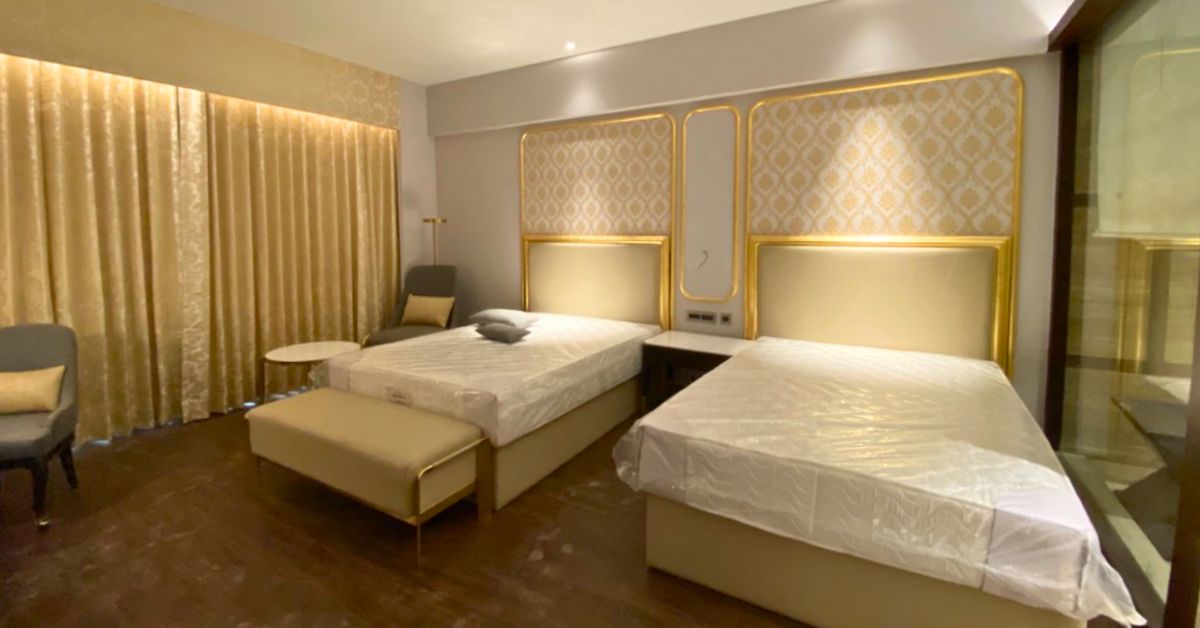
Your hotel FF&E sourcing partner should align delivery schedules with your contractor and site supervisor. This coordination ensures:
- No trade conflicts: FF&E deliveries don't block MEP teams, painters, or flooring installers.
- Efficient unloading: Labor, lifts, and access routes are available when containers arrive.
- Damage prevention: Furniture isn't placed in active construction zones or exposed to dust, moisture, or heavy foot traffic.
- Smooth handovers: Clear sign-off process when FF&E transfers from logistics to installation teams, documenting condition and quantity.
How to shortlist the right FF&E sourcing partner in Riyadh

Use this checklist when evaluating potential partners for your hotel FF&E procurement in Saudi Arabia:
- Can they handle multi-category BOQs + custom manufacturing? You need one partner who can source casegoods, seating, lighting, and loose furniture across multiple factories, not a fragmented vendor list you manage yourself.
- Do they provide quote comparison + production tracking? Transparency on pricing, lead times, and factory progress gives you control without micromanagement.
- Do they run QC checkpoints + share evidence? Ask for examples of their QC process: how often they inspect, what they document, and how they handle failed inspections.
- Do they understand the KSA compliance flow and documentation? Probe their knowledge of SABER, PCoC/SCoC requirements, pre-shipment inspections, and core import documents (commercial invoice, bill of lading, certificate of origin). Experience with Saudi customs processes is critical.
- Can they plan shipping + inland delivery sequencing into Riyadh? Check if they coordinate Dammam to Riyadh inland haulage, handle Riyadh Dry Port clearance, and sequence deliveries by floor/zone.
- Can they coordinate installation timelines with your site team? The best logistics plan fails if deliveries arrive when your site isn't ready. Confirm they actively communicate with your contractor/PMC to align schedules.
Ask for case studies or references from similar Riyadh or KSA hotel projects. Verify their track record on compliance, on-time delivery, and QC pass rates.
Conclusion
Choosing the right hotel FF&E sourcing partner in Riyadh is not about finding the lowest quote. It is about protecting your opening date, managing risk across sourcing, compliance, and logistics, and keeping control from BOQ to site delivery.
Or share your details now and get a custom plan:
Send us your BOQ/specs, Riyadh location details, and target opening date. We'll respond within 48 hours with:
- Sourcing route recommendations (India factories + alternates)
- Lead time plan (sampling, production, shipping, site delivery)
- QC checkpoint schedule (when inspections happen, what evidence you receive)
- Delivery sequencing approach (by floor/zone, aligned with your contractor)
- Compliance checklist (SABER, import docs, inspection requirements)
Contact us to start your hotel FF&E sourcing partner search in Riyadh with a clear, executable plan that gets you to opening day on time.
FAQs
How do I find a hotel FF&E sourcing partner for Riyadh projects?
Shortlist partners who work from BOQs (not catalogs) and source from multiple factories across FF&E categories. They should handle procurement, QC, Saudi compliance, shipping, and Riyadh delivery sequencing. Verify their process clarity, documented QC procedures, and track record on similar hospitality projects before making a decision.
Can you source hotel furniture from India and ship to Riyadh?
Yes, India offers strong custom manufacturing for hotel casegoods, upholstery, and loose furniture. A sourcing partner manages factory selection, QC inspections, SABER compliance, sea freight to KSA, inland coordination, and phased Riyadh site delivery aligned with your installation timeline.
What should I share first to get accurate pricing?
Share your BOQ with dimensions, finishes, quantities, and room-wise splits. Include Riyadh site location, target opening date, budget bands per category, and phased handover plans. This enables accurate quoting, production scheduling, and logistics planning without delays from missing information.
How do you ensure finishes match approved samples?
Finish control uses physical sample approvals, mockups when needed, and staged QC checkpoints. Inspections compare finishes against approved reference samples under consistent lighting, documented with photos and videos before packing. This creates clear evidence trails for accountability.
What QC happens before FF&E ships to Saudi Arabia?
QC includes dimensional tolerance checks, finish accuracy against approved samples, hardware function testing, surface defect review, and export packaging verification. Photo and video evidence is shared before final shipment approval to minimize site surprises and document quality standards.
What documents are needed to import FF&E into Saudi Arabia?
Essential documents include a commercial invoice (detailed goods description), packing list (carton-level itemization), a bill of lading (shipment proof), a certificate of origin (manufacturing country), and SABER platform conformity documents (PCoC or SCoC), depending on product category and HS code.
How long does India to Saudi shipping for FF&E take?
Shipping duration depends on route, port availability, and consolidation. Sea freight typically takes 12-18 days port to port, plus inland movement to Riyadh. Production takes 6-10 weeks, with QC and sampling timelines planned separately from shipping.
Should shipments go via Dammam or Jeddah for Riyadh sites?
Both ports work for Riyadh projects. Dammam often suits central region sites with efficient Riyadh Dry Port access. Choice depends on shipping schedules, consolidation opportunities, service reliability, and inland delivery needs. Your logistics partner should evaluate both options.
Can you manage delivery sequencing and installation timelines?
Yes, delivery sequencing by floor or zone aligns with your construction handover schedule. Active coordination with your site team and contractor ensures FF&E arrival matches installation readiness, prevents storage congestion, and keeps your opening timeline on track.
What are the common mistakes in Riyadh hotel FF&E procurement?
Common mistakes include late BOQ changes after production starts, inadequate QC processes, missing compliance documentation, poor export packaging, and unplanned delivery sequencing. These errors cause delays, budget overruns, rework, and jeopardize opening schedules and project budgets.