Hotel Furniture Shipping Damage Dubai | Packaging + Checklist
Hotel Furniture Shipping Damage Dubai | Packaging + Checklist
Date :
Author :Shruti Agrawal
Read Time :18 Min
Reduce hotel furniture shipping damage delivered to Dubai using packaging specs, pre-dispatch QC, palletization, and site checklist. Download the PDF.
Hotel Furniture Shipping Damage Dubai: How to Prevent FF&E Damage Before It Reaches the Site
Hotel furniture shipping damage in Dubai is not a quality problem at the factory. It is a packaging and handling problem that develops across six to nine handoff points between the production floor and a Dubai hotel guestroom. You approved the samples. The finish was correct. The factory passed inspection. Then the headboards arrived dented, the lounge chairs had scratched legs, and two stone tops were cracked in the crate. Sound familiar to any Dubai hotel owner or project manager?
The gap between sample approval and damage-free delivery is a system gap, not a vendor gap. Most hotel FF&E procurement processes control workmanship tightly and control packaging almost not at all. This guide closes that gap with a six-step, evidence-based FF&E shipping damage prevention system: export packaging standards for furniture Dubai, pre-dispatch QC with photo and video proof, furniture packing and palletization checklist by room and zone, container loading controls, and a site receiving checklist hotel FF&E Dubai built specifically for Dubai hotel delivery conditions.
According to Packaging Digest, as many as 11% of unit loads arriving at a distribution center carry some level of case damage – a figure that climbs further for hotel FF&E shipped via international sea freight across six or more handoff points before reaching a Dubai hotel site.
Quick Answer:
To reduce hotel furniture shipping damage in Dubai, control quality and handling before dispatch: lock approved sample benchmarks, run pre-dispatch QC checklist for hotel furniture with photo and video evidence, enforce export packaging standards for furniture Dubai per category (edge protection, moisture barrier, crating for glass), use a furniture packing and palletization checklist by room and zone, document container loading, and apply a site receiving checklist hotel FF&E Dubai covering slot booking, staged floor delivery, and damage logging.
Why Hotel Furniture Arrives Damaged After Sample Approval
Sample approval is a finish and workmanship check. It is not a transit simulation. The approved sample never travels through a sea freight container, gets offloaded at Jebel Ali port, loads onto a local delivery truck, and then moves through a service corridor in a Dubai high-rise tower. The piece you actually receive does all of that, with packaging rarely designed for any of those conditions.
The Four Root Causes
Packaging as an Afterthought. Most factories use the same basic carton for local and export deliveries. No corner guards. No moisture barrier. No foam fit between surfaces. A carton that survives a 30-minute local truck trip fails under 28 days of sea freight stacking load.
No Pre-Dispatch Evidence. Without photo and video documentation before packing, you cannot prove whether damage happened in the factory, the container, at Jebel Ali, or during site unloading. Every dispute becomes unresolvable without evidence.
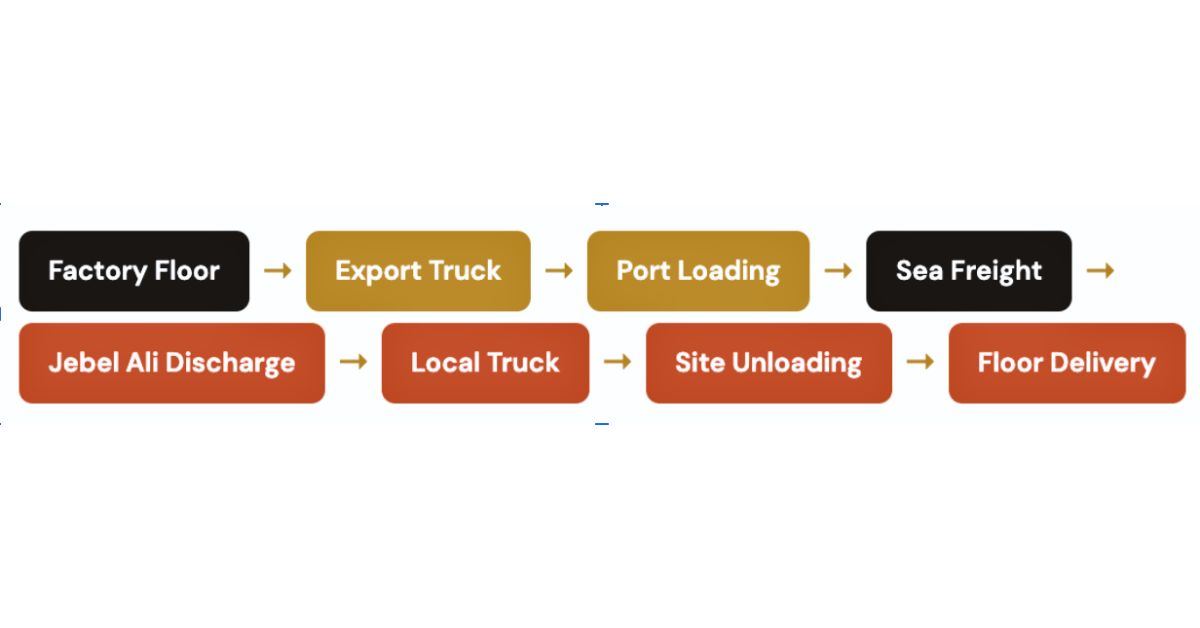
Too Many Handoffs. Factory truck → port loading → sea transit → Jebel Ali discharge → local truck → site unloading → service lift → corridor. Each transition is a new damage risk point when packaging specs are not enforced at every stage.
Last-Mile Re-Handling in Dubai. Dubai hotel sites have zero dedicated FF&E storage. Items travel from truck to corridor to floor repeatedly. Re-handling inside the building without trolleys or pad protection is where most scratches and corner dents actually originate.
Every FF&E delivery to a Dubai hotel site passes through this chain:
Gold nodes = elevated damage risk. Red nodes = highest re-handling damage exposure for hotel FF&E shipping in Dubai.
Highest re-handling damage exposure: Jebel Ali Discharge, Local Truck, Site Unloading, and Floor Delivery are the four highest-risk nodes for hotel FF&E shipping damage in Dubai.
Where Hotel FF&E Damage Actually Originates
Sample approval confirms finish and workmanship only – not packaging performance or handling resilience. Hotel furniture shipping damage in Dubai originates primarily from inadequate export-grade packaging, absent pre-dispatch photo documentation, and last-mile re-handling in UAE high-rise construction environments. Controlling all three upstream is the only reliable prevention strategy.
QC Defect vs Transit Damage: Know the Difference Before You Escalate
Mixing up a quality defect with transit damage leads to wrong vendor escalations, wasted weeks, and lost claims. Here is the distinction every Dubai hotel procurement lead and PMC project manager needs before initiating any damage resolution.
Attribute
QC Defect
Transit Damage
Definition
Workmanship, material, or finish issues from production
Damage from packaging failure, stacking, or rough handling in shipping or site delivery
Detected At
Pre-dispatch inspection (PDI) at the factory before any packing
Corner chips, surface dents, leg scratches, cracked glass tops, and moisture marks
Prevention Control
Pre-dispatch QC against the approved sample benchmark
Written packaging spec + container loading plan + site checklist
Evidence Required
Photo vs approved sample; measurement record; finish code confirmation
Carton condition photo; item damage log; BOL notation before signing delivery note
Accountable Party
Manufacturer
Freight handler or packaging spec owner
A strong pre-shipment inspection (PSI) catches QC defects before any item enters a carton. A written export packaging standard for furniture in Dubai prevents transit damage. Without both, you are managing damage on site rather than eliminating it upstream, where it costs a fraction of the price.
Packaging Failure vs Site Handling Failure
Attribute
Packaging Failure
Site Handling Failure
When It Occurs
During sea transit, container stacking, or port discharge
During service lift entry, corridor movement, or room-floor staging
Visible Signs
Crushed carton corners, moisture ingress marks, and compression dents on surfaces
Leg scratches, fabric scuffs, and corner chips on exposed furniture faces
Primary Cause
Under-rated carton, missing foam, no moisture barrier for 28-day sea freight
No trolleys or pad protection, items slid across floors, and corridor stacking
Prevention Owner
Procurement team: written packaging specification enforced at the factory
Site receiving team: receiving checklist + pad protection protocol
Evidence Needed
Container loading photo, pre-dispatch QC pack, carton condition on truck
In-building movement log, carton-open photos, pre/post corridor photos
QC defects originate in production and must be caught during pre-dispatch inspection. Transit damage originates during packaging failure, container loading, freight handling, or site movement within Dubai hospitality projects. Prevention requires separate controls and separate evidence standards for each risk category.
How to Reduce Hotel Furniture Shipping Damage in Dubai Before Containers Leave the Factory: The 6-Step System
This is the hotel FF&E shipping damage prevention process Arcedior applies across hospitality procurement projects delivered to Dubai, from Jebel Ali port clearance through phased floor handovers in high-rise towers. Each step removes one defined layer of damage risk.
Step 1: Lock Approved Sample Benchmarks Before Production Ends
What to do: Confirm the approved sample with finish codes, material references, and tolerance notes – signed by both the procurement team and the vendor before production completes.
Why it matters: This becomes your pass/fail reference at every pre-dispatch QC checklist for hotel furniture. Without locked benchmarks, a PDI has no baseline to measure against.
Step 2: Pre-Dispatch QC with a Full Photo and Video Evidence Pack
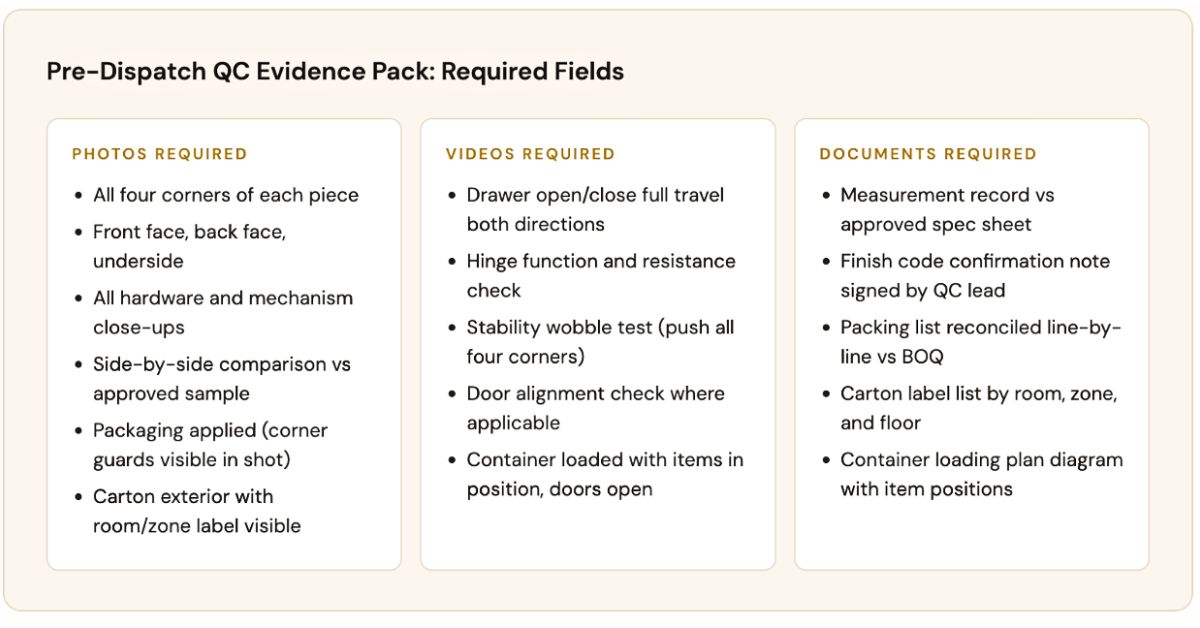
What to do: Run a structured pass/fail inspection at the factory before any item is packed. Capture corner photos, edge photos, surface photos, underside shots, hardware close-ups, and video of drawer runners, hinges, wobble tests, and stability checks.
Why it matters: Without this evidence pack, you cannot establish when or where damage occurred if it is discovered later on the Dubai site.
Step 3: Send Vendors a Written Export Packaging Specification by Category
What to do: A written document, not a verbal briefing, sent before production ends. Category-wise rules covering casegoods, upholstered chairs and sofas, glass and stone tops, metal and chrome items, and hardware kits.
Why it matters: Specifying corner guard types, foam density, moisture barrier film, desiccant sachets, carton ratings, and crating requirements gives vendors time to source materials. See the full export packaging standards for furniture Dubai section below.
Step 4: Palletize and Label Every Item by Room, Zone, and Floor
What to do: Every pallet and carton carries a room number, zone, and floor label applied at the factory. Apply This Side Up, Fragile, and Do Not Stack labels on all four vertical faces of each carton.
Why it matters: In Dubai hotel sites where there is zero dedicated storage and Dubai main contractor access protocols limit re-entry windows, the furniture packing and palletization checklist is the only system that keeps the delivery day orderly.
Step 5: Control Container Loading with a Documented Loading Plan
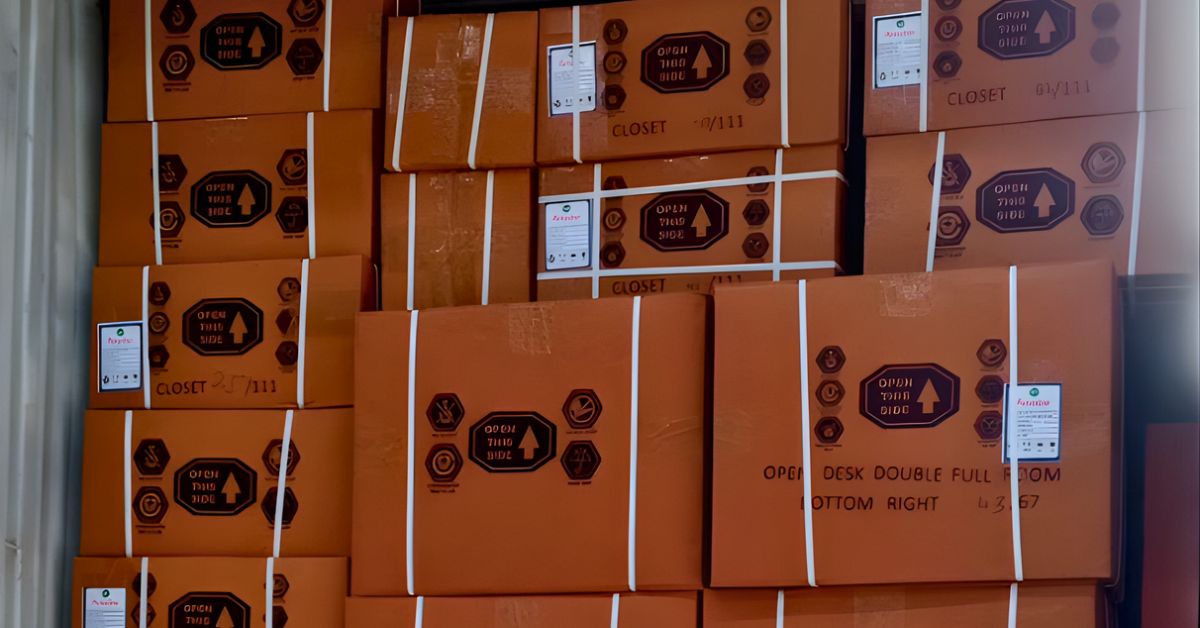
What to do: Require a container loading plan showing exact item placement, stacking layers, protection between pieces, and anti-tip bracing. Photograph the loaded container with doors open before sealing.
Why it matters: Confirming packing list quantities match carton labels exactly eliminates the most common source of missing items discovered only after Jebel Ali clearance.
Step 6: Use a Dubai-Specific Site Receiving and Staged Handover Checklist
What to do: A process that accounts for slot booking, phased floor handover sequencing, service lift dimension constraints, zero on-site storage, and demurrage risk at Jebel Ali. Every item inspected against the pre-dispatch evidence pack before the delivery note is signed.
Why it matters: A generic receiving checklist fails in Dubai hotel construction. See the full site receiving checklist hotel FF&E Dubai below.
The six-step hotel FF&E shipping damage prevention system covers: locked sample benchmarks, structured pre-dispatch QC with visual evidence, written export packaging specifications by category, room-zone-floor palletization, documented container loading, and a Dubai-specific site receiving process. Each step eliminates a distinct damage risk layer before any item reaches the project site.
Export Packaging Specification by FF&E Category
One packaging spec does not protect all categories equally. Use this category-wise export packaging checklist for all hotel furniture shipping to Dubai via sea freight.
Foam-backed corner guards on all corners; edge protectors on all edges; surface protection film on all visible finished faces; foam spacing between stacked pieces; double-wall carton rated for sea freight; zero rubbing contact points inside carton
Single-wall carton; items loose inside carton; no foam between stacked surfaces; no protection on table legs
Upholstery (chairs, sofas, ottomans, banquettes)
Full polywrap covering all fabric; foam or cardboard leg protectors on every leg; moisture barrier film inside carton for sea freight; carton base reinforcement; no direct contact between fabric and carton interior
Fabric in direct carton contact; unprotected legs; polywrap at edges only; no moisture barrier on sea freight
Glass and Stone Tops
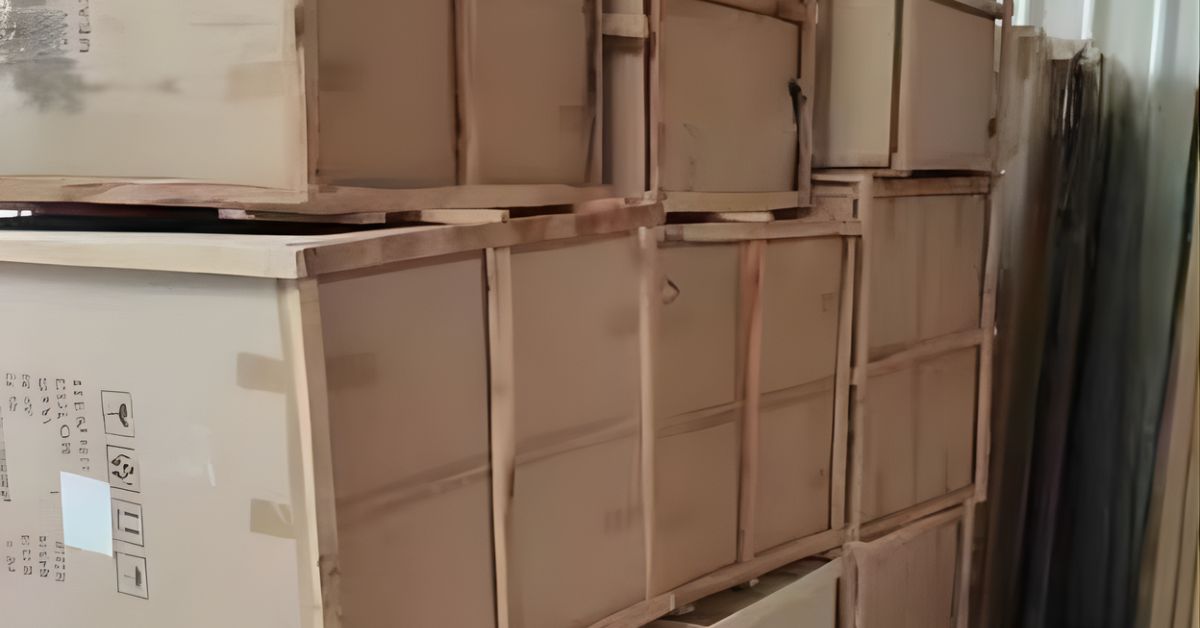
Timber crating (not carton); shock-absorbing foam lining on all interior crate faces; vertical orientation only with clear orientation marking; Do Not Lay Flat label on all four sides; foam sheet separation between pieces inside crate
Laid flat in a container; cardboard carton instead of timber crate; no shock protection at corners; pieces in direct contact
Metal and Chrome Items
Bubble wrap on all chrome and polished surfaces; moisture barrier film as outer wrap; desiccant sachets sealed inside carton; no abrasive packaging in direct contact with polished finish
Abrasive foam touching chrome; no desiccant for sea freight; moisture condensation during 28-day transit
Hardware Kits
Sealed poly bag per room and zone; each bag labelled with room number, item reference, and quantity; master carton per floor with floor label on all four sides; quantities reconciled against BOQ before container loading
Hardware from multiple rooms mixed in one bag; unlabelled bags; no BOQ reconciliation; hardware separated from its furniture item
Export packaging requirements differ significantly by FF&E category. Casegoods require foam-backed corner guards and double-wall sea-freight-rated cartons. Glass and stone must be timber-crated vertically. Upholstery needs a full polywrap with a moisture barrier. Chrome and metal items require desiccant sachets. Hardware kits must be reconciled against the BOQ and labelled by room before loading.
Pre-Dispatch QC Evidence Pack: Template and What to Demand from Every Vendor
A pre-dispatch QC checklist for hotel furniture without a structured evidence pack gives you almost no leverage for dispute resolution. Here is the complete template to send to every vendor before dispatch.
Use a Third-Party Inspector for High-Value Categories
For high-value bespoke categories, consider engaging a third-party PSI provider. Their formal report carries more weight than vendor self-certification in freight damage claims.
Site Receiving Checklist to Prevent Hotel Furniture Shipping Damage in Dubai
Dubai hotel sites have structural conditions that make a standard receiving checklist insufficient for preventing hotel furniture shipping damage in the last mile.
Five Dubai Realities That Change Your Site Receiving Process
Strict slot booking and tower access windows. Active Dubai hotel construction sites operate on scheduled delivery windows under the Dubai main contractor access protocols.
Book Delivery Slots 72 Hours Before – Not the Day Before
Book slots at least 72 hours in advance and reconfirm the morning before delivery. Missing a booked slot can delay delivery by several days and trigger demurrage risk at Jebel Ali.
Phased floor handovers by the main contractor: Dubai towers hand over floors in phases. FF&E deliveries must align exactly with each phase handover. Delivering ahead of floor handover means items sit in unsecured corridors and suffer repeated re-handling damage from multiple trades operating in the same space.
Zero on-site storage. There is no dedicated FF&E storage area at any active Dubai hotel construction site. Every item must go directly from the delivery truck to the correct floor and zone. The furniture packing and palletization checklist with room-zone-floor labels is the only system that makes this model work without corridor chaos.
Service lift size constraints: Dubai tower service lifts have fixed internal dimension limits. Large headboards, full-height wardrobes, and long conference tables must be measured against lift dimensions before dispatch from the factory. An oversized item that cannot enter the service lift must be assembled outside the room, significantly increasing damage exposure.
High re-handling risk in service corridors. After Jebel Ali clearance and site truck delivery, every piece moves from the loading dock through the service lift to the corridor and into the room. Each internal movement without pad protection or furniture trolleys adds new damage risk, the primary cause of last-mile FF&E damage in last-mile handling in Dubai hospitality projects.
Dubai hotel site receiving differs from standard construction delivery in five critical ways: mandatory slot booking under Dubai main contractor access protocols, phased floor handover sequencing, zero on-site storage requiring direct floor-zone delivery, service lift dimension constraints on large items, and high corridor re-handling exposure. Each condition requires a specific checklist control.
Dubai Hotel Site Receiving Checklist
Confirm delivery slot booking with the main contractor site manager at least 72 hours in advance; note access gate, time window, and site contact name
Prepare and distribute the room and zone staging plan to the site team before truck arrival; every pallet has a confirmed destination before unloading begins
Check carton labels on the truck against the packing list before any item is moved; note all discrepancies before unloading
Inspect carton condition on the truck: note crushed corners, wet cartons, broken stretch wrap, or visible impact damage before accepting delivery
Unpack in a designated receiving zone only, not in installation corridors; maintain clear passage for other active trades throughout
Inspect each piece against the pre-dispatch QC evidence pack photos before signing the delivery note
Log all damage immediately with carton exterior photo, item damage photo, carton label photo, and delivery note reference in a single timestamped record
Quarantine all damaged items, mark clearly, and escalate with photographs and a replacement ETA request within the same working day
Reconcile packing list quantities against BOQ line items after every delivery; flag shortages and discrepancies within 24 hours
Keep a touch-up kit and pre-agreed spare items on site for minor in-tolerance scuffs; do not hold room completion for damage that is correctable on site within the agreed tolerance
What to Do When Hotel FF&E Arrives Damaged: Damage Claims Workflow
Even with a complete pre-dispatch QC checklist for hotel furniture and an export packaging specification system in place, some damage will occur across a large hotel FF&E delivery program. The difference between a project that recovers quickly and one that misses opening dates is a defined damage response workflow that starts the moment a problem is identified – not the next morning.
Step
Action
Responsible
Timeframe
1
Quarantine all damaged items. Mark clearly. Do not install or move further.
Site receiving team
Immediately on discovery
2
Photograph carton exterior, item damage, carton label, and delivery note together in one frame for traceability.
Site receiving team
Within 1 hour
3
Compare site damage photos against the pre-dispatch QC evidence pack to confirm the damage point in the chain.
Procurement or QC lead
Within 24 hours
4
Notify the carrier or vendor in writing with full photographic evidence and delivery note reference.
Procurement lead
Within 48 hours
5
Confirm the repair or replacement path with a clear ETA against the Dubai hotel opening date schedule.
Project manager
Within 72 hours
6
Activate pre-agreed spare items for critical-path rooms to prevent room-readiness delay during replacement.
Sourcing partner or PMC
Same day as Step 5
Key Reference Numbers
Conclusion: Hotel Furniture Shipping Damage in Dubai Is Preventable
Hotel furniture shipping damage in Dubai is not an unavoidable cost of procuring FF&E from international manufacturers. It is the predictable result of treating packaging as an afterthought, skipping structured pre-dispatch QC documentation, and running a site receiving process that was not built for Dubai hotel delivery conditions. Every dent, scratch, and cracked top that arrives on a Dubai hotel site represents a preventable failure in one of six steps.
The system in this guide – combined with the category-wise export packaging standards for furniture Dubai, the pre-dispatch QC checklist for hotel furniture, and the site receiving checklist hotel FF&E Dubai – gives hotel owners, project managers, procurement leads, and PMCs the tools to reduce transit damage claims, protect opening dates, and hold vendors accountable with documented evidence.
If you are planning an FF&E delivery to a Dubai hotel and want a packaging specification and staged delivery plan built around your specific BOQ, your project location, and your target opening date, Arcedior's procurement and logistics coordination team will build it with you before the first container is loaded.
Plan Your Dubai FF&E Delivery – Get Your Custom Specification
Share your BOQ, Dubai project location, and target opening month. Arcedior's hotel FF&E procurement partner team will respond with:
A written export packaging specification by FF&E category
Category-wise QC checkpoints aligned to your BOQ
A floor-wise phased staging plan built for your Dubai tower
Why does hotel furniture arrive damaged even after samples are approved?
Sample approval confirms finish and workmanship only, not packaging or handling. Hotel FF&E shipping damage happens because packaging is treated as an afterthought, no photo evidence is captured before dispatch, and problems are only discovered after six or more handling handoffs between the factory floor and the Dubai hotel site.
Factory cartons are almost never rated for 28-day sea freight stacking loads
Without pre-dispatch photo documentation, you cannot establish which handoff caused the damage
Dubai site re-handling in corridors and service lifts is the most common last-mile damage origin
How do I reduce furniture shipping damage for hotel FF&E delivered to Dubai?
Apply a six-step hotel FF&E shipping damage prevention system: lock approved benchmarks, run a pre-dispatch QC checklist for hotel furniture with photo and video evidence, enforce written export packaging standards for furniture Dubai by category, use a furniture packing and palletization checklist with room and zone labels, document container loading, and apply a site receiving checklist hotel FF&E Dubai covering slot booking, phased staging, and damage logging.
Start with a written packaging specification document sent to vendors before packing begins, not after
Demand container loading photos before the container seal is applied
Book Dubai delivery slots at least 72 hours in advance to avoid site access delays and demurrage
What export packaging standard should I ask suppliers to follow for hotel furniture shipping to Dubai?
For hotel FF&E sea freight to Dubai, the written packaging specification must cover corner guards and edge protectors on all casegoods, moisture barrier film with desiccant sachets, double-wall sea-freight-rated cartons, polywrap on all upholstery, timber crating for glass and stone, and anti-tip pallet strapping across all categories.
Specify foam density and thickness, not just the foam type, in the written spec document
Require surface protection film to be applied before any carton material contacts a finished face
Confirm carton weight ratings are suitable for the stacking loads typical of a fully loaded sea freight container
What is the difference between a QC defect and transit damage in hotel FF&E?
A QC defect is a production workmanship or finish issue caught at pre-dispatch inspection. Transit damage is caused by packaging failure or rough handling during shipping or site delivery. Both require separate prevention controls and different evidence requirements. Confusing the two leads to wrong vendor escalations and unrecoverable damage claims.
QC defects are the manufacturer's liability; pre-dispatch inspection identifies them before packing
Transit damage liability depends on which handoff point the evidence pack can prove that damage occurred
Without a complete evidence pack, transit damage claims have almost no legal standing
What should a pre-dispatch QC evidence pack include?
A pre-shipment inspection evidence pack must include corner and edge photos, front and underside shots, video of all mechanisms, a side-by-side comparison with the approved sample, measurement records against the spec sheet, packaging application photos with corner guards visible, container loading photos, and a packing list reconciled against the BOQ.
Photograph carton labels alongside the item to create a traceable link between the piece and the carton record
Record video before and after packing to confirm the condition inside the sealed carton
The container loading plan diagram must show item positions, stacking order, and anti-tip bracing location
How should hotel FF&E furniture be palletized and labeled for Dubai hotel projects?
Every pallet must carry a room number, zone, and floor label so items move directly from the delivery truck to the correct floor without corridor confusion. This is the core principle of any effective furniture packing and palletization checklist. Handling labels – This Side Up, Fragile, Do Not Stack – must appear on all four vertical carton faces.
Use colour-coded labels per floor to accelerate sorting at the Dubai site loading dock on delivery day
Apply handling labels on all four vertical carton faces, not only the top face
Anti-tip pallet strapping is mandatory for tall items, including wardrobes, headboard cartons, and framed art
What should my site receiving checklist include for Dubai hotel deliveries?
Your site receiving checklist hotel FF&E Dubai must cover: delivery slot booking 72 hours in advance, floor-zone staging plan confirmed before truck arrival, carton label check against packing list on the truck, carton condition inspection before unloading, per-item inspection against pre-dispatch evidence pack photos, damage logging with photos, quarantine for rejected items, and BOQ reconciliation within 24 hours.
Account for the tower access window times issued by your specific main contractor
Measure the service lift internal dimensions against your largest single carton before dispatch from the factory
Designate and mark a protected unpacking zone before the first delivery arrives on site
How do I prevent damage during unloading and staging inside a Dubai hotel?
Prevent unloading and staging damage by designating a protected unpacking zone away from corridors, inspecting each carton for external damage before unloading begins, using trolleys and pad protection for all corridor movement, and never stacking cartons in service corridors or lift lobbies. Corridor re-handling is the primary cause of last-mile FF&E damage in Dubai high-rise hotels.
Pad all corridor corners and door frames before any furniture is moved through the building
Never allow items to be slid on floors without furniture glides or moving blankets underneath
Assign one dedicated team member per delivery to the damage log role with a photo-capable device
Should I use a third-party inspection service for high-value hotel FF&E shipped to Dubai?
For high-value or bespoke categories such as custom casegoods, stone tops, and large upholstery orders, a third-party pre-dispatch inspection adds independent pass/fail verification against your specification. The inspector produces a formal report with photographic evidence critical for transit damage claims against the freight handler or manufacturer.
A third-party PSI report carries significantly more weight than a vendor self-certification document
Book the inspection 7 to 10 days before planned loading to allow re-packing time if required
Ensure the inspector works from your approved spec and BOQ, not the vendor's own internal checklist
How can a single sourcing partner reduce hotel furniture shipping damage risk across multiple vendors in Dubai?
A single hotel FF&E procurement partner owns packaging specification, pre-dispatch QC, container loading supervision, and site receiving coordination across all vendors simultaneously. One channel means damage is identified upstream, escalated immediately, and resolved before your Dubai hotel opening date is threatened.
Centralised BOQ tracking means missing items are flagged before the container departs, not after arrival
One team manages phased Dubai delivery sequencing across all FF&E categories in parallel
Pre-agreed spares and touch-up kits are planned from project start, not sourced reactively after damage is discovered