Ramadan Hotel Procurement Dubai | FF&E Timeline Risk Plan

Ramadan Hotel Procurement Dubai: FF&E Timeline Risks & How to Avoid Delays
Ramadan hotel procurement in Dubai does not go wrong because the opening date moves. It goes wrong because the vendor's inbox does. That gap, multiplied across RFQs, sample reviews, factory sign-offs, and site delivery windows, is where hotel projects lose weeks.
This delay is not random. It is structural and entirely predictable. Approvals slow, vendor communication gaps widen, and delivery coordination stalls – all at once, not one at a time. Dubai hotel owners, PMCs, and procurement heads who have been through a Ramadan cycle know the feeling: "We thought we had a buffer. We did not."
Many Dubai hotel teams discover the problem too late. The timeline assumed normal vendor response speed, but Ramadan changed the rhythm of every approval, meeting, and delivery coordination step.
This guide maps exactly where your FF&E procurement timeline drifts, why it happens, and how to stop it with a deadline-led plan built around QC checkpoints, shipping coordination, and Dubai delivery sequencing.
Quick Answer: How do Ramadan schedules affect FF&E procurement timelines for Dubai hotels?
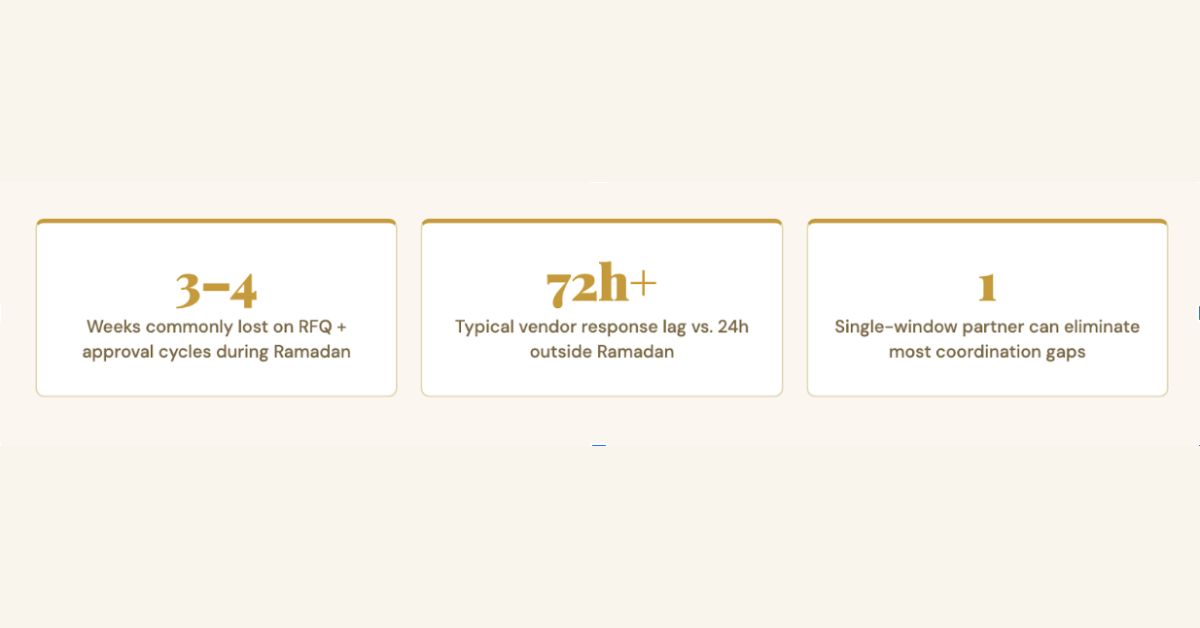
How Ramadan Affects Hotel Procurement Timelines in Dubai
Hotel procurement in Dubai runs on fixed opening dates. FF&E sourcing, approvals, production, QC inspections, shipping, and site delivery all run in sequence – each stage feeding the next. When any part of that chain slows, the delay does not stay local. It moves downstream.
During Ramadan, several things happen simultaneously. Consultant and vendor offices run on shortened schedules. Eid holidays land exactly when approval chains are already stretched. Hotel opening dates do not move to accommodate any of this, which means a soft-launch deadline that looked comfortable in January can feel genuinely tight by March. On active Dubai construction sites, phased handovers and limited storage mean delivery windows are already narrow before Ramadan adds another layer of pressure.
The teams that handle this well are not the ones with bigger buffers. They are the ones who plan around it before it starts.
What Actually Changes During Ramadan (Procurement-Only)
Most factories continue production through Ramadan. The slowdown lives in the coordination layer: decisions, responses, approvals, and logistics handoffs. That distinction matters because the fix is not about pushing factories harder – it is about managing everything around them.
- Decision cycles lengthen. Multi-round approvals that normally close in 48 hours stretch to a week or more because key sign-offs get deferred.
- Vendor response windows shrink. RFQ replies, sample dispatch confirmations, and specification queries slow noticeably. Without a follow-up cadence, quotes go stale and scopes get reopened – each clarification loop adding days you do not have.
- Sample reviews get pushed. Physical couriering slows, review meetings get rescheduled, and "non-urgent" decisions pile up. Sample approval delays feed directly into production lead times.
- Quote clarification loops multiply. Incomplete RFQs that would generate one round of clarification normally can generate three during Ramadan, when response windows are compressed, and follow-up emails go unanswered for days.
- Site readiness communication gaps widen. Coordinating between contractors, site managers, and delivery teams is harder when everyone is operating at reduced availability and communication lags compound across time zones.
- Site receiving windows tighten. Reduced on-site teams and compressed contractor schedules mean uncoordinated deliveries create dock bottlenecks, or goods sit unattended on site.
What Is "Ramadan Procurement Drift"?
Ramadan Procurement Drift Map for Dubai Hotel FF&E Projects
Use this as a diagnostic against your current project plan. The "What to do" column is the action that prevents each stage from drifting.
FF&E Procurement Flow: Risk Zones During Ramadan
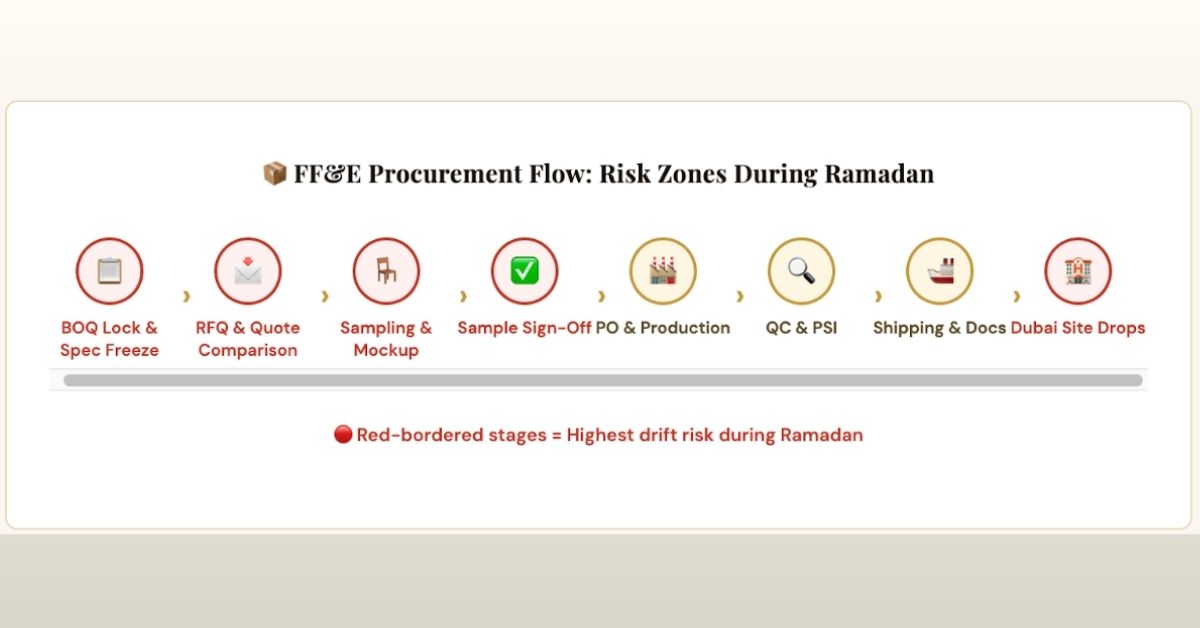
Procurement Stage | Common Cause of Delay | Risk | What to Do |
RFQ and Quote Turnaround | Incomplete scope; slow vendor responses; multiple clarification rounds | HIGH | Send complete scope + comparison template to pre-approved vendors only |
Sample Courier and Review | Delayed dispatch; review meetings rescheduled; no hard decision deadline | HIGH | Pre-book sign-off meeting; set written deadline with stated consequence |
Approval and Sign-Off | Compressed hours; multi-level approvals; deferred decisions | HIGH | Name a single decision owner per stage; set non-negotiable must-decide-by dates |
Production Milestone Tracking | No visibility between PO and QC; factory communication lag | MEDIUM | Weekly factory check-ins at defined milestones; maintain a factory communication log |
QC and Pre-Shipment Inspection | Inspector availability; delayed PSI evidence pack preparation | MEDIUM | No dispatch without a complete photo and video PSI evidence pack |
Dubai Site Receiving | Reduced on-site team; uncoordinated delivery timing; no room labeling | HIGH | Floor-wise delivery sequencing, room labeling, and carton mapping before the first drop |
Quick Answer: Why do hotel procurement timelines drift during Ramadan in Dubai?
How a 4-Day Approval Delay Becomes a 3-Week Delivery Delay
- Sample approval delayed by 4 days
- Production slot missed at the factory
- Next available factory slot: 10 days later
- QC inspection rescheduled accordingly
- Shipping booking shifts to the next window
Result: 3 weeks of delivery drift from one missed sign-off. Decision deadlines matter more than hopeful buffer days. A buffer with no named owner is just a delayed problem.
FF&E Procurement Timeline Model for Dubai Hotel Projects
Dubai hotel procurement runs backwards from a fixed opening date. Every stage feeds the one after it. The three stages in red are the ones most exposed to Ramadan drift; they are also the ones most controllable, which is where you lock things first.
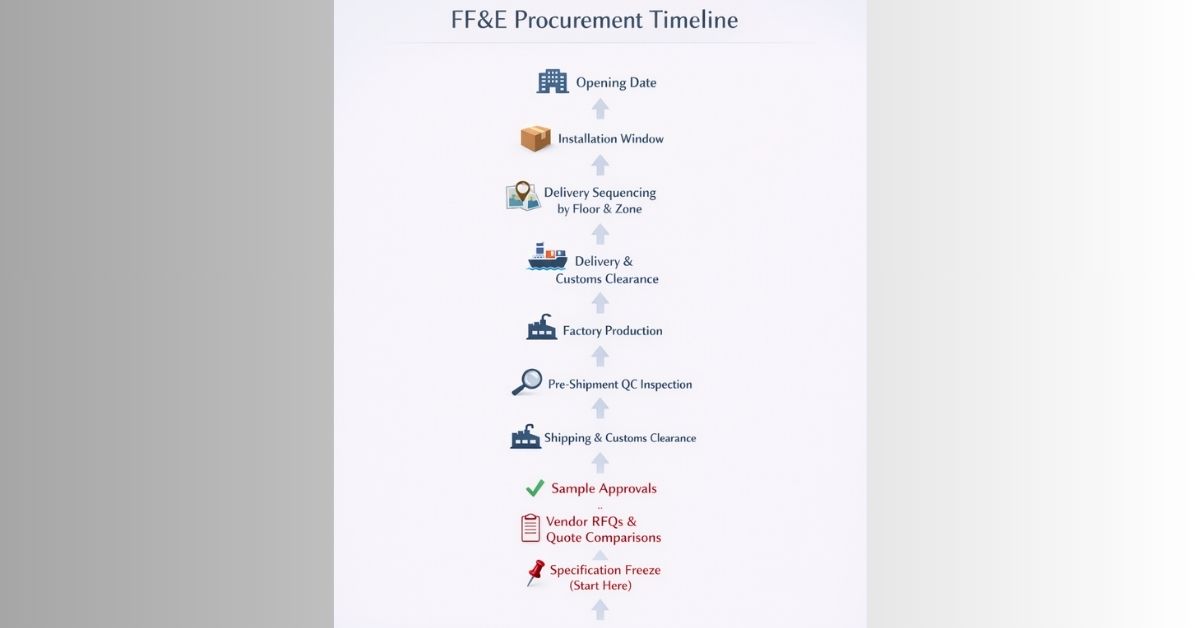
The stages in red are the ones most exposed to Ramadan drift. Lock them first.
Stage | Key Activity | Ramadan Exposure |
Specification Freeze | Final BOQ, finishes, and finish approvals confirmed | HIGH – lock before Ramadan |
Vendor RFQs | Quotes and lead times collected with the comparison template | HIGH – allow 10–14 day turnaround |
Sample Approval | Materials and finishes approved with a hard sign-off date | HIGH – pre-book review meeting |
Production | Manufacturing against the approved spec | MEDIUM – weekly milestone check-ins |
QC Inspection | Photo + video PSI evidence pack before dispatch | MEDIUM – schedule early |
Shipping | Freight and customs documentation run parallel to production | MEDIUM – start docs before goods are ready |
Delivery Sequencing | Goods delivered by floor and zone, room-labeled | HIGH – coordinate with contractor readiness |
How to Avoid Hotel Procurement Delays During Ramadan in Dubai
A deadline-led plan starts at your opening date and works backwards. Every stage needs a named decision owner and a fixed must-decide-by date – not just a buffer window. Teams that stay on schedule do not have more time. They have fewer open decisions when Ramadan starts.

Step 1: Freeze BOQ, Specs, and Budget Bands
Lock all room-wise specifications and budget bands before Ramadan starts. Spec changes after PO issuance during Ramadan are the single biggest cause of late deliveries.
Step 2: Shortlist Vendors and Approved Alternates
Avoid single-source dependency for any critical FF&E category. Enter Ramadan with an approved vendor shortlist and at least one qualified alternate per category, so a slow primary vendor does not restart your entire RFQ process.
Step 3: Issue RFQs with Complete Scope
Send RFQs with full technical scope, finish specs, lead time requirements, and a comparison template vendors can complete directly. Incomplete RFQs guarantee multiple clarification rounds, and during Ramadan, each round adds days you do not have.
Step 4: Sampling with Hard Sign-Off Deadlines
Pre-book sample review meetings before Ramadan. Set a non-negotiable sign-off deadline and communicate it in writing: "No sign-off by [date] means production shifts by [lead time]." This removes ambiguity and forces decisions at the right stage.
Step 5: PO and Production Milestone Tracker
After PO issuance, track production weekly with factory check-ins at defined milestones. Keep a factory communication log so you have a record of what was confirmed, when, and by whom. The "factory went silent" problem is real – a log makes slippage visible before it becomes unrecoverable.
Step 6: QC Checkpoints and PSI Evidence Pack
Build QC checkpoints mid-production and pre-dispatch. Require photo and video evidence as part of the pre-shipment inspection (PSI) pack before any shipment is authorized. No PSI pack, no dispatch authorization.

Step 7: Shipping and Documentation Readiness
Export packaging readiness, shipping documents, and customs clearance preparation must run parallel to production. Starting documentation after goods are ready adds 5 to 10 days to dispatch timelines during Ramadan, when logistics providers are also on compressed schedules.
Step 8: Dubai Site Drops by Floor and Zone
Coordinate deliveries by floor and zone with a confirmed sequencing plan. Room labeling and carton mapping must be finalized before the first drop. Align each delivery with confirmed contractor readiness on that specific floor.
Pro Tip: Lock a No-Change Window After PO Issuance
Buffer Rules That Prevent Losing Weeks
Ramadan hotel procurement in Dubai delays are structural, not exceptional. Procurement approval delays in Dubai during Ramadan apply specifically to the Ramadan-affected procurement window and should be built into your plan before you begin, not added reactively.
Stage | Standard Buffer | Ramadan Buffer | Why |
RFQ Response | 5 to 7 working days | 10 to 14 working days | Compressed hours; multiple follow-ups needed |
Sample Courier and Review | 7 to 10 days | 14 to 18 days | Courier delays plus rescheduled review meetings |
Approval Sign-Off | 2 to 3 days | 5 to 7 days | Multi-level approvals in compressed schedules |
QC and PSI Scheduling | 3 to 5 days | 7 to 10 days | Inspector availability and factory responsiveness |
Dubai Site Receiving | As scheduled | Add 3 days per drop | Reduced site teams; delivery window sensitivity |
Note: The ranges below are planning allowances, not fixed standards. Actual timelines vary by scope, supplier mix, shipping route, and site readiness. Use them as conservative working assumptions, not contractual commitments.
A buffer without a deadline-led structure just moves the problem forward. Buffer works when every stage has a named owner and a fixed must-decide-by date.
Quick Answer: How do Dubai hotels protect FF&E procurement timelines during Ramadan?
Dubai Site Delivery Sequencing for Hotel FF&E Projects

Dubai-specific delivery dynamics amplify Ramadan-related delays if not planned for. Most of this is knowable in advance, which makes it preventable.
- Phased handovers + limited storage. Most Dubai hotel sites run phased floor handovers. Delivery must be sequenced by floor and zone, not by container or vendor. Dumping goods on site before a floor is ready creates storage problems that cascade into installation delays.
- Staging reduces chaos. A pre-agreed staging plan means goods arriving at the site are labeled, organized, and ready to install, not stacked in a corridor waiting for a site manager who is unavailable at 2 pm during Ramadan.
- Room labeling + carton mapping. Each carton should be tagged to a specific room or zone. This eliminates the installation confusion that causes snag lists to balloon post-opening.
- Delivery vs. installation. "Arrived at site" is not "installed." Coordinating the delivery drop with actual contractor readiness on each floor is the difference between a smooth fit-out and goods sitting uninstalled for days.
- Spares planning. Build a spares plan for fast-damage items (cushions, soft furnishings, glass elements) before opening. Post-opening procurement during peak season is expensive and slow.
Why This Matters Specifically for Dubai Hotel Projects
Dubai hotel projects carry a specific set of pressures that make Ramadan procurement drift more damaging than on other project types.
- Opening dates are fixed. Soft-launch and opening commitments are made to operators, investors, and booking systems long before handover. A 3-week procurement delay does not move the date; it compresses the installation window.
- Phased handovers reduce storage options. You cannot hold goods on site waiting for floors to clear. The delivery sequencing plan has to match the actual handover sequence, not an optimistic assumption.
- Consultant and vendor schedules compress simultaneously. Procurement drift happens faster in Dubai during Ramadan because approvals, logistics, and contractor coordination all slow down at the same time, not in sequence.
- Delivery windows on active sites are already tight. Loading dock access, lift availability, and site security restrictions do not relax during Ramadan. Uncoordinated deliveries during compressed site hours create bottlenecks that take days to clear.
- Eid adds another hard stop. Eid holidays follow Ramadan and add a further 4 to 7 days of reduced activity across vendor offices, freight providers, and site teams. Projects that have not already locked shipping and site receiving plans before Eid absorb both Ramadan drift and Eid lag.
Logistics Coordination for Hotel FF&E Deliveries in Dubai
Hospitality procurement in Dubai involves coordination between overseas manufacturers, freight providers, customs clearance teams, and site receiving teams. During Ramadan, delivery windows, site access, and contractor schedules shift, which makes delivery sequencing and shipment coordination critical for keeping installation timelines intact.
Export documentation, booking confirmations, and customs paperwork need to be prepared in parallel with production, not after goods are ready. Starting documentation late is one of the most common sources of 5 to 10-day dispatch slippage that rarely gets tracked back to its real cause.
FF&E logistics for Dubai hotels during Ramadan typically requires three things to work in parallel: export documentation prepared ahead of goods readiness, freight bookings made with Ramadan schedule contingencies built in, and site receiving plans coordinated with contractor floor readiness rather than arrival dates alone.
Dubai construction schedules often adjust during Ramadan due to shorter working hours across consultants, suppliers, and logistics providers. Planning FF&E logistics around this reality, not around the pre-Ramadan schedule, is what keeps the installation window intact.
Why Single-Window Procurement Coordination Reduces Ramadan Drift
Hotel projects typically involve 10 to 20 vendors, multiple factories, and several shipping providers – all communicating independently. When each supplier follows its own timeline, coordination gaps appear quickly. During Ramadan, those gaps appear faster.
Managing sourcing, QC checkpoints, shipping coordination, and delivery sequencing through a single procurement window keeps one team holding the milestone tracker, the escalation path, and the site drop plan across the full FF&E scope. Your internal team tracks one contact, not twelve.
This is where Arcedior's model fits: not interior design, not turnkey delivery, but the coordination layer across suppliers, QC, logistics, and site drops, the part that breaks fastest during compressed working periods.
What to Share for a Fast Procurement Plan
If you are working with a single-window procurement partner like Arcedior, you can get a realistic FF&E procurement timeline for your Dubai hotel project that can be built from one submission. Here is what speeds up the process:
What to Share | Why It Matters |
BOQ and specs with room-wise split | Enables accurate RFQ scope; prevents clarification rounds |
Target opening and handover dates | Allows backward milestone and buffer planning |
Site constraints | Delivery hours, lift access, storage, and floor handover sequence |
Durability and specification requirements | Hospitality-grade vs. standard; custom vs. contract |
Preferred procurement model | Local only, overseas only, or a category split |
Plan Before the Drift Starts
The risk is predictable because the sequence is fixed. RFQs feed sampling. Sampling feeds approvals. Approvals release production. Production feeds QC. QC releases shipping. Shipping feeds site drops. When the coordination layer slows at any stage, every stage after it absorbs the delay, and during Ramadan, the coordination layer always slows.
The teams that protect their opening dates are not the ones with the most buffer. They are the ones who froze specs before Ramadan started, sent complete RFQs with hard turnaround deadlines, set written sample sign-off cutoffs, tracked production actively, cleared QC before dispatch, and sequenced Dubai site drops by floor and zone.
A single-window procurement partner handles the coordination, so your team is not chasing 12 vendors at once on shortened working days. The plan is the difference between a controlled FF&E delivery and a missed handover.
FAQs
How do Ramadan schedules affect FF&E procurement timelines for Dubai hotels?
Ramadan affects Dubai hotel FF&E procurement because working hours compress, decision-maker availability drops, and vendor response times slow across RFQs, sampling, approvals, and site coordination. The cumulative drift across sequential procurement stages can cost 3 to 5 weeks on a project with a fixed opening date. A deadline-led plan built before Ramadan starts is the most effective mitigation.
Why do hotel procurement approvals slow down during Ramadan?
Approval chains slow because decision-makers work shorter hours and defer non-critical sign-offs. Multi-level approvals that normally close in 48 hours can stretch to a week or more. Pre-booking approval meetings and setting hard sign-off deadlines before Ramadan begins stops this delay pattern from compounding across the full timeline.
What should I finalize before Ramadan to avoid losing time on FF&E procurement?
Finalize your BOQ and full specifications, lock your vendor shortlist with approved alternates, issue RFQs with complete scope, and pre-book sample review meetings with firm deadlines. Entering Ramadan with even one of these open creates a compounding delay that is hard to recover from without moving the handover date.
How should I plan RFQs and quote comparisons during Ramadan?
Send RFQs with a complete technical scope and a comparison template to pre-approved vendors only. Extend your expected quote turnaround to 10 to 14 working days and build in a follow-up cadence every 3 to 4 days. A shared comparison format reduces back-and-forth and speeds your PO decision without reopening scope discussions.
Does production actually slow down during Ramadan, or is it mostly approvals and coordination?
Most factories maintain production through Ramadan, though the pace can vary. The bigger risk is the coordination layer: factory communication lag, delayed QC scheduling, and slow responses to production queries. Mid-production milestone tracking with weekly factory check-ins is what keeps production-phase drift from going unnoticed until it is too late to recover.
How should delivery sequencing and site receiving be planned in Dubai during Ramadan?
Plan deliveries by floor and zone, not by container or vendor. Coordinate each drop with confirmed contractor readiness on that floor. Use room labeling and carton mapping so goods go directly to the correct location. Add a 3-day buffer per delivery drop to account for reduced on-site team availability.
What are the biggest procurement mistakes teams make during Ramadan in Dubai?
Entering Ramadan with incomplete specifications, sending RFQs without a full scope, skipping formal sample sign-off deadlines, and assuming normal vendor response speed. The cascade is consistently underestimated: a 4-day sample delay becomes 3 weeks at delivery when production lead times, QC scheduling, and shipping windows run in sequence behind it.
Can a single-window procurement partner reduce Ramadan timeline drift?
Yes. A single-window partner managing vendor communication, QC checkpoints, shipping coordination, and Dubai delivery sequencing removes the multi-vendor coordination burden during compressed working hours. Instead of chasing 12 vendors independently, your team tracks one contact holding the milestone tracker, escalation path, and site drop plan for the full scope.
What should be in a Ramadan-to-Eid procurement planner for hotel FF&E?
A useful planner includes a decision deadline map covering spec freeze, vendor shortlist, and sample sign-off dates; approval buffers per stage; a vendor response SLA and follow-up cadence template; a production milestone tracker from PO to dispatch; and a Dubai site drop planner with floor and zone sequencing, room labeling guidance, and a receiving checklist.
What information do I need to share to get a realistic procurement plan quickly?
Share your BOQ and specifications with a room-wise split, target opening or handover dates, site constraints including delivery hours and lift access, durability requirements, and your preferred procurement model. With this, a single-window partner builds a decision deadline map, QC checkpoint schedule, shipping plan, and delivery sequencing approach without multiple discovery calls.