Chair Clearance Behind Dining Tables | Exact Space Rules
Chair Clearance Behind Dining Tables: The Practical Sizing Guide
Most dining spaces fail the same way. The table fits. The chairs fit. But the moment two people try to pull back at the same time, someone gets stuck. Or the chair scrapes the wall every meal. Or guests have to turn sideways to walk past the table.
None of this is a design problem. It is a clearance problem. And it is almost always avoidable when you work from the right numbers before anything is procured or installed.
This guide covers exact chair clearance behind dining tables, broken down by seating size, room type, and typical apartment constraints. If you are an architect or project team, there is a procurement checklist at the end formatted for BOQ use.
Quick Answer
What Chair Clearance Behind Dining Tables Actually Means
Definition
There are two zones that most people confuse during space planning.
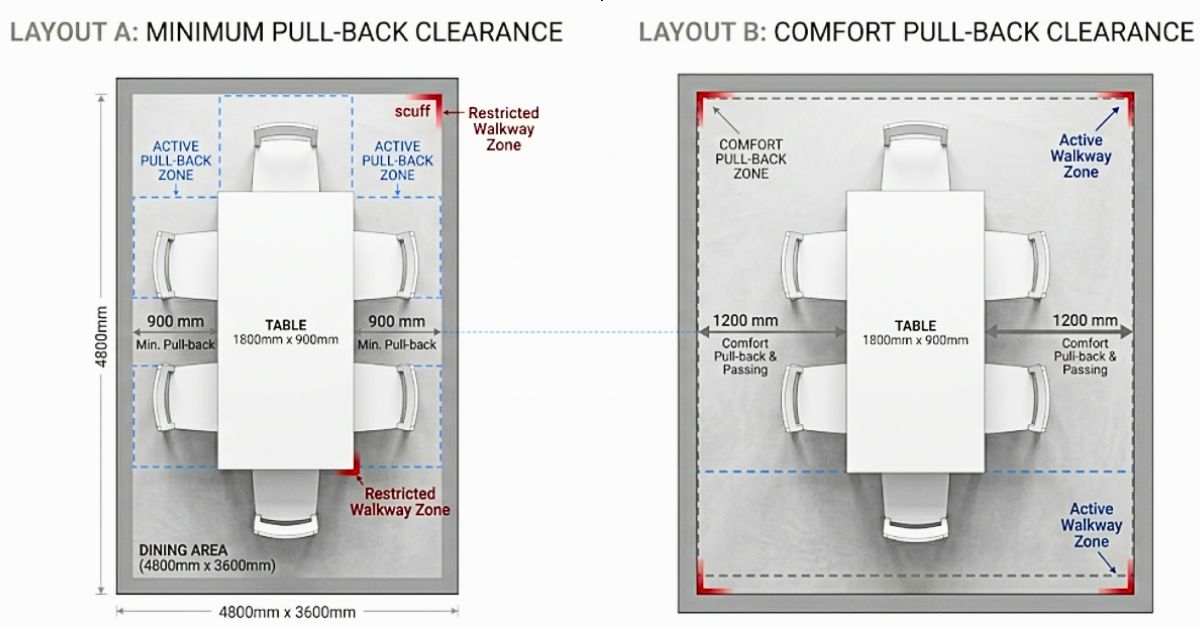
Pull-back zone is the space needed for a chair to slide out so someone can sit down or stand up. A dining chair typically needs 400 to 500 mm of seat depth, plus 300 to 400 mm of pull-back behind it.
Walkway zone is the space needed for someone to pass behind a seated diner. This requires more room because you are accounting for body width in motion, not just the act of sitting.
When planning any dining area, decide upfront which one you are solving for. A dining room that backs against a wall with no foot traffic only needs pull-back clearance. An open-plan apartment where the dining table sits in the middle of a circulation path needs walkway clearance, and that number is higher.
What Is the Minimum Clearance Behind a Dining Chair?
Here is a range that covers most residential and hospitality projects. Use the minimum only in genuinely constrained spaces:
Clearance Type | Minimum | Comfortable | With Active Walkway | In Inches (approx.) |
Pull-back only (chair to wall) | 800 mm | 900 mm | N/A | 31–35 in |
Pull-back + occasional passing | 950 mm | 1050 mm | 1100 mm | 37–43 in |
Active walkway behind seated diners | 1100 mm | 1200 mm | 1350 mm | 43–53 in |
Elderly-friendly / accessibility | 1200 mm | 1350 mm | 1500 mm | 47–59 in |
All measurements from the chair back at the full pull-out position to the nearest wall, sideboard, or fixed element.
For compact apartments in Mumbai, Bangalore, or Delhi NCR where room widths often run between 2700 and 3200 mm, 900 mm pull-back is the working minimum. But if there is any doubt, always go higher. Procurement locks in dimensions. Cramped clearance after installation is not a fix you can source your way out of.
Scenario | Clearance Needed |
Chair only, no traffic | 900 mm |
Chair + occasional passing | 1050 mm |
Active walkway behind diners | 1200 mm |
Elderly-friendly / accessible | 1350 mm |
Clearance Rules by Scenario
Table Against Wall
The chair on the wall side has the hardest constraint. Plan 850–950 mm from wall to table edge. Below 850 mm, the chair back grazes the wall on exit, which damages both the wall finish and the chair frame over time.
Table with Sideboard Behind
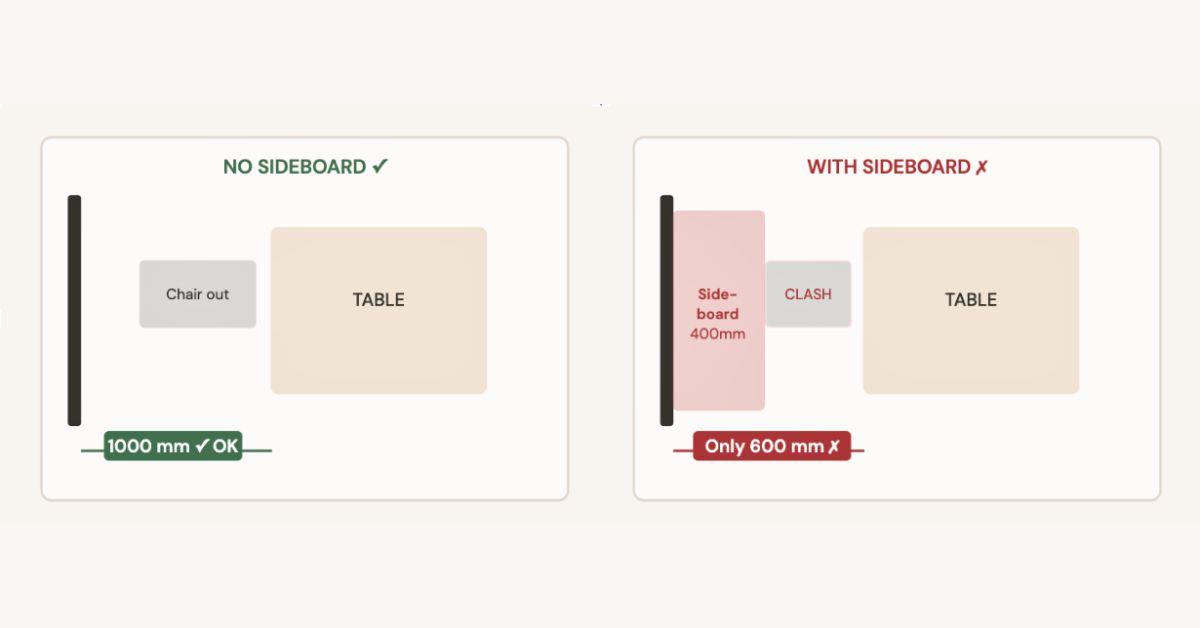
Treat the sideboard face as your effective wall. A 400 mm deep sideboard with 1000 mm total from table to wall leaves only 600 mm of real clearance. That is not enough. Add sideboard depth to your required clearance before finalising placement.
Open-Plan Living-Dining
Walkway clearance rules here. People pass through during meals from the kitchen to the living area. Minimum 1050 mm from the table edge to the next fixed element on the active side. Measure both sides independently.
Specifying dining furniture for multiple units or spaces?
Arcedior supports architects and project teams with sourcing and procurement of dining chairs and tables matched to confirmed on-site clearance specifications, including QC and delivery coordination.
When to Use Each Clearance
Use 900 mm when:
- No one moves behind chairs during meals
- The chair side faces a wall or a fixed unit
- The room is compact, and circulation is on the opposite side
Use 1050–1200 mm when:
- Dining sits within the main circulation path (kitchen to living)
- Guests walk behind seated diners regularly
- The layout is open-plan
Use 1200 mm or more when:
- Comfort is a priority over space optimisation
- Elderly users or mobility aids are a consideration
- The project is hospitality, serviced apartments, or senior living
4-Seater, 6-Seater, and 8-Seater: Space Planning Quick Rules
Table Size | Typical Dimensions | Min. Room Width | Comfortable Width | Min. Room Length |
4-seater rectangle | 900 × 1500 mm | 2700 mm | 3000 mm | 3300 mm |
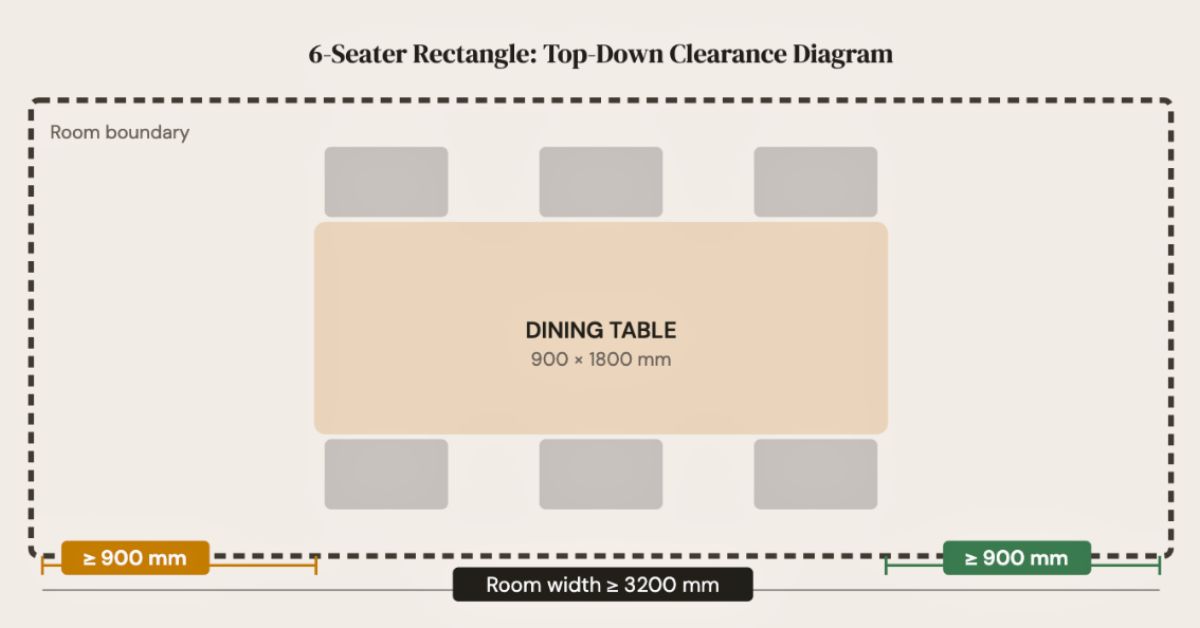
6-seater rectangle | 900 × 1800 mm | 2700 mm | 3200 mm | 3600 mm |
8-seater rectangle | 1000 × 2200 mm | 2900 mm | 3500 mm | 4000 mm |
4-seater round | Ø 900 mm | 2700 mm | 3000 mm | 2700 mm |
6-seater round | Ø 1100 mm | 2900 mm | 3200 mm | 2900 mm |
These numbers tell you quickly whether a 6-seater will actually function in a given room, or whether a 4-seater with pull-up chairs is the more practical answer for the space.
Round Table vs Rectangle: Where People Actually Bump
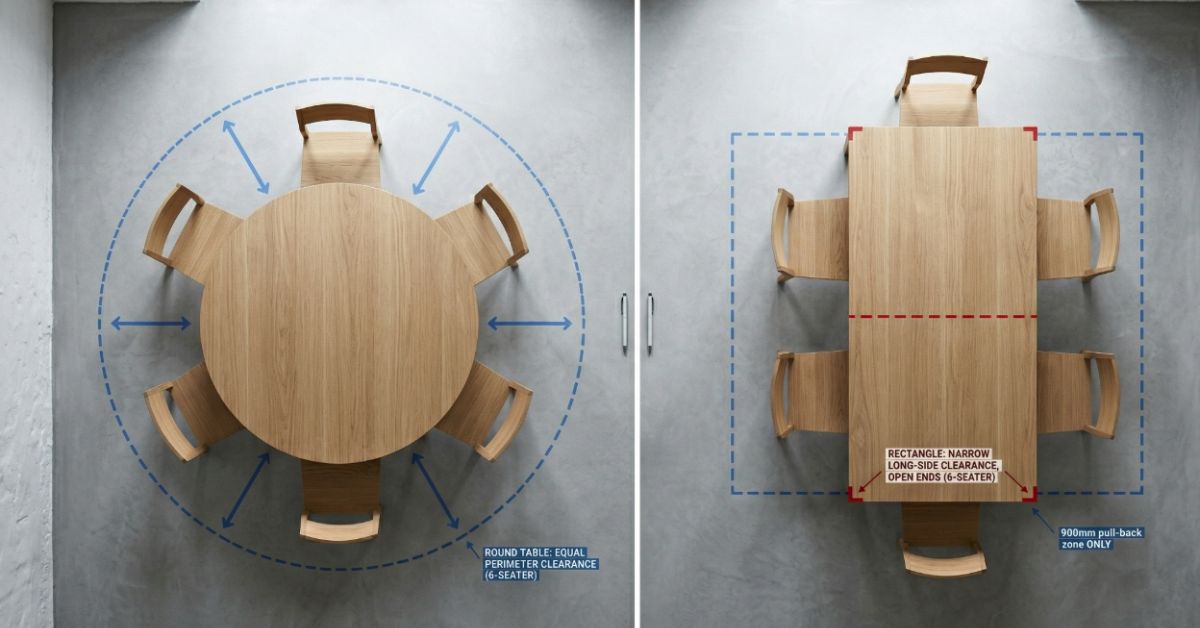
Round tables feel more forgiving because there are no corner seats. Clearance is roughly equal on all sides, so there is no consistently bad position for pull-back.
But round tables have a different problem: there is no natural back-of-chair alignment. People spread out more, and the clearance per person in practice tends to be less than what the numbers on paper suggest. For a 6-seater round at 1100 mm diameter, the chairs can end up covering almost the full perimeter, which reduces effective pull-back on all sides simultaneously.
For rectangular tables, the short ends typically have more clearance than the long sides. In small apartments, the chair on the long side against the wall is the one that causes problems. That is the chair to measure first before any layout is finalised.
Dining Layout for Small Rooms
Small dining rooms are the most searched gap in this topic, yet most guides ignore them.
Rules that actually work in compact spaces:
- Choose a 4-seater over a forced 6-seater. The numbers rarely lie: a 6-seater in a tight room means someone always has a bad seat.
- Use armless chairs to reduce the footprint. An armless chair can save 80–100 mm per side compared to a chair with arms.
- Place one long side against the wall if needed. This recovers 900 mm on that side and redirects it to other clearance zones.
- Avoid sideboards in rooms narrower than 3000 mm. A 400 mm sideboard behind dining chairs in a 2800 mm room will leave the seated person grazing it every meal.
- For open-plan layouts in compact, typical Indian apartment widths (2700–3200 mm), dining table placement directly affects the kitchen-to-living circulation. Solve for that path first, then place the table.
Compact Apartment vs Larger Home: Clearance Rules That Actually Fit the Space
Clearance rules do not change based on geography, but they do need to flex based on how much room you actually have to work with.
Compact Apartments
- Work from 900 mm pull-back as the floor, not the default
- 4-seater rectangle or round is more honest than a 6-seater forced into a tight room
- Avoid sideboards on the same wall as dining chairs unless the room width is at least 3200 mm
- In open-plan layouts, dining table placement affects the kitchen-to-living circulation
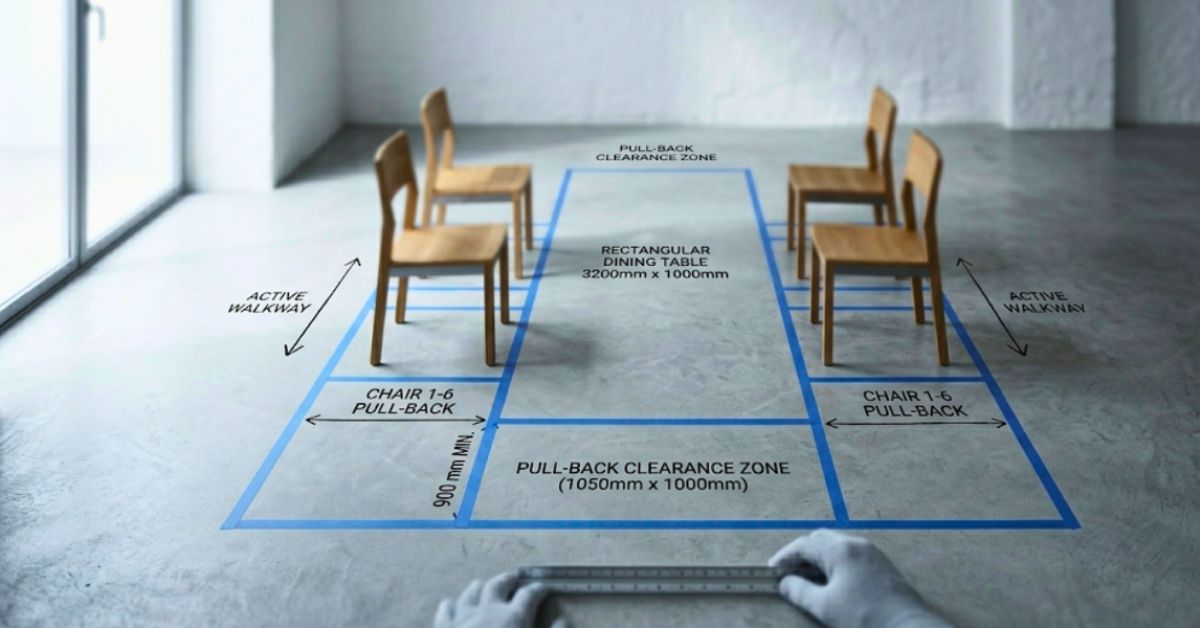
- Tape-mark the layout on site before procurement. This step alone prevents most clearance failures
Villas and Larger Homes
- Use a comfortable range (1050–1200 mm) as the baseline, not the target
- 8-seater layouts benefit from 1200 mm behind the long side for formal dining comfort
- Sideboards can sit behind chairs if the total table-to-wall is 1400 mm or more
- Elderly-friendly clearance (1200–1350 mm) is achievable and worth planning in from the start
- Separate dining rooms allow stricter walkway planning since circulation is contained
Common Mistakes That Make Dining Feel Cramped
Mistake 1: Measuring to the table edge, not the pulled-out chair Fix: The chair back at full pull-out sits 400–500 mm behind the table edge. Always measure from the pulled-out chair back. Measure only to the table edge and you are off by almost half a metre.
Mistake 2: Ignoring chair depth variation Fix: An upholstered armchair with a 600 mm seat depth pulls out significantly further than a compact side chair. If you are specifying anything over 550 mm deep, recalculate clearance for those specific chairs.
Mistake 3: Placing sideboards behind chairs without recalculating Fix: Sideboards move your effective wall position forward by their full depth. A 400 mm sideboard in a 1000 mm space leaves only 600 mm — not enough for comfortable seating.
Mistake 4: Assuming both long sides have equal clearance Fix: In open-plan layouts, one side of the table often faces a wall and the other faces open space. The tighter side sets the constraint. Measure both sides independently.
Mistake 5: Finalising chair procurement before confirming dimensions on site Fix: When chairs are sourced separately from the table, the final seat depth and footprint can differ from the catalogue specs. Confirm actual dimensions before placing the order.
If You Only Remember One Thing
If you only remember one rule: always measure clearance from the chair back at full pull-out, not the table edge.
Pro Tip
Quick 3-Step Method to Plan Any Dining Layout
1. Fix the chair footprint
Get the actual dimensions of the chair being specified: seat depth, back height, leg spread. Do not use catalogue measurements for layout planning; use confirmed sample or prototype dimensions. Chair specifications from different vendors vary more than most people expect.
2. Decide what you are solving for
Is the space behind seated diners a dead zone or a walkway? Pull-back clearance and walkway clearance require different minimum values. Decide this before picking a number, or you will plan for the wrong scenario.
3. Lock the clearance range and mark it on site
Choose a number from the tables above based on your specific scenario. Mark the chair pull-out zone with tape on the actual floor before any furniture is ordered. Any adjustment at this stage costs nothing. After delivery, it costs significantly more.
Quick Planning Checklist
Before any dining furniture is procured, confirm:
- Chair seat depth measured from the actual sample, not the catalogue
- Pull-back vs walkway decision made and documented
- Sideboard depth added to total clearance if present
- Minimum 900 mm clearance confirmed from the chair back at full pull-out
- Layout tape-marked on site and physically tested
- Both long sides of the table measured independently
In most residential and hospitality projects, clearance issues are only discovered after installation, when fixing them becomes expensive or impossible. Experienced procurement teams validate chair footprint, pull-back, and circulation space before finalising furniture specifications. This is not extra diligence; it is standard practice in projects where procurement and on-site execution are coordinated from the same brief.
Get Chair Clearance Right Before Procurement Locks It In
For project teams managing multiple dining setups (residential towers, hospitality lounges, serviced apartments), the right chair clearance behind dining tables is a specification decision, not an afterthought. Arcedior works with architects and procurement leads to source and supply dining furniture matched to confirmed on-site dimensions, with QC and logistics coordination built into the process.
Working on a project?
Share your room size, table type, and chair style. Arcedior's team can provide clearance specifications ready to use directly for sourcing and execution.