Developer Furniture Procurement Bangalore: Delivery & QC

Furniture Procurement for Developers in Bangalore: Site Realities, Tower-wise Delivery, and What Actually Breaks Down
Quick Answer
If you've managed a multi-tower project in Bangalore, you already know the furniture problem does not start at delivery. It starts three months before, when a vendor confirms a laminate shade over WhatsApp, nobody locks it into a shared reference, and by the time 180 units are in production, Tower A and Tower B are running on two different whites.
That is not just a visual problem. It creates a chain: the consultant flags a mismatch, rework gets discussed, the vendor argues it's "within range," and the handover schedule starts slipping. The furniture itself might cost less than 8% of the project value. The coordination breakdown around it can cost far more.
Most content about furniture procurement for developers explains what a sourcing partner is. You probably don't need that explained. What's harder to find is a clear answer to how this actually runs on a Bangalore site – with ORR traffic, basement truck restrictions, lift booking windows, RERA handover pressure, and vendors who go quiet mid-production.
This page is for project directors, procurement heads managing 80+ units with staggered tower handovers, and PMCs who need a furniture sourcing partner for real estate developers in Bangalore that handles the full backend: BOQ to phased delivery, with QC gates in between. No design involvement. No turnkey promises.
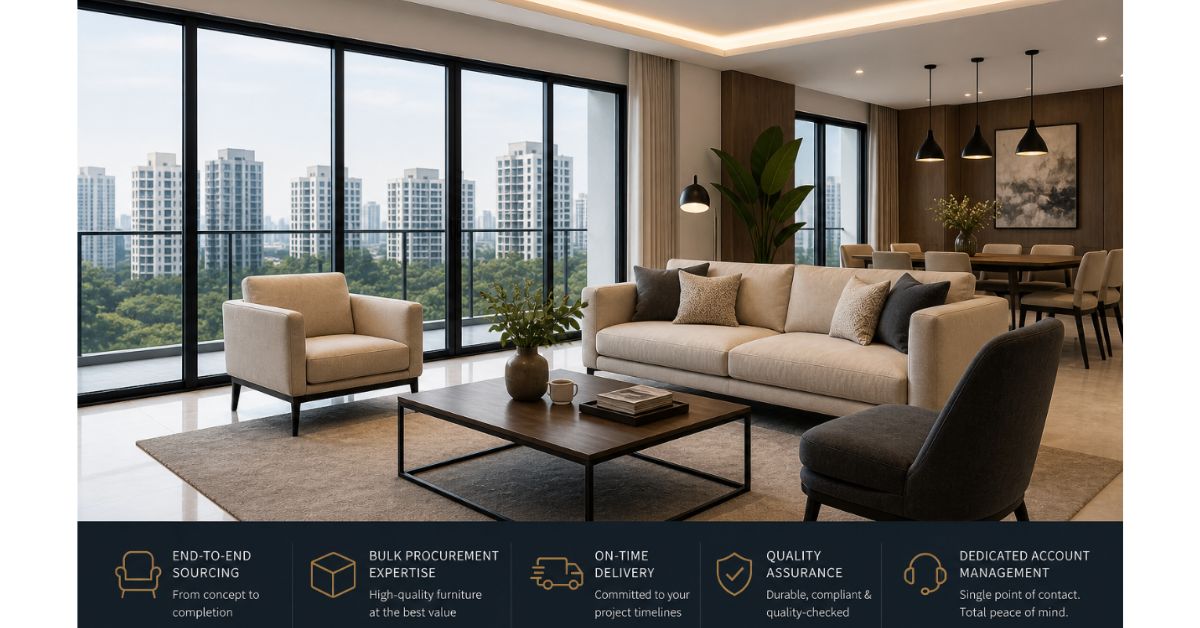
Why Developers in Bangalore Don't Hire Turnkey Firms for Procurement
Most furniture and interior companies in Bangalore sell two things: consumer retail packages or full turnkey interiors. Neither is built for a developer managing 200+ units across towers.
Here's what actually goes wrong when developers use turnkey firms for procurement:
Margin conflict. Turnkey firms source products to protect their own margin, not yours. They have preferred vendors. You rarely see the factory price, so you can't benchmark it.
Design entanglement. You already have a design consultant. Bringing in a turnkey firm means two parties with overlapping scope and no clear accountability when something goes wrong at the site.
No phasing logic. Turnkey firms are set up for single-site delivery. Developer projects need tower-wise sequencing, floor-by-floor drops, and delivery calendars that flex with site readiness. Most turnkey setups are not built for that.
Finish control is weak. When the turnkey firm manages five categories across two vendors, finish codes drift unless someone is specifically watching them. On large projects, managing five categories across multiple vendors creates 20 to 30 active coordination points running simultaneously. Usually, no one is watching all of them at once.
A procurement-only partner does not have these conflicts. There is no design to protect, no preferred vendor kickback, and no incentive to speed delivery before the site is ready. The job is to get the right product to the right floor on the right date, cleared through QC before it leaves the factory.
That is a narrower scope. It is also the one that actually maps to how developer projects run.
Handling 50+ Units? Check Your Procurement Risk Before Dispatch Starts
This free assessment helps developers and PMCs identify delivery sequencing risks, vendor coordination gaps, QC exposure, tower-wise execution issues, and Bangalore logistics constraints.
What Actually Breaks Down in Bangalore Developer Projects
Most procurement guides describe how things should work. This section covers how they actually break down, specifically on Bangalore sites.
1. Finish codes get confirmed informally and never documented
A project manager approves a laminate shade on a WhatsApp video call. The vendor notes it internally. Six months later, when Phase 2 goes into production, no one can find the original reference. Tower A and Tower B end up with finishes that look the same in bad lighting and wrong in good lighting.
This is not just a visual problem. A finish mismatch across towers can delay sample approval sign-offs, trigger rework negotiations with your design consultant, and create homeowner escalations during handover – on a timeline you cannot afford to extend.
The fix is not complicated. A shared finish reference pack, signed off before any PO, covers every category. It takes a day to set up and prevents weeks of rework.
2. Deliveries arrive before the site is ready
This is probably the most expensive and least-discussed mistake in developer procurement. Furniture arriving two weeks before the floor is ready will be moved. Workers will walk around it, stack pieces in corridors, and double-book lifts. By the time installation begins, half the pieces have been handled three to four times. The QC cleared at the factory – dimensions, surface quality, hardware – gets partially undone through repeated handling on site. Projects with phased tower handovers typically need delivery buffers of 10 to 14 days between production completion and delivery date to avoid this overlap.
The fix is to build delivery calendars backward from handover dates, not forward from production completion. Furniture should arrive when the site is ready to receive it.
3. Whitefield and Sarjapur Road projects have specific delivery constraints that most vendors don't know
Large trucks cannot enter most project basements in these corridors. The height limit rules out standard 32-foot vehicles. Vendors based outside Bangalore often show up with the wrong truck, which means same-day reloading into a smaller vehicle at extra cost and lost time.
Lift booking windows in large township projects in Whitefield, Hebbal, and North Bangalore are strict – often 6 AM to 10 AM for heavy material movement before resident traffic starts. If a delivery lands at 11 AM, it waits until the next window.
These are not edge cases. They are standard conditions on any large Bangalore residential project, and they need to be in the delivery plan from day one, not discovered on delivery day.
4. Vendor communication breaks down mid-production
A vendor confirms a delivery date in week 6. At week 4, there is a production issue. The vendor does not call. Your procurement team finds out when the truck does not show up.
This happens when there is no milestone tracker and no midpoint check-in built into the process. A production milestone at 40% and 80% completion, with photo evidence at both points, catches delays before they cascade into handover problems.
5. Snag closure has no owner
Post-delivery snags are normal. A hinge is stiff. A laminate edge is not sealed properly. A drawer runner binds. The question is not whether snags happen; it is whether there is a plan to close them before the handover date.
Most snag delays happen because nobody defined ownership before delivery started. Without a punch-list SLA, snag closure becomes a negotiation every single time. The developer's site team calls the vendor. The vendor says they'll send someone. Three weeks later, the snag is still open and the homeowner is asking questions on a project with a RERA deadline behind it.
Already dealing with one of these on a live project?
Send your BOQ and current project status on WhatsApp for a quick procurement review. No pitch, just a straight read on what stage the project is at and what would help.
Who Needs a Furniture Sourcing Partner in Bangalore?
Not every developer project hits procurement chaos. But if you are managing more than 80 units with staggered tower handovers, or handling sample flats, clubhouses, and bulk residential across one timeline, vendor coordination starts to cost real time.
The pattern is consistent. A project starts with two or three vendors by category. One delivers late. One sends the wrong finish. A third sends 60% of the order and goes silent. By the time you've sorted it, the site team is behind, and the handover date is under pressure.
The procurement model that works at scale is a single-window backend: one contact, one milestone tracker, QC evidence before dispatch, and a delivery plan that maps to your tower phasing. Not a design firm, not a turnkey contractor. A sourcing partner.
Bangalore Logistics Reality – What Your Delivery Plan Needs to Account For
Delivery planning for Bangalore developer projects is not the same as delivery planning anywhere else in India.
ORR and corridor-specific traffic windows
Projects in Whitefield, Marathahalli, and Sarjapur Road sit on corridors where mid-day delivery is effectively impossible during peak hours. A furniture truck dispatched from a factory in KIADB or the Peenya belt can easily spend 4 hours on what should be a 45-minute run if the timing is wrong. Deliveries on these corridors should be scheduled for early morning, and the logistics partner needs to know this before dispatch, not on the day.
Basement access and vehicle sizing
A significant number of large residential projects in North Bangalore and the ORR corridor have basement entry restrictions. Height clearances vary. Many basements cannot take a standard 32-foot vehicle. Vendors who source from outside Bangalore frequently do not know this until they arrive. The loading team should confirm basement access, turn radius, and vehicle size limits during a pre-delivery site visit.
Monsoon delivery and moisture risk
Bangalore's monsoon season (June to September) creates a delivery problem that most procurement plans ignore entirely. Furniture in transit during heavy rain, particularly flat-pack or veneer-finished items, is exposed to humidity spikes that cause warping, swelling, and finish bubbling. For projects with handover timelines between July and October, the packaging spec needs to account for this: sealed cartons, moisture barriers, and waterproof outer wrapping on anything with wood substrates. Deliveries should also be scheduled for morning windows when rain is less likely, and trucks should have tarpaulin cover as a baseline.
Basement moisture during and after the monsoon
Basements in projects under construction or recently completed often retain moisture well into October. Furniture stored in a damp basement, even for 10 to 14 days, is at risk of edge swelling and laminate lifting, particularly on lower-grade substrates. If your delivery window falls near or after the monsoon season, confirm the basement's ventilation and drainage status before any furniture drops there.
Labour for unloading and installation
Skilled furniture installation labour in Bangalore is concentrated in specific pockets – around Rajajinagar, parts of Electronic City, and a few clusters near the Outer Ring Road. During peak construction seasons (typically October to February before Diwali and the new year rush), skilled carpenters are in short supply. Procurement plans that assume labour availability without confirming it in advance run into delays that are entirely avoidable.
Electronic City and South Bangalore delivery windows
Electronic City Phase 1 and Phase 2, and large residential clusters in Begur and Hosa Road, have their own traffic and access constraints. The flyover approach from Hosur Road restricts large vehicle movement during peak IT shift hours (8 AM to 10 AM and 5 PM to 8 PM). Deliveries to these corridors run most smoothly between 10 AM and 3 PM – the opposite window from ORR projects. If you have projects across both corridors in the same phase, your logistics plan needs separate scheduling windows for each.
Township lift scheduling specifics
Large township projects in North Bangalore (Hebbal, Thanisandra, Devanahalli corridor) often run residential towers alongside still-active construction on adjacent towers. Lifts are shared between construction workers and furniture installation teams, and booking windows are managed centrally by the project management team. Furniture drops that are not pre-confirmed in the lift booking system get bumped. On large projects, unconfirmed lifts typically cause a delay of one to three days per tower, not because of any procurement failure, but because the system was not worked with properly from the start.
RERA timelines
Bangalore projects operate under RERA, which means handover delays carry legal and financial consequences. This changes how developers should think about furniture delivery buffers. The procurement plan should have a two-week buffer before RERA handover dates, not a one-week buffer. If something goes wrong at the factory or in transit, the buffer is what saves the handover.
Three Procurement Models for Developers (Compared)
Most Bangalore developers use one of these models. The risk column is what rarely gets mentioned.
Approach | Where It Works | The Real Risk |
Category-by-category from local vendors | Small-scale, urgent, 1-2 categories | Finish drifting across categories. No one watches the finish codes across all vendors simultaneously. Works fine at 20 units. Breaks at 120. |
Direct manufacturer per category | High-volume, single-category orders | Coordination burden is entirely on your internal team. Running 5 factories simultaneously across 4 categories is a full-time job. |
Single-window procurement partner | Multi-category BOQs, phased towers, tight timelines | Dependency on one partner's systems. Vet their QC process, not just their pitch. Ask to see sample QC evidence packs from a previous project. |
BOQ to Handover-Ready: The Procurement Workflow
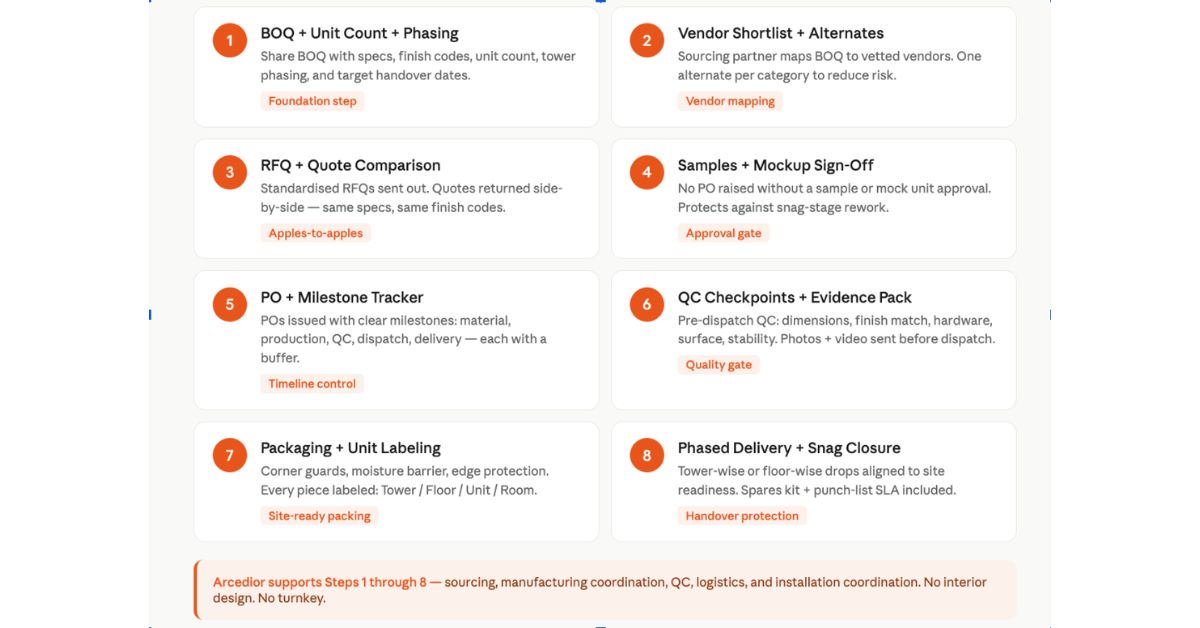
Step 1: BOQ, unit count, phasing, and handover dates
This is the only input that makes everything downstream accurate. An incomplete BOQ means inaccurate quotes, unreliable lead times, and a sourcing plan that needs to be rebuilt halfway through.
What to lock before approaching vendors: finish codes, dimensions, room-wise split, tower phasing, site delivery constraints, and target handover dates by tower. Sending a partial BOQ and asking for a quote gets you a number that will change three times before PO.
Step 2: Vendor shortlist with alternates
Every category needs at least one alternate vendor. This is not optional. A production failure with no alternate means a delay you cannot recover from before the handover.
For Bangalore projects specifically, confirm whether vendors can deliver to your site's vehicle access constraints before they are shortlisted.
Step 3: RFQ and comparable quote table
RFQs go out in a standardized format. Quotes come back and are compared on the same basis: same specs, same finish codes, same delivery terms. Without standardization, you are comparing different assumptions, not different prices.
Step 4: Samples and mock unit sign-off
No PO is raised without sample approval. For bulk residential, this means a furnished mock unit. Getting sample approval right is the highest-leverage step in the process. A finish that looks right in a showroom and wrong in the actual unit is a problem that costs far more to fix than the sample visit cost.
Step 5: PO with milestone tracker
Production milestones should be defined in the PO: material procurement date, production start, 50% completion check-in with photos, QC date, dispatch, and delivery. Each milestone has a buffer. The 50% check-in catches production issues before they become dispatch issues.
Step 6: Pre-dispatch QC with evidence pack
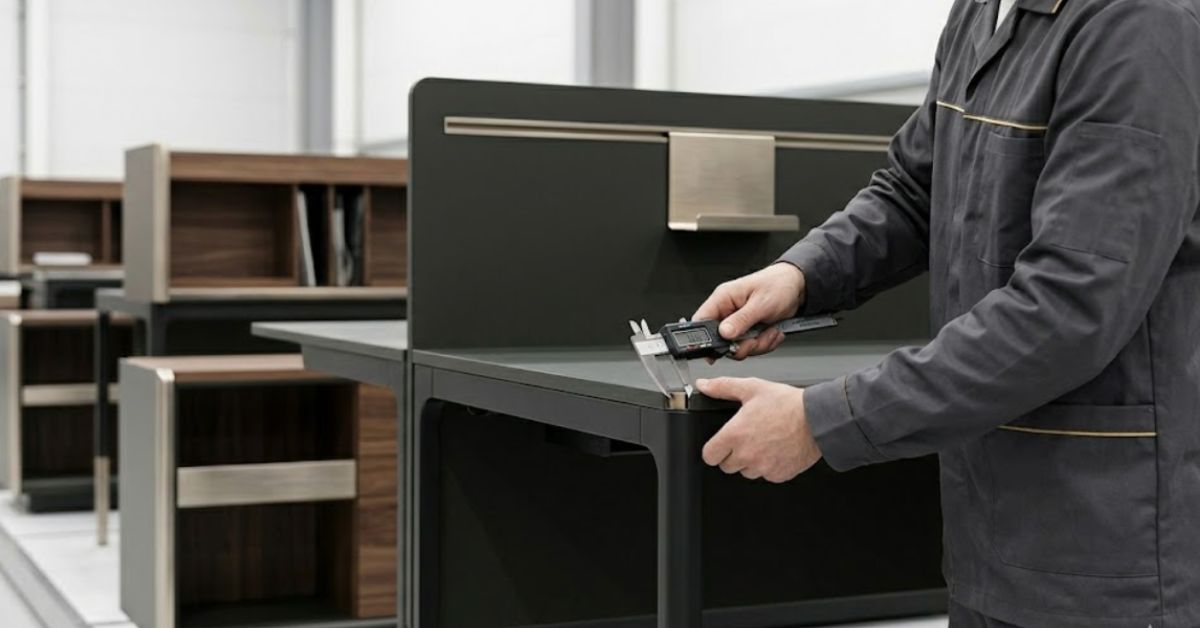
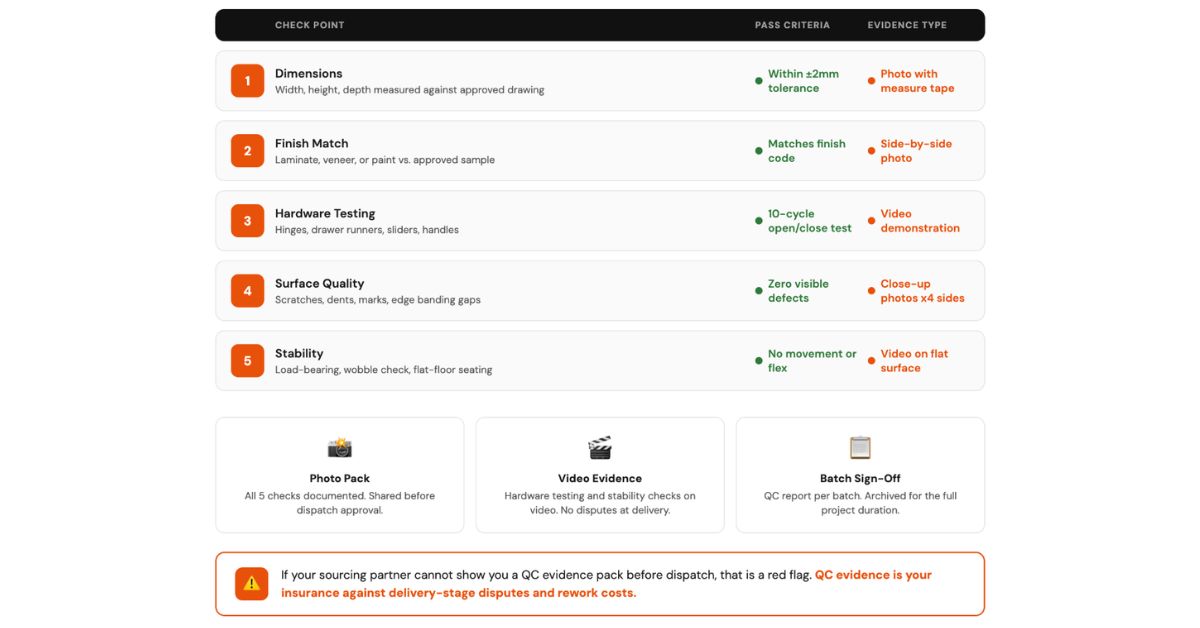
QC is not a site visit and a call. It is a documented process: dimensions checked against approved drawings, finish matched against the approved sample, hardware tested, surface inspected, stability confirmed. Every check is photographed and sent before the truck leaves the factory.
Across the projects Arcedior has managed, pre-dispatch QC catches roughly 8 to 12% of units with fixable defects before dispatch. Those defects get fixed at the factory. The alternative is they land at the site during installation, which is slower and more disruptive to close.
Step 7: Packaging and labeling
Furniture that is not labeled by tower, floor, and unit creates a sorting problem at the site. On a 200-unit project, unlabeled furniture is a multi-day sorting exercise that your site team should not be doing. Corner guards, edge protection, moisture barriers, and unit-level labeling are not optional – they are what get furniture from the factory to the flat without damage and without chaos.
Step 8: Phased delivery and installation coordination
Delivery calendars are built backward from handover dates, not forward from production. Tower-wise drops, floor-by-floor sequencing, and confirmed lift booking windows before any truck moves. Installation coordination runs in parallel. Snag closure follows with a defined punch-list SLA and a spares kit for every batch.
Key Takeaway
One Procurement Mistake Can Delay an Entire Tower Handover
Basement access issues, wrong delivery sequencing, finish mismatches, and vendor coordination gaps usually appear too late – after production has already started.
Use this Bangalore Procurement Failure Predictor to identify risk areas before they become site problems.
What to Share to Get Accurate Quotes
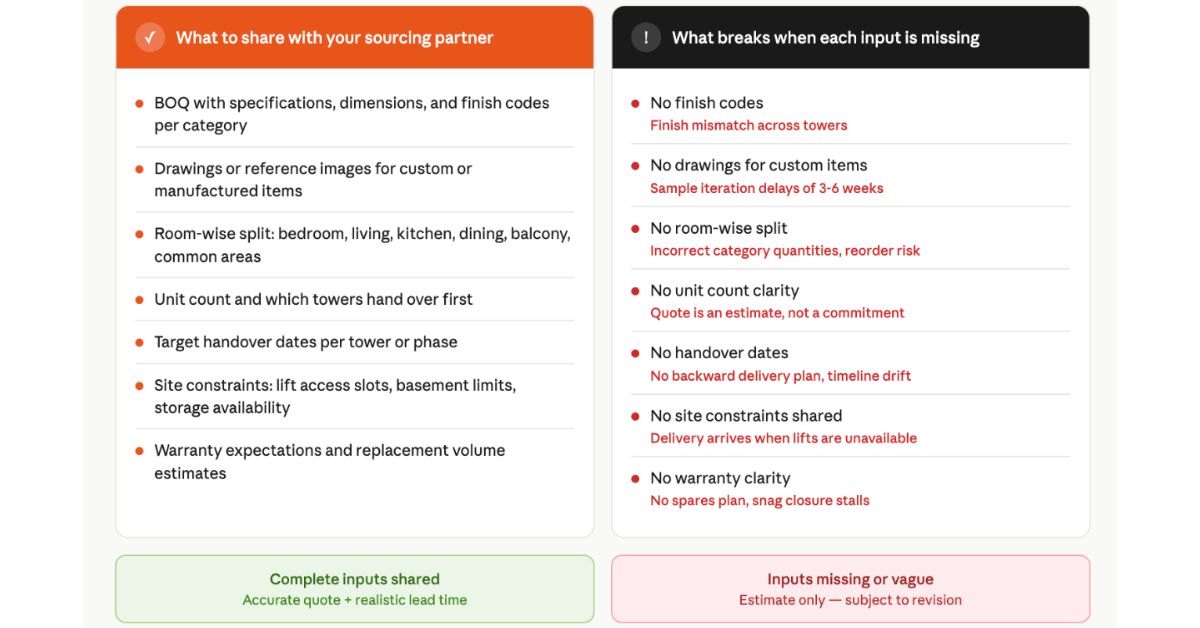
If you're reaching out to a procurement partner for the first time, prepare:
- BOQ with specifications, finish codes, and dimensions
- Drawings or reference images for custom or manufactured items
- Room-wise split (bedroom, living, kitchen, dining, balcony, common areas)
- Site constraints: delivery slot restrictions, lift access windows, basement movement limits, storage availability
- Phasing plan: which towers hand over first and when
- Warranty and replacement expectations
Working on a Bangalore developer project and need someone to review your BOQ?
Book a 20-minute Bangalore Developer Sourcing Workshop Call. Arcedior will check your BOQ, suggest a sourcing split, give you a realistic lead time range, and walk through a QC and delivery sequencing plan. No pitch. Just operational clarity.
QC for Developer Projects: What Good Evidence Looks Like
Most furniture supply chains treat QC as a step. Developer procurement needs it as a system.
What gets checked at pre-dispatch:
Dimensions against approved drawings. Finish against the approved sample in the same lighting. Hardware – hinges, runners, sliders – tested under load, not just opened and closed. Surface quality for scratches, dents, and edge seal. Stability under weight.
What the evidence pack should contain:
Photos of every category, matched against the sample reference. Video of hardware testing for anything with moving parts. Any rework done and re-checked. A batch checklist is signed off on before dispatch.
If a procurement partner cannot show you this for a previous project, that tells you what their QC system actually is.
Finish Reference System – How to Prevent the Most Common Bangalore Procurement Mistake
The single most common cause of post-delivery disputes in multi-tower developer projects is finish inconsistency. Tower A looks right. Tower B looks slightly different. Both vendors had "the same code," but they were working from different sample references, and nobody caught it until both towers were in installation.
Here is how to prevent it.
Build a shared finish reference pack before any PO.
This is a physical file and a digital folder. Every category, every finish code, every approved sample swatch or laminate chip. Vendor name, batch reference, date of approval. Every vendor who touches that category signs off on the same reference.
Lock the reference pack before Phase 1 PO. Use it for every subsequent phase.
Multi-phase projects fail on this because finish references get updated informally between phases. Someone approves a "closer" shade on a call, and it is not documented. By Phase 3, there is visible drift across towers.
Include finish references in the QC evidence pack.
Every pre-dispatch QC check includes a comparison photo: the approved sample next to the produced finish in the same light. Not described. Photographed. Side by side.
This takes one extra day to set up before sourcing starts. It prevents a problem that routinely costs 4 to 6 weeks to resolve post-delivery.
Snag Closure: What to Define Before Delivery, Not After
Even with strong QC, site handling, and installation, there are snags. That is expected. What is not acceptable is a snag closure process that is undefined until after delivery.
Spares kit per batch: Every bulk delivery should include extra handles, replacement drawer runners, touch-up paint matched to the finish codes, and laminate offcuts from the same batch. For clubhouse furniture with heavy usage, the spares plan should be more detailed.
Punch-list SLA defined in writing before delivery: Who raises the snag? Who responds? Within how many days? Who confirms closure? On large developer projects, snag closure without a defined process becomes a negotiation every single time, and it is always slower than it needs to be.
Ask your procurement partner to show you the punch-list SLA template before they start sourcing, not after delivery.
Definition
Conclusion
Most of what ranks for this topic is aimed at a different buyer. Turnkey interior firms, consumer furniture packages, and design-to-handover companies. None of that maps to how a developer project actually procures furniture.
What you need is a procurement backend: BOQ in, QC-cleared, and tower-sequenced furniture out. No design involvement, no vague commitments, no vendor management falling back on your project team.
Bangalore adds specific constraints on top of that – delivery logistics, RERA-linked timelines, lift window restrictions, and site labour availability. A procurement plan that does not account for these will hit avoidable problems.
Arcedior handles the sourcing, custom manufacturing coordination, pre-dispatch QC, packaging, and phased delivery side. Your design is yours. Arcedior handles what comes after it.
Book the Bangalore Developer Sourcing Workshop Call
A 20-minute call where Arcedior reviews your BOQ, suggests a sourcing split by category, gives you a lead time range, walks through a QC plan, and maps a delivery sequencing framework to your site phasing.
What you get from the call:
- BOQ sanity check
- Recommended sourcing split by category
- Realistic lead time range
- QC plan outline
- Delivery sequencing framework by tower and phase