Export Packing List for Furniture: Example, Format & Checklist

Export Packing List for Furniture: Example, Format & Checklist
Furniture shipments fail quietly before the container even closes.
A dining table top travels as a wooden crate. The base ships separately. The hardware for both sits in a small inner box inside a third carton. The upholstered chairs need foam wrapping on every edge. The marble slab requires a "this side up" label and nothing stacked on top of it. Now multiply that across 200 rooms in a hotel project, add three different factories, two freight forwarders, and a site team waiting at the other end.
When the packing list is incomplete, every person in that chain makes assumptions. The customs officer flags a quantity mismatch. The warehouse team signs off on 47 cartons instead of 50 because they could not find the hardware boxes. The installation crew opens the wrong crate first and damages a veneer finish, looking for the base plates.
None of this is dramatic. It is just what happens when documentation does not match physical reality.
An export packing list for furniture is a document that shows what is packed, how it is packed, and the weight, dimensions, package count, carton numbers, and shipping marks for each item in the shipment. It is used by customs teams, logistics coordinators, warehouses, and project managers to verify cargo before anything is unpacked on site.
This guide gives you a working furniture export packing list example, a clear format to follow, furniture-specific fields most templates skip, real scenarios where packing documentation caused delays and damage claims, and a dispatch checklist to run before the container is sealed.
What Is an Export Packing List for Furniture?
Quick Answer
A packing list is not a price list. It does not need to show invoice values. Its job is to describe the physical shipment clearly enough that any person receiving it at any point in the supply chain can identify what is in front of them and handle it correctly.
For furniture exports, this document becomes especially important because:
- Items are often large and packed in custom crates or multi-layer carton boxes
- Knock-down parts from the same item can be split across multiple cartons
- Hardware packs travel separately from the main furniture pieces
- Fragile tops, glass, mirrors, and upholstered surfaces need specific handling instructions
- Any mismatch between the packing list and the physical cargo can delay customs clearance or create problems during damage claims
The packing list typically includes exporter details, consignee details, invoice number, PO or project reference, port of loading, port of discharge, and a line-by-line breakdown of every package in the shipment.
Export Packing List Furniture Example
This is a sample furniture export packing list for a dining set shipment. You can use this format as the starting point for your own export documentation.
Carton No. | Item Description | Model / Code | Qty | Packaging Type | Net Wt. | Gross Wt. | Dimensions (cm) | CBM | Shipping Mark | Remarks |
C-01 | Dining Chair, upholstered seat | DC-104 | 2 pcs | 5-ply carton + foam | 18 kg | 22 kg | 75 x 60 x 95 | 0.43 | AR/PROJ/01 | Keep dry |
C-02 | Dining Chair, upholstered seat | DC-104 | 2 pcs | 5-ply carton + foam | 18 kg | 22 kg | 75 x 60 x 95 | 0.43 | AR/PROJ/02 | Keep dry |
C-03 | Dining Table Top, walnut veneer | DT-220-T | 1 pc | Wooden crate + foam | 48 kg | 62 kg | 230 x 110 x 18 | 0.46 | AR/PROJ/03 | Fragile, This side up |
C-04 | Dining Table Base, metal powder coat | DT-220-B | 1 pc | Wooden crate | 35 kg | 48 kg | 90 x 70 x 75 | 0.47 | AR/PROJ/04 | This side up |
C-05 | Hardware and fittings | HW-DT-220 | 1 set | Inner box in carton | 3 kg | 4 kg | 35 x 25 x 20 | 0.02 | AR/PROJ/05 | Attach to C-03/C-04 |
C-06 | Sideboard, 3 drawer | SB-180 | 1 pc | Wooden crate + foam | 55 kg | 72 kg | 190 x 50 x 80 | 0.76 | AR/PROJ/06 | Fragile, keep dry |
Totals | 9 pcs + 1 set | 177 kg | 230 kg | 2.57 CBM |
Pro Tip
Avoid customs delays and site confusion. Get the carton-level Excel format that procurement teams use before dispatch, with auto-calculated CBM and shipping totals built in.
Furniture Export Packing List Format: Section by Section
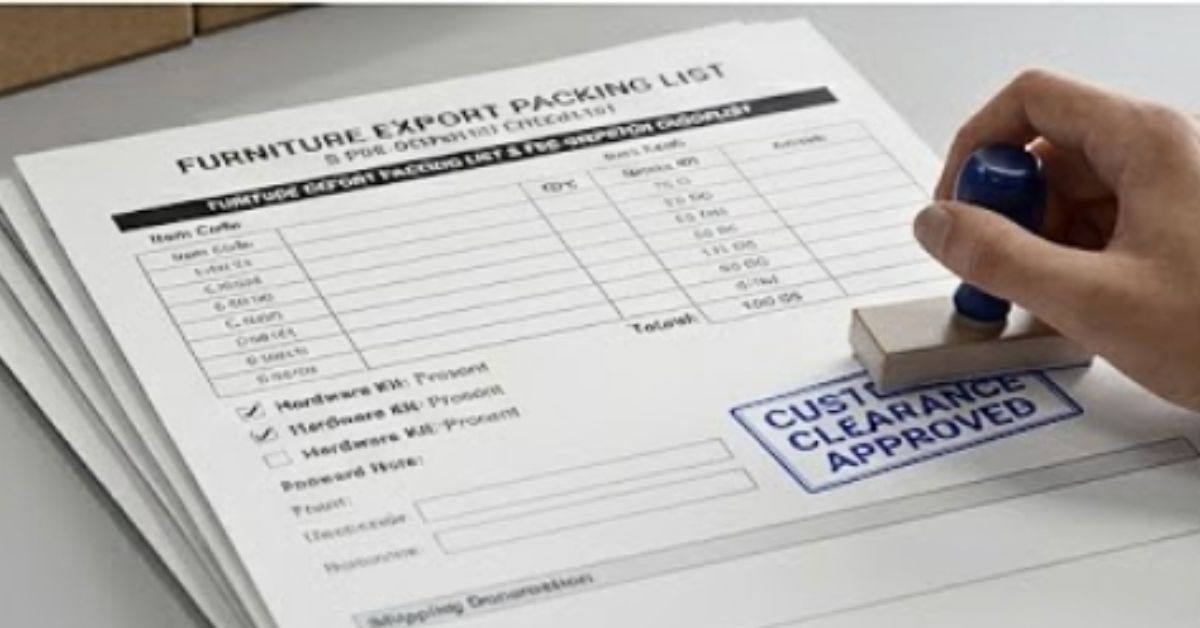
Generic templates list the fields but do not explain what to write in each one. Here is a breakdown specific to furniture shipments.
1. Shipment Header
This section identifies the parties and the shipment at a glance.
- Exporter name and address
- Consignee name and address
- Notify party (if applicable)
- Packing list number and date
- Invoice number and PO or project reference
- Country of origin
- Port of loading and port of discharge
- Incoterms, if applicable
For furniture projects, add a project name or site reference in this section. If the shipment is going to a hotel project, office development, or residential complex, label it clearly. This helps the receiving team on-site cross-reference against their delivery schedule.
2. Package-Level Details
Each row in your packing list table should cover:
- Carton or crate number (unique, sequential)
- Item description and product code
- Quantity per carton
- Packaging type (5-ply carton, wooden crate, bubble wrap plus carton, foam crate, etc.)
- Net weight (product only, no packaging)
- Gross weight (product plus all packaging materials)
- Dimensions in cm or mm (outer carton or crate dimensions)
- CBM
- Shipping mark
- Remarks for handling
3. Shipment Totals
At the bottom of the table, add:
- Total number of packages
- Total quantity of items
- Total net weight
- Total gross weight
- Total CBM
- Container number and seal number (once loaded)
4. Authorization Block
- Prepared by
- Checked by
- Date
- Authorized signatory
Furniture-Specific Fields Most Packing List Templates Miss
This is where most competitor templates fall short. Generic logistics templates do not account for the way furniture shipments are actually structured. These are the fields and notes that matter for furniture exports.

Hardware Boxes
Bolts, screws, Allen keys, corner brackets, shelf pins, connectors, and spare fittings should always be listed as a separate carton. Do not bundle them inside the main furniture carton without noting it. If hardware goes missing, the entire item is unusable on-site. Label each hardware carton with the product code it belongs to and add a note like "Attach to C-03/C-04" as shown in the example above.
Knock-Down Furniture Parts
Wardrobes, platform beds, modular shelving units, and folding desks are often shipped disassembled. Each panel, frame section, and component needs its own line or at least a clear reference. If a bed headboard and side rails are in one carton and the bed base panels are in another, both cartons need to reflect that on the packing list so the receiving team does not think one carton is missing.
Fragile Components
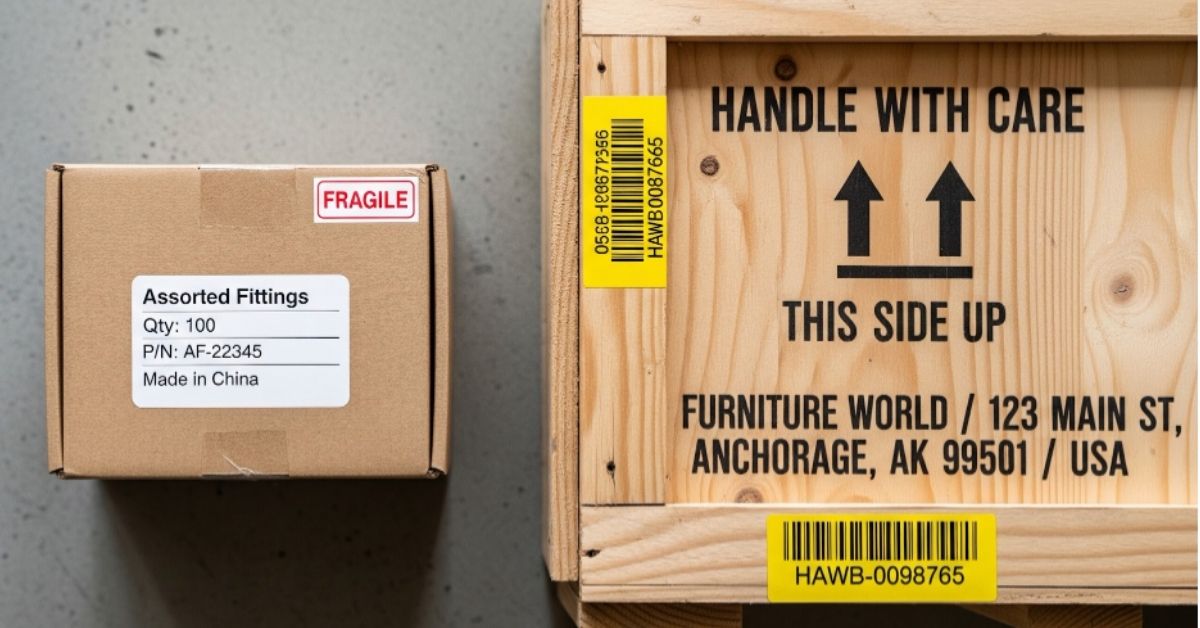
Glass tops, marble surfaces, mirror panels, veneer finishes, upholstered backs, and polished stone all need remarks in the handling notes column. Use standard terms: Fragile, This Side Up, Keep Dry, Do Not Stack. Do not leave this column blank for any carton that contains a surface-sensitive item.
Material and Finish References
Add a brief material note in the item description column. "Dining table top, walnut veneer, 40mm" tells the receiving team what they are looking for and what to handle carefully. This does not need to be a full specification sheet. One short identifier per item is enough.
Carton Marking
Every carton or crate in the shipment should carry a physical shipping mark that matches the packing list. A standard mark for furniture exports typically includes:
- Consignee short name or project code
- Carton number out of total (e.g., C-03 of 06)
- Item code
- Destination room or area reference, if applicable
- Handling symbols: fragile glass symbol, upward arrows, no stacking symbol
Pre-Dispatch Photo Documentation
Before the container is sealed, photograph each labelled carton and crate, the container being loaded, and the final packed container with the door open. These photos protect everyone if a damage claim is raised later. Note in the packing list remarks column that photo documentation is available.
Key Takeaway
What Usually Goes Wrong in Furniture Export Shipments
Most packing list guides stop at the format. They tell you what fields to fill. They do not tell you what happens when those fields are wrong, blank, or missing.
These are real categories of failures that happen in furniture shipments. If any of them sound familiar, your documentation needs attention before the next dispatch.
Hardware Carton Not Listed Separately
A hardware box gets bundled inside the main furniture carton without a separate packing list entry. The customs declaration shows 6 items. The actual carton count is 7. The officer flags a quantity mismatch. The shipment goes into secondary inspection. Clearance takes an extra 4 to 8 days. The installation crew is already on site waiting. The project team calls the freight forwarder. The freight forwarder calls the factory. Nobody has a clear answer until someone physically locates the hardware carton.
No Room or Area Reference on Hotel Project Shipments
A hotel project ships 340 furniture pieces across 80 rooms. The packing list shows item codes and carton numbers, but no room references. The receiving warehouse team sorts everything into a general holding area. When installation starts, the crew spends the first two days finding which carton belongs in which room instead of installing. A job that should take 8 days takes 14. The client holds the final payment pending completion.
Gross Weight Left Blank
The freight forwarder uses the net weight to book the container. The actual gross weights, once all the wooden crates and foam packaging are included, push the load over the booked limit. The container cannot be sealed until the manifest is revised. Departure is delayed. For a project on a tight opening timeline, that single day creates a cascade of issues.
Mixed Units Without Labels
One factory sends dimensions in millimetres. Another sends them in centimetres. The forwarder calculates CBM from the packing list without checking units. The container loading plan is built on the wrong volumes. Pieces that should fit do not. The container gets repacked at the port. Additional handling fees apply.
Knock-Down Panels Split Across Cartons With No Cross-Reference
A wardrobe ships in four cartons: two for side panels, one for the top and bottom, one for the back panel, and doors. The packing list treats each carton as an independent item with no note linking them together. At the destination warehouse, one carton is flagged for a minor damage inspection and held separately. The other three move to the project site. The installation crew arrives and cannot complete a single unit. The held carton takes three more days to clear. Every other wardrobe installation waits.
No Handling Notes on Fragile Surfaces
A marble table top ships without a "This Side Up" or "Fragile" marking on either the carton or the packing list. During port transfer, the crate is placed on its side. The marble cracks at the edge. There is no damage notation at loading because no pre-dispatch photos were taken. The damage claim becomes a dispute between the factory, the freight forwarder, and the insurance provider. It takes months to resolve. The client receives a replacement well after the project has already opened.
These are not rare edge cases. They happen on real projects with experienced teams when documentation gets treated as a formality rather than a coordination tool. If any of your current shipments are going out without carton-level packing lists, proper handling notes, or pre-dispatch photos, the risk is real.
Want a Second Review Before Dispatch?
Share your BOQ or current packing list format for a quick review before your next dispatch.
Export Packing List vs Commercial Invoice: What Is the Difference?
These two documents travel together but serve different purposes.
Point | Export Packing List | Commercial Invoice |
Main purpose | Shows physical shipment details | Shows commercial and financial details |
Includes prices? | Usually no | Yes |
Used by | Customs, forwarder, warehouse, consignee | Customs, buyer, bank, accounts team |
Key details | Packages, weights, dimensions, marks | Value, currency, payment terms, HS code |
Furniture relevance | Identifies cartons and verifies contents | Records transaction value and product details |
Definition
3 Things Experienced Procurement Teams Always Check Before Dispatch
You can run the full checklist at the end of this guide. But if you work on large furniture project shipments regularly, three specific checks come up almost every time something goes wrong.
1. Does every hardware carton have its own line with a product reference?
This is the most common omission. Hardware that ships without its own entry on the packing list either gets missed at customs or goes missing at the warehouse. Before the container closes, confirm that every hardware kit, fitting set, and accessory pack has a unique carton number and a clear note linking it to the item it belongs to.
2. Do carton numbers on the physical labels match the packing list exactly?
Factories sometimes repack items during final QC. A carton gets renumbered at the factory floor, but the packing list does not get updated. This creates a mismatch that customs officers catch immediately. The fix takes five minutes at the factory. Finding it after the container is sealed takes days.
3. Are room or area references included for project shipments?
If you are shipping to a hotel, residential complex, or commercial fit-out, the packing list should show where each item is going inside the building. Generic consignee entries help nobody on installation day. Room references on carton marks and in the remarks column let the installation crew get straight to work instead of spending the first day sorting cartons by hand.
Common Mistakes in Furniture Export Packing Lists
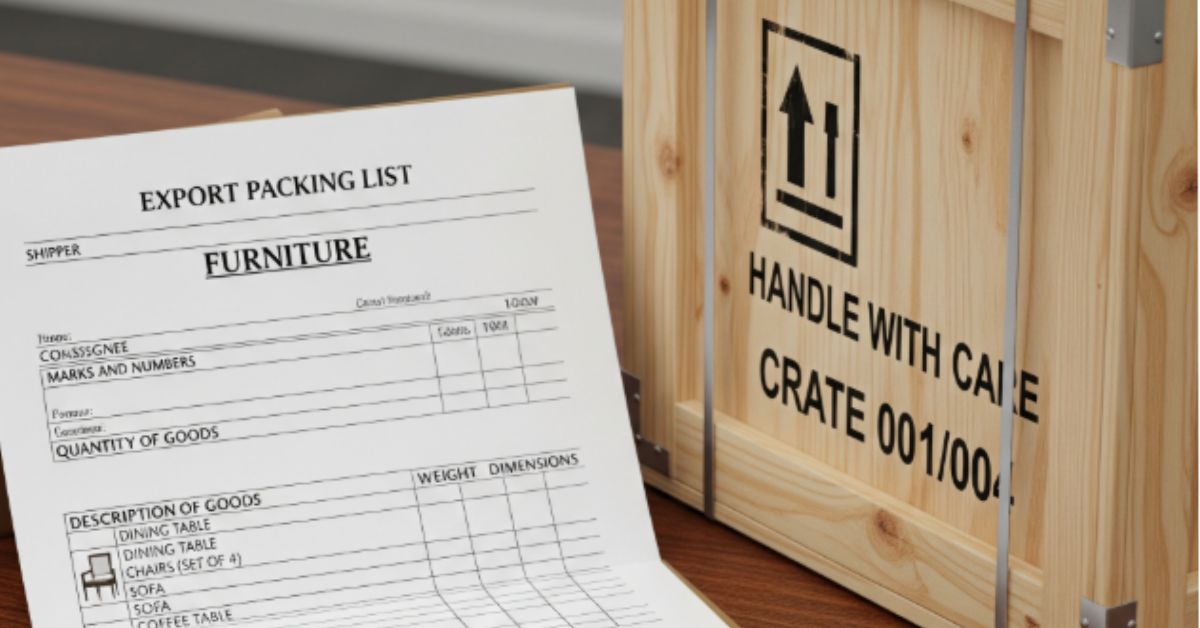
These are the errors that create the most problems. Most generic packing list guides do not cover them.
- Listing hardware inside the main furniture carton without a separate note
- Using the same carton number twice in one shipment
- Leaving the gross weight blank and writing only the net weight
- Writing dimensions in mixed units (some in cm, some in mm) without labelling
- Forgetting to calculate CBM
- Using vague item descriptions like "furniture item" or "chair" with no product code
- No handling notes on cartons containing fragile surfaces
- Quantity mismatch between the packing list and the commercial invoice
- No project or room reference for multi-area installations
- Shipping without photographing packed cartons before dispatch
Any one of these can delay a shipment, complicate a customs check, or make a damage claim harder to resolve.
Furniture Export Dispatch Checklist
Run through this before the container is sealed.
- Packing list matches the commercial invoice on item codes and quantities
- Every carton has a unique carton number
- Net weight and gross weight are filled in for every row
- Dimensions are in consistent units
- CBM is calculated for each carton
- Hardware cartons are listed separately with a product reference
- Fragile, Keep Dry, and This Side Up notes are added where needed
- Shipping marks on physical cartons match the packing list
- Project or room reference added if relevant
- Pre-dispatch photos taken of labelled cartons
- Container loading photos taken
- Signed copy filed with export documentation
Reduce customs delays, site confusion, and damage claims with the complete template pack used for furniture project shipments.
Includes the editable Excel template with auto CBM, a filled sample PDF for a dining set, the pre-dispatch checklist, and a carton marking guide.

How Arcedior Supports Furniture Export Coordination
A complete packing list is the visible part of a process that involves significant coordination before the factory starts packing anything.
Large hotel, office, and residential projects typically source furniture from multiple factories. Those products consolidate into one or two containers, with knock-down components, fragile surfaces, and custom finishes all moving together on tight timelines. The packing list for that container is only as accurate as the supplier follow-up, QC process, and documentation coordination that went into preparing it.
Arcedior works with project teams as a global sourcing and contract manufacturing coordination partner. In practice, that means working across multiple suppliers to standardise packing formats before dispatch, coordinating carton-level tracking, running pre-shipment quality checks at the factory floor, following up on export documentation, and staying in contact with the logistics and installation teams so problems get identified before a container is sealed rather than after it lands on site.
For a 300-room hotel project, that coordination also covers making sure the wardrobe hardware from one factory, the bed frames from another, and the FF&E accessories from a third all arrive with documentation the site team can actually use. When packing formats differ by supplier, room references are missing, or one factory labels cartons in millimetres while another uses centimetres, those are the issues Arcedior works through with suppliers during the coordination stage.
If you are managing a furniture shipment for a hotel, office, residential, or commercial project and need support at any stage from sourcing and QC through to logistics and installation coordination, reach out directly.
Managing Multiple Furniture Suppliers?
Arcedior coordinates carton formats, QC processes, packing standards, export documentation, and shipment tracking across multiple factories for hospitality and commercial projects.
Conclusion
Most furniture shipment problems come down to documentation gaps. The packing list is the one document that connects what was manufactured to what actually arrives on site. When it is incomplete or vague, every person in the chain from the customs agent to the site installation crew works with less information than they need.
This guide has covered a working export packing list furniture example, the full format structure, furniture-specific fields that standard templates skip, common dispatch mistakes, and a pre-shipment checklist. Use the example table as your starting point, run through the dispatch checklist before the container is sealed, and download the free Excel template to build your own carton-level documentation.
If your project involves custom or contract-manufactured furniture and you need support coordinating the sourcing, QC, logistics, or shipping documentation, the Arcedior team works directly with project managers and procurement teams at every stage.
Avoid Shipment Delays Before They Reach the Site
Download the free Furniture Export Packing List Template or share your shipment details for a review before your next dispatch.