Furniture Sourcing Partner for Real Estate Developers: 3 Models
Is There a Furniture Sourcing Partner for Real Estate Developers?
Yes. Many real estate developers work with a furniture sourcing and procurement partner (often called FF&E procurement) who manages requirements, vendor shortlisting, sampling, quality checks, logistics, and site delivery coordination. It's different from design: the focus is execution, cost control, and on-time handover.
If you're a real estate developer managing show flats, clubhouses, or multi-unit projects, you know the pain: 15 different vendors, delayed shipments, quality mismatches between units, and site teams chasing you for delivery slots. The interior design might be approved, but getting hundreds of furniture pieces and interior products to arrive on time, at the right quality, and within budget becomes a full-time coordination nightmare.
This is exactly why furniture sourcing partners exist for real estate developers. Not to design your spaces, but to handle the entire procurement backend once your design and BOQ (Bill of Quantities), and approved specifications are ready.
This guide explains:
- The three models developers use today
- Why large developers shift to a sourcing partner
- A developer-ready procurement workflow
- How risk is controlled (specs, mockups, QC, logistics)
- Where this model fits: show flats, clubhouses, lobbies, amenity areas, serviced apartments, rental-ready units
- Real FAQs procurement teams actually ask
Why Furniture Sourcing Is Hard for Real Estate Developers
Before we compare sourcing models, let's acknowledge the reality most developers face:
- Multiple units, multiple sites, same deadline. A 200-unit residential project or a phased township development means the same furniture specifications need to be procured consistently across dozens or hundreds of units. One vendor delay affects the entire project handover.
- Vendor follow-ups eat into core development time. Your project managers and site teams are already handling construction, MEP coordination, and regulatory approvals. Adding furniture procurement means chasing 10-20 different vendors for quotations, production updates, quality complaints, and delivery scheduling.
- Quality inconsistency across show flats, clubhouses, and amenities. The show flat sofa looks perfect. The clubhouse version arrives in a different shade. The amenity area chairs are scratched on delivery. Without quality checks before dispatch, site teams discover issues only after installation, when fixing them costs time and money.
- Delays due to production, transport, or site coordination. Custom furniture takes 6-8 weeks to manufacture. Imported pieces need shipping and customs clearance. Site access windows are tight. If any vendor misses their timeline, your entire handover schedule shifts.
- No single owner for sourcing accountability. When you're working with multiple furniture vendors, interior product suppliers, and logistics companies, who owns the delay when something goes wrong? Finger-pointing between vendors wastes critical days during project closeout.
For developers in cities like Ahmedabad, Mumbai, Delhi NCR, Bangalore, Pune, or projects in Dubai, Abu Dhabi, and Riyadh, these challenges multiply when you're coordinating across geographies, import timelines, and local site constraints.
3 Furniture Sourcing Models for Real Estate Developers (DIY vs Designer vs Procurement Partner)
Real estate developers typically use one of three models to handle furniture procurement. Each works differently, and each has trade-offs in time, cost, and control.
Model 1: DIY Furniture Sourcing (In-House or PMC-Led)
How it works: The developer's internal team or their Project Management Consultant (PMC) handles furniture sourcing directly. They collect quotations from local and online vendors, place orders, track production, manage logistics, and coordinate site deliveries.
When developers try this: Usually on smaller projects (under 50 units), first-time developments, or when the developer wants maximum cost visibility and direct vendor relationships.
Limitations:
- Time drain on the core team. Your project managers spend hours comparing vendor quotations, following up on production status, and troubleshooting quality issues instead of focusing on construction milestones.
- Fragmented vendor relationships. You're managing 15-20 different suppliers with different payment terms, lead times, and quality standards. No single accountability point.
- QC gaps. Without pre-dispatch quality inspections, issues surface only on site when furniture arrives damaged, mismatched, or off-spec. Re-work delays handover.
- Difficult to scale. What works for one show flat becomes unmanageable for 200 units or multiple project phases.
Model 2: Designer-Led Furniture Buying
How it works: Your interior designer or architect helps specify furniture, creates mood boards, and shortlists products. They may help with vendor introductions or facilitate orders, but procurement execution, tracking production, quality control, and logistics coordination often depend on multiple vendors or the developer's team.
When this works: For design-intensive projects where aesthetic control is the priority: boutique hotels, luxury show flats, branded residences, or high-end clubhouses where the approved specifications must be executed exactly as specified.
Risk of delays, misaligned pricing, and unclear ownership: Designers excel at creating specifications, but procurement execution is not their core competency. Production delays, quality complaints, and site delivery issues fall back on the developer or PMC to resolve. Pricing transparency can be unclear if designers are sourcing through their vendor networks with undisclosed markups.
Works for small projects, struggles at scale. Designer-led buying works beautifully for a single penthouse or a signature clubhouse. For 150 rental-ready apartments or a phased township with standardized units, the designer's vendor relationships can't always deliver the procurement volume, timeline discipline, and QC rigor developers need.
Model 3: Furniture Sourcing & Procurement Partner (Single-Window Backend)
What does a furniture sourcing partner do? A furniture sourcing partner is responsible for execution: vendor shortlist, sampling, production tracking, QC, logistics, and delivery coordination. Developers use this model to reduce delays, control costs, and standardize quality across units.
How it works: A furniture sourcing and procurement partner for real estate developers specializes in executing the procurement side of your project once the design and BOQ with approved specifications are ready. They're not designing your interiors. Their job is to take your specifications and handle global sourcing of interior products, custom and contract manufacturing, vendor management, quality checks, logistics, and installation coordination as a single-window partner.
Focused on execution, not design. The boundary is clear: your designer or in-house team handles the creative work, space planning, and design approvals. The sourcing partner handles the backend: finding the right vendors, negotiating pricing, production tracking, conducting pre-dispatch inspections, managing imports and logistics, and coordinating with your site team for delivery and installation coordination support.
One point of responsibility from the requirement to the site delivery. Instead of chasing 15 vendors, you have one partner accountable for the entire furniture procurement workflow. If a sofa shipment is delayed, a quality issue surfaces, or a delivery slot needs rescheduling, there's one team to call.
Scales across multiple projects and phases. Whether you're furnishing 10 show flats, 200 rental apartments, or five clubhouses across different cities, a procurement partner can standardize specifications, maintain quality consistency, and manage procurement across your entire portfolio. This is why developers working on bulk furniture sourcing for property developers or FF&E procurement partner services across geographies prefer this model.
Sourcing Model | Best For | Developer Time Required | Quality Control | Scalability | Accountability |
DIY (In-House/PMC) | Small projects, tight budgets, first-time developers | High (vendor management, follow-ups, site coordination) | Limited (no pre-dispatch QC) | Low | Fragmented across vendors |
Designer-Led Buying | Design-intensive projects, luxury positioning, aesthetic control priority | Medium (depends on designer's procurement bandwidth) | Variable (depends on the designer's vendor network) | Medium | Split between the designer and the vendors |
Sourcing Partner | Multi-unit projects, phased developments, show flats + amenities, standardized quality, tight timelines | Low (partner owns procurement backend) | High (structured QC checkpoints before dispatch) | High | Single-window accountability |
What a Furniture Sourcing Partner Actually Does for Developers
A true FF&E procurement partner for real estate developers or an execution partner for furniture sourcing works like an operations layer between your project and the supply chain.
For developers in India and the Middle East, this typically includes:
- Requirement analysis and BOQ finalisation. Your design team provides specifications, finishes, and quantities. The sourcing partner translates these into a detailed BOQ with spec sheets and finish schedules so vendors can quote accurately.
- Global and local vendor sourcing. Instead of limiting options to local suppliers, a sourcing partner evaluates global vendors (India, China, Vietnam, Turkey, UAE) and local manufacturers to find the best combination of cost, quality, and lead time for your project. This includes contract manufacturing furniture for projects where custom specifications are needed.
- Custom and contract manufacturing were required. Standard catalog furniture rarely fits developer projects perfectly. Sourcing partners coordinate custom manufacturing, modifying dimensions, finishes, or materials, and manage contract manufacturing relationships for bulk orders across multiple units.
- Sampling, mock-ups, and approvals. Before committing to production for 200 units, you see physical samples or mock-ups. The sourcing partner arranges samples, coordinates your approval process, and ensures the final production matches the approved sample exactly.
- Cost optimisation and value engineering. If your budget is tight, a procurement partner can suggest alternate materials, vendors, or manufacturing approaches that reduce cost while maintaining approved specifications and quality standards. This is vendor management for furniture procurement at work: balancing cost and quality intelligently.
- Production tracking and timelines. Once orders are placed, the sourcing partner tracks production progress weekly, flags delays early, and coordinates with your site schedule so deliveries align with handover timelines. For projects in Hyderabad, Chennai, Jeddah, or Doha, this includes managing long-lead items and import clearances.
- Quality checks before dispatch. Pre-dispatch quality inspections catch issues before furniture leaves the factory: wrong finishes, construction defects, packaging damage, or spec mismatches. This is the single biggest risk control in bulk furniture sourcing for property developers. Fixing issues at the factory is faster and cheaper than handling them on site.
- Logistics, shipping, and site delivery planning. Sourcing partners coordinate freight, customs (for imports), warehousing if needed, and final-mile delivery to match your site's access windows. If your site team can only receive deliveries on weekends or needs phased delivery across 10 floors, the sourcing partner manages the logistics choreography.
- Installation coordination and snag closure. Once furniture arrives on site, the sourcing partner coordinates with installation teams (carpenters, upholsterers, assembly contractors) and closes punch list items: minor touch-ups, adjustments, or replacements discovered during final inspection.
Furniture Procurement Workflow for Developers (Checklist)
Here's the step-by-step workflow a furniture sourcing and procurement partner follows for real estate projects. This is the process developers should expect when engaging a single-window procurement partner:
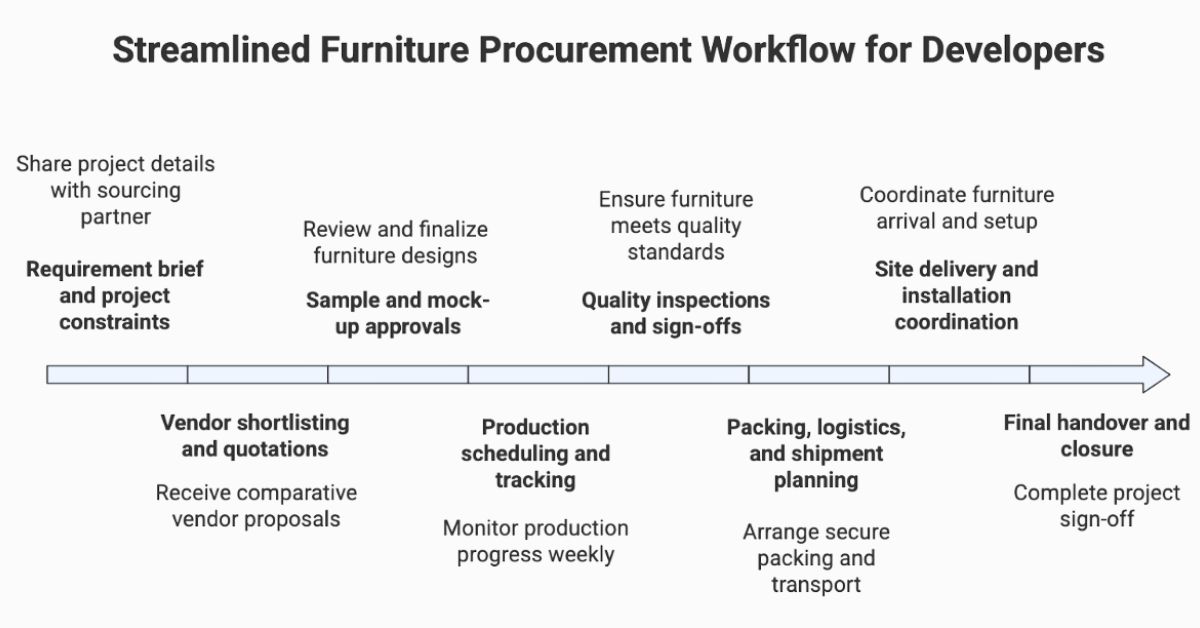
Step 1: Requirement brief and project constraints. You share approved designs, BOQ, and finish schedule (even if rough), budget range, site location, and handover deadline. The sourcing partner understands your project type (show flat, clubhouse, rental units, serviced apartments) and any constraints (import restrictions, tight site access, phased delivery).
Step 2: Vendor shortlisting and quotations. Based on your requirements, the sourcing partner identifies 3-5 suitable vendors per product category (sofas, beds, dining tables, loose furniture, soft furnishings). You receive comparative quotations with lead times, payment terms, and vendor credentials.
Step 3: Sample and mock-up approvals. For key furniture pieces (especially custom items), you review physical samples or mock-ups. Changes are finalized before production begins. This avoids costly revisions later.
Step 4: Production scheduling and tracking. Orders are placed with vendors, and production timelines are locked. The sourcing partner tracks progress weekly, photographs work-in-progress, and alerts you if any vendor falls behind schedule. For projects in Mumbai, Ahmedabad, Dubai, or Abu Dhabi, this includes managing import timelines if sourcing globally.
Step 5: Quality inspections and sign-offs. Before dispatch, the sourcing partner conducts quality control for furniture procurement: checking construction, finishes, dimensions, packaging, and compliance with the approved sample. Only products that pass inspection are cleared for shipment.
Step 6: Packing, logistics, and shipment planning. Furniture is packed securely (especially for long-distance transport), and logistics are arranged. If you're importing, the sourcing partner handles customs documentation, freight booking, and clearance. Domestic shipments are coordinated with your site delivery schedule.
Step 7: Site delivery and installation coordination. Furniture arrives at your site during the agreed time window. The sourcing partner coordinates with installation teams (if required), ensures items are placed correctly, and handles any on-site assembly or touch-ups.
Step 8: Final handover and closure. Once all furniture is installed and inspected, the sourcing partner closes snags (minor fixes, replacements for damaged items) and hands over to your team for final project sign-off.
Developer Procurement Checklist
What you need to start:
- BOQ (Bill of Quantities) – even rough versions work
- Finish schedule/spec sheet with materials and finishes
- Handover date and project timeline
- Site location + delivery constraints (access windows, lift restrictions, storage)
- Budget range per unit or area
Before signing with any sourcing partner:
- Confirm pre-dispatch QC is included
- Get production tracking schedule format
- Clarify who owns delays and how they're escalated
- Review warranty structure (vendor vs partner)
- Understand the storage/warehousing plan if site delays
Quality Control Checklist for Bulk Furniture Procurement
Risk controls developers should insist on (5 checkpoints):
- BOQ freeze + spec sheet final – Lock specifications, finishes, and quantities before production. No mid-production changes without written approval and timeline impact assessment.
- Sample/mockup approval sign-off – Physical sample approval for all custom items and key furniture pieces. Production doesn't start until you sign off on the exact product you'll receive.
- In-process production checks – Weekly progress photos, measurements, and finish verification during manufacturing. Catch issues early before full production runs.
- Pre-dispatch QC (factory inspection report) – Independent quality inspection at the factory before shipment. Check construction, finishes, dimensions, and packaging. Only approved items ship.
- Site delivery checklist + punch list closure – On-site inspection during delivery, installation verification, and documented snag closure process with timeline for fixes.
When Should a Developer Use a Furniture Sourcing Partner?
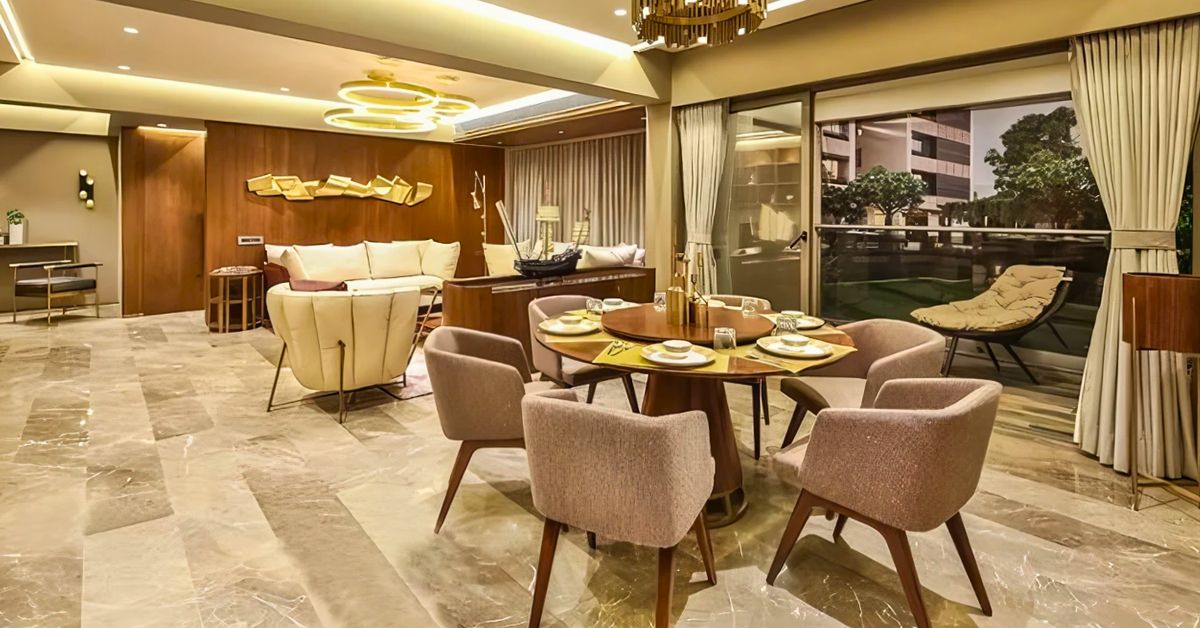
Not every project needs a dedicated furniture sourcing and procurement partner. Here's when it makes sense:
- Show flats with fixed launch dates. Your sales team has committed to a launch event in 8 weeks. The show flat must be ready, fully furnished, and photo-perfect. A sourcing partner ensures every furniture piece arrives on time, quality-checked, and ready for installation. No surprises.
- Clubhouses and amenity spaces. These are high-visibility areas: gym equipment, lounge furniture, outdoor seating, kid's play area furnishings. Quality and durability matter because usage is heavy. A sourcing partner manages vendor shortlisting, QC, and coordination for these diverse product categories.
- Multi-unit or phased developments. When you're furnishing 100+ apartments, 5 clubhouses, or a phased township, consistency and scalability matter. The same sofa specification must look identical in Unit 101 and Unit 450. A sourcing partner standardizes procurement, maintains quality across batches, and scales efficiently.
- Serviced apartments and rental projects. For rental-ready units or serviced apartments (coliving, student housing, corporate rentals), furniture must be durable, cost-effective, and delivered quickly so you can start leasing. An FF&E procurement partner helps you balance cost and quality without sacrificing timelines.
- Projects with tight budgets and strict timelines. If your budget is fixed and your handover date is non-negotiable, a sourcing partner can suggest alternate vendors, value-engineer specifications, and track production aggressively to protect both constraints.
- Developments across multiple cities or countries. If you're a developer with projects in Pune, Bangalore, and Dubai simultaneously, managing furniture procurement in-house means juggling vendors, logistics, and QC across three geographies. A sourcing partner centralizes this as a single backend operation.
How Developers Benefit from a Single-Window Sourcing Partner
Let's translate the workflow and use cases into tangible benefits:
- Clear ownership and accountability.
One partner owns the entire procurement process. If a delivery is late, quality is off, or a vendor drops out, you have one point of contact to resolve it. No finger-pointing between 10 different suppliers. - Better control over cost and lead times.
Sourcing partners have vendor relationships across geographies, so they can negotiate better pricing and realistic lead times. They also track long-lead items early and suggest alternates if a vendor can't meet your deadline. - Consistent quality across units and sites.
Pre-dispatch quality inspections ensure every sofa, every bed, every dining table matches the approved spec before it leaves the factory. This is especially critical for multi-unit projects where consistency defines your brand. - Fewer coordination headaches.
Your site team isn't chasing 15 vendors for delivery updates. Your PMC isn't troubleshooting damaged furniture claims. Your internal team focuses on construction and approvals, while the sourcing partner handles the furniture backend. - Faster site readiness and smoother handovers.
With structured timelines, QC checkpoints, and logistics planning, furniture arrives when your site is ready to receive it. Installation happens smoothly. Snags are closed quickly. Your project handover stays on schedule.
Furniture Procurement Realities in India + GCC (What Changes by City)
Procurement challenges vary significantly by location. Here's what changes:
Ahmedabad/Mumbai:
- Tight site access windows (limited delivery hours in dense areas)
- On-site storage constraints – furniture often arrives before sites are ready
- Multi-floor tower deliveries require lift scheduling and phased coordination
Delhi NCR:
- Tower deliveries across 20-30 floor buildings
- Strict lift scheduling conflicts with construction teams
- Weather-related delays during the monsoon and winter fog season
Bangalore/Hyderabad:
- Vendor fragmentation – local suppliers can't handle bulk volumes
- Last-mile delivery delays due to traffic and infrastructure
- Custom manufacturing lead times longer than metro cities
Dubai/Abu Dhabi:
- Import compliance and documentation requirements are stricter
- Delivery slot booking is required weeks in advance
- Municipality approval needed for certain furniture categories
Riyadh/Jeddah:
- Long-lead imports (8-12 weeks minimum for international sourcing)
- Warehousing and staging are needed due to extended clearance times
- Coordination with Saudi contractors for final installation and approvals
Why this matters: A sourcing partner with multi-city experience can anticipate these location-specific challenges and build them into your procurement timeline and logistics plan.
How Furniture Sourcing Partners Charge (Simple Explanation)
Transparency around pricing helps developers budget correctly. Here's how furniture sourcing and procurement partners typically charge:
- Percentage-based procurement fee.
The most common model: the sourcing partner charges a percentage (usually 10-18%) of the total furniture procurement value. This covers vendor management for furniture procurement, quality control, logistics coordination, and their margin. You pay the vendor cost + the procurement fee. - Fixed project management fee.
For large or long-term projects, some sourcing partners charge a fixed fee per unit or per project phase. Example: ₹15,000 per apartment for full furniture procurement management, regardless of the furniture value. - Hybrid models (management + QC/logistics).
Some partners charge a base management fee + separate charges for quality inspections, logistics coordination, or installation support. This works when the developer wants to retain some vendor relationships directly but needs support for QC and site coordination.
What developers should clarify upfront:
- Is the fee inclusive of quality inspections, logistics, and installation coordination, or are these separate?
- Who negotiates with vendors, are vendor costs transparent or bundled?
- What happens if a vendor fails mid-project, does the sourcing partner absorb the risk or charge extra for finding alternates?
- Are there volume discounts for multi-phase projects or portfolio deals?
Questions Real Estate Developers Should Ask Before Choosing a Sourcing Partner
Not all furniture sourcing partners for real estate developers operate the same way. Here are the questions developers should ask to evaluate whether a partner is right for their project:
- Who owns quality control? Is there an in-factory inspection or only visual checks on site?
- How are timelines tracked? Will I get a production schedule and milestone updates?
- Can you handle custom manufacturing? Or only catalogue buying?
- How do you manage logistics and site constraints? Do you align with floor-wise schedules?
- What happens if something is delayed? Is there escalation and mitigation?
- Can you support multiple projects simultaneously? This matters for growing developers.
- What geographies do you operate in? Especially important for India + Middle East portfolios.
- How do you handle vendor failures mid-project? Do you have backup suppliers ready?
- What's included in your QC process? Pre-dispatch only, or on-site inspection too?
- Can you provide client references for similar-scale projects? Developers want to see proven track records.
The right partner will answer in process, not in promises.
What Developers Need to Share to Begin Procurement
To start furniture sourcing efficiently, share these with your procurement partner:
- BOQ (Bill of Quantities) – even rough versions help
- Finish schedule/spec sheet – materials, colors, finishes
- Handover date – your project timeline and launch date
- Site location + delivery constraints – access windows, lift restrictions, storage availability
- Budget range – per unit, per area, or total project budget
The more clarity upfront, the faster your sourcing partner can shortlist vendors and lock timelines.
How Arcedior Fits This Model
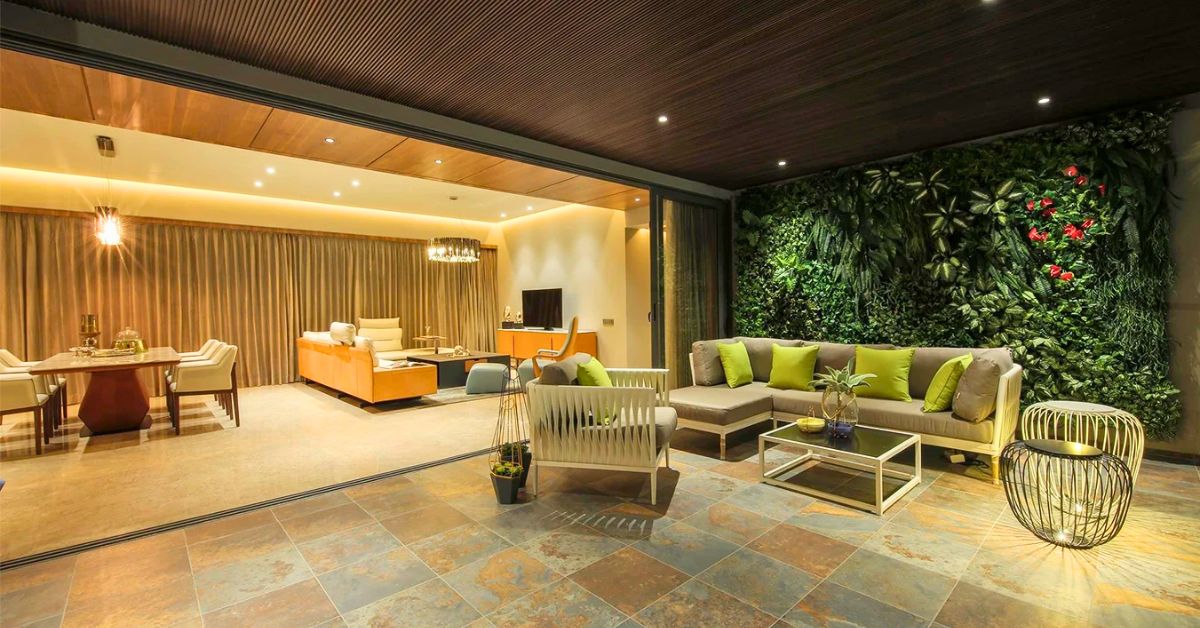
Arcedior works as a single-window sourcing and procurement backend for real estate developers across India and the Middle East.
Our role is clear:
- Translate project requirements into executable BOQs
- Develop and manage manufacturing partners globally
- Handle custom and contract manufacturing
- Run quality control for furniture procurement
- Coordinate logistics and site delivery
- Support installation and punch list closure
We execute what developers need, on time, at scale, with accountability.
Whether you’re furnishing:
- Show flats in Mumbai
- Clubhouses in Ahmedabad
- Serviced apartments in Dubai
- Rental units in Riyadh
The challenge is the same: How do we deliver at scale without chaos?
That’s what a furniture sourcing partner solves.
Conclusion
Most real estate developers start with DIY sourcing or designer-led buying for their first few projects. It works when the scale is small, timelines are flexible, and the team has bandwidth to manage vendor coordination.
But as projects scale, when you're managing 100+ units, multiple clubhouses, tight launch deadlines, or developments across cities like Delhi NCR, Chennai, Bangalore, Riyadh, or Doha, the procurement backend becomes a liability. Vendor follow-ups consume core team time. Quality inconsistencies frustrate site teams. Delays push handovers.
This is when developers shift to a furniture sourcing and procurement partner. Not because they lack design clarity, but because they need a single-window backend to execute the approved specifications reliably: global sourcing, custom manufacturing, quality checks, logistics, and installation coordination as one accountable process.
If you're furnishing show flats, clubhouses, rental-ready units, or multi-unit projects and want a sourcing backend that protects your timelines and budgets, it's worth evaluating how a procurement partner fits your project.
Ready to simplify your furniture procurement?
Share your BOQ and project timeline, and get a vendor shortlist + lead-time map with QC checkpoints and delivery slot planning tailored to your development.
What we need to start:
- BOQ (even rough)
- Finish schedule/spec sheet
- Handover date
- Site location + delivery constraints
- Budget range
Contact us on WhatsApp or schedule a call at +91 6353673040 to discuss how a single-window sourcing partner can protect your handover schedule.
FAQs
What is FF&E procurement in real estate projects?
FF&E stands for Furniture, Fixtures, and Equipment procurement. In real estate projects, it refers to the process of sourcing, ordering, quality-checking, and delivering all furniture and interior products needed for show flats, clubhouses, amenity areas, or residential/commercial units. FF&E procurement partners handle this as a specialized function, separate from interior design or turnkey contracting.
Is a furniture procurement partner the same as an interior designer?
No. Designers define what's needed. Procurement partners ensure it gets delivered as approved: correct spec, correct finish, correct quantity, on the required date.
An interior designer creates the design concept, space planning, and specifications. A furniture procurement partner executes the sourcing side: finding vendors, managing production, conducting quality checks, coordinating logistics, and ensuring furniture arrives on site as specified. The designer defines what you need; the procurement partner makes sure you get it, on time and on budget.
How do developers control quality when sourcing furniture in bulk?
Quality control happens through three checkpoints:
(1) Sample approvals before production begins, so you can verify the exact product you'll receive.
(2) Pre-dispatch inspections at the vendor's factory to catch defects, finish mismatches, or construction issues before shipment.
(3) On-site inspection during delivery and installation to confirm everything matches specs and arrives undamaged.
A furniture sourcing partner structures these QC checkpoints as part of the procurement workflow.
How long does furniture procurement take for a clubhouse or show flat?
Typical timelines are: ready stock 2-4 weeks, custom 6-8 weeks, imports 8-12+ weeks (including shipping and clearance). The safest approach is to map long-lead items first, then lock vendors and QC dates.
Timelines depend on whether you're buying ready stock, custom manufacturing, or importing:
- Ready stock from local vendors: 2-4 weeks
- Custom manufacturing (modified dimensions, finishes): 6-8 weeks
- Imported furniture (China, Vietnam, Turkey): 8-12 weeks, including production and shipping
A sourcing partner maps these lead times against your handover deadline and tracks production weekly to avoid delays.
Can procurement partners manage imports and delivery scheduling?
Yes. Furniture sourcing partners coordinate international logistics: freight booking, customs documentation, clearance, and final-mile delivery to your site. They also manage delivery scheduling based on your site constraints—phased delivery across buildings, weekend-only access windows, or coordinating with MEP/civil timelines so furniture doesn't arrive before the site is ready.
What documents should a developer share to start sourcing?
At minimum:
(1) Approved design layouts or mood boards showing furniture styles and finishes.
(2) BOQ (Bill of Quantities) spec sheets and finish schedules, with item list, quantities, and rough dimensions.
(3) Budget range or target cost per unit/area.
(4) Site location and handover deadline.
(5) Any specific constraints: import restrictions, site access limitations, or branding requirements.
Even rough versions help the sourcing partner start vendor shortlisting and timeline planning.
Who holds warranties: vendor or procurement partner?
Typically, warranties remain with the original manufacturer/vendor, but a good procurement partner acts as the single point of contact for warranty claims. They coordinate with vendors for replacements, repairs, or credit notes so developers don't have to chase multiple suppliers. Clarify this structure upfront: who handles warranty administration, claim processing timelines, and on-site resolution for post-handover issues.
Can you standardize furniture across phases without shade/finish variation?
Yes, but it requires careful planning. The sourcing partner should:
- Lock vendor relationships and material batches for multi-phase projects
- Maintain reference samples from Phase 1 for quality matching in Phase 2
- Use the same production facility and finish suppliers across phases
- Conduct side-by-side comparisons during pre-dispatch QC
Shade and finish consistency is one of the biggest quality challenges in phased developments, which is why batch control and vendor standardization are critical.
What happens if the site isn't ready when the furniture arrives? (Storage/warehousing plan)
A good sourcing partner anticipates this and builds a buffer into the logistics plan:
- Warehousing coordination: Arrange temporary storage near the site if delivery slots are delayed
- Phased delivery: Split shipments so furniture arrives only when the site is ready to receive and install
- Site readiness checkpoints: Confirm that flooring, painting, and MEP work are complete before scheduling final deliveries
- Storage costs: Clarify upfront who bears warehousing charges if delays are on the developer's side
This is especially important in cities like Mumbai, Ahmedabad, and Dubai, where on-site storage space is limited.