HR Foam vs Memory Foam Seating | India Buying Guide
HR Foam vs Memory Foam Seating: Which One Should You Choose in India?
You spend good money on a sofa or office chair. It looks solid on day one. Six months later, the cushions are flat, the seat dips on one side, and sitting for more than an hour feels like perching on a plank.
Nine times out of ten, the foam is the problem. Not the fabric. Not the frame. The foam.
In India, where seating takes serious daily punishment, heat above 35°C for months at a stretch, joint-family use, back-to-back guests in hospitality setups – picking the wrong foam type costs you more than comfort. It costs you replacement cycles, complaints, and money.
This guide breaks down HR foam vs memory foam seating in plain terms, covers what the specs actually mean, and gives you a simple checklist to confirm foam quality before you place a bulk or custom order.
Quick Answer:
HR Foam vs Memory Foam Seating: What They Actually Feel Like
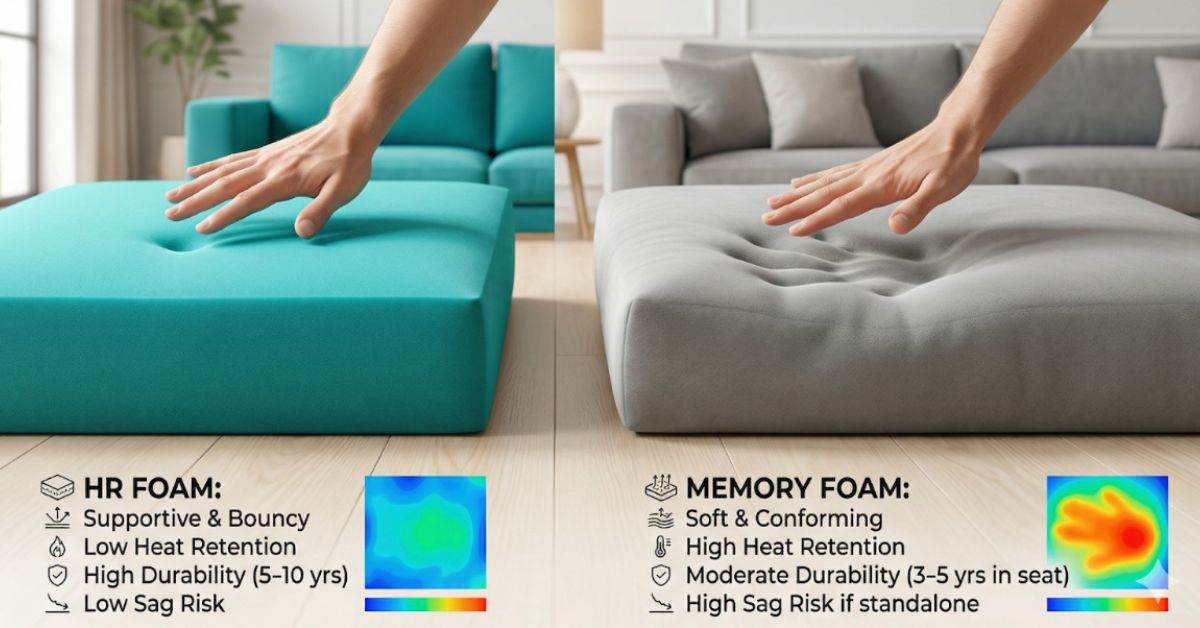
HR foam (High Resilience foam) is an open-cell polyurethane foam with a fast recovery rate. Press it down, let go, it snaps back. That bounce is not just a tactile thing – it is what keeps the cushion from caving in over time. HR foam at the right density feels firm-ish on the surface but gives enough to feel comfortable through long sitting hours.
Memory foam is viscoelastic. It responds to body heat and pressure, slowly moulding around you. That sinking feeling is intentional. It distributes pressure across a wider surface area, which is why it shows up in medical mattresses and ergonomic backrests. The problem with memory foam in seat cushions: it stays compressed longer than HR foam does, it traps heat, and in warmer cities like Delhi NCR, Mumbai, or Hyderabad, it can feel uncomfortably warm within 20 minutes of sitting.
HR foam vs memory foam seating for sofa in India depends on density, firmness, and usage – not just softness.
Best use at a glance:
- HR foam: seat cushions, bench seating, recliner bases, dining chairs
- Memory foam: backrests, headrests, pillow-top comfort layers (not the base seat)
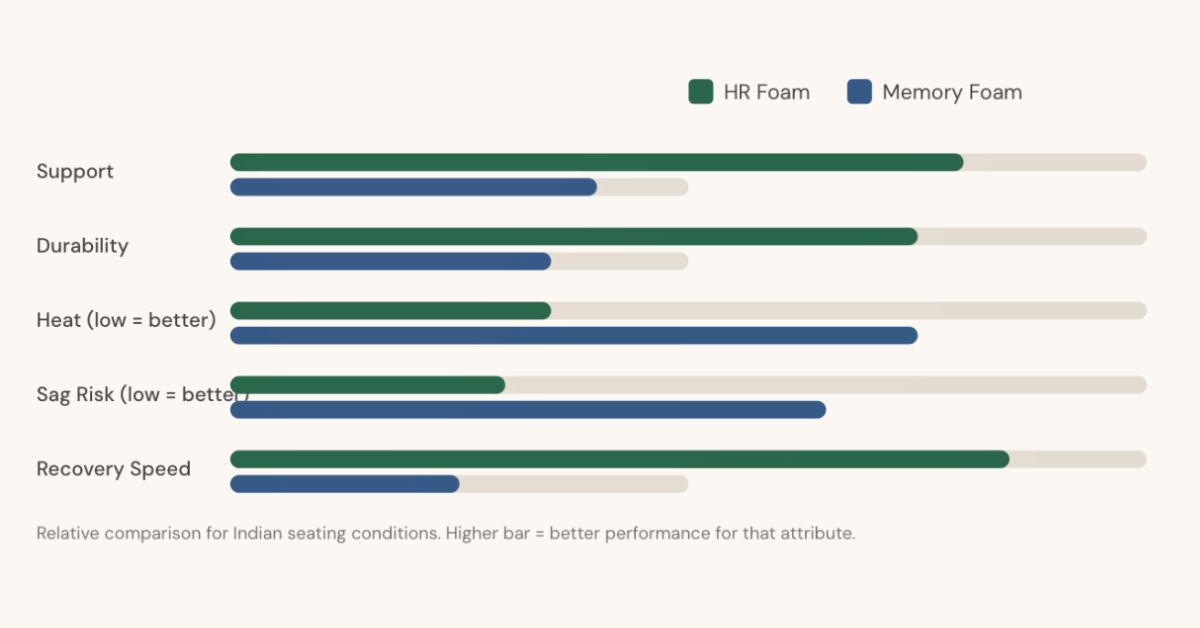
Comparison Table: HR Foam vs Memory Foam
Factor | HR Foam | Memory Foam |
Comfort feel | Firm, supportive, bouncy | Soft, slow-sink, pressure-relieving |
Support | High | Moderate (base layer only) |
Heat retention | Low to moderate | High, problematic in Indian summers |
Durability (seat) | 5–10 years (right density) | 3–5 years in full seat use |
Sag risk | Low with correct density | Higher if used as a standalone seat base |
Best for | Daily use, office, hospitality | Backrests, layering over the HR base |
Watch-out | Low-density HR foam sags fast | Gets warm, feels firmer in AC rooms |
How Indian Climate Affects Foam Seating Performance
Foam does not perform the same way in Chennai as it does in Shimla. Climate is a real variable, and it changes, which foam type makes sense for your project.
Heat above 35°C. Memory foam softens as the temperature rises. In Indian summers, this means the seat feels progressively less supportive through the day. Users sitting for 6 to 8 hours report a noticeably warm, sunken feeling by the afternoon. HR foam is far less sensitive to ambient temperature, which is why it remains the default for non-AC or semi-covered environments.
Best foam for Indian weather comes down to this: HR foam handles heat without structural compromise. Memory foam does not.
Humidity in coastal cities. Mumbai, Chennai, and Kochi see humidity levels that can accelerate foam degradation if the upholstery is not breathable. High-density HR foam with an open-cell structure handles moisture better than closed-cell or low-grade bonded foams. Memory foam, being denser by nature, can feel clammy in high-humidity conditions and takes longer to air out.
AC environments. Memory foam is more viable in consistently air-conditioned spaces, like corporate offices or hotel lounges with year-round climate control. The cooler temperature firms it up slightly and reduces the heat-trap problem. But recovery time is still slower than HR foam, so high-turnover seating (lobbies, co-working hot desks) still benefits from HR as the base.
Bottom line by city type:
- Delhi NCR, Jaipur, Nagpur (dry heat): HR foam for all seat applications
- Mumbai, Chennai, Kochi (humid): HR foam base mandatory, breathable fabric essential
- Bangalore, Pune (milder): Memory foam comfort layer is viable in AC rooms
- Hill stations, cold climates: Memory foam firms up in cold, which can feel uncomfortably hard in winter
What Works Best for India Use Cases: HR Foam vs Memory Foam Seating
Daily Family Sofa: 32–40 kg/m³ · ILD 30–35
Most Indian households have one sofa that does everything: morning chai, afternoon naps, evening TV, and occasional overnight sleeping. That is a lot of compression cycles per day. HR foam for Indian weather at 32–40 kg/m³ density with a 30–35 ILD firmness rating holds up reasonably well. Anything below 28 kg/m³ will sag within a year under this kind of load.
Elderly Comfort Seating: 35–40 kg/m³ HR + 25mm memory top
Older users often need a seat that is easy to get up from, which means the foam cannot be too soft or too slow to recover. A layered build works well here: a firm HR foam base (35–40 kg/m³, ILD 28–32) with a thin memory foam comfort layer on top (25–30mm). The HR foam does the structural work; the memory foam softens the surface pressure without making the seat hard to rise from.
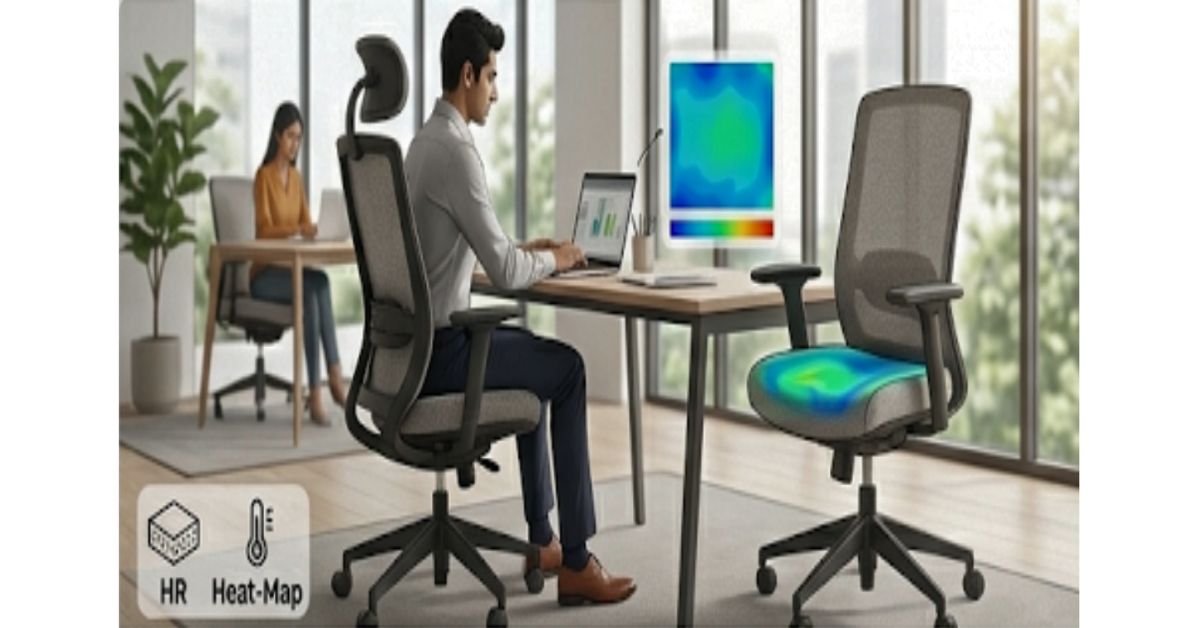
Office Chair Foam India: 36 to 40 kg/m³, ILD 30 to 38 (8 to 10 Hour Use)
Long sitting hours demand posture support, not softness. Office chair foam India spec for quality seating sits at 36–40 kg/m³ with an ILD of 30–38 with an ILD of 30–38. Memory foam alone in a seat pan will compress progressively through the day, causing lower back fatigue by the afternoon. The replacement cycle slows down noticeably when you switch to 36–40 kg/m³ HR foam. That is the consistent pattern across co-working fit-outs in Bangalore and Mumbai.
Hospitality Lounge and Guest Seating: 36–40 kg/m³ · ILD 30–38
Hotel lobbies and restaurant lounge areas run high turnover. Guests sit, leave, new guests sit. The foam needs to recover fast. HR foam with a sag factor of 2.0 or above is worth specifying here. Memory foam is fine in the backrest, where recovery time matters less. In air-conditioned environments, memory foam is more viable, but it remains the weaker choice for the actual seat base.
Recliners and Media Rooms: Dual HR (firm base + softer top) + thin memory comfort layer
Recliners see sustained pressure in multiple positions. A dual-density HR foam build, with a firmer base and a slightly softer top layer, works better than a single block of either foam type. Media room seating where users sit for 2 to 3 hours at a stretch benefits from a layered approach, with memory foam limited to the comfort layer and HR foam carrying the structural load.
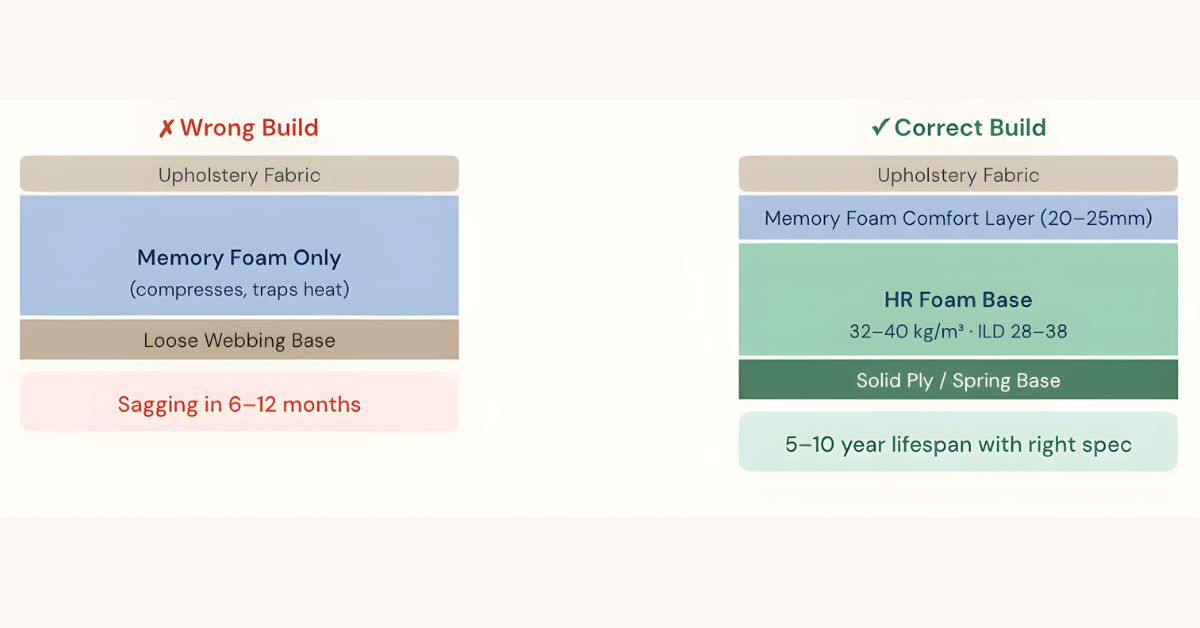
Why Cushions Fail (And How to Prevent It)
Foam sagging is not random. It follows a pattern, and most of it comes down to buying decisions made before the furniture was even assembled.
The common failure reasons:
- Low-density foam sold as "high density": Density (kg/m³) is the weight of the foam per cubic metre. A vendor calling 24 kg/m³ foam "high density" is not technically wrong by loose market standards, but it is wrong for seating. Seat cushions need a minimum of 32 kg/m³ for light residential use and 36–40 kg/m³ for commercial or heavy daily use.
- Wrong firmness for the use case: Density and firmness (ILD) are not the same thing. Low-density foam can feel firm initially, but still fails faster because there is less material to compress.
- Poor seat base construction: Foam sitting on a base of loose webbing or thin ply will sag regardless of the foam grade. The base needs to distribute the load evenly.
- No layering logic: Stacking a hard foam directly under fabric without a comfort layer, or using memory foam as a standalone seat base, both produce disappointing results within months.
- Skipping the sample stage: Many bulk orders skip sample approval. The foam that arrives in production may not match the approved sample in density or recovery rate.
Specs You Should Ask For Before Ordering
If you are specifying foam for a residential renovation, office fit-out, or hospitality project across Delhi NCR, Mumbai, Bangalore, or Hyderabad, these are the numbers worth getting in writing before any order is placed.
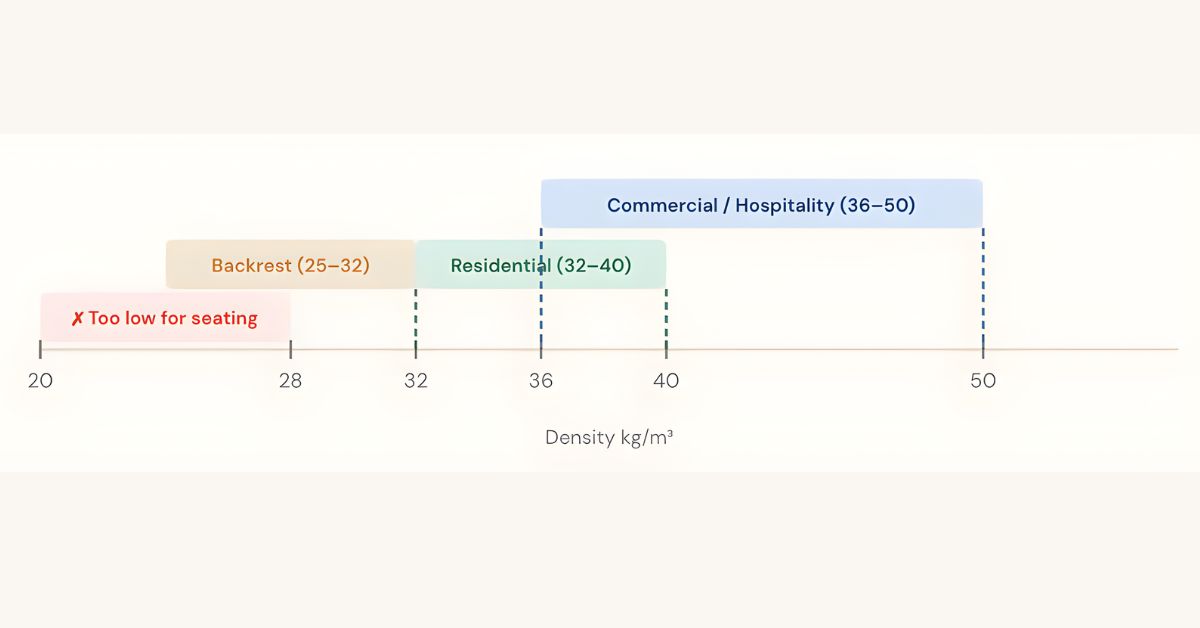
Spec Ranges | Seat Cushion | Backrest |
Density | 32–40 kg/m³ | 25–32 kg/m³ |
Firmness / ILD | 28–38 ILD (by weight + hours) | 18–25 ILD (softer is fine) |
Thickness | 100–120mm (sofa) · 80–100mm (bench) | 60–80mm typical |
Sag Factor | 2.0 minimum (high-use seating) | Not critical for backrests |
Layered Build | HR base + 20–30mm comfort layer on top | Single layer or HR + thin memory |
Pro Tip:
QC Checklist Before Dispatch
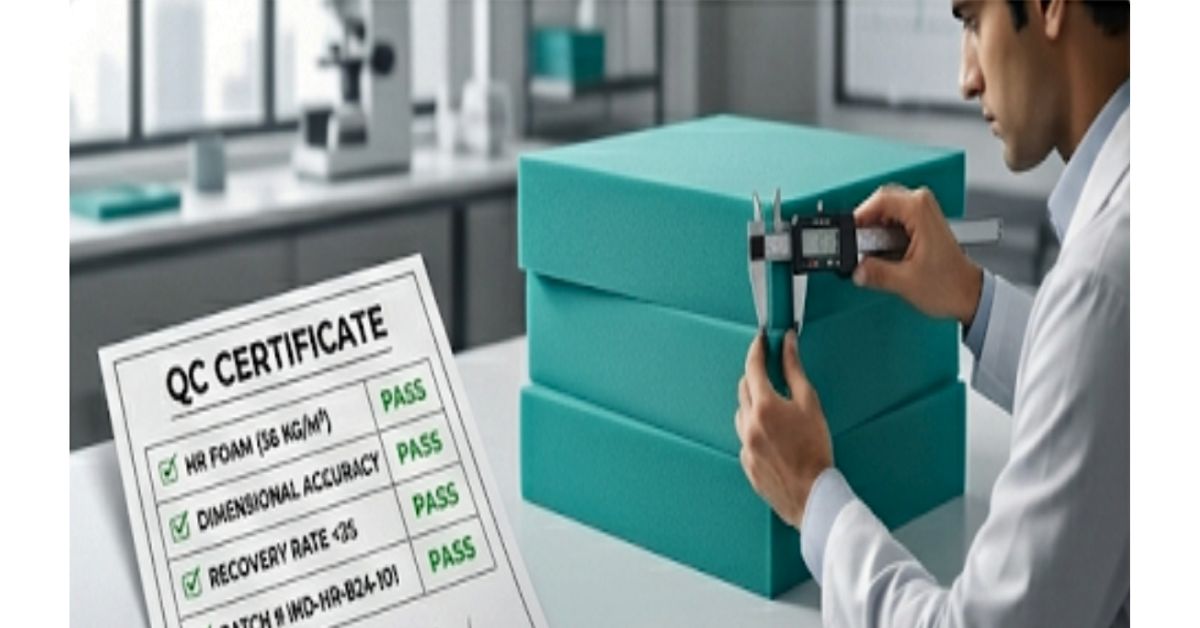
Paper specs and actual foam are two different things. The gap between them is where most bulk order regret lives. Check these before you accept any batch.
Sample approval
- Physical sample matches spec sheet (density, ILD, thickness)
- Recovery time tested: push the foam down fully, release, and time how long it takes to return to shape. HR foam should recover in under 3 seconds. Memory foam may take 5–10 seconds; that is normal for memory foam, but flag it if it does not recover fully.
- No visible density variation across the block (cut a corner to check)
Dimensional checks
- Length, width, and thickness match BOQ specs within +/- 3mm
- Corner integrity (no crumbling, clean cut edges)
Visual and bonding checks
- No bubbles, voids, or irregular cell structure visible on the cut face
- Bonding adhesive (if layered) is even, with no dry patches
- Consistent colour throughout the block (colour variation can indicate inconsistent density)
Documentation
- Spec sheet from manufacturer or supplier
- Batch number recorded for traceability
- Photos of the cross-section are on file before dispatch
Pro Tip:
How to Choose the Right Foam Seating in 5 Steps
This is the shortest path from confusion to a confident spec decision.
- Identify your usage type. Is this for a home sofa, an office chair, or a hospitality setting? Usage type sets the density floor. Residential light use starts at 32 kg/m³. Office and commercial use starts at 36 kg/m³.
- Choose your density range. Match density to usage hours and user weight. Heavier users or longer daily use means moving toward the upper end of the range (38–40 kg/m³).
- Match the firmness (ILD) to the user. A 28 ILD feels noticeably softer than a 38 ILD at the same density. Lighter users or comfort-focused seating goes lower. Postural or prolonged sitting goes higher.
- Decide your layering approach. HR foam base for all seat applications. Add a 20–25mm memory foam comfort layer only if the environment is air-conditioned and heat retention is not a concern.
- Run QC checks before dispatch. Get the spec sheet, do a hand-test for recovery, and request a cross-section photo. These three steps catch most quality issues before the furniture is assembled.
Before You Place That Order
If you are specifying seating foam for a renovation, office fit-out, or hospitality rollout, the decisions you make at the spec and sampling stage matter more than anything that happens after. The difference between HR foam vs memory foam seating for a sofa in India comes down to density, firmness, and usage, not just how it feels in a showroom.
Low-density foam that sags in 8 months costs far more in the long run than a slightly higher material cost upfront. Spec it right the first time.
Have a project in progress?
Share your BOQ or specs, Quantity, and usage type (home, office, or hospitality). We will help you:
- Finalise correct foam specs for your use case
- Avoid common QC mistakes before dispatch
- Plan sampling and delivery timelines