Sofa Size Guide for Small Living Rooms
Sofa Size Guide for Small Living Rooms: Dimensions, Layouts & Clearances
Small living rooms are some of the trickiest spaces to furnish. The sofa is usually the largest piece of furniture in the room, so even a few inches of miscalculation can make the entire space feel cramped. In most compact living rooms, whether it's an 8×10 apartment in Mumbai, a 10×12 condo in Dubai, or a studio in Singapore, your sofa determines how freely people can move. Even a 4 to 6 inch overshoot can block walkways and make the space feel congested.
Sofa size for small living room planning affects traffic flow, door movement, sightlines, and comfort.
This living room sofa size guide promises:
• A step-by-step system for measuring
• A clear overview of small living room sofa dimensions
• Universal spacing rules that prevent congestion
• Multiple small room layouts with labeled measurements
• A printable measurement sheet
Quick Answer: What Size Sofa for a Small Living Room?
This sofa size guide for small living room walks you through the exact measurements, clearance rules, and layout options you need to choose a sofa. The goal is to help you pick the right sofa dimensions for small apartment living, whether it is an 8×10 ft city apartment or a compact 10×12 ft living room in cities like Mumbai, Dubai, London, or New York.
Let us start with the most important step: measuring your room correctly.
Step 1: Measure Your Small Living Room the Right Way
Before you look at a single sofa, grab a tape measure and spend five minutes mapping your space. This prevents expensive mistakes and saves you from that sinking feeling when a delivery won't fit through your door.
Grab These Measurements (In 5 Minutes)
You need four key numbers:
- Room length and width in feet or meters, wall-to-wall
- Distance between the walls where your sofa will sit (accounting for baseboards, radiators, or outlets)
- Location of doors, windows, and obstacles like heating vents, pillars, or alcoves
- TV wall or focal wall width if your sofa faces a television or fireplace
Write these down. You'll reference them repeatedly.
How Much Wall Width Should Your Sofa Take?
As a general rule, your sofa should take up no more than two-thirds (66%) of your wall width. For a 10-foot wall, that means a maximum 80-inch sofa. This leaves breathing room on both sides for end tables, lamps, or visual balance.
If your wall has a door or window, reduce the sofa width by another 10 to 15 inches to maintain proper clearances.
What Depth of Sofa Works in Small Spaces?
Sofa depth matters as much as width in small rooms. A sofa with a 30-inch depth projects significantly more into your floor space than one with a 22-inch depth.
For small living rooms under 150 square feet, choose sofas with seat depths between 20 to 24 inches. Anything deeper than 26 inches overwhelms the space and reduces walkway clearance.
Exact Measuring Checklist for Small Apartments
Use this checklist when measuring:
- ☑ Wall length where sofa will sit (minus door/window space)
- ☑ Distance from sofa wall to opposite wall
- ☑ Doorway width and diagonal clearance for delivery
- ☑ Distance from sofa placement to TV or focal point
- ☑ Path width from entrance through living room to other rooms
- ☑ Radiator, AC vent, or electrical outlet locations
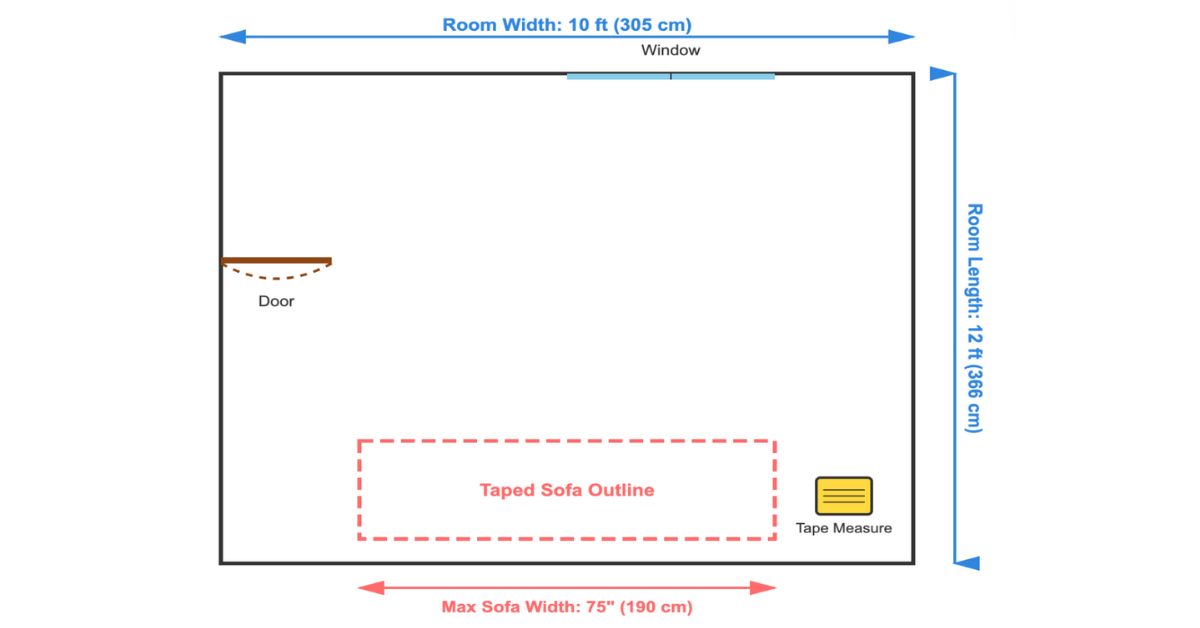
Use Painter's Tape to "Draw" Your Future Sofa
Here's a trick that prevents buyer's remorse: use painter's tape on your floor to mark the exact footprint of sofas you're considering.
Start by marking your maximum sofa width on the floor. Then add tape lines for your coffee table position and the main walkway paths. This gives you a real-world sense of how much space remains.
Rule: Leave at least 30 to 36 inches (75 to 90 cm) for any walkway people use regularly. This includes the path from your entrance to other rooms, the route to windows or balconies, and the space behind the sofa if it sits in the middle of the room.
Walk through your taped layout. Sit where the sofa would be. Can you move freely? Does the path to your bedroom feel cramped? Adjust before you buy.
Step 2: Understand Small Living Room Sofa Dimensions
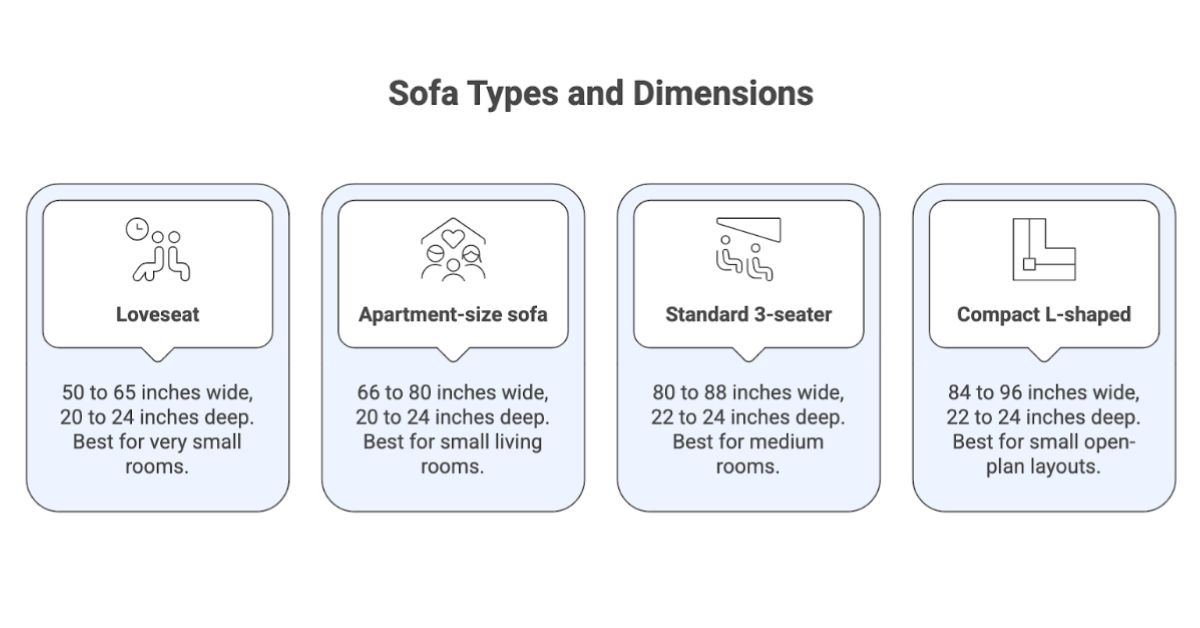
Not all sofas are created equal. A standard three-seater that fits beautifully in a suburban living room will overpower a city apartment. Here's what size sofa for small living room spaces actually works.
Common Sofa Types & Dimensions
Sofa Type | Typical Width | Width (cm) | Seat Depth | Best For |
Loveseat | 50 to 65 inches | 127 to 165 cm | 20 to 24 inches (50 to 60 cm) | Very small rooms, 1 to 2 people |
Apartment-size sofa | 66 to 80 inches | 168 to 203 cm | 20 to 24 inches (50 to 60 cm) | Small living rooms, small families |
Standard 3-seater | 80 to 88 inches | 203 to 224 cm | 22 to 24 inches (55 to 60 cm) | Medium rooms with clearance |
Compact L-shaped | 84 to 96 inches on the long side | 213 to 244 cm | 22 to 24 inches (55 to 60 cm) | Small open-plan layouts |
Notice the seat depth column. Many people ignore depth, but in a small room, a sofa that projects 30 inches into the space eats up significantly more floor area than one with a 22-inch depth.
Standard Sofa Depth for Small Rooms
The ideal seat depth for small living rooms is 20 to 24 inches (50 to 60 cm). This measurement refers to the distance from the front edge of the seat to the backrest.
Why this matters: A sofa with 22-inch depth takes up 8 inches less floor space than a 30-inch deep sofa. In a small room, those 8 inches can mean the difference between a comfortable walkway and a cramped squeeze.
Avoid sofas deeper than 26 inches unless your room is over 12 feet wide. Deep sofas look luxurious but sacrifice too much walkway space in compact apartments.
Ideal Sofa Height for Small Living Rooms
For small spaces, choose sofas with back heights between 28 to 34 inches. Lower profiles (under 32 inches) make rooms feel more open by maintaining clear sightlines across the space.
High-back sofas (36 inches or taller) can make small rooms feel closed in, especially if positioned away from walls. Save high backs for larger living rooms where they won't block views.
Ideal Sofa Sizes for Small Rooms (Under 150 Square Feet)
Match your room size to these maximum sofa widths:
- 8×10 ft rooms: Stick to loveseats or sofas 70 inches wide or less. Anything larger leaves inadequate walkway space. If you have a door on the same wall, consider a 60 to 65-inch loveseat instead.
- 10×10 ft rooms: A 65 to 75-inch apartment sofa works well. You'll have room for one accent chair or a small side table. Avoid full three-seaters unless you skip additional seating entirely.
- 10×12 ft rooms: This size accommodates the best sofa size for 10x12 living room layouts, which is typically a 70 to 80-inch sofa or a compact L-shaped sectional. Place the sofa on the long wall to maintain the best traffic flow.
- Studio corners: If your living area shares space with a kitchen or bedroom, an L-shaped sectional between 70 to 80 inches on the long side can define the zone without blocking sightlines. Keep the chaise away from doorways.
In compact city apartments, whether you're in Mumbai living in a 10×10 ft space, Dubai fitting furniture into a studio, or Singapore navigating a compact HDB flat, these sofa dimensions for small apartment living give you breathing room while maximizing seating.
Step 3: Clearance Rules Around a Sofa
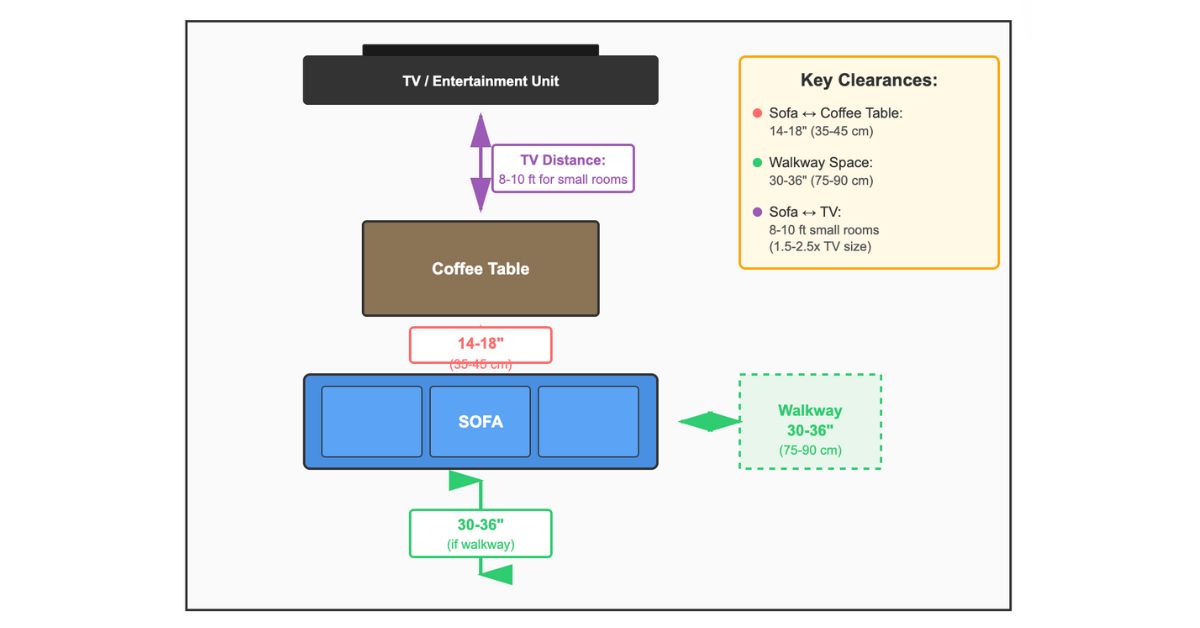
Clearance around sofa placement matters more than sofa size itself. The following spacing standards are considered non-negotiable, especially in small rooms.
Rule of Thumb:
Walkway Clearance
Leave 30 to 36 inches (75 to 90 cm) for any primary walkway. This is the space people use to move through the room to reach other areas.
If your sofa backs up to the main path from your entrance to the bedroom, you need the full 36 inches. If the path goes around the front of the sofa with less traffic, 30 inches works.
For secondary paths, like the space between the sofa arm and a wall, you can reduce this to 24 inches, but not less. You need enough room to vacuum and squeeze past without turning sideways every time.
Sofa to Coffee Table Distance
Keep 14 to 18 inches (35 to 45 cm) between the front edge of your sofa and the coffee table.
At 14 inches, you can comfortably reach the table from a seated position. Go shorter, and you'll bang your knees standing up. Go longer than 18 inches, and you're stretching awkwardly for your drink.
If you have long legs, aim for 16 to 18 inches. Shorter individuals do fine with 14 to 15 inches.
Sofa to TV Distance (For Small Rooms)
The viewing distance formula is 1.5 to 2.5 times your TV's diagonal screen size.
For a 43-inch TV, sit 5.5 to 9 feet away. For a 55-inch TV, sit 7 to 11.5 feet away.
In small rooms, you're often working with the shorter end of this range. A 10×12 ft living room with the sofa on one wall and TV on the opposite gives you about 8 to 10 feet of viewing distance, which works well for TVs between 43 to 55 inches.
If your room forces you closer than the minimum distance, consider a smaller TV rather than a larger sofa setback that kills your floor space.
Doorway & Delivery Clearance
Measure your doorway width, hallway turns, stairwells, and elevator dimensions before ordering.
Most sofas need to angle through doorways. Measure the diagonal depth (from the top of the backrest to the bottom front of the sofa) and compare it to your doorway width. If the diagonal exceeds your doorway by more than 2 inches, delivery gets complicated.
Modular sofas and sectionals with removable legs solve this problem. Many apartment-size sofas now come in two pieces specifically for tight entryways.
Step 4: Small Living Room Layout Ideas (With Measurements)
Theory is helpful. Actual floor plans with real numbers are better. Here are four proven layouts for small spaces, each with specific measurements you can adapt to your room.
Best Sofa Layout for 10×12 Living Room: Classic 3-Seater Against the Wall
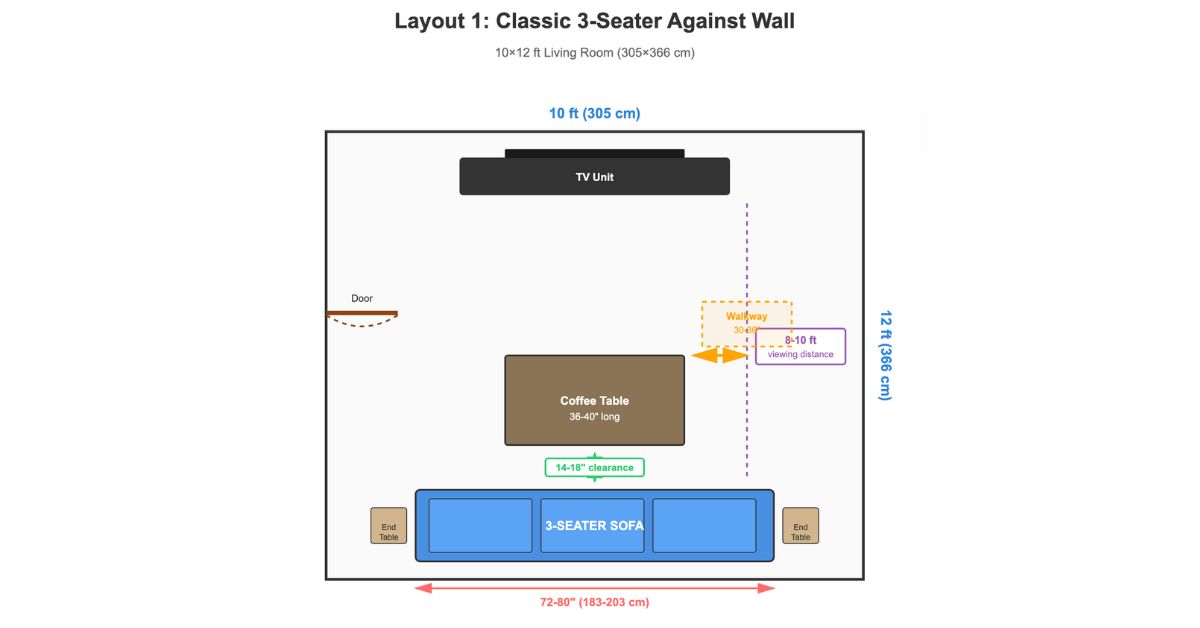
This is the most common small living room setup and works when you have one clear long wall.
- Sofa placement: 72 to 80-inch sofa centered on the long wall
- Coffee table: 36 to 40 inches long, placed 14 to 18 inches from the sofa
- TV placement: Opposite wall, 8 to 10 feet from the sofa
- Walkway: 30 to 36 inches between the coffee table and TV console or opposite seating
This layout leaves space on either side of the sofa for end tables or floor lamps. If you have a window behind the sofa, keep the sofa at least 4 inches from the wall so window treatments can function and air can circulate.
Best Sofa Layout for 10×10 Living Room: Apartment Sofa Plus Accent Chair
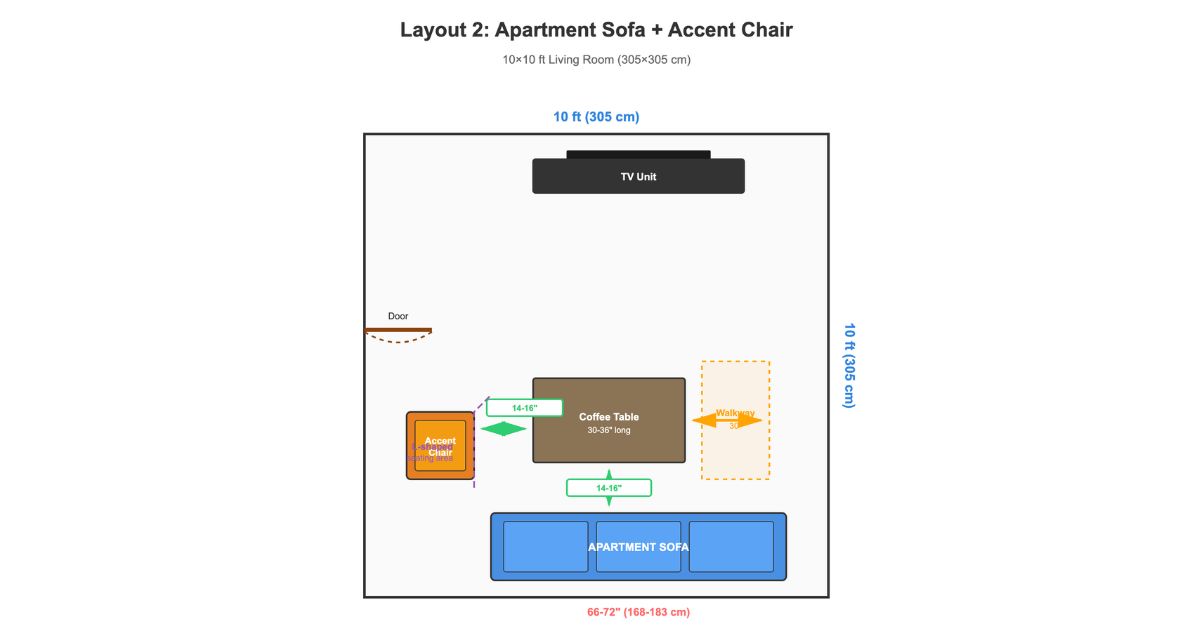
When your room is truly tight, a smaller sofa plus one accent chair often works better than cramming in a three-seater.
- Sofa placement: 66 to 72-inch apartment sofa on the longest wall
- Accent chair: Positioned perpendicular to the sofa, creating an L-shaped conversation area
- Coffee table: 30 to 36 inches, centered between both pieces, 14 to 16 inches from each
- Walkway: 30 inches from the open side of the L to the opposite wall or door
This arrangement seats four people comfortably and maintains open sightlines. It's particularly effective in square rooms where a sectional would block too much space.
L-Shaped Sofa Layout for Studio Apartments: Compact Sectional in Open Plan
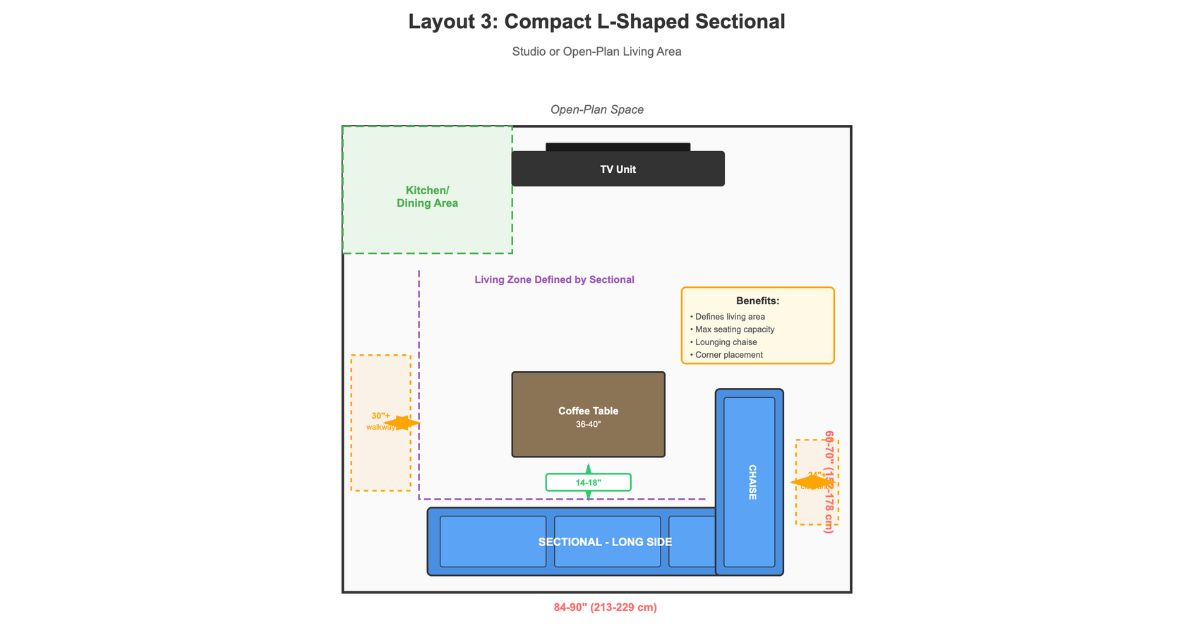
Small sectionals work beautifully when you need to define a living zone within a larger open area, like a studio apartment.
- Sectional dimensions: 84 to 90 inches on the long side, 60 to 70 inches on the short side
- Placement: Corner position with the long side parallel to the main wall
- Coffee table: 36 to 40 inches, positioned in the L's open space
- Clearance behind chaise: Minimum 24 inches if it backs onto a dining area or walkway
The sectional creates a psychological boundary without physical walls. Keep the chaise end away from your entrance or kitchen area to maintain flow.
Sectional vs three-seater in this layout: The sectional provides more seating in the same footprint and eliminates the need for extra chairs. However, if you have multiple doorways or heavy cross-traffic, a three-seater with an accent chair offers more flexibility.
Best Layout for a Small Living Room with Door on Sofa Wall
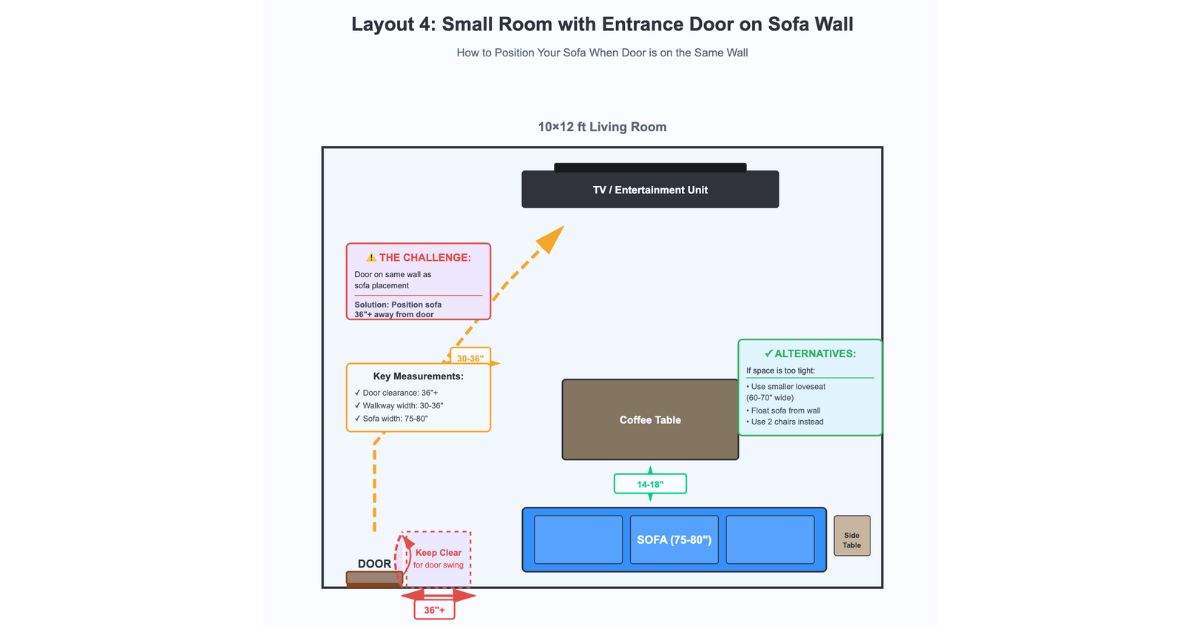
This awkward scenario is common in apartments where the entrance opens directly into the living area.
- Sofa placement: Position the sofa 36 inches from the door's swing path
- Sofa size: 65 to 75 inches maximum to leave space on the far end for a side table or floor lamp
- Walkway: Maintain 30 to 36 inches from the door, through the living area, to the next room
- Alternative: Float the sofa away from the wall, creating a small console space behind it, and keeping the door path clear
If the door path cuts diagonally through your room, consider rotating your layout 90 degrees or using a loveseat plus two chairs instead of one long sofa.
Step 5: Sectional vs 3 Seater for Small Spaces: Which One Wins?
This is the question that trips up most small-space dwellers. Both can work. The right choice depends on your specific room layout and how you use the space.
Is a Sectional Good for Small Living Rooms?
Yes, a compact sectional can work beautifully in small living rooms if you have an open corner and clear traffic paths. Sectionals under 90 inches on the long side maximize seating without taking up more floor space than a sofa plus chair combination.
However, sectionals fail in small rooms with multiple doorways, narrow widths (under 10 feet), or diagonal traffic patterns. In those cases, a straight sofa offers better flexibility.
When a Sectional Works Better in a Small Room
Choose a compact sectional if:
- You have an open corner that would otherwise go unused
- You regularly seat four or more people and want to skip extra chairs
- Your room is part of an open-plan space, and you need to define the living zone
- You prefer lounging and want a chaise for stretching out
- Your traffic paths are clearly defined and don't cut through the middle of the room
Small sectionals maximize seating capacity per square foot. A compact L-shaped sectional occupies roughly the same floor space as a three-seater sofa plus an accent chair, but typically seats one additional person.
When a 3-Seater or Loveseat Is Safer
Stick with a straight sofa if:
- Your room has multiple doorways or heavy cross-traffic
- The space is narrow (less than 10 feet wide)
- You rearrange furniture seasonally or might move soon
- You want maximum flexibility to add or remove chairs
- Your room has bay windows, radiators, or other obstacles that break up wall space
Three-seaters are also easier to move through tight hallways and doorways. If you've ever tried navigating a sectional around a corner stairwell, you know why this matters.
5 Point Decision Checklist
Answer these five questions:
- Do you have a clear, unobstructed corner? (Yes = sectional-friendly)
- Do you need to regularly walk past or behind your sofa? (Yes = straight sofa better)
- Will four or more people use this sofa daily? (Yes = sectional adds value)
- Is your living room narrower than 10 feet? (Yes = straight sofa safer)
- Do you move or rearrange furniture often? (Yes = straight sofa more flexible)
Three or more answers pointing to sectionals? A compact L-shaped design will likely serve you well. Three or more answers pointing to straight sofas? A two-seater or apartment-size three-seater is your better bet.
Quick "Room Size to Sofa Size" Cheat Sheet
Here is the most accurate room-size-to-sofa-size chart for small living rooms. Use this sofa size guide table when shopping to quickly eliminate sofas that won't work in your space.
Room Size | Suggested Sofa Width | Suggested Sofa Type | Notes |
8×10 ft | 55 to 70 inches | Loveseat or compact 2.5-seater | Prioritize walkway and door clearance |
10×10 ft | 65 to 75 inches | Apartment sofa | Add one accent chair if needed |
10×12 ft | 70 to 80 inches | 3-seater or small sectional | Place the sofa on the long wall |
Studio corner | 70 to 80 inches on the long side | L-shaped apartment sectional | Keep the chaise away from the doors |
These ranges assume standard furniture layouts with a coffee table and at least one walkway. If your room has unusual features like a fireplace, built-in shelving, or an off-center entrance, adjust down by 6 to 10 inches to maintain comfortable clearances.
Common Mistakes to Avoid in Small Living Rooms
After helping numerous small-space homes find the right sofa, these are the mistakes that cause the most frustration:
- Choosing a sofa deeper than 38 inches, which overwhelms narrow rooms
- Choosing a sofa depth that projects into main walkways and reduces clearance below 30 inches
- Blocking balcony or patio doors
- Using a coffee table that is too large
- Forgetting about the sofa's back height
- Buying a sofa that blocks AC airflow or radiator access, reducing heating and cooling efficiency
- Ignoring delivery paths and doorway measurements
- Leaving less than 30 inches of walkway space
- Buying a rug that is too small
- Placing the TV too far or too close
- Choosing a sofa wider than your available wall space, minus 6 inches of breathing room
Downloadable Sofa Measurement Sheet
To make furniture shopping easier, use a simple printable measurement sheet that travels with you to stores or lives in your phone for online shopping.
Your sheet should include:
- Your room length and width in feet and centimeters
- Maximum sofa width that fits your space
- Maximum sofa depth based on your layout
- Doorway and hallway widths for delivery
- Planned walkway clearances (30 to 36 inches)
- Distance between sofa and coffee table (14 to 18 inches)
- A copy of the room size to sofa size table from earlier in this guide
Fill this out once, and you'll quickly eliminate sofas that don't work without having to remeasure or recalculate every time you shop. Keep notes on each sofa you seriously consider, including the model name, dimensions, and any delivery restrictions.
Conclusion
The difference between a small living room that feels cramped and one that functions beautifully comes down to intentional choices about size and spacing. A sofa that's 6 inches too wide or placed 4 inches too close to your coffee table creates daily frustration that compounds over time.
The measurements and layouts in this sofa size guide for small living room spaces come from real-world experience with small-space furniture placement. When you measure your room carefully, respect clearance around sofa minimums, and choose appropriately sized furniture, even a 10×10 ft space can feel open and inviting.
Start with your tape measure, not a furniture store. Map your room, test layouts with painter's tape, and refer back to the room size to sofa size table when evaluating options. These steps take less than an hour and prevent expensive mistakes that you'll live with for years.
Your small living room has more potential than you think. The right-size sofa, placed thoughtfully, transforms constraint into comfort.
Ready to transform your living room?
View our completed residential projects for inspiration.
FAQs
What is the best sofa size for a small living room?
For most small living rooms, a sofa between 66 to 78 inches wide works best. This typically means an apartment-size two-and-a-half to three-seater. Prioritize models with shallow depths (22 to 24 inches) to maximize floor space. Always leave 30 to 36 inches for walkways and 14 to 18 inches between the sofa and coffee table.
Is a 3-seater sofa too big for a 10×10 room?
Yes, a standard three-seater (80 to 88 inches) is generally too large for a 10×10 ft room. You'll sacrifice necessary walkway space or eliminate room for a coffee table. Instead, choose an apartment-size sofa (66 to 75 inches) or a loveseat (60 to 65 inches) plus one accent chair to maintain comfortable clearances and better traffic flow.
How much clearance do I need between a sofa and a coffee table?
Maintain 14 to 18 inches between the front edge of your sofa and the coffee table. This distance allows you to reach the table comfortably while seated without stretching, and gives enough space to stand up without bumping your knees. People with longer legs should aim for 16 to 18 inches.
Can I use a sectional in a small living room?
Yes, if you choose a compact sectional (under 90 inches on the long side) and have an open corner layout. Sectionals work well in small open-plan spaces where they define the living zone, or in rooms without multiple doorways. Avoid sectionals in narrow rooms (under 10 feet wide) or spaces with heavy cross-traffic through the middle.
How do I know if my sofa will fit through the door?
Measure your doorway width and the sofa's diagonal depth (from the top of the backrest to the bottom front edge). The diagonal must be smaller than the doorway width for the sofa to angle through. Also measure hallway widths and any turns in your building's stairwell or elevator. Many apartment sofas come with removable legs or in modular pieces to solve delivery challenges.
What sofa depth works best for small living rooms?
The ideal sofa depth for small living rooms is 20 to 24 inches (50 to 60 cm). This seat depth provides comfortable seating without projecting too far into the room. Sofas deeper than 26 inches reduce walkway clearance significantly and should only be used in rooms wider than 12 feet. Shallow-depth sofas maximize floor space while maintaining comfort.
How far should a sofa be from a TV in a small room?
Sit 1.5 to 2.5 times your TV's diagonal screen size away from the screen. For a 43-inch TV, this means 5.5 to 9 feet. For a 55-inch TV, aim for 7 to 11.5 feet. In small rooms, you'll typically be at the shorter end of this range. If your space forces closer viewing, consider a smaller TV rather than pushing the sofa back and losing valuable floor area.
What's the minimum walkway space I need around a sofa?
Primary walkways need 30 to 36 inches of clearance. This includes paths from your entrance to other rooms or the main route people take through the space. Secondary paths, like the space between a sofa arm and wall, can be reduced to a minimum of 24 inches. Any less, and the room becomes difficult to navigate and clean.