TV Unit Height & Viewing Distance: Wall Mount or Console
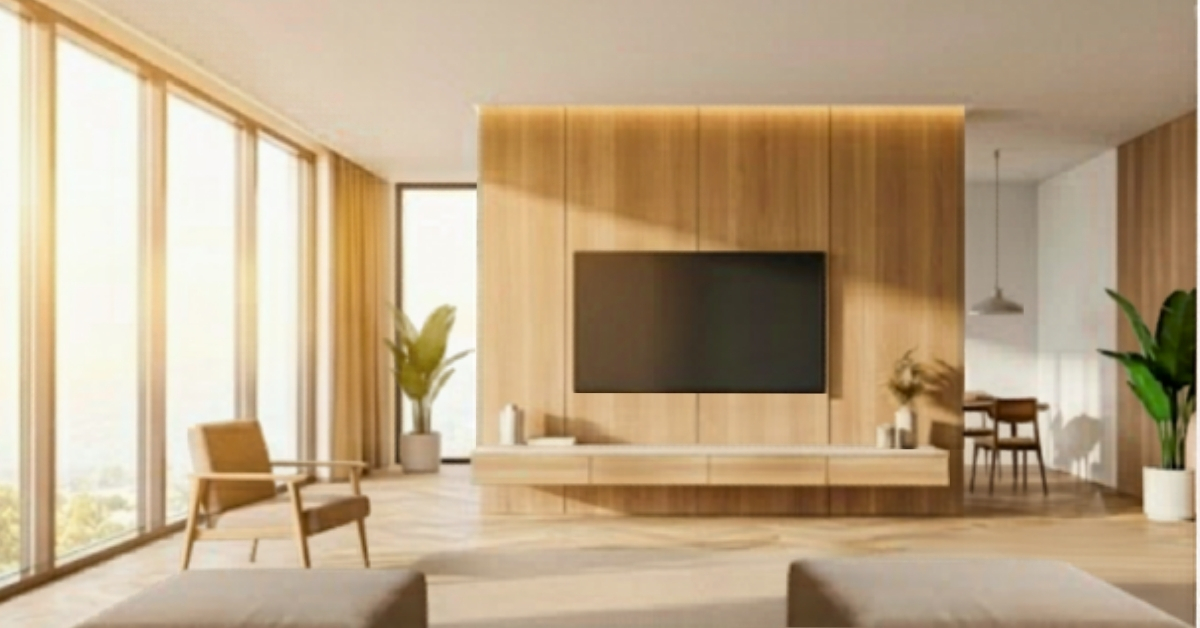
TV Unit Height and Viewing Distance: Wall Mount or Console – What Actually Works?
Getting the TV position wrong is one of the most common and most fixable mistakes in a living room. Most people either mount too high, sit too close, or pick a console that quietly pushes the screen out of eye line. This guide gives you the numbers to avoid all three.
Quick Answer: TV Viewing Distance by Screen Size
Why TV Placement Gets Miscalculated in Most Living Rooms
The TV usually goes in the wrong spot for one simple reason: people measure from the wrong reference point.
Most people measure from the floor to the bottom of the TV, or from the wall to the back of the sofa. Neither of those is the right number to work from. The correct starting point is seated eye height, and the second number is screen diagonal.
When a TV gets mounted above a fireplace, it often ends up 60 to 70 inches above the floor. That is 15 to 25 inches higher than the optimal range. Watching from that height for two hours puts your neck in a sustained upward tilt. You will feel it the next morning.
The "too close" problem comes from sofas placed against the back wall in rooms where the TV is on the opposite wall. In a 12-foot-deep room with a deep sofa, the actual eye-to-screen distance can be under 7 feet for a 65-inch screen. That is below the minimum comfortable distance.
Both problems are completely avoidable with the right numbers up front.
TV Size vs Room Size: What Actually Fits Comfortably?
Choosing the right TV size starts with the room width, not the wall space available. A larger screen is not always better – it can exceed the comfortable field of vision when the sofa is too close relative to the screen diagonal.
Room Width | Recommended TV Size | Why |
|---|---|---|
10 ft | 43–55 inches | Sofa-to-screen distance typically 7–8 ft; 65" would exceed comfortable arc |
12 ft | 55–65 inches | Most common living room width; optimal range for 4K content |
14 ft | 65–75 inches | Sofa typically 10–11 ft from screen; a wider field of view is comfortable |
16 ft or wider | 75–85 inches | Large seating distances require a larger screen to maintain detailed visibility |
These recommendations assume the sofa sits at a natural distance from the TV wall – roughly one-third to one-half the room depth. In open-plan layouts where the sofa floats further back, you can size up by one bracket.
Quick Rule – Room Width to TV Size
- 10 ft room: 43–55 inch TV
- 12 ft room: 55–65 inch TV
- 14 ft room: 65–75 inch TV
- 16 ft+ room: 75–85 inch TV
Definition
What Is the Right Viewing Distance for Your TV Size?
Definition
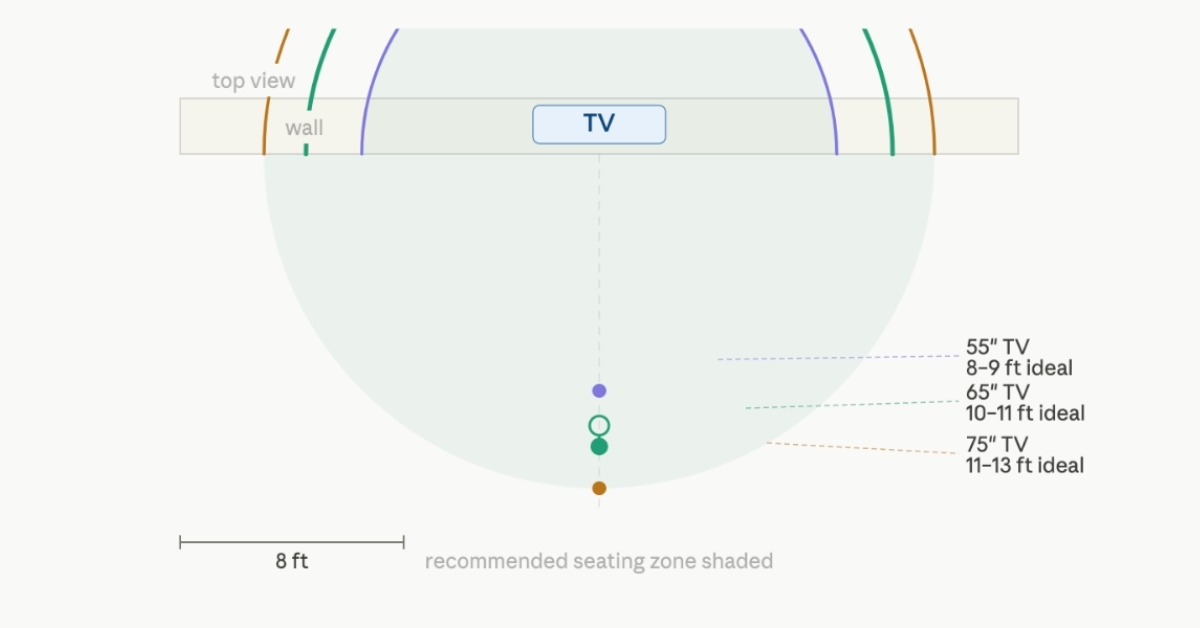
The Society of Motion Picture and Television Engineers (SMPTE) recommends a 30-degree field of view for comfortable viewing. THX goes slightly wider at 36 degrees for a more cinematic feel. The table below is based on the SMPTE standard, which is the most practical for living room setups.
Screen Size | Minimum Distance | Maximum Distance | Recommended Sofa Position |
43 inches | 5.5 ft | 9 ft | 6 to 7 ft |
55 inches | 7 ft | 11 ft | 8 to 9 ft |
65 inches | 8 ft | 13.5 ft | 10 to 11 ft |
75 inches | 9.5 ft | 15.5 ft | 11 to 13 ft |
85 inches | 10.5 ft | 17.5 ft | 13 to 14 ft |
4K vs 1080p: With a 4K UHD panel, you can sit closer than the table shows without seeing pixel structure. A 4K 65-inch TV watched from 7 feet is perfectly sharp. With a 1080p panel of the same size, 7 feet starts showing pixels, depending on the panel quality. Stick to the minimum distances above for 1080p.
Definition
Key Takeaway
TV Viewing Distance Calculator: Find Your Number in 30 Seconds
No tool required. Apply these two formulas directly:
Minimum comfortable distance (ft) = TV diagonal (inches) × 1.5 ÷ 12
Maximum comfortable distance (ft) = TV diagonal (inches) × 2.5 ÷ 12
TV Size | Minimum Distance | Recommended | Maximum Distance | 4K Minimum |
|---|---|---|---|---|
43 inches | 5.4 ft | 6–7 ft | 9 ft | 3.6 ft |
55 inches | 6.9 ft | 8–9 ft | 11.5 ft | 4.6 ft |
65 inches | 8.1 ft | 10–11 ft | 13.5 ft | 5.4 ft |
75 inches | 9.4 ft | 11–13 ft | 15.6 ft | 6.3 ft |
85 inches | 10.6 ft | 13–14 ft | 17.7 ft | 7.1 ft |
4K minimum = TV diagonal × 1.0 ÷ 12. Moving within 4K minimum on 4K content shows no pixel grain. 1080p panels: Use the standard minimum column.
TV viewing distance calculator
Select your TV size to instantly see exact distances for comfortable viewing in any room.
TV viewing distance calculator
Select your TV size to instantly see exact distances for comfortable viewing in any room.
Select a TV size above to see your viewing distances instantly.
What Height Should a TV Be Mounted at From the Floor?
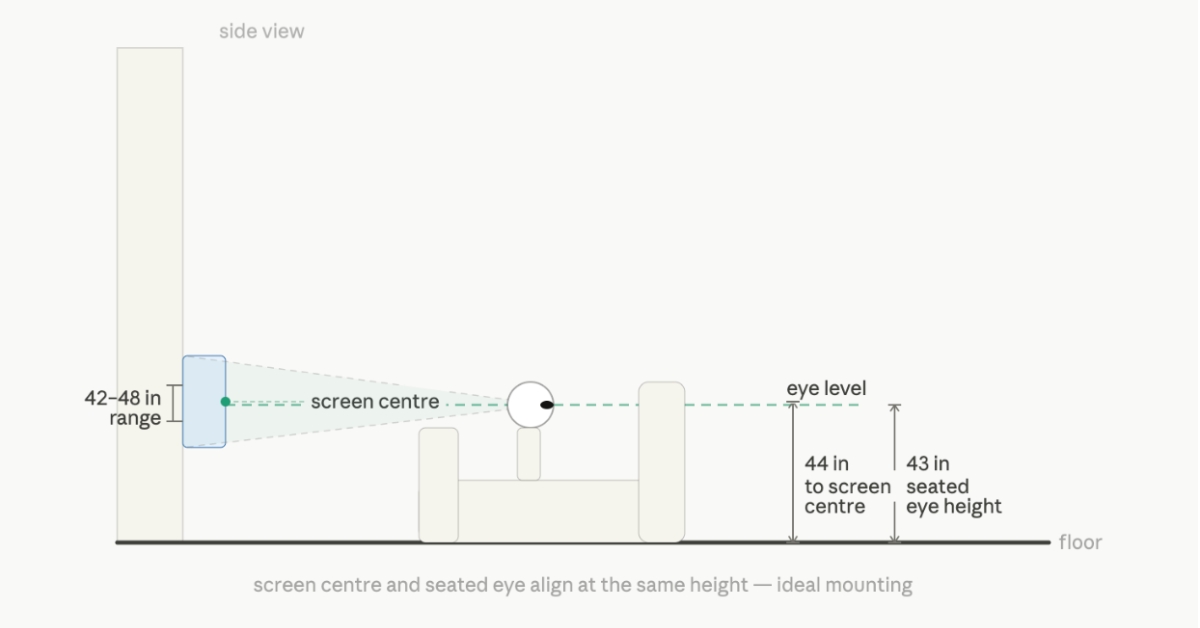
The screen centre should sit at or within 5 degrees of your seated eye level. For most adults, seated on a standard sofa, which is 42 to 45 inches from the floor. So the optimal TV centre height is 42 to 48 inches from the floor.
If your sofa seats are lower (floor-level cushions, Japanese-style seating, low-slung sectionals), subtract 4 to 6 inches from that range.
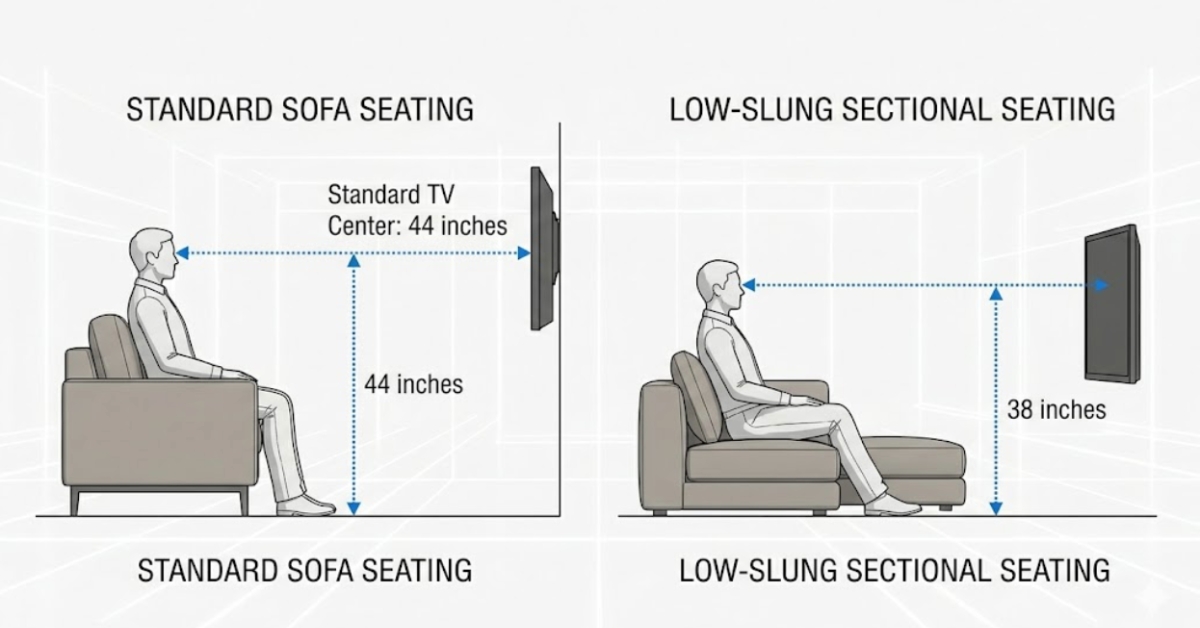
How to Find Your Eye Level When Seated
Sit normally on your sofa. Have someone mark the wall at eye height. Measure that mark from the floor. That single number is your screen centre target – everything else follows from it.
Formula: Seated eye height − (TV height ÷ 2) = ideal bottom-of-screen height.
Example: 44-inch eye height, 30-inch tall TV → Screen centre: 44 in · Bottom: 44 − 15 = 29 in · Top: 29 + 30 = 59 in
The most common error is mounting to the wall centre (~60 inches on a 9-foot ceiling) instead of the seated eye centre. Those two numbers are not the same.
Example: Seated eye height of 44 inches. The TV is 30 inches tall.
- Screen centre target: 44 inches from the floor
- Bottom of screen: 44 minus 15 = 29 inches from the floor
- Top of screen: 29 plus 30 = 59 inches from the floor
The most common mistake is mounting to the wall centre, roughly 60 inches on a standard 9-foot ceiling – instead of the seated eye centre. Those two numbers are not the same.
Definition
TV Centre Height Calculator by Screen Size
The screen centre target stays the same regardless of TV size. What changes is where the bottom and top of the screen fall.
TV Size | Approx. TV Width | Recommended Console Width |
|---|---|---|
43 inches | 38 inches | 50–62 inches |
55 inches | 49 inches | 61–73 inches |
65 inches | 57 inches | 69–81 inches |
75 inches | 66 inches | 78–90 inches |
For a 75-inch TV, the bottom of the screen sits close to 21–24 inches from the floor. This is lower than most people expect and is correct. The large screen fills upward from eye level, not downward.
Quick Rule – TV Mounting Height
Screen centre target 42–48 in from the floor
Seated eye height (adults) 42–45 in from the floor
Low-profile seating Subtract 4–6 inches
Fireplace mount error 65–70 in – 15–25 in too high
Definition
Does Screen Resolution Change Viewing Distance? (4K, 1080p, 8K)
4K: You can sit meaningfully closer than the SMPTE table without visible pixel grain. Formula: screen diagonal (inches) × 1.0 ÷ 12 gives the 4K comfortable minimum in feet.
1080p: Use the standard SMPTE table. Moving below the minimum starts showing pixel structure on fast-moving content.
8K: In a typical living room, 8K does not meaningfully change the practical viewing distance. At normal sofa-to-screen distances (7–14 feet), the human eye cannot resolve the pixel difference between 4K and 8K. The 8K benefit applies mainly at very large screen sizes (85 inches and above) in rooms where seating is unusually close.
Bottom line: For most living room setups, use the 4K formula for 4K panels and the standard table for 1080p. 8K can be treated the same as 4K for distance planning purposes.
Free Download: TV & Console Specification Generator
TV and console specification generator for Arcedior — three steps: enter room width and TV size, then seating type and preferences, then receive a full spec card with viewing distances, mounting heights, and console dimensions.
Wall Mount vs TV Console: Which Is Right for Your Living Room?
Both can work. The choice comes down to ceiling height, how you manage cables, and how fixed you want the setup to be.
Factor | Wall Mount | TV Console / Unit |
Height flexibility | Fixed after install | Adjustable by changing the unit height |
Cable management | Requires in-wall conduit routing | Console hides cables naturally |
Room feel | Clean, floating, minimal | Anchored, furniture-led |
Best for | Compact or minimalist rooms | Larger rooms with storage needs |
Ideal ceiling height | 9 ft or higher | Any ceiling height |
Risk | Permanent, difficult to adjust | Unit height selection matters more |
Cost of error | New mount or patch-and-repaint | Swap the console unit |
Pro Tip
How Wide Should a TV Console Be?
Console width is one of the most overlooked dimensions in TV unit planning. A console that is too narrow looks mismatched and creates a top-heavy visual imbalance on the wall.
The Rule: The TV console should be 6 to 12 inches wider than the TV on each side – meaning 12 to 24 inches wider than the TV overall.
TV Size | Approx. TV Width | Recommended Console Width |
|---|---|---|
43 inches | 38 inches | 50–62 inches |
55 inches | 49 inches | 61–73 inches |
65 inches | 57 inches | 69–81 inches |
75 inches | 66 inches | 78–90 inches |
In narrow rooms (under 12 feet wide), a console matching the TV width exactly is acceptable if wall space is limited. In wider rooms, err toward the wider end of the range for better visual proportion.
Floating console proportion rule: A wall-hung floating console should sit 12 to 18 inches from the floor in rooms with 9-foot ceilings. This keeps it within visual reach of floor-level objects without appearing disconnected from the floor plane.
What Is the Ideal TV Console Height?
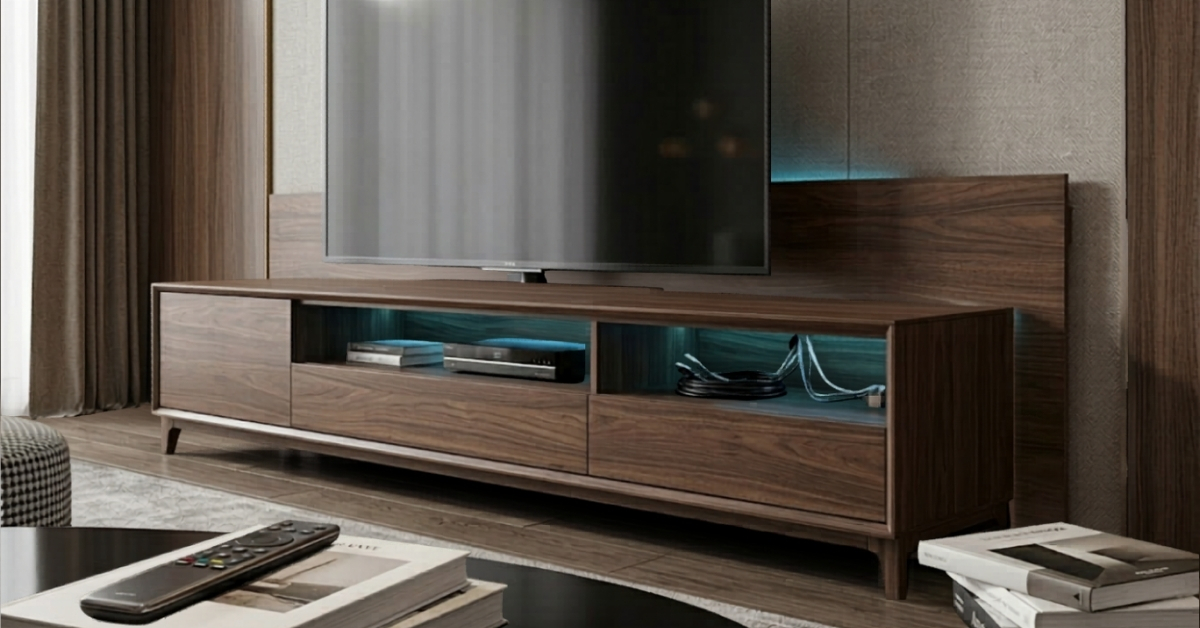
Standard consoles sit 18 to 24 inches tall – right for most sofa heights.
Formula: console height + (TV height ÷ 2) = screen centre. If the result is more than 5 inches away from your seated eye height, the console is the wrong height.
Low-profile (10–16 in): For floor seating, sunken rooms, Japanese-style interiors. A standard 22-inch console will push the screen too high in these setups.
Taller (24–30 in): For bar-height seating or raised platforms where seated eye level reaches 48–52 inches.
Quick Rule – Console Height Check
Formula: Console ht + ½ TV ht = screen centre
Acceptable range Within 5 in of eye height
Standard console 18–24 in tall
Low-profile sofa Use 10–16 in console
Definition: TV Screen Centre Height
How Console Depth Affects the Room
Shallow (12–16 in deep): Keeps the room open. Best for tight rooms and narrow corridors. Deep (18–24 in): Adds AV storage and visual weight. In large rooms, a shallow console can look undersized against the wall.
Definition
How Room Layout Affects TV Placement
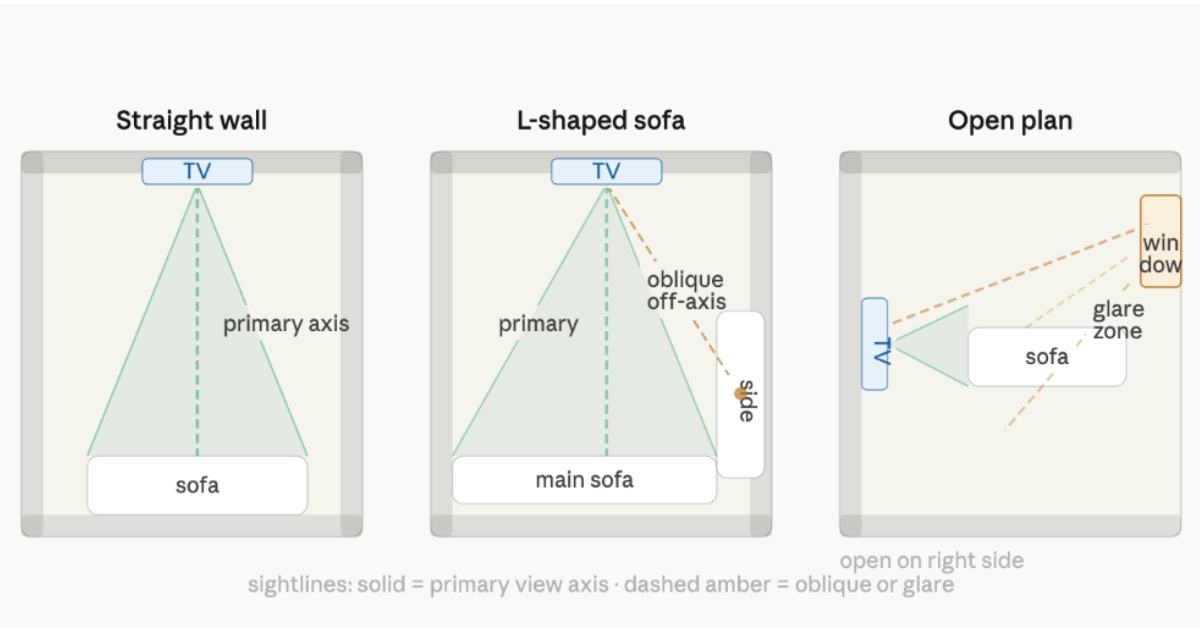
L-Shaped Sofas
The primary seating position on an L-shaped sofa determines the TV axis. If the two sides of the sofa create a 90-degree angle, the TV should face the longer section, not the corner where the sofa joins. Angling the TV 15 degrees in a fixed wall mount helps, but does not fully solve oblique viewing for the shorter sofa leg.
A swivel wall bracket is worth considering in these setups.
Open-Plan Rooms
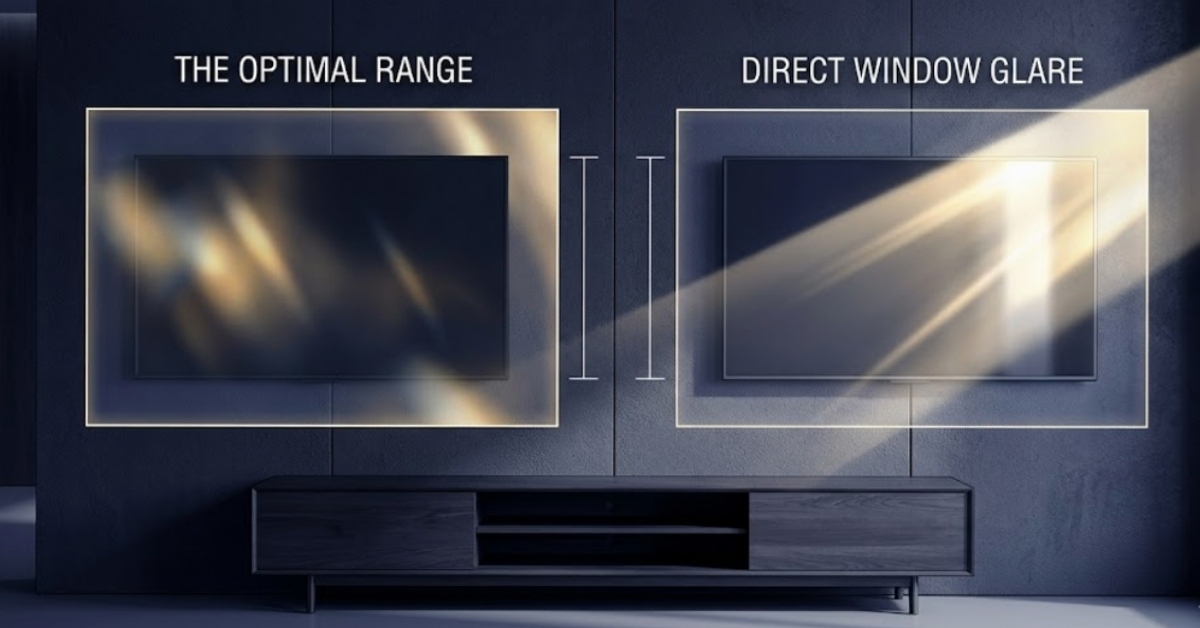
Glare is the main problem in open-plan rooms. Windows on adjacent walls throw light across the screen at angles that are difficult to predict until the sun moves in the afternoon. Always test the room at different times of day before finalizing the TV wall position.
Positioning the TV wall perpendicular to windows, rather than opposite them, removes most of the glare problem.
Recessed Alcoves
Mounting a TV inside a recessed alcove limits the viewing angle on either side of the room. Before committing to this setup, stand at the widest seating positions in the room and check the sightline to the alcove opening. If any regular seating position is more than 30 degrees off-axis, the picture quality drops meaningfully on LCD panels.
OLED panels are more forgiving at off-axis angles if an alcove setup is required.
Floating TV Walls in Luxury Residences
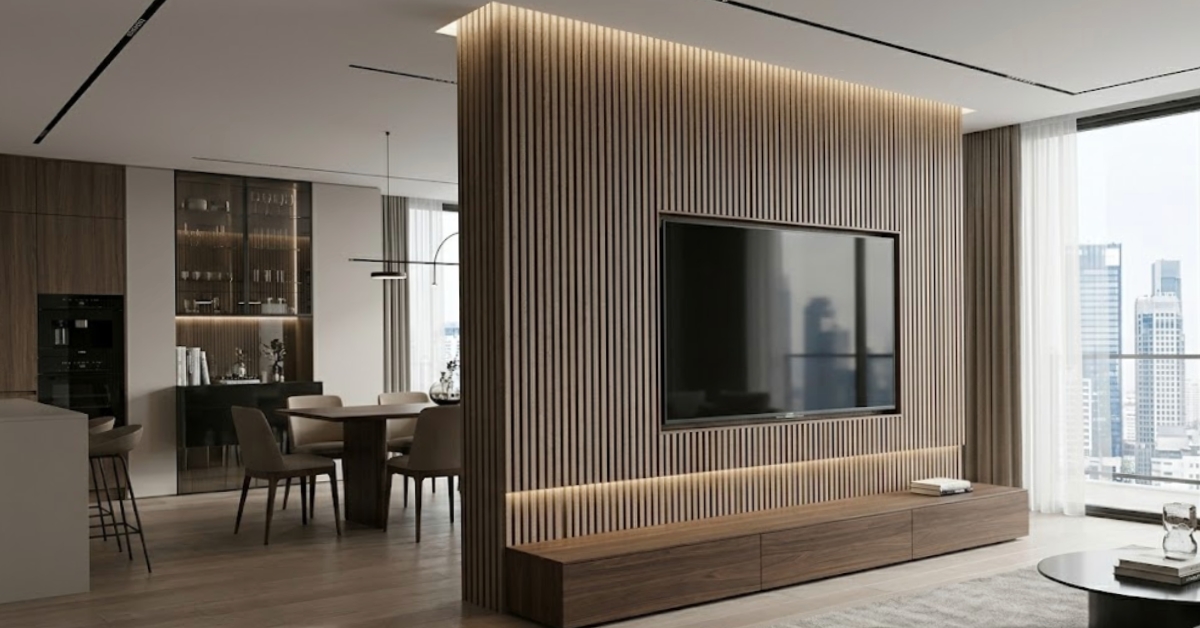
Floating TV walls built on a false partition give complete control over TV height, panel depth, and cable routing. They also create a natural back wall for the living room in open-plan layouts. The trade-off is structural planning (the partition needs to carry the TV weight and route cables internally) and a higher build cost.
For residential projects specifying this setup, the console unit or floating panel behind the TV is typically custom-manufactured to exact dimensions rather than sourced from off-the-shelf ranges.
Common TV Placement Mistakes to Avoid
Mounting above a fireplace. The "fireplace error" is the single most common one. It almost always puts the screen at 60 to 70 inches from the floor. That is 15 to 25 inches above the optimal range. Neck strain builds up over weeks.
Screen facing a window. Direct window opposition creates glare that degrades picture quality significantly during daylight hours. If the layout requires it, add a blackout blind or recess the TV to reduce light reflection.
Console too tall, pushing the TV above eye line. A 30-inch console plus a 55-inch TV puts the screen centre at roughly 57 inches. That is 12 to 15 inches above comfortable eye level for most adults.
Not accounting for sofa depth when measuring distance. A 40-inch-deep sofa pushed against a back wall adds roughly 3 feet to the room depth but 0 feet to the useful viewing distance. Measure from the front of the seat cushion, not the back wall.
No wall treatment behind the TV. An acoustic panel, ribbed wood slat wall, or stone cladding behind the TV improves both the visual and audio performance of the setup. A bare white wall behind a large TV tends to look unfinished.
In residential fit-outs and interior projects, TV wall dimensions are typically finalised only after sofa depth, viewing distance, ceiling height, and electrical routing are confirmed together. Locking TV placement before furniture layouts are finalised often creates height misalignment once furniture arrives on site.
The sequence that avoids rework:
- Confirm sofa depth and final position in the room
- Measure seated eye height from that sofa
- Set the TV centre height from that measurement
- Specify console height or wall mount bracket position accordingly
- Confirm cable routing and power point positions before any wall opening
This order matters because console height, mount position, and joinery dimensions all derive from a single upstream number: seated eye height. Changing the sofa after the TV is mounted is one of the most common sources of height misalignment in custom fit-out projects.
Download: TV Viewing Distance and Height Dimension Sheet
A one-page PDF reference covering screen size-to-distance ratios, mounting height calculations, console sizing formulas, and room layout notes. Useful for sharing with your contractor, interior team, or joinery supplier before specifying a custom TV unit.
Conclusion
The numbers are not complicated once you know which ones to work from. Seated eye height is the anchor measurement for TV unit height, and the 42-to-48-inch screen centre rule applies to every screen size, from 43 to 85 inches. Screen diagonal is the anchor for TV viewing distance – multiply by 1.5 for the minimum, 2.5 for the maximum, and the room practically plans itself.
For wall mounts and consoles alike, the measurement process is the same. Where ceiling height constrains a wall mount, a correctly specified console gives better height control without the structural commitment. In open-plan layouts, TV placement relative to window glare matters as much as the viewing distance formula.
The most common errors – mounting above a fireplace, sitting too close, choosing a console that quietly pushes the screen above eye line – are all avoidable with two measurements: seated eye height and room depth. Get those right, and the rest of the specification follows logically.
If you are fitting out multiple rooms or specifying a custom TV unit for a residential project, the Dimension Sheet above gives you a single-page reference for contractor handoff without back-and-forth on dimensions.
For residential projects requiring custom TV console manufacturing to specific heights, depths, and material finishes, Arcedior supports the sourcing and manufacturing side – vendor coordination, material selection, QC before dispatch, and delivery logistics. The design direction stays with your team.
If you're specifying a custom TV unit for a residential project, Arcedior supports sourcing and custom manufacturing of console units to exact dimensions – from material selection to QC and delivery coordination.