Coffee Shop Seating Layout Tips: Sizes, Clearances & Checklist
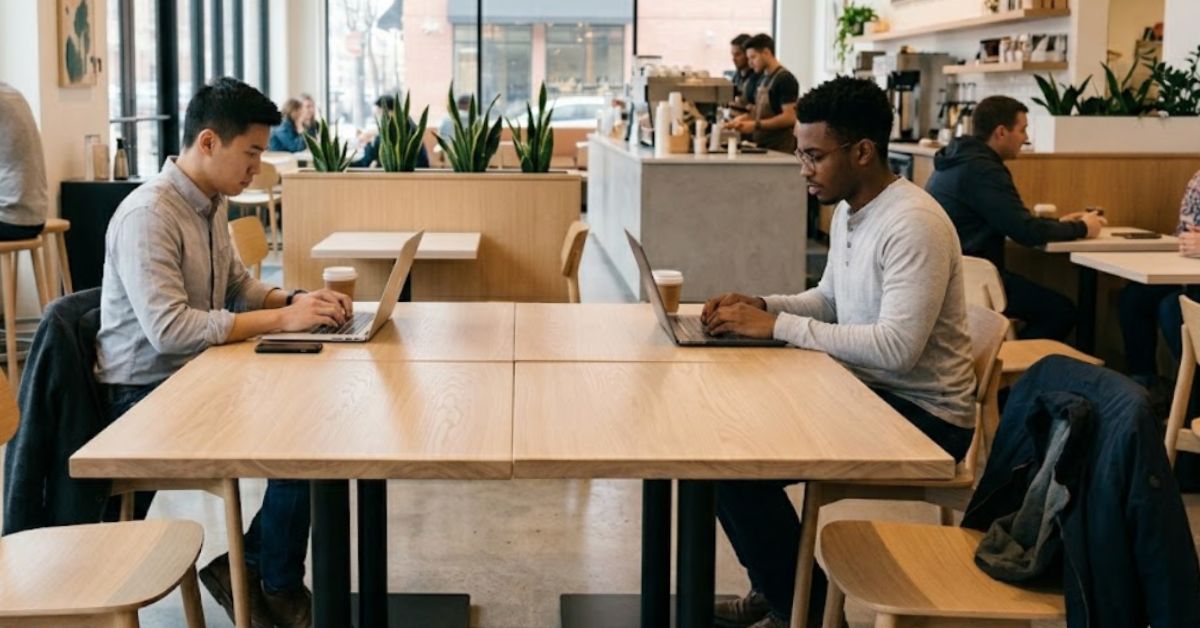
Coffee Shop Seating Layout Tips: Sizes, Clearances & Pairing Rules (2026 Guide)
Coffee shop seating layouts aren't just about style – they drive revenue through smoother flow, higher turnover, and happier customers. Nail the sizes (60×60 cm tables), clearances (75–90 cm behind chairs), and pairings to fit laptop lingerers and quick grabs alike. This 2026 guide gives you exact specs, a free checklist, and the capacity math you need to outpace competitors who are still writing "12–18 inches" without the m²/seat math to back it up.
Quick Answer
Coffee Shop Seating Layout: Quick Reference Table
Use this as a snapshot before you start sketching anything.
Seating Element | Recommended Size / Clearance |
2-seater café table | 60 x 60 cm to 70 x 70 cm |
4-seater table | 75 x 75 cm to 90 x 90 cm |
Chair width allowance | 45 to 60 cm per chair |
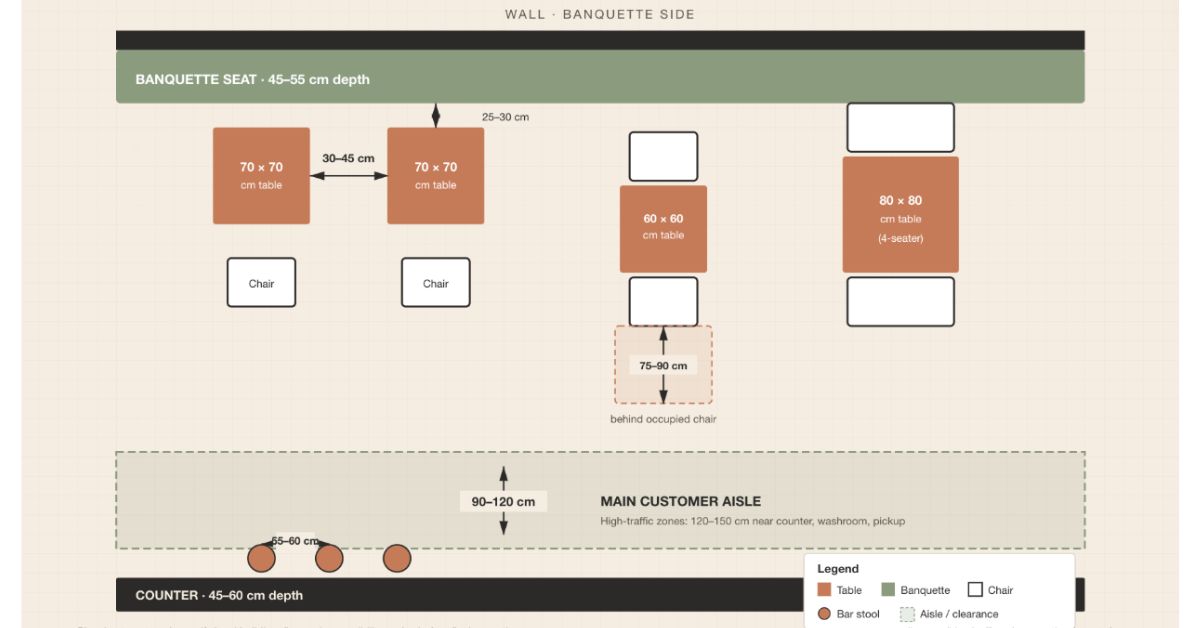
Space behind the occupied chair | 75 to 90 cm minimum |
Main customer aisle | 90 to 120 cm minimum |
High-traffic aisle | 120 to 150 cm |
Bar stool spacing | 55 to 60 cm per stool |
Banquette seat depth | 45 to 55 cm |
Banquette table distance | 25 to 30 cm from seat edge |
Accessible route | 915 mm / 36 in minimum |
Accessible dining height | 28 to 34 in |
Treat these as planning targets. Always verify local building, fire, and accessibility codes before final execution. ADA guidance also notes around 30 x 48 inches of clear floor space for wheelchair seating within accessible café zones.
Start With the Coffee Shop Type, Not the Furniture
Most café layouts go wrong because the team picks chairs and tables before defining the customer pattern. The same 60 m² space behaves very differently for a grab-and-go kiosk and a hotel lobby café. Decide the type first, then size the seating.
- Grab-and-go café: More queue space, fewer lounge seats, more counter stools, and 2-seater tables.
- Boutique neighbourhood café: A mix of 2-seater and 4-seater tables with banquette zones along long walls.
- Hotel or lobby café: More lounge pairings, wider circulation, durable FF&E (Furniture, Fixtures & Equipment), and clear routes for staff and luggage.
- Co-working café: Communal tables, laptop counters with power, and longer dwell-time seating with bag space.
- Bakery or dessert café: Visible display counter, queue separated from seating, smaller quick-turn tables.
Planning a Café Fit-Out?
From compact cafés to hospitality coffee lounges, Arcedior supports sourcing, custom manufacturing, QC, logistics, and installation coordination for café FF&E projects.
How Much Space Should Be Between Tables in a Coffee Shop?
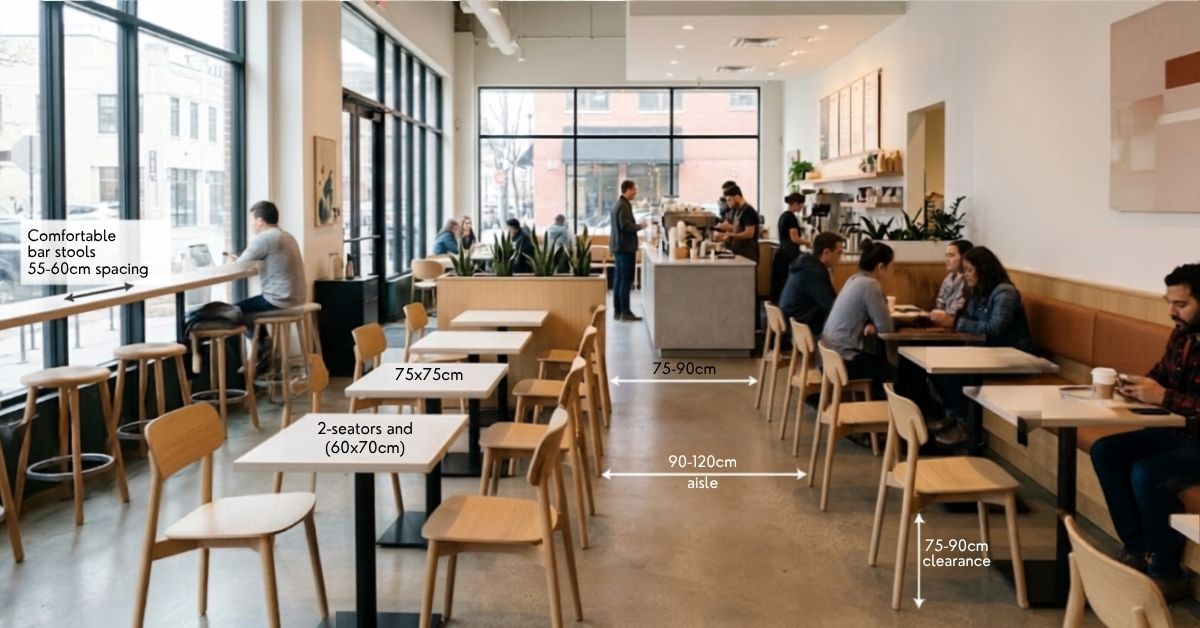
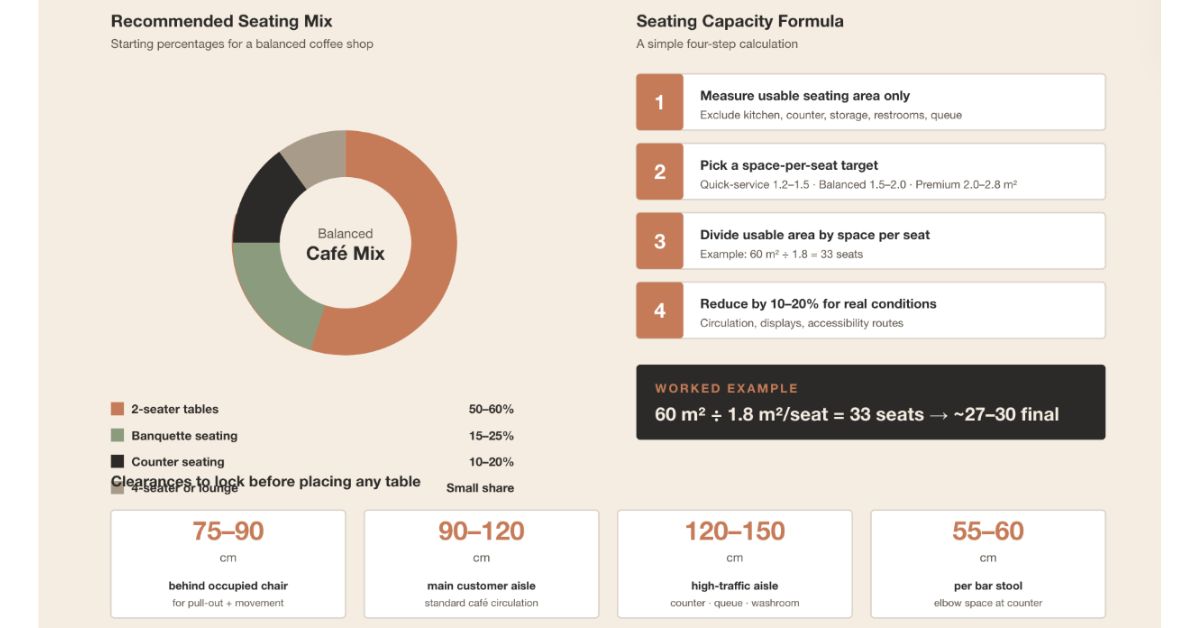
Plan at least 75 to 90 cm where chairs need to pull out and people need to walk past. For main aisles, keep 90 to 120 cm. Near the counter, the washroom path, and any zone where service staff move with trays, keep 120 to 150 cm.
A common mistake is treating table-to-table distance as the only number. The real measurement is occupied chair to occupied chair, because that is the gap a guest actually walks through during a busy hour.
Coffee Shop Table Sizes and Best Pairings
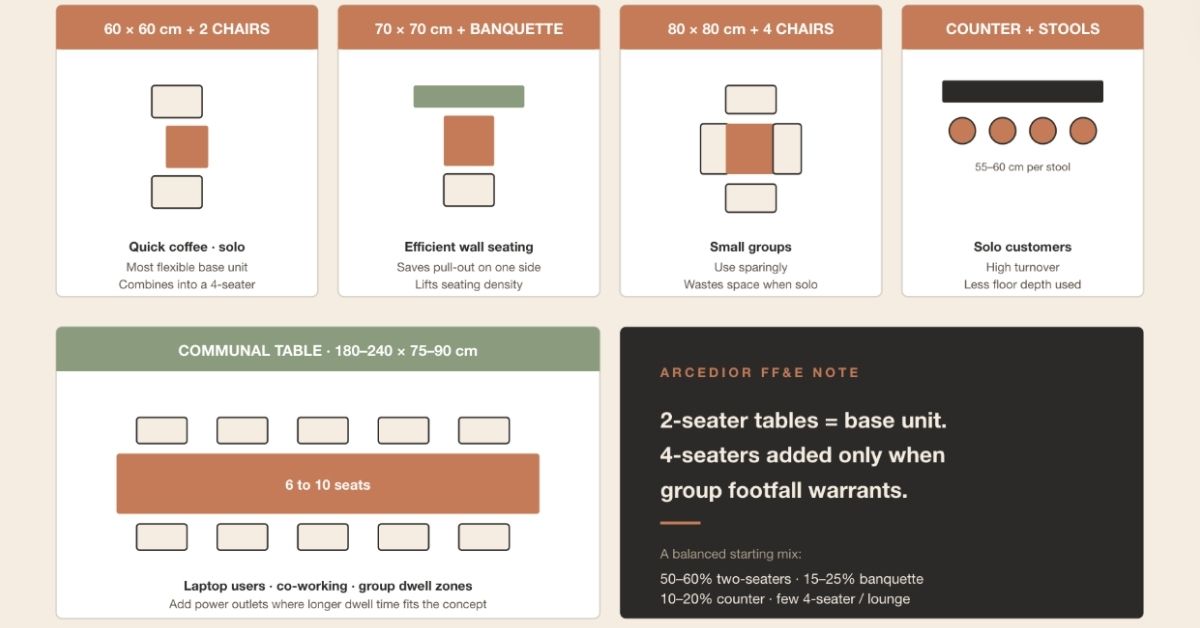
Table size drives almost everything else: capacity, comfort, and how flexible the layout feels when the café is full.
Table Type | Size | Seating |
Small square | 60 x 60 cm | 1 to 2 |
Medium square | 70 x 70 cm | 2 |
Standard 4-seater | 75 x 75 or 80 x 80 cm | 4 |
Round table | 60 to 75 cm dia. | 2 to 3 |
Communal table | 180 to 240 x 75 to 90 cm | 6 to 10 |
Counter ledge | 45 to 60 cm depth | Linear |
Lounge table | 45 to 60 cm dia. | 2 |
Pro Tip
Chair, Sofa, Banquette, and Bar Stool Clearances
Café chairs: Seat width 45 to 55 cm. Pull-out zone 45 to 60 cm. Movement behind the chair is 75 to 90 cm minimum, so a guest can leave without disturbing the next table.
Banquette seating: Banquettes save floor space because one side of the table needs no pull-out clearance. They work best along long walls and in narrow plans.
- Seat height: 45 to 48 cm
- Seat depth: 45 to 55 cm
- Slight back angle for comfort
- Table edge from seat front: 25 to 30 cm
- Table-to-table along a banquette run: 30 to 45 cm, depending on privacy
Bar stools: Allow 55 to 60 cm width per stool. Counter depth 45 to 60 cm. Keep 90 to 120 cm behind the stools if staff or other guests walk past.
Lounge seating: Use lounge seats sparingly in small cafés. They build brand experience and good photos, but drop seats per square metre sharply. Window corners, hotel lobbies, and dwell zones are where they earn their footprint.
How to Calculate Coffee Shop Seating Capacity
A simple formula avoids guesswork:
- Measure usable seating area only. Exclude kitchen, counter, storage, restrooms, and queue space.
- Pick a space-per-seat target.
- Divide the usable seating area by the space per seat.
- Reduce by 10 to 20% for circulation, displays, and accessibility.
Suggested targets:
- Tight quick-service café: 1.2 to 1.5 m² per seat
- Balanced café: 1.5 to 2.0 m² per seat
- Premium or lounge café: 2.0 to 2.8 m² per seat
Example
If your usable seating area is 60 m² and you use 1.8 m² per seat: 60 ÷ 1.8 = 33 seats. Then reduce slightly if the café has a large queue zone, a wide display counter, or generous accessibility routes.
Key Takeaway
Seating Mix Rules for Better Covers Without Crowding
A strong starting mix for a balanced café: 50 to 60% two-seater tables, 15 to 25% banquette seating, 10 to 20% counter seating, and a small share of 4-seater or lounge seats.
Six rules when you draw the floor plan:
- Avoid loading the plan with 4-seater tables. They sit empty when guests come alone or in pairs.
- Use 2-seater tables as the base unit. They combine and separate as the day shifts.
- Place banquettes along long walls to save pull-out space and lift density.
- Add counter or window seating for solo customers without the floor depth of a regular table.
- Keep flexible 2-seaters in the middle so they can be joined for groups.
- Limit lounge seating. It builds brand experience, not capacity.
How Many Seats Can Your Café Actually Handle?
Avoid overcrowding, bad circulation, and wasted floor space. Get instant recommendations for seating mix, aisle widths, and table layouts.
Small Coffee Shop Seating Layout: Under 40 m²
For cafés under 40 m², wall banquettes are the single biggest space-saver. Pair them with 60 × 60 cm 2-seater tables, a window or counter ledge, and stackable or lightweight chairs that don't eat floor space when pulled out. Keep one clear main path. Skip bulky sofas entirely – they're beautiful in concept and frustrating in practice when a full café needs to move. Use round tables only where corners create flow problems.
The other non-negotiable: keep the queue physically separate from seated customers. In a tight space, this feels obvious, but it's the first thing that gets ignored when furniture gets placed.
India-Specific Note (FSSAI & Local Codes): FSSAI licensing for F&B establishments in India requires a defined customer flow area – keep your queue path clearly demarcated and away from the food prep and serving counter. In UP and other high-humidity states, plan a minimum 90 cm clearance on monsoon-prone floors (non-slip tiles, no rugs), especially near entry zones where wet footfall is concentrated. Check with your local municipal corporation for fire NOC aisle minimums; these vary by city and often exceed the standard 90 cm.
Pro Tip: The rush-hour test
Coffee Shop Seating Layout by Zone
A café usually has five zones. Each one needs its own clearance logic.
- Entry zone: Visually open, no seating blocking the door. A first-time guest should spot the order point within three seconds.
- Order and queue zone: Queue kept away from seated diners using floor marks, planters, low partitions, or furniture orientation.
- Pickup zone: A separate handoff point. Avoid placing 2-seaters in front of pickup, because waiting guests drift into seated diners' space.
- Main seating zone: Flexible 2-seater tables in the centre, banquettes on long walls.
- Window or counter zone: Best for solo visitors and laptop users. Add power outlets only where a longer dwell time fits the concept.
On power outlets: Add them only where longer dwell time fits your concept – window counters and co-working communal tables, not quick-turn 2-seater zones. Outlets at every seat are an invitation for a solo guest to occupy a 4-seater for three hours on a Saturday morning. That's a business decision, not just a design one. Decide your dwell-time policy first, then wire accordingly.
ADA-Compliant Coffee Shop Seating
If any part of your café is open to the public in India or internationally, accessible seating isn't optional – it's part of the brief. Here's what that means in practice:
- At least one accessible route through the seating area, 915 mm (36 inches) minimum clear width
- At least one table at accessible height (28 to 34 inches) with 30 × 48 inches of clear floor space for a wheelchair alongside it
- No seating blocking accessible routes – this includes chairs that pull out into the aisle
- If you have a raised platform or mezzanine, accessible seating must be available on the ground level, too.
The clearances for accessible routes often end up being the most generous in the café. Build them first and fit everything else around them; they tend to force better decisions about aisle width and table placement.
Common Coffee Shop Seating Layout Mistakes
- Cramming too many tables to chase covers
- Chairs are backing into the main aisles
- Too many fixed 4-seater tables
- No flexible table combinations
- Oversized sofas in small cafés
- No accessible seating route
- Tables placed in front of the pickup counter
- Delicate furniture finishes in high-use areas
Coffee Shop Seating Layout Checklist
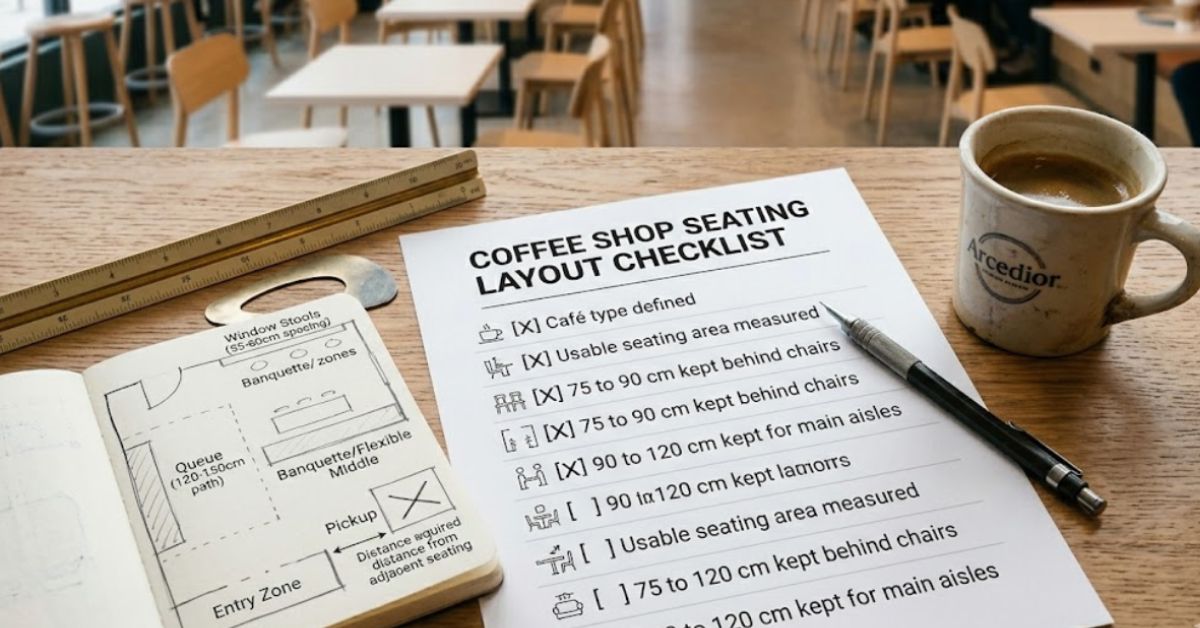
A final walk-through before placing furniture orders:
- Café type defined: grab-and-go, boutique, hotel, co-working, or bakery
- Usable seating area measured
- Queue separated from the seated guests
- 2-seater tables used as the base module
- Banquettes added on long walls
- 75 to 90 cm kept behind occupied chairs
- 90 to 120 cm kept for main aisles
- 120 to 150 cm kept near the counter and high-traffic paths
- 55 to 60 cm allowed per bar stool
- At least one accessible route is included
- Furniture finishes suitable for heavy hospitality use
- Layout tested with a peak-hour walk-through
- Power outlet placement reviewed against dwell-time policy
Plan Your Café Seating Before You Order Furniture
Use the free Coffee Shop Seating Calculator to estimate ideal seat count, aisle spacing, banquette usage, and seating mix in minutes.
2026 Trends Worth Factoring In
Two things are showing up in café FF&E briefs more often in 2026:
Sustainable seating: Recycled-content frames and FSC-certified timber tops are moving from "nice to have" to a procurement requirement for hotel café projects and branded chain rollouts. If you're specifying now, ask vendors for material origin documentation – it affects both the brief and the eventual brand story.
AI layout tools: A handful of tools now let you input your floor dimensions and spit out a draft seating arrangement. They're useful for quick capacity checks, not for replacing a proper layout review. Run one as a first pass, then apply the zone logic and rush-hour test above to what it produces. The tools miss context – queue patterns, humidity, local code – that no floor-plan algorithm accounts for yet.
How Arcedior Supports Coffee Shop FF&E Planning
A solid seating plan is only half the job. The other half is getting the right furniture, in the right finish, at the right time, to the site. This is where café projects usually slow down: vendor delays, finish mismatches, quality issues caught only after delivery, customs hold-ups, and installation timing that misses the rest of the fit-out.
Arcedior supports hospitality and F&B projects with global sourcing of interior products and furniture, custom and contract manufacturing coordination, vendor management, factory quality checks, logistics, shipping, and installation coordination with on-ground teams. Design stays with the designer or operator. Arcedior moves the product side from drawings to a fitted café floor.
Conclusion
Strong coffee shop seating layout tips come down to four things. Pick the café type first. Plan exact clearances before placing any table. Use 2-seater tables as the base unit. Keep the seating mix flexible enough for solo guests at 9 a.m. and small groups at 5 p.m.
Once the layout is locked, the next risk is execution. Right furniture, right finish, right timing, right site. That part is where most café projects either run smoothly or lose three weeks. If you are moving from layout to FF&E sourcing, Arcedior can support that side with global sourcing, custom and contract manufacturing coordination, QC, logistics, and installation coordination, so the seating plan you have built does not get diluted on its way to the floor.
Moving From Layout Planning to Execution?
Arcedior supports café and hospitality projects with global sourcing, custom manufacturing coordination, QC, logistics, and installation support – helping your approved layout translate smoothly to the actual site.