Custom Furniture Project Management Mumbai | No Follow-Ups
Custom Furniture Project Management Mumbai: How HNIs Manage Without Daily Follow-Ups
Quick Answer:
If you've managed custom furniture for a Mumbai residence, you know the real problem isn't choosing vendors. It's managing them daily. One supplier delays, another changes the finish, and delivery clashes with building rules and freight lift slots. Suddenly, you're stuck coordinating 10 moving parts and making calls you never planned for.
This blog shows how HNI homeowners and estate managers reduce that burden using a single coordination execution model, one that kicks in after your BOQ/specs are ready from your architect or interior consultant. The workflow runs: sourcing/custom manufacturing → sample approvals → production tracking → QC evidence → logistics and delivery → installation coordination support and snag closure.
You don't chase vendors. You approve a few critical gates. Everything else stays controlled through documented checkpoints that prevent finish mismatch, rework, damage in transit, and timeline drift.
Custom Furniture Project Management in Mumbai: What You Approve vs What Gets Managed
The most important shift you can make is separating your role from the execution team's role. You are not the project manager. You are the decision-maker at four critical gates.
You Approve | What Gets Managed for You |
BOQ + spec sheet (dimensions, materials, hardware, tolerances) | Vendor coordination across categories + geographies |
Samples/mockups sign-off | Production milestone tracking + escalation |
QC the evidence pack before dispatch | In-process checks + documentation |
Delivery window + room-wise sequencing | Packaging standards + logistics + last-mile coordination + installation coordination support + snag closure |
Stop/Go Rule: No production without a sample sign-off. No dispatch without a QC evidence pack.
This is what a single-window coordination partner does. To borrow another line worth keeping in mind: the goal is to "not only talk about it but also deliver." A good coordination model is only as strong as its actual execution record.
Why Custom Furniture Becomes Stressful in Mumbai Homes
Mumbai is not a forgiving city for project management. The buildings are dense, the timelines are tight, and the expectations for premium finishes are genuinely high. When you add multiple vendors across different categories, each with its own lead times and communication styles, the coordination burden falls almost entirely on whoever is sitting at the center of the project.
Here is what typically goes wrong:
Too many vendors, unclear scope. A typical custom furniture project for a large Mumbai apartment can involve upholstery suppliers, cabinet makers, hardware vendors, a logistics company, and a separate installation team. None of them talks to each other unless someone makes them. That someone usually ends up being you.
Finish mismatches. This is one of the most common and most frustrating problems. A sample gets approved at a certain point in the process, production happens weeks later under different conditions, and what arrives on site is visibly different. Without structured sample sign-off and pre-dispatch inspection, this happens more often than it should.
Hardware failures. Hinges that do not sit flush, drawer runners that catch, sliders that stiffen after two weeks. These are the details that separate a genuinely well-made piece from something that looks good in photographs but frustrates daily.
Delivery damage. High-rise delivery in Mumbai is its own discipline. Furniture that is not packaged for the specific conditions of a building lobby, a tight lift shaft, and a partially finished floor will arrive scratched, chipped, or worse.
The 7-Step System HNIs Use to Manage Custom Furniture Without Chasing Anyone
This is the execution framework that keeps timelines intact and reduces your daily involvement to four structured approvals.
Step 1: Requirements and BOQ / Spec Sheet
Everything starts here. Before sourcing begins, before a single vendor is contacted, the BOQ and full specification sheet must be locked. This means dimensions, materials, finishes, hardware specs, tolerances, and any site-specific constraints like doorway widths, lift dimensions, or flooring types that affect delivery.
Vague scope at this stage is the single biggest cause of change orders and delays later. The spec sheet is your insurance policy.
Step 2: Sourcing and Manufacturing Options with Timeline Plan
Once the spec is confirmed, your coordination partner presents sourcing and manufacturing options. This could be domestic custom manufacturing, contract manufacturing from custom furniture, or global sourcing, depending on the category, the finish required, and the lead time available.
At this stage, a realistic timeline with milestones is set. Not an optimistic one. One that accounts for Mumbai's real-world delivery conditions, building permissions, and monsoon risk if relevant.
Step 3: Samples, Mockups, and Sign-Off
This is your first approval gate, and it is non-negotiable. No production order should go out without a signed-off sample or mockup. This includes finished samples for laminates, veneers, lacquers, and upholstery fabrics. For complex pieces, a full mockup of a representative section is worth the time investment.
The sample approval document becomes the reference against which all pre-dispatch QC is measured. Without it, finish-mismatch disputes are impossible to resolve cleanly.
Step 4: Purchase Order and Milestone Tracker
Once samples are approved, the production order is placed. A milestone tracker is set up that logs key dates: production start, mid-production check, production complete, QC date, dispatch date, delivery date, and installation date. Your coordination partner owns the follow-ups on every milestone.
Milestone Tracker Preview
Item / Category | Detail |
Spec version + approved sample code | — |
Vendor/factory location | — |
Production start date | — |
Mid-production check date | — |
Pre-dispatch QC date (evidence pack link) | — |
Dispatch date | — |
Delivery date + building lift booking | — |
Install date (room-wise) | — |
Snag list status + closure date | — |
Step 5: In-Process Checks and Updates
Mid-production checks catch problems before they become expensive. For longer lead items, an in-process inspection at the factory confirms dimensions, joinery quality, and finish progress before the piece is assembled and packed. Photographs and video are shared with you as evidence, not just a verbal update.
Step 6: Pre-Dispatch QC and Evidence Pack
This is your second approval gate. Nothing leaves the factory or warehouse without a completed pre-dispatch inspection.
QC Evidence Pack: What You Receive
Step 7: Delivery Sequencing, Installation Coordination, and Snag Closure
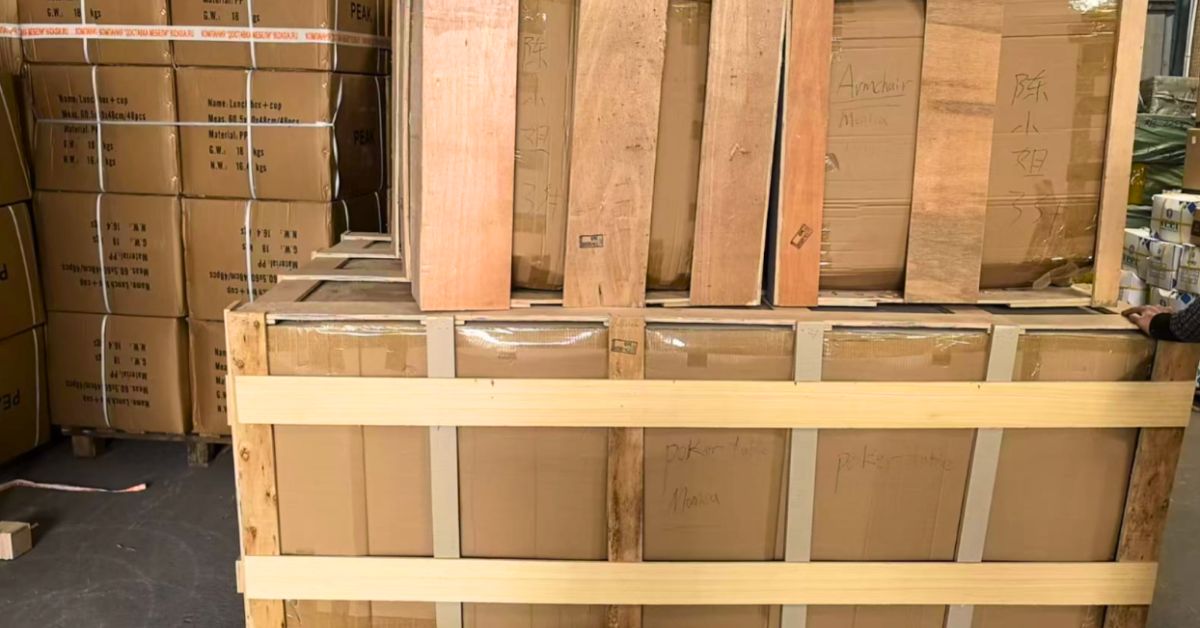
Delivery in Mumbai requires planning that most vendors simply do not do. Room-wise delivery sequencing ensures furniture arrives in the order it is needed, not in the order that is most convenient for the transporter. Your coordination partner works with the building management to confirm lift timings, freight lift booking windows, and any permissions required for large item movement.
On-ground installation coordination ensures your site team and the installation crew are aligned before the first piece comes off the truck. A receiving checklist is used at delivery to catch any transit damage immediately, before the delivery team leaves.
After installation, a snag list is compiled and closed before the project is signed off. Touch-up kits and spares for consumable hardware are confirmed as part of the handover.
On-Site Receiving Checklist
Custom Furniture Quality Control in Mumbai: The Pre-Dispatch Evidence Pack
Before you approve the dispatch of any custom furniture piece, ask for evidence on each of these points:
- Finish match confirmed against the approved sample (not verbal, photographic)
- All dimensions within agreed tolerance
- Hardware tested and functioning: hinges, runners, sliders, locks, handles
- Surface free from scratches, dents, or uneven polish
- Packaging complete: edge and corner protection, moisture barrier, scratch-proof wrapping
- Photo and video evidence compiled and shared
- Delivery window and room sequencing confirmed with the site team
If your current vendor or coordination partner cannot provide this evidence, that is the information you need before the next project.
Custom Furniture Installation Coordination in Mumbai: High-Rise Delivery and Sequencing
Mumbai's infrastructure makes the last mile genuinely difficult, and it catches out vendors who work primarily in other cities.
Building permissions and freight lift access. Most premium residential buildings in Mumbai have strict rules about freight lift usage. Bookings are often limited to specific hours, sometimes only on weekdays, sometimes only on weekends. Large items that cannot fit in the freight lift require special permissions, sometimes involving building management, the society secretary, and a security deposit. If your coordination partner does not know this before the delivery is scheduled, you will find out on the day, and the furniture will sit in a truck outside.
Storage limitations. Unlike a sprawling site in Ahmedabad or Bengaluru, a Mumbai apartment under renovation often has almost no staging space. Furniture cannot arrive all at once. Room-wise delivery sequencing is not a nice-to-have; it is a logistical necessity.
Staging and corridor protection. Building society rules in Mumbai often require floor protection sheets, wall corner guards, and lift-interior liners before any large item enters a common area. Movement paths – lobby to lift to flat entrance – need to be assessed and protected in advance. A coordination partner who manages this before the delivery day avoids delays, fines, and damage disputes with the building management.
Phased handover reality. Many Mumbai renovation projects run room by room – one space is ready for delivery while another is still under civil work. In this environment, room-wise delivery sequencing is not a preference. It is the only practical way to move furniture in without blocking active work zones or creating bottlenecks in tight corridors. A delivery plan that accounts for phased handover is built into the project timeline from the start, not added on the day of delivery.
Transit damage risk. Mumbai's roads, the stop-and-start of city traffic, and the physical handling required to move pieces through lobbies and stairwells all create opportunities for damage. Export-grade packaging, specifically edge protectors, corner guards, and scratch-resistant wrapping, is the standard that should be applied to every delivery, not just items being shipped internationally.
Monsoon timing. If your project delivery falls between June and September, moisture protection in packaging is not optional.
Before Delivery: Confirm with Your Society (Mumbai High-Rise Checklist)
Arcedior's experience across hospitality projects in Mumbai, including large hotel FF&E sourcing, has made these realities part of the standard process, not an afterthought.
Mumbai Projects: Coordination in Practice
Two recent Mumbai residential projects where the execution model above was applied:
Mumbai Private Residence: Coordinated sourcing and supply across luxury furniture and decorative lighting for a Mumbai bungalow project. Full production tracking, pre-dispatch QC, and high-rise delivery sequencing are managed as a single window.
Mumbai HNI Residence: Single-window coordination across multiple categories – furniture, lighting, sanitaryware, doors, and windows – with delivery planning aligned to phased site handover and building access constraints.
Common Mistakes and How to Fix Them
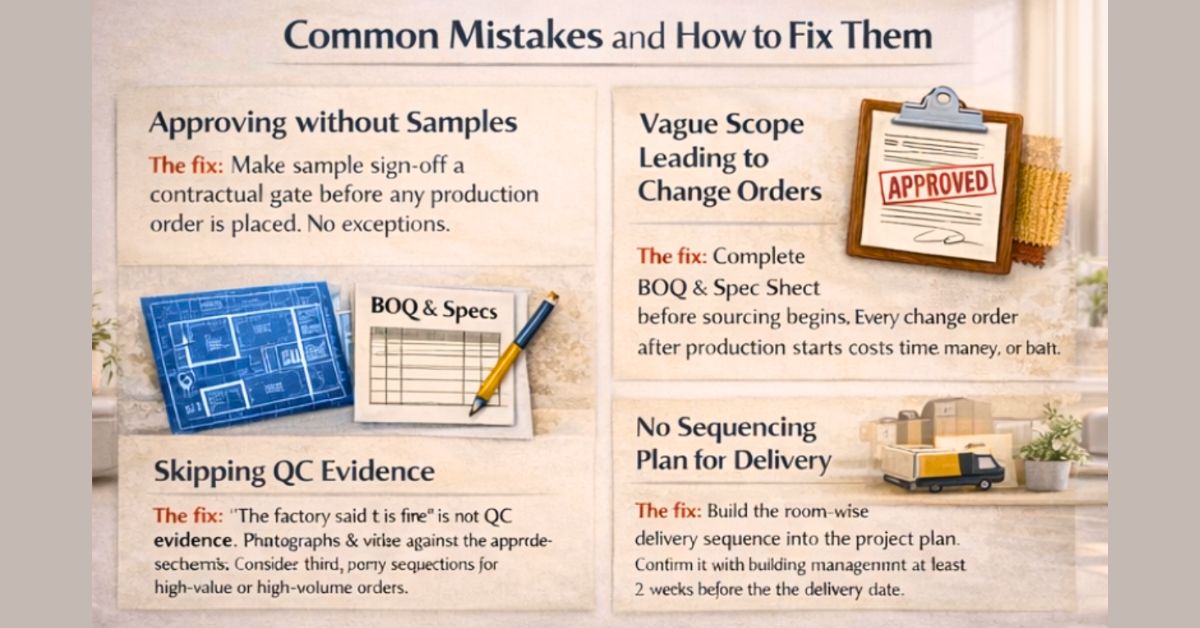
- Approving without samples. The fix is simple: make sample sign-off a contractual gate before any production order is placed. No exceptions.
- Vague scope leading to change orders. The fix is a complete BOQ and specification sheet before sourcing begins. Every change order after production starts costs time, money, or both.
- Skipping QC evidence. "The factory said it is fine" is not QC evidence. Photographs and video against the approved sample are the minimum standard. Third-party inspection is worth considering for high-value or high-volume orders.
- No sequencing plan for delivery. The fix is building the room-wise delivery sequence into the project plan before production begins, then confirming it with the building management at least two weeks before the first delivery date.
- Choosing a vendor based on price alone. The same principle applies when you are choosing who coordinates your project.
Ready to move forward?
Share your BOQ/specs + Mumbai location + target handover month → we reply with a timeline, QC gates, and room-wise delivery sequence plan.
Arcedior handles global sourcing, custom manufacturing, QC, logistics, and installation coordination.
What Is Changing in Mumbai's Custom Furniture Market Right Now
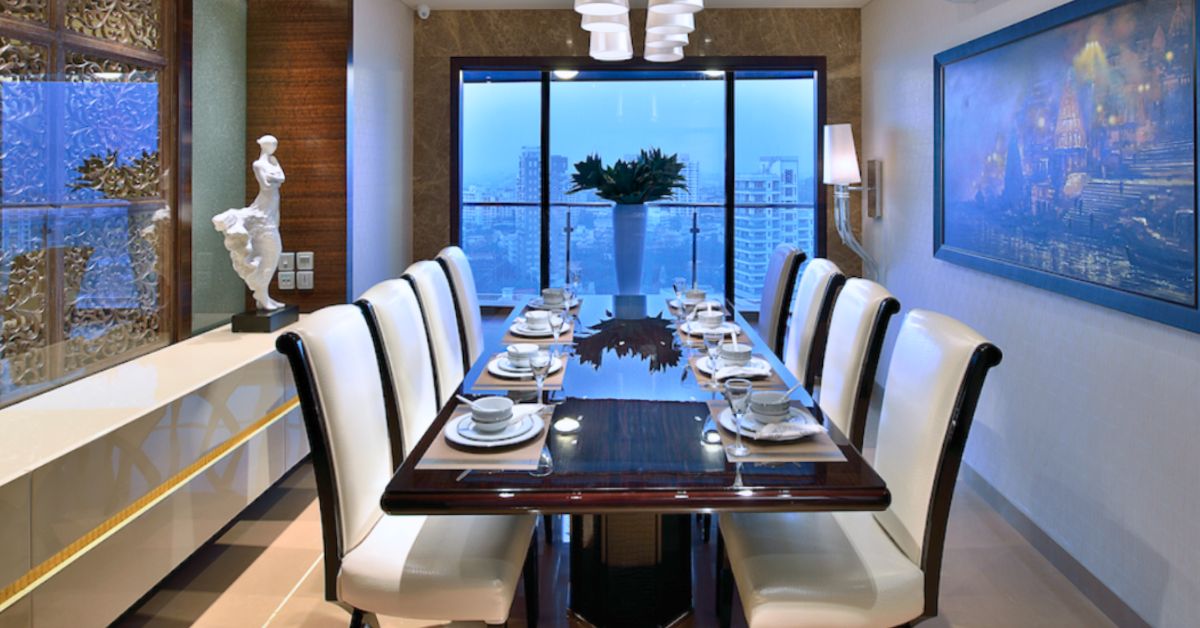
The most significant shift happening in Mumbai's custom furniture space is the move away from mass-produced and toward genuinely bespoke, handcrafted pieces. Clients are no longer satisfied with catalogue furniture dressed up with a custom finish. They want pieces that were designed for their specific space, made to their exact specifications, and delivered with proof that the quality was verified before it arrived.
This shift is raising the standard for everyone in the industry. It is also raising the importance of structured execution, because a truly bespoke piece has no factory equivalent to fall back on if something goes wrong. The spec sheet, the sample sign-off, the production tracking, and the pre-dispatch QC are not bureaucracy. They are what make bespoke furniture actually arrive as bespoke furniture.
At Arcedior, this is the work we have been doing across hospitality and residential projects for over 18 years. We do not do design or turnkey interiors. Our role starts after the design and BOQ are ready. From that point, we take over global sourcing of interior products, custom and contract manufacturing, QC, logistics, and installation coordination as a single-window partner, so the design intent is executed correctly on site.
FAQs
How do HNIs manage custom furniture projects in Mumbai without daily follow-ups?
HNIs avoid daily follow-ups by using a single coordination partner who manages sourcing, production tracking, QC, logistics, and delivery after the BOQ is ready. You only approve four gates – specs, samples, QC evidence, and delivery windows – while all vendor communication and issue resolution stays handled end-to-end.
- Approve the BOQ/spec sheet first
- Sign off on samples before production begins
- Review the QC evidence pack before dispatch
- Confirm room-wise delivery and lift bookings
Who coordinates custom furniture end-to-end in Mumbai?
A single-window residential sourcing and procurement partner manages the workflow after your BOQ and specs are ready – vendor planning, sampling, production tracking, quality checks, packaging, logistics, and delivery scheduling with installation coordination support. This is different from turnkey interior providers focused on design and civil execution.
- Works from approved specs, not design moodboards
- Runs all factory and vendor follow-ups
- Shares QC documentation at every gate
- Aligns delivery sequencing with Mumbai site constraints
What should I approve vs delegate in a custom furniture project?
Approve only decisions that change cost, timeline, or outcome: the spec sheet, samples or mockups, QC evidence before dispatch, and delivery windows. Delegate all operational work – vendor follow-ups, milestone tracking, in-process checks, packaging, logistics, and snag closure management.
- Approve 4 gates, delegate approximately 40 follow-ups
- Ask for documentation at every gate
- Never approve dispatch without a QC evidence pack
How do I make sure the finish matches the approved sample?
Finish matching is controlled by a signed sample sign-off and a pre-dispatch inspection that compares the finished item against that exact reference. Ask for photos and video under consistent lighting, and written confirmation that the approved sample code is the production reference – not memory, not verbal confirmation.
- Sample sign-off document is mandatory before production
- Compare against the sample code, not the verbal description
- QC photos and video required before dispatch
- Fix at source, not after delivery
What QC checks should happen before furniture is delivered?
Pre-delivery QC must verify finish match against the approved sample, dimensions within tolerance, hardware function, surface quality, and packaging integrity – all before dispatch. Checks done at the source allow correction before the item reaches the site, where rework is slower and more expensive.
- Finish match vs approved sample (photographic evidence)
- Dimensions within tolerance
- Hardware tested: hinges, runners, sliders, locks
- Packaging verified: edge, corner, and moisture protection
How long does custom furniture take for a luxury home in Mumbai?
Timelines vary by category, complexity, and whether items are locally made or globally sourced. Imports add shipping and clearance lead time. What matters most is locking milestones early, completing sample sign-off without delay, and protecting the timeline with QC gates throughout production.
- Lock a milestone tracker from the start
- Sample sign-off prevents costly rework delays
- Plan delivery sequencing with site access windows
- Avoid late scope changes after production begins
What causes delays in custom furniture projects in Mumbai?
Delays most commonly come from unclear specs, missing sample sign-offs, late site readiness, and last-mile constraints like freight lift booking windows and limited in-apartment storage. Transit damage also causes replacement lead times when packaging standards are not enforced. Most are preventable with documented gates and sequencing plans.
- Spec clarity upfront reduces change orders
- Sample sign-off prevents finish disputes mid-production
- QC evidence prevents on-site surprises
- Delivery sequencing avoids storage pile-ups
How do I prevent damage during delivery to high-rise apartments in Mumbai?
Prevent damage by enforcing export-grade packaging, edge and corner protection, scratch wrap, moisture barrier, and planning the last mile carefully: freight lift booking, floor and wall protection, corridor clearance, and a receiving checklist to record any damage before the delivery team departs.
- Packaging photos included in the QC evidence pack
- Lift and doorway constraintsare checked before scheduling
- Room-wise delivery reduces unnecessary handling
- Receiving the checklist signed on-site
What documents should I ask for before production starts?
Ask for a complete BOQ and specification sheet, supplier confirmation of feasibility, the sample or mockup sign-off document, a production milestone tracker with key dates, and the agreed QC checklist that will be used for the pre-dispatch inspection before any item is shipped.
- BOQ + spec sheet locked before any order is placed
- Feasibility confirmation from the manufacturer
- Sample sign-off document as a formal record
- Milestone tracker shared at the purchase order stage
Can one partner coordinate multiple vendors and categories?
Yes, and this is the primary advantage of a single-window coordination model. Instead of managing a cabinet maker, upholstery supplier, hardware vendor, logistics company, and installation team separately, one coordination partner interfaces with all of them and reports to you only at the four key approval gates.
- All vendor communication goes through one contact
- Milestone tracking is consolidated into one report
- Delivery sequencing is planned across all categories
- You review four gates, not forty updates
Ready to Stop Managing Vendors Daily?
If you have a custom furniture project coming up for a Mumbai home or property, here is what we suggest as a starting point.
- Share your BOQ+ location + handover date → we reply with timeline + QC gates + delivery sequencing plan.
- Or reach out directly on WhatsApp to start with your requirements.
Arcedior is a global sourcing, custom manufacturing, and coordination partner for interior projects. We are not an interior design studio or a turnkey contractor. We make the design real, through sourcing, manufacturing, QC, logistics, and installation coordination, as a single-window partner.