Hotel FF&E Spares Strategy Dubai | Spares List + Calculator

Hotel FF&E Spares Strategy Dubai: What to Order Before Opening
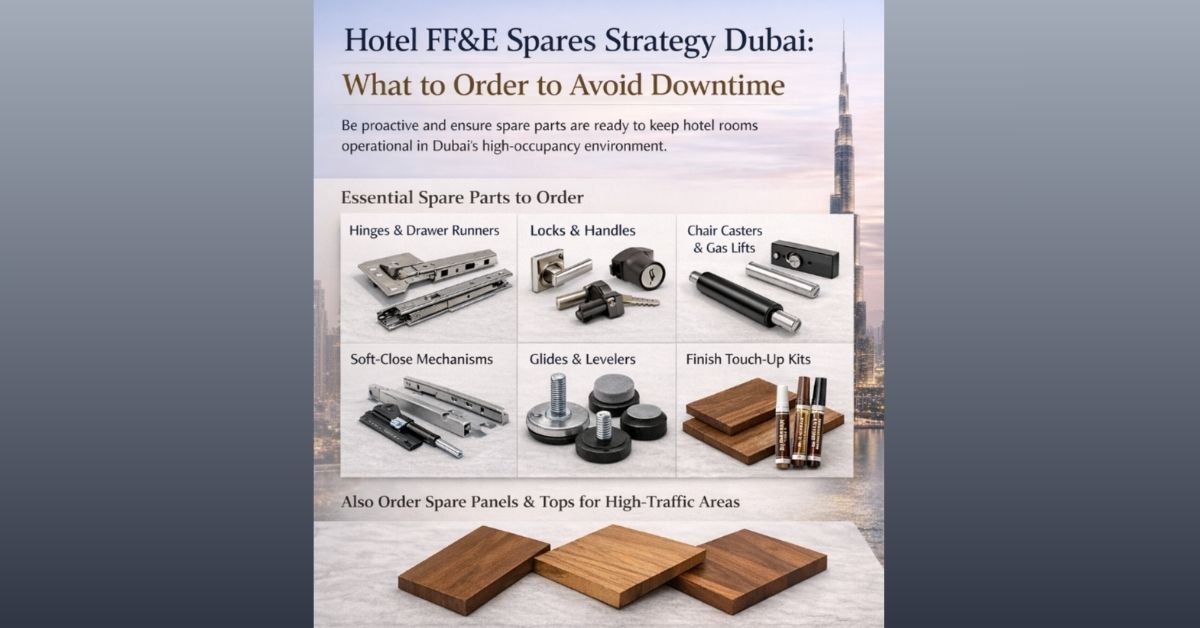
Dubai hotels run at occupancy levels that leave zero tolerance for guestroom downtime. When a chair gas lift collapses, or a drawer refuses to close, maintenance cannot wait three weeks for a replacement shipment from overseas. That single failure, multiplied across 200 rooms operating at 85% occupancy, quickly becomes a revenue and reputation problem. A hotel FF&E spares strategy built before your furniture ships is one of the highest-return procurement decisions a Dubai hotel project can make, and the one most commonly deferred until the container has already left the factory.
This page covers exactly what Dubai hotel owners and project teams should order, how to decide quantities, when to raise the spares order, and how to set up a warranty workflow that keeps replacements moving without chaos.
Quick Answer:
What Breaks First in Hotel FF&E (Realistic Failure Points)
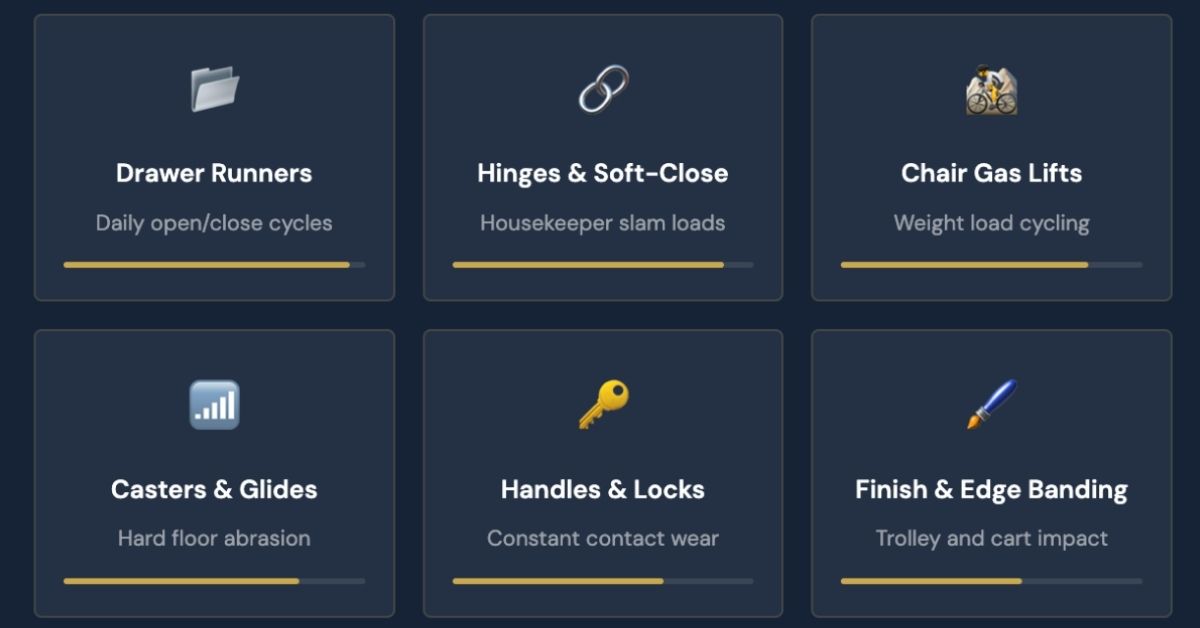
Understanding what breaks first in hotel furniture after opening is the foundation of any spares plan. Failure is not random. Specific parts fail in a predictable sequence based on touch frequency, load cycles, and housekeeping handling.
Item | Why It Fails | Where It Fails First | What Maintenance Needs On Hand |
Drawer runners | High open-close cycles from guests and housekeeping, daily loading | Bedside tables, wardrobe base drawers | Matched runner pairs (left + right), correct load rating |
Soft-close hinges | Mechanism wears under repeated slam-and-close cycles | Wardrobe doors, minibar doors | Exact model + finish code; hinge and screw set together |
Chair casters | Hard-floor vs carpet mismatch, overload during housekeeping moves | Desk chairs, lobby seating, business-center chairs | Correct stem size, hard-floor and carpet variants stocked separately |
Gas lifts | Load fatigue + lever mechanism wear | Business-center desk chairs, F&B chairs with height adjustment | Matching height range + load rating; lift + clip |
Handles & locks | Constant contact and grip force; finish degrades before structure | Wardrobe, minibar, connecting-room locks | Handle + screw set + matching lock barrel |
Surface finishes/edge banding | Housekeeping trolley impact; cleaning chemical exposure | Housekeeping corridors, wardrobe ends, desk front edges | Touch-up kits from the same production batch; edge banding strip + adhesive |
Felt glides | Self-adhesive bond fails on hard floors from daily repositioning | Chairs, occasional tables, ottomans | Generous stock; self-adhesive; low cost, high volume |
From project experience at Arcedior:
Across hotel FF&E projects, first-failure issues consistently cluster around hinges, runners, chair casters, gas lifts, and finish touch-ups, because these take the highest daily handling from guests and housekeeping. Structural casegood failures are rare in the first two years when manufacturing QC is sound; hardware and finish failures are not.
"On one Dubai hotel project (250 rooms, 4-star business, phased handover), the maintenance team called us at week three of occupancy. Roughly 40% of reported failures in the first month were drawer runners and hinges – all from the same supplier, all in the same room type. The root cause was a single hardware model that had not been cross-standardized across room types. A 60-unit runner reorder from Asia took 11 weeks to arrive. The fix cost more than the spares budget would have."
The Hotel FF&E Spares List (Category by Category)
A complete hotel furniture spare parts list for maintenance teams covers five categories. Each has a different failure rate, storage requirement, and replacement urgency. All quantities in this section are indicative planning ranges used by Arcedior at the budgeting and BOQ-freeze stage – not universal minimums. Final quantities depend on room count, room-type standardization, public-area seat density, number of distinct hardware models, and warranty structure negotiated with the manufacturer. Apply the planning matrix below for a more structured view.
Casegoods Hardware
Item | Risk Level | Critical Note |
Soft-close hinges (specify model) | 🔴 High | Match finish code, not just physical size |
Telescopic drawer runners (specify load rating) | 🔴 High | Store left and right pairs together |
Handles and knobs + screw sets | 🟠 Medium | Cross-room standardization reduces variety |
Locks + keys + master key sets | 🟠 Medium | Log the master key hierarchy separately |
Levelers and adjustable feet | 🟡 Low | Critical for snagging resolution at handover |
Cam locks, brackets, and wall fixings | 🟡 Low | Include in the installation kit per room |
Seating Spares
Item | Risk Level | Critical Note |
Chair casters (specify stem size) | 🔴 High | Hard floor vs carpet casters are different |
Gas lifts (specify height range + load rating) | 🔴 High | Desk chairs in business-center areas fail fastest |
Felt glides (specify diameter) | 🟠 Medium | Self-adhesive; stock generously |
Arm pads (specify attachment type) | 🟠 Medium | Upholstered pads chip from armrest contact |
Base screws and assembly hardware kit | 🟡 Low | Pack alongside chair crates during delivery |
Finish and Surface Spares
- Laminate repair kits matched to exact color codes from your BOQ
- Veneer touch-up markers and stain pens matched to grain and tone
- Paint touch-up sets labeled per paint batch reference
- Edge banding repair strips with matching adhesive
- Spare tops and panels for reception counters, desks, and high-traffic casegoods
Installation Spares
- Extra fasteners, cam locks, and dowels per room type
- Wall-fixing accessories (anchors, brackets) for wall-mounted units
- Spare skirting trims and filler strips for close-tolerance fits
Pro Tip
HOTEL FF&E SPARES PLANNING MATRIX
This is the page's primary linkable asset. Place it prominently – after the spares list categories and before the quantities section. This table is the "reason to bookmark and share" the page. It is ungated and visual, complementing the gated calculator CTA.
Item Category | Typical Failure Trigger | Criticality | Indicative Planning Range | Must-Log Spec Field | Store By | Repair or Replace |
Soft-close hinges | Slam cycles/mechanism wear | Critical | 8–12% of total installed count* | Model no. + finish code | Floor zone | Replace (30 min) |
Drawer runners | Overload/housekeeping handling | Critical | 10–15% of total pairs* | Load rating + L/R pair | Floor zone | Replace (30 min) |
Chair casters | Floor-type mismatch/overload | Critical | 15–20% of installed count* | Stem size + floor type | Area (lobby/F&B/rooms) | Replace (5 min) |
Gas lifts | Load fatigue + lever wear | Critical | 10–15% of desk chair count* | Height range + load rating | Area (business center) | Replace (15 min) |
Handles & locks | Constant grip/finish degradation | Medium | 8–12% of installed handles* | Model no. + finish + screw size | Floor zone | Replace (15 min) |
Finish touch-up kits | Trolley impact/chemical exposure | Medium | 1 kit per 20–25 rooms* | Batch ref + color code | Central maintenance store | Repair (cosmetic) |
Felt glides | Adhesive bond failure | Low | 30–40% of installed count* | Diameter | Central maintenance store | Replace (2 min) |
Spare panels/tops | Structural damage/guest incident | Medium | 2–3% of high-traffic surfaces* | Dimension + finish code | Secure store (flat) | Replace (full swap) |
* Indicative planning ranges used by Arcedior at the budgeting and BOQ-freeze stage. Final quantities depend on room count, hardware standardization level, public-area load density, and warranty structure negotiated with the manufacturer.
How to Decide Quantities: Ranges Per 100 Rooms
There is no universal spare quantity for every hotel. The ranges below are indicative planning benchmarks used by Arcedior during budgeting and BOQ-freeze stages – not minimums to apply blindly. Final quantities depend on room count, room types, seat density in public areas, hardware standardization, and warranty structure.
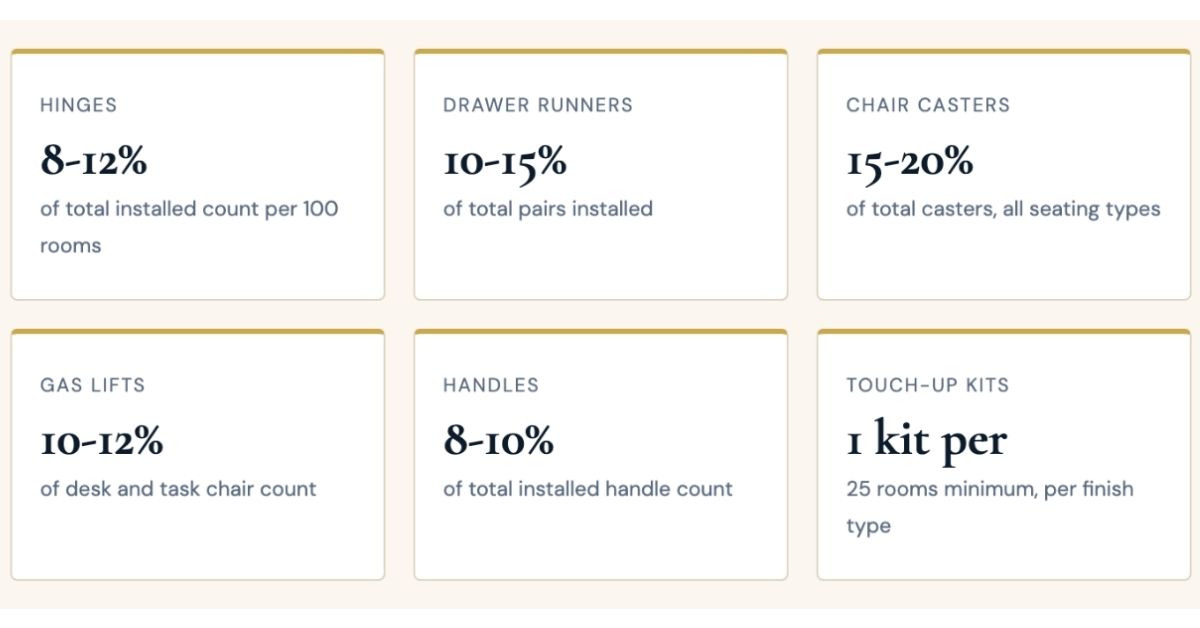
Quick Answer: How many spares should I order per 100 rooms?
Public areas need a higher spares rate than guestrooms. Lobby seating, F&B chairs, and front-desk casegoods absorb far more load cycles per unit than a guestroom wardrobe. Plan public-area seating spares at 1.5 times the guestroom rate.
Key Takeaway
When to Order Spares: The Procurement Tie-In
Quick Answer: Should I order spares now or later?
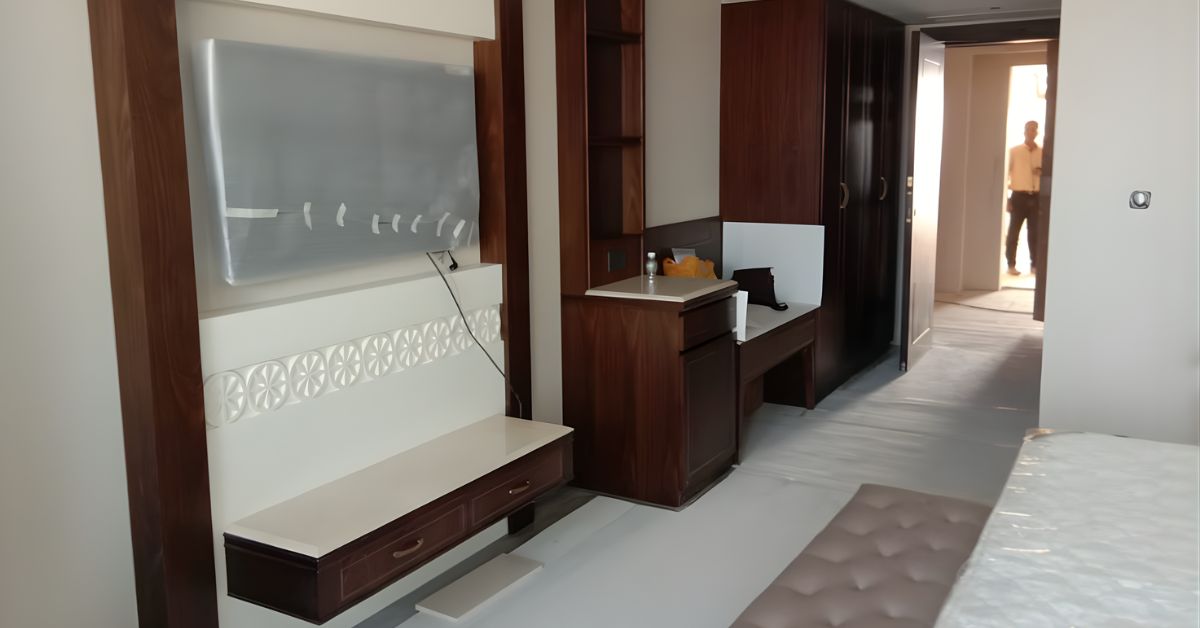
The most common mistake in hotel FF&E spares planning is treating spares as an afterthought. Teams raise the spares order only after opening, when lead times are months long and urgent reorders carry a heavy price premium. The correct trigger is production, not occupancy.
Spares Order Workflow: From BOQ to Maintenance Store
Step 1 – BOQ Freeze Confirm hardware model numbers and finish codes. Spares must reference exact specifications, not approximate equivalents.
Step 2 – Raise Spares Order Alongside Main Production Spares raised with the main order ship together, eliminating reorder lead-time cost and repeat import duty charges.
Step 3 – Pack Spares in Separate Labeled Cartons. Never mix spares with installation furniture. Label cartons by category and hardware model number for clean site receiving.
Step 4 – Site Receiving: Verify Against BOQ. Check model numbers and finish codes match the installed items before signing the receiving note. A "close enough" spare creates a mismatch problem that is expensive to fix later.
Step 5 – Store by Floor and Zone Map cartons to maintenance store locations by floor. Engineering teams must be able to pull a runner for Floor 12 without unpacking the entire warehouse.
Quick Answer: How should spares be packed for phased handover?
Dubai Execution: Why Spares Planning Works Differently Here
Dubai hotel operations add specific pressures that make a reactive spares approach genuinely expensive. Any team building a hotel FF&E spares strategy in Dubai needs to account for these on-ground realities.
Dubai-Specific Pressure | Impact on Spares | Planning Response |
High occupancy from Day 1 | No grace period to wait for reorders | Order spares before soft opening, not after |
Phased handovers by floor | Spares must be ready per phase, not in one bulk delivery | Pack and label spares by floor zone ahead of each handover |
Overseas reorder lead times | 8 to 16 weeks for exact hardware matches | Stock 60-day buffer minimum for high-failure items |
Site receiving constraints | Jumbled cartons slow the maintenance workflow | Insist on labeled cartons and a floor-mapped packing list |
Receiving bay congestion | Large hotel sites face delivery scheduling windows — a delayed spare cannot be rushed in | Confirm spares are in the same container as the main FF&E delivery |
Room-out-of-order cost exposure | At 80–85% occupancy, one blocked room can cost AED 1,500–4,500+ per night, depending on category | Treat spares budget as insurance against ADR loss, not a procurement overhead |
Imported hardware reorder risk | Custom hardware from Asia requires an exact model match; generic substitutes cause finish and fit mismatches | Log hardware model numbers at BOQ freeze; never substitute without QC sign-off |
Quick Answer: What makes Dubai hotel spares planning different from other markets?
Phased handovers are a core operational reality in Dubai hotel projects. Floors open in batches, and each phase must carry its own spares. Pooling all spares in one general store and expecting maintenance teams to locate the right runner across 400 cartons is a workflow that fails within the first week of operation.
Warranty and Replacement Workflow
A spares strategy is incomplete without a workflow that defines what happens when something fails. The warranty and replacement workflow closes the loop between the maintenance team, the procurement record, and the supplier.
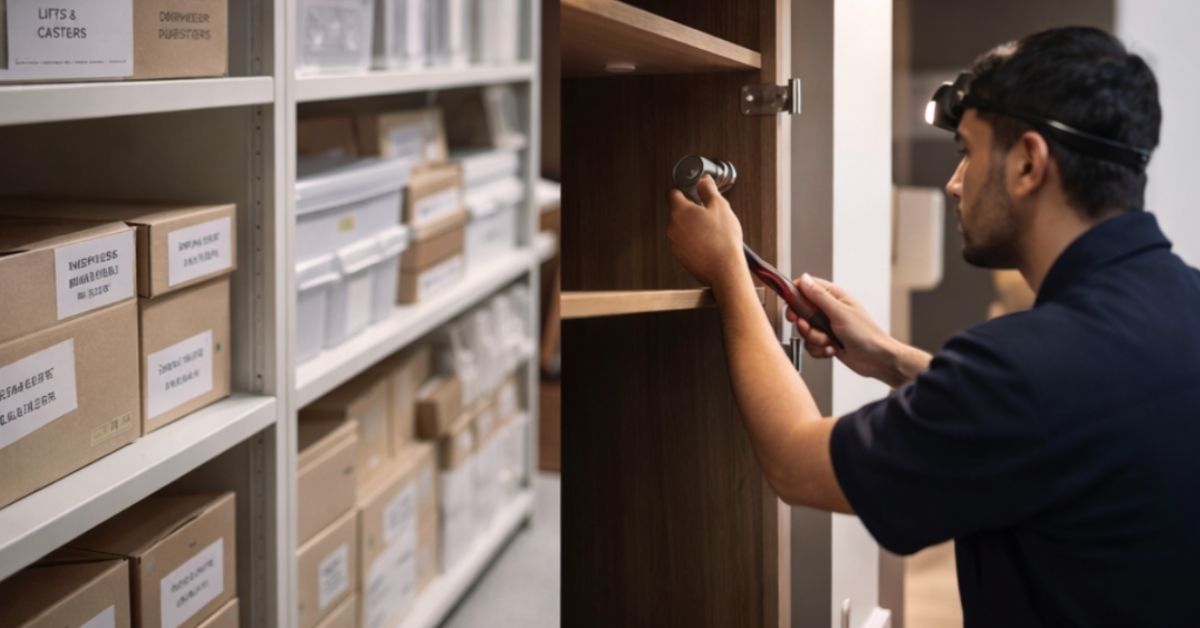
Define Repair vs Replace
- Repair: Cosmetic damage addressable with a touch-up kit; hardware swap completable in under 30 minutes using on-site spares
- Replace: Structural failure, upholstery tear beyond surface repair, or hardware mismatch that cannot be resolved from the maintenance store
Claim Evidence Pack (Required for Every Replacement Request)
- Photo of the failure with the room number clearly visible
- Carton ID or delivery reference for the original item
- Hardware model number and finish code from the original BOQ
- Date of failure and maintenance log entry number
- SLA deadline: 72 hours for urgent cases, 14 days for non-urgent cases
What the Maintenance Team Should Log at Time of Failure
Field | Why It Matters |
Room number | Links failure to occupancy record and room-out-of-order cost |
Asset / item code | Identifies the exact casegood or seating piece from the BOQ |
Photo of failure | Required for warranty claim; establishes failure mode and extent |
Hardware model number | Ensures the right spare is pulled from the maintenance store |
Finish code | Prevents color-mismatch repairs |
Carton ID (from delivery) | Traces the item back to the production run for warranty escalation |
Date reported | Starts SLA clock; supports warranty claim timeline |
Temporary fix used | Documents whether the room was blocked or a workaround was applied |
Replacement approval status | Tracks who authorized spending and when |
Comparison: Reactive vs Planned Warranty Workflow
Factor | Reactive (No Spares Plan) | Planned (Spares + Workflow) |
Time to resolve hardware failure | 8–16 weeks reorder lead time | Same day from the maintenance store |
Cost of replacement | Reorder premium + repeat import duty | Already costed in the original order |
Finish match accuracy | High risk of color or model mismatch | Exact match from the same production run |
Engineering team effort | Search across vendors, raise a new PO | Pull from labeled carton, log claim |
Guest impact | Room blocked for weeks | Room restored within hours |
Linking your replacement workflow to your original procurement record is the step most teams skip. Without it, replacement parts arrive as approximate matches, creating a visual inconsistency that guests and QC auditors notice. Single-window procurement coordination for both the main FF&E order and the spares order simplifies warranty resolution significantly.
Build Your Hotel FF&E Spares Strategy Before the Furniture Ships
A robust hotel FF&E spares strategy for Dubai is not a post-opening problem to solve. It is a procurement decision made at BOQ freeze, built into the production order, packed and labeled before the container leaves the factory, and stored on the floor before the first guestroom opens. Teams that get this right avoid the reorder premium, the downtime cost, and the mismatch risk that define reactive maintenance. Arcedior coordinates spares planning as part of single-window FF&E procurement, from model-number logging through to warranty workflow setup. Share your BOQ and room count, and we will revert with recommended quantities, a packing plan, and a warranty structure tailored to your project.
Get Your Spares Quantities Right the First Time
FAQs
What spares should I order with hotel FF&E for a Dubai hotel?
Order hinges, drawer runners, soft-close mechanisms, locks and handles, chair casters and gas lifts, glides and levelers, and finish touch-up kits. Add spare tops and panels for high-traffic public areas. Every spare must be tied to the exact hardware model number and finish code from your BOQ to prevent mismatches on-site.
- Casegoods hardware: hinges, runners, locks, handles, levelers
- Seating: casters, gas lifts, glides, arm pads
- Finish: laminate and veneer touch-up kits, edge banding strips
- Structural: spare tops and panels for reception and desk surfaces
What breaks first in hotel furniture after opening?
Drawer runners and hinges fail first due to high open-close cycles from guests and housekeeping. Chair casters and gas lifts follow, especially in lobby, F&B, and business-center areas. Handles and locks degrade from constant contact. Surface finishes chip in housekeeping corridors from the daily trolley impact.
How many hinges and drawer runners should I stock per 100 rooms?
Stock 8 to 12% of your total installed hinge count and 10 to 15% of your total installed drawer runner pairs as spares per 100 rooms. Increase the percentage for public areas by 1.5 times. Standardizing on one hinge model across all rooms significantly reduces the variety you need to stock.
Is it cheaper to order spares now or reorder later?
Ordering spares with your main FF&E production order is almost always cheaper. Reorders incur additional shipping costs, repeat import duties, longer lead times of 8 to 16 weeks for custom hardware, and price premiums from minimum order quantity penalties. Dubai's high-occupancy environment adds a hidden downtime cost that makes urgent reorders even more expensive in practice.
How do I make sure spares match the installed FF&E exactly?
Record hardware model numbers and finish codes in your BOQ before production closes. Order spares from the same production run. On-site, verify carton labels against your BOQ before storing. "Close enough" spares from a different model or finish code create mismatches that are visible to guests and unresolvable without a new order.
- Log: hardware model number, finish code, supplier reference
- Tag: each spare carton with the corresponding FF&E item reference
- Check: at the site receiving, verify at least one item per carton against the installed piece
How do spares planning and delivery sequencing work together for Dubai projects?
Spares should be packed in dedicated cartons separate from installation furniture and delivered in the same shipment. On phased handover projects, spares cartons must be labeled by floor and zone and received into the correct maintenance store location. Mixing spares with installation furniture creates a receiving and storage problem that maintenance teams carry for years.
Can one procurement partner coordinate spares across multiple vendors?
Yes. A single-window procurement partner who coordinates casegoods, seating, and hardware vendors under one sourcing umbrella can consolidate spares orders, unify model-number logging, and manage packing and labeling across all categories. This removes the risk of mismatched spares arriving from vendors who were briefed separately and had no visibility into each other's hardware specifications.
What should my site's receiving team check for spares and hardware kits?
Check that carton labels match the spare parts log, that model numbers and finish codes are legible on the carton or inner packaging, that quantities match the packing list, and that finish touch-up kits are sealed and undamaged. Log any discrepancies with photos and carton IDs before the receiving note is signed.