Hotel Mockup Room FF&E Dubai | Approval Checklist + Pack
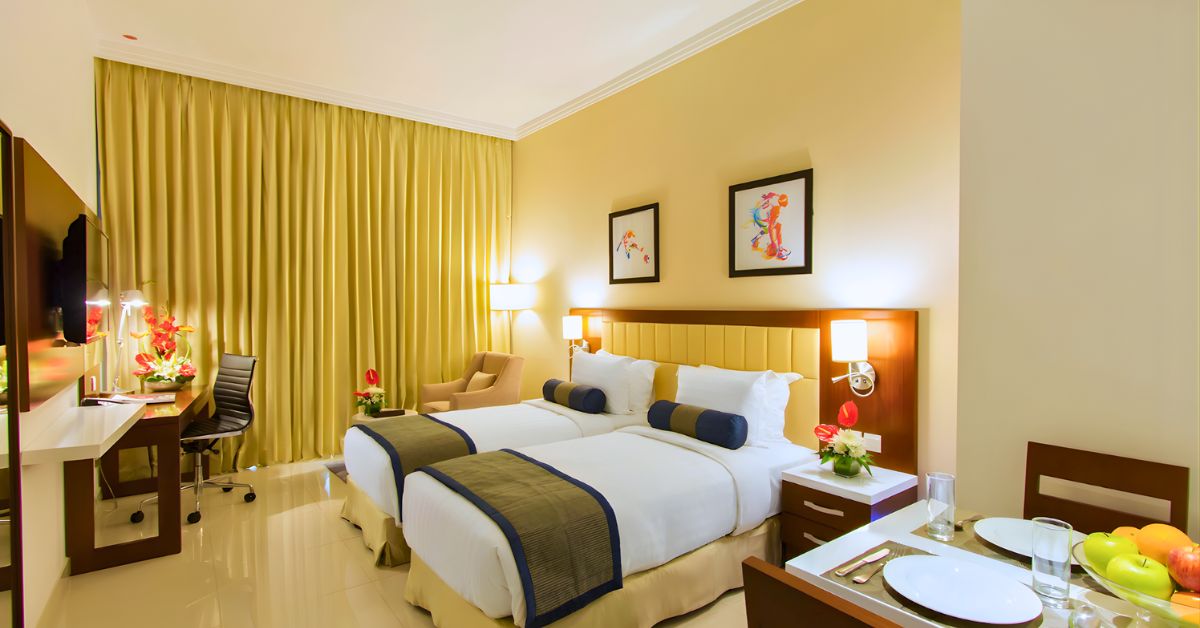
Hotel Mockup Room FF&E Dubai: Do You Need It, and What Should You Approve?
Every Dubai hotel project eventually faces the same question: Should you build a hotel mockup room for FF&E before production begins? For developers in Dubai managing large FF&E procurement packages, this decision directly affects finish accuracy, QC benchmarks, and delivery sequencing.
One path says: skip the mockup room, trust the supplier samples, and push straight to bulk production to protect the schedule. The other says: invest time upfront in a proper FF&E mockup room, approve every finish, hardware item, and tolerance before production starts, and eliminate the rework, delay, and cost overruns that derail openings.
The right path is not always obvious. This blog gives you the decision rule, the approval checklist, and the sign-off system that connects directly to QC benchmarks, dispatch evidence, and Dubai delivery sequencing.
Quick Answer:
Should You Build a Hotel FF&E Mockup Room in Dubai?
You likely need a mockup room if your project has:
- Custom casegoods
- Multiple finishes across room types
- 100+ rooms
- Operator brand standards
- Phased handovers or limited schedule float
You may not need a full mockup room if your project has:
- Low quantities with catalogue products
- Repeat supplier with proven history
- Like-for-like replacement scope
Key Takeaways
- Mockup room = production benchmark, not a showroom or design review
- Approvals must cover finishes, tolerances, hardware, upholstery, and installation fitment
- Signed mockup becomes the QC reference used at every pre-dispatch inspection
What a Hotel FF&E Mockup Room Is (and What It Is Not)
A hotel FF&E mockup room is not a showroom. It is not a staging exercise for branding photography. It is a production benchmark and execution rehearsal assembled before bulk manufacturing begins. It contains one set of production-intent pieces: a wardrobe, a bed with a headboard, nightstands, a desk and chair, soft seating, and bathroom vanity units, built exactly as the factory intends to build them at scale.
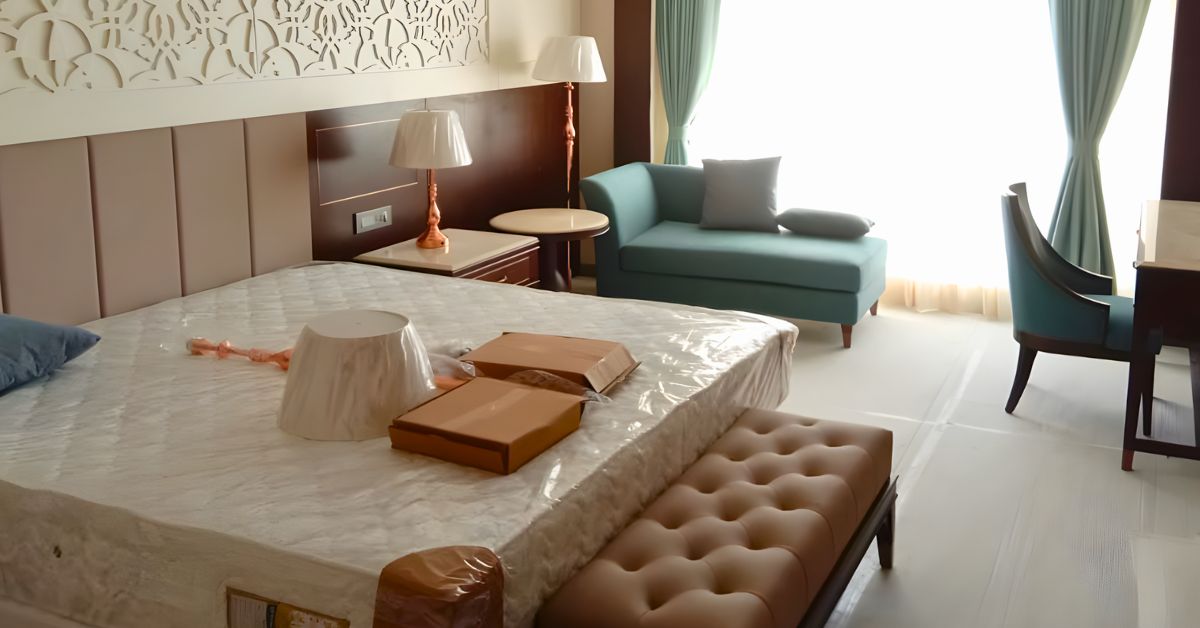
The mockup room is where your project team, operator, and procurement partner sit in the same space, under real lighting, and make pass-or-fail decisions on every finish, every hardware item, every dimension tolerance, and every interface detail. Those decisions are documented and signed off. That signed-off set becomes the reference for every QC inspection checkpoint through the production and pre-dispatch process.
Why a Hotel Mockup Room for FF&E Is Critical on Dubai Projects
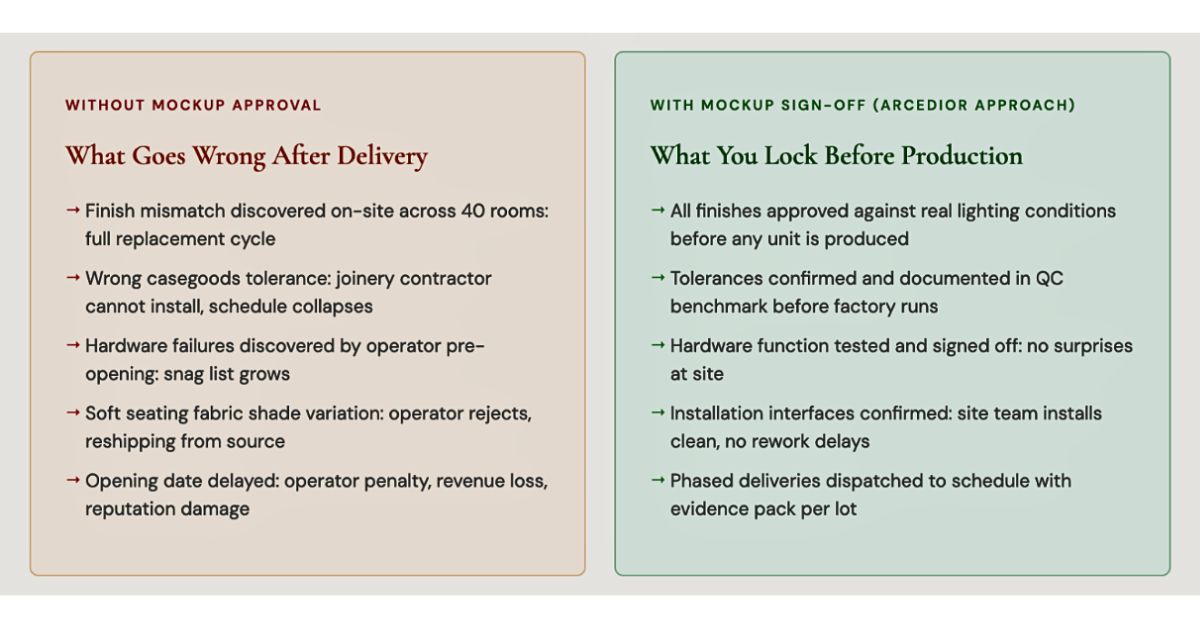
The hotel mockup room for FF&E is the single most effective mechanism for preventing production errors before they reach the site. On Dubai projects, where lead times run 10 to 18 weeks, and site access is strictly controlled, discovering a finish mismatch or tolerance failure after delivery creates a rework cycle that has no clean solution. The mockup room eliminates that discovery moment by locking every specification before bulk production begins.
This is the same mockup-first logic applied during FF&E procurement coordination for the Auris Fakhruddin Hotel Apartments project, where approvals had to support quality control and delivery sequencing rather than remain informal design-stage comments.
When a Hotel Mockup Room Is Worth It: Decision Triggers
The question most hotel developers in Dubai ask is not "what is a mockup room" but "do I actually need one for my specific project?" The answer depends on your risk profile across five dimensions.
Project Trigger | Mockup Needed? | Why It Matters |
Custom casegoods with bespoke finishes | YES | No reference product exists. Mockup is the only way to lock the benchmark before production. |
100+ rooms with multi-category FF&E BOQ | YES | Rework cost at scale is exponential. A 3% rejection rate on 200 rooms is 6 full room sets. |
Multiple finishes across room types | YES | Finish drift between categories (casegoods vs. panelling vs. joinery) is the single most common failure mode. |
Operator brand standards in play | YES | International brands require documented sign-off; verbal approvals do not satisfy OS&E compliance review. |
Tight phased handover, no float in schedule | YES | Any rework event after delivery in Dubai occupies congested site access windows and delays floor openings. |
Standard catalogue items, proven supplier history | EVALUATE | Sample approval may suffice if quantities are low and operator standards are flexible. |
Small refurbishment (<30 rooms, like-for-like) | LOWER PRIORITY | Risk exposure is limited. Sample + QC inspection may be proportionate. |
Why Samples Alone Are Not Enough
A finish sample can confirm colour or texture in isolation, but it cannot show how wardrobes, headboards, vanities, bedside units, and soft seating work together in one room. A full mockup test finish harmony, dimensional alignment, hardware performance, and installation interfaces under real lighting and site-like conditions. This is why sample approval alone is not sufficient for custom projects with multiple finish categories or phased floor releases.
Hotel Mockup Room FF&E Dubai: What Developers Must Approve Before Production
Quick Answer: What Should You Approve in a Hotel Mockup Room?
- Dimensions and tolerances
- Finish shade, sheen, and grain direction
- Hardware function and alignment
- Upholstery seams, comfort, and fabric match
- Wall clearances and installation interfaces
- Documented pass/fail remarks with sign-off authority
Pass-or-Fail Approval Checklist
The hotel FF&E mockup room approval checklist is the core output of the exercise. Each category below carries specific pass-or-fail criteria. Vague approvals create disputes in production. Every item needs a documented outcome: approved, approved with conditions, or rejected with a revision brief.
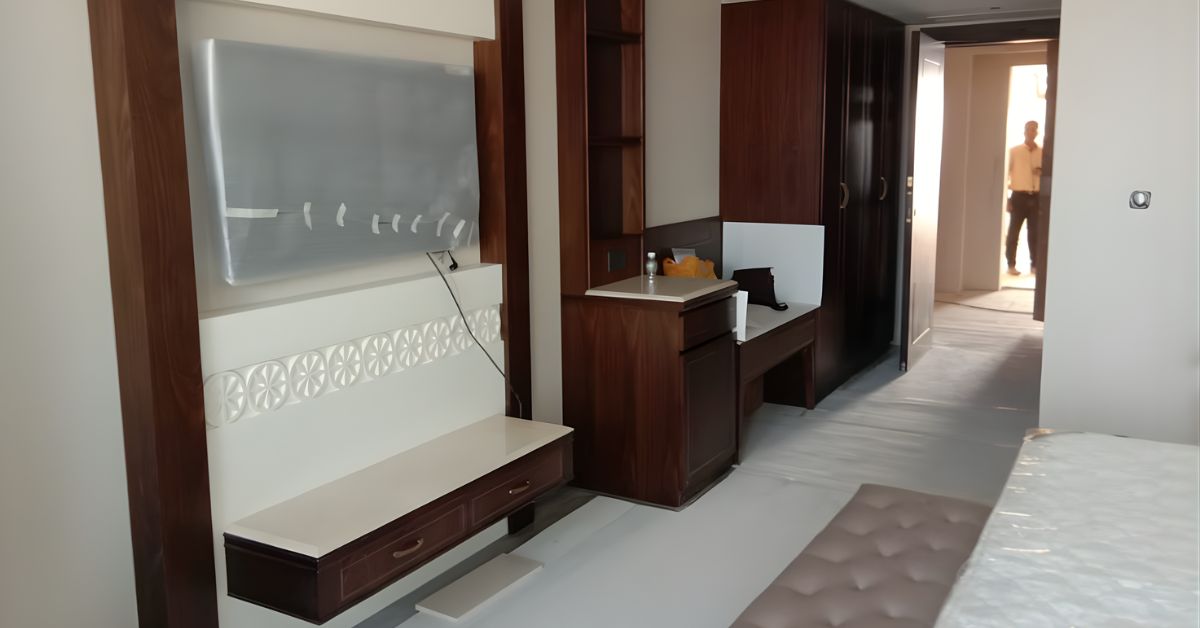
Casegoods (Wardrobe, Nightstands, Vanities, Headboards)
Soft Seating (Chairs, Sofas, Stools)
Hardware & Functionality
Finishes Under Real Lighting
Installation Interfaces
Tolerance Standards: What to Enforce Before Bulk Production
Tolerance checks are the most under-documented part of the hotel mockup room approval process. The table below provides a working reference for casegoods tolerance checklist items that Arcedior applies across hospitality furniture procurement projects.
Item | Measurement Point | Accepted Tolerance | Failure Impact |
Wardrobe carcass | Height, width, depth | ±2mm | Fitment failure in the alcove; skirting clash |
Door reveal (all casegoods) | Gap around the door leaf | ±1mm | Visible inconsistency across 200 rooms; guest perception issue |
Drawer gap differential | Side-to-side, top-to-bottom | Max 1.5mm | Operator snag list; delays pre-opening punch-list sign-off |
Handle/pull height | Floor to pull centre | ±1.5mm | Visual alignment failure on multi-drawer units |
Headboard panel alignment | Top edge vs. wall mount rail | ±3mm | Side lamp misalignment; shadow gap visible from the bed |
Soft seating leg height | Floor to seat pad surface | ±4mm | Desk height mismatch; ergonomic failure report |
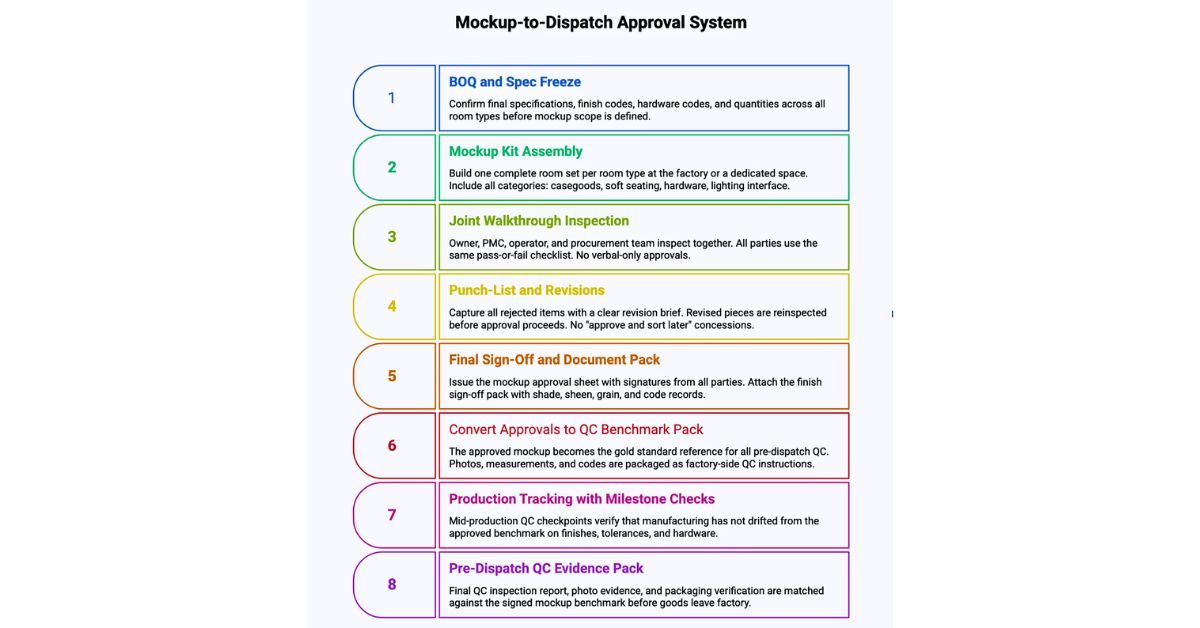
Hotel FF&E Mockup Approval Workflow: 8 Steps
The mockup sign-off before bulk production is only valuable if it connects directly to QC benchmarks and dispatch evidence. Below is the hotel FF&E sample approval workflow that Arcedior implements across procurement projects in Dubai and the UAE.
- Freeze BOQ and specifications
- Define mockup scope (full room or partial set)
- Produce a mockup furniture set
- Joint inspection with owner, operator, and PMC
- Document punch-list revisions
- Final mockup approval sign-off
- Convert approval into QC benchmark pack
- Use the approved mockup for pre-dispatch inspections
Download Free Resource
Mockup Approval Sheet + Finish Sign-Off Pack
A ready-to-use PDF with pass-or-fail approval fields, finish code recording, QC benchmark rules, and sign-off columns for owner, operator, and PMC. Built for Dubai hotel projects.Mockup Cost vs. Rework Cost: The Real Calculation
The mockup room cost vs. rework cost comparison is the decision most Dubai developers need before committing. A mockup room for a 200-room hotel typically represents 0.3% to 0.8% of the total FF&E budget. The rework events it prevents routinely cost 3% to 12% of that same budget when compounded across replacements, reshipping, labour, site access delays, and opening date penalties.
Quick Reference: When Is a Mockup Required?
Scenario | Mockup Required | Risk Without Mockup |
|---|---|---|
Custom casegoods | Yes | Finish mismatch, fitment failure |
150+ rooms | Yes | Rework cost multiplies across scale |
Multiple finish palettes | Yes | Cross-category finish mismatch |
Catalogue furniture | Sometimes | Depends on supplier history |
Dubai Execution: Why Mockup Approvals Hit Differently Here
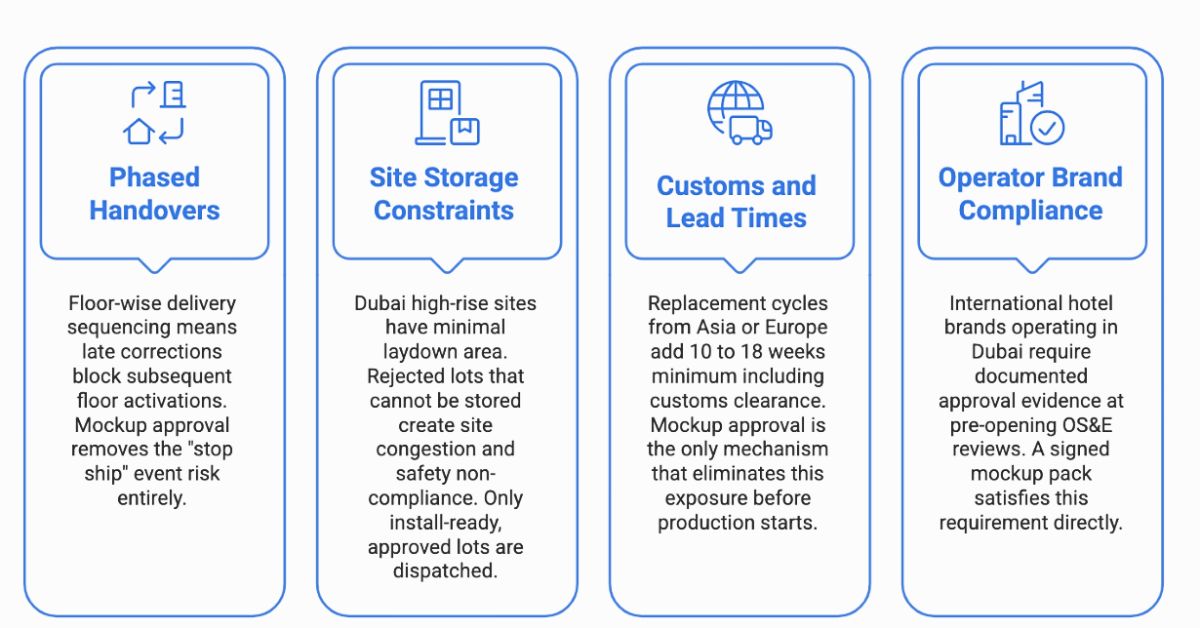
The hotel FF&E sample approval process in Dubai carries risks that do not exist in other markets. Dubai projects operate under phased floor release schedules, restricted loading windows, limited back-of-house storage, and an opening-date risk that is commercially non-negotiable. A single batch of non-conforming furniture creates a stop-ship event that blocks install-ready lot planning and delays floor activations across the entire handover sequence.
Dubai Hotel Projects: Execution Constraints That Make Mockups Essential
Hotel projects in Dubai operate under execution conditions that amplify the risk of production errors. Typical constraints include:
- Limited on-site storage for FF&E deliveries
- Restricted loading dock access windows
- Phased floor-wise handovers
- Strict operator pre-opening inspections
A mockup room allows the project team to lock approvals early so bulk production and dispatch can proceed without late "stop-ship" events that disrupt installation sequencing. These constraints apply across Dubai and the wider UAE hospitality market, where procurement timelines are commercially non-negotiable.
Common Mockup Approval Mistakes
The most common mistakes are approving loose samples instead of a full room set, signing off finishes under only one lighting condition, skipping hardware cycle testing, failing to record exact material and hardware codes, and not converting mockup approvals into QC checkpoints before dispatch. Each of these gaps creates a dispute that is expensive to resolve after bulk production has already started.
Conclusion
For hotel developers in Dubai, an FF&E mockup room is not just a review step. It is the point where finishes, tolerances, hardware, and installation interfaces are approved before production risk multiplies across hundreds of rooms. When approvals are documented properly, the mockup becomes the benchmark for QC, dispatch, and site coordination, helping projects open with fewer surprises, less rework, and better control over schedule.
Planning a Hotel Project in Dubai?
Share your BOQ, specifications, project location, and target handover plan. Our team can review the mockup scope, approval checkpoints, QC requirements, and delivery sequencing needed before bulk production starts.