Hybrid Workspace Furniture Gurgaon | Get the WFH Ratio
Hybrid Workspace Furniture Gurgaon: How to Get the Furniture Mix Right Without Oversupplying Desks You Won't Need
Last reviewed: June 2026. If your Gurgaon office has 80 desks and 40 of them are empty on any given Tuesday, you haven't designed a hybrid workspace. You've installed a traditional office that people stopped using fully. This guide gives you the ratio, the zone plan, and the procurement sequence to fix that.
Most companies in DLF Cyber City, Udyog Vihar, and Golf Course Road made the same call in 2021: keep the desks, wait for people to come back. Two years later, hybrid workspace furniture in Gurgaon is still largely a legacy layout problem. The desks are there. The occupancy isn't.
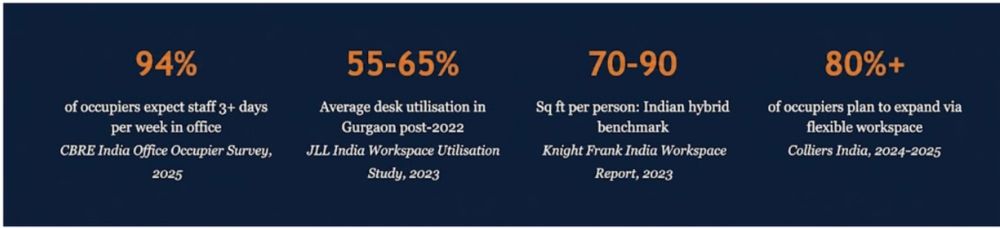
According to the JLL India Workspace Utilisation Study (2023), average desk utilisation in Gurgaon corporate offices dropped to 55–65% post-2022. That means a 100-seat office is running at the density of a 55-seat floor on most days. The furniture bought for the full headcount is now a sunk cost that also consumes real estate.
Definition
CBRE India's 2025 Office Occupier Survey found that 94% of occupiers now expect employees to spend at least three days per week in the office. That expectation has stabilised. It is no longer a transitional phase. It is the baseline most Gurgaon companies are planning around.
The problem isn't hybrid work. Procurement habits haven't caught up. This guide walks through how to recalculate hybrid workspace furniture in Gurgaon from scratch: how many seats, what types, where they go, what specs they need, and how to source them without over-ordering.
Quick Answer: What office furniture should Gurgaon companies buy for a hybrid team?
Gurgaon Hybrid Office: Key Benchmarks at a Glance New
Metric | Benchmark | Source |
Average Gurgaon desk utilisation post-2022 | 55–65% | JLL India Workspace Utilisation Study, 2023 |
Occupiers expecting staff 3+ days/week in the office | 94% | CBRE India Office Occupier Survey, 2025 |
Indian hybrid office floor area benchmark | 70–90 sq ft per person | Knight Frank India Workspace Report, 2023 |
Occupiers planning flexible workspace expansion | 80%+ | Colliers India, 2024–2025 |
Gurgaon share of Delhi NCR Grade A office absorption | ~30% | JLL India Office Markets Report, Q4 2024 |
Full procurement cycle: BOQ to installation | 14–18 weeks | Arcedior BOQ analysis, 2025 |
Why Most Gurgaon Offices Are Oversupplying Fixed Desks in the Hybrid Era
The fixed-desk trap has a simple origin. When companies ordered furniture in 2018 or 2019, they ordered by headcount. 120 employees, 120 desks. That model made sense when attendance was close to 100%.
Post-WFH shift, that math no longer holds. If 40–50% of your staff works from home on any given day, your effective daily occupancy is 60–70 people, not 120. You're maintaining and paying rent on 50+ desks that sit empty from Monday to Thursday. In Cyber City and Golf Course Road office towers, where per-sq-ft costs are among the highest in Delhi NCR, that's a real number.
The second problem is the one nobody talks about: the empty desks take space from zones that would actually get used. A 100-sq-ft lounge cluster, a 4-person focus pod, and three phone booths for confidential calls. None of that exists because the fixed-desk bank occupies the floor plate.
Pro Tip
Older buildings in Udyog Vihar Phases 1–6 have tighter floor plates, lower floor-to-ceiling heights, and less natural light. That makes the zone mix even more important. You can't compensate for a cramped floor with more furniture. You compensate by putting less of the wrong furniture in.
JLL's India data also shows that Gurgaon accounts for approximately 30% of Delhi NCR's Grade A office absorption (JLL India Office Markets Report, Q4 2024). That concentration means fit-out decisions made in Gurugram right now set the template for a significant share of NCR's corporate workspace baseline.
You're About to Approve a Large Furniture Order. Have You Done These 47 Things?
Download the 47-Point audit and run it against your current plan before you approve a vendor, sign a PO, or release production.
How Hybrid Workspace Planning Differs Across Gurgaon Office Clusters
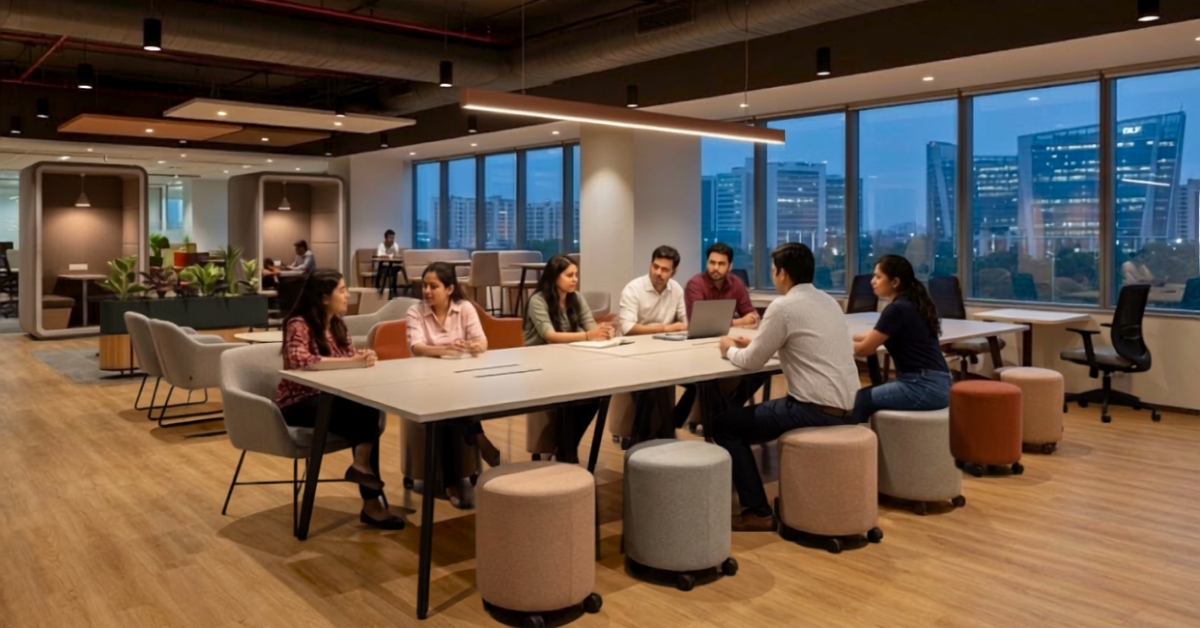
Most hybrid office guides treat Gurgaon as one market. It isn't. The floor plate sizes, rental costs, building ages, and tenant profiles across Cyber City, Golf Course Road, Udyog Vihar, and the Sector 32–44 corridor are different enough to change the furniture calculus in each cluster. Here is what that means for procurement.
DLF Cyber City: Higher rental cost makes desk reduction most valuable here
Cyber City commands some of the highest per-sq-ft lease rates in Delhi NCR. At Rs 110–130/sq ft/month, every desk you eliminate and replace with a shared zone produces a measurable lease saving at renewal. Hybrid seating ratios of 0.6–0.7 desks per person are financially justified even for conservative occupiers. Floor plates are large and generally well-serviced, which makes acoustic pod installation straightforward.
Golf Course Road: Larger floor plates allow more generous collaboration zone allocation
Golf Course Road towers typically offer wider floor plates and better natural light than older Gurgaon stock. That gives procurement teams more flexibility to allocate 20–25% of the floor to lounge, café, and collaboration zones without squeezing the workstation bank. If your team is client-facing or sales-driven, this cluster supports a higher lounge-to-desk ratio than most Gurgaon locations allow.
Udyog Vihar: Older buildings require more efficient furniture layouts
Udyog Vihar Phases 1–6 have smaller and more irregular floor plates, lower slab-to-slab heights, and older HVAC systems. That limits acoustic pod options since many pods require 2.2m+ internal clearance for ventilation compliance. Panel-based acoustic dividers work better here than enclosed pods in Phase 1. Furniture selection needs to account for tighter column grids and narrower corridors for delivery.
Sector 32 and Sector 44: Tech and IT firms here need higher focus pod allocation
The Sector 32–44 corridor houses a concentration of technology, IT services, and product companies. These teams typically run more deep-focus work and fewer client meetings than BFSI or sales organisations. Focus pod allocation of 15–20% of total seating (versus the standard 10%) is common in fit-outs here. Acoustic specifications also tend to be stricter, with NRC ≥0.75 pods preferred over the baseline NRC ≥0.7.
Key Takeaway
How to Calculate the Right Furniture Mix for Your WFH Ratio
Definition
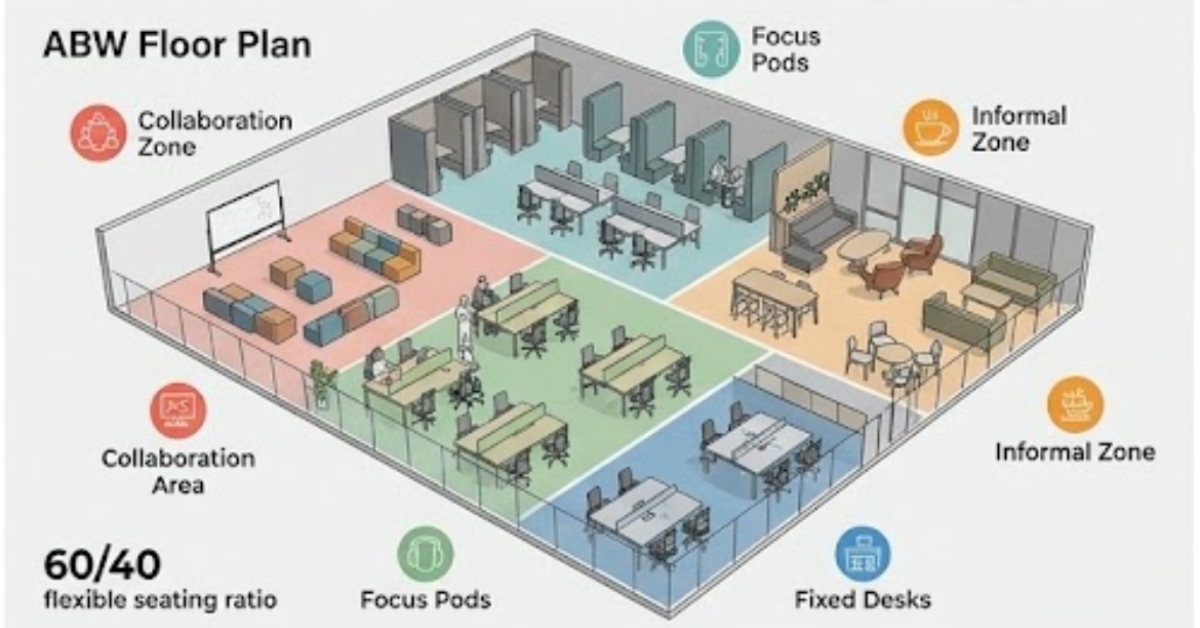
ABW in Indian offices runs slightly differently from Western models. Indian team culture includes more informal collaboration, longer social interaction at break times, and a preference for side-by-side work over distributed individual workstations. That means your collaborative and lounge zone needs to account for a slightly higher proportion of seats than a UK or Singapore ABW guide would suggest.
Over 80% of occupiers plan to expand through flexible workspace solutions over the next three to five years, according to Colliers India. The numbers below are calibrated for Indian hybrid teams, not repurposed from a Western office design playbook.
The Hybrid Furniture Mix Formula
Start with your daily peak attendance, not your headcount. Then split it across zone types.
WFH Ratio | Peak Attendance | Desks per Employee | Recommended Model | Sq ft Target (per person) |
20% | 80 of 100 | 0.9 | Mostly assigned seating | 110–120 sq ft |
40% | 60 of 100 | 0.7 | Hybrid seating | 90–100 sq ft |
60% | 40 of 100 | 0.5 | Activity-based working | 75–90 sq ft |
80% | 20 of 100 | 0.3 | Collaboration-focused office | 60–75 sq ft |
Formula: Daily peak = Total headcount × (1 − WFH ratio). Apply the percentages above to that peak number.
Zone | 20% WFH | 40% WFH | 60% WFH | 80% WFH |
Fixed desks | 56 seats | 21 seats | 14 seats | 6 seats |
Hot-desk / flexible | 16 seats | 27 seats | 18 seats | 8 seats |
Focus pods | 4 units | 6 units | 4 units | 2 units |
Lounge/collaboration | 4 seats | 6 seats | 4 seats | 4 seats |
Percentages: 35% fixed, 45% hot-desk, 10% focus pods, 10% lounge. Adjust the lounge upward for client-facing and sales teams.
Interactive Calculator
Hybrid Workspace Furniture Planner
Enter your headcount and WFH ratio. See your desk split, zone counts, and floor area estimate instantly.
Peak daily
in office
60
Fixed desks
21
Hot-desk seats
27
Focus pods / booths
6
Estimated floor area (Knight Frank India 70–90 sq ft/person hybrid benchmark)
Add a 10–15% buffer above peak for project spikes and all-hands days. Verify with a 10-day badge scan before finalising your BOQ.
Using those ratios for a 100-person team on a 40% WFH ratio: 21 fixed desks, 27 hot-desk seats, 6 focus pod seats, and 6 phone booth units. That's a 60-seat functional office on a floor that used to need 100 desks. The remaining floor area goes to lounge clusters and a café corner. Those aren't decorative. They're the collaboration infrastructure that keeps a hybrid team functional when 60 people are physically present.
Knight Frank India's Workspace Report (2023) cites 70–90 sq ft per person as the emerging Indian hybrid benchmark, down from 120+ sq ft in fully assigned traditional setups. For a 60-person peak occupancy, your hybrid floor should sit in the 4,200–5,400 sq ft range to hit that benchmark.
Ready to Plan Your Hybrid Office Procurement?
If you already know your floor area, headcount, and WFH ratio, the next step is not browsing furniture catalogs. The next step is confirming whether your furniture mix, specifications, lead times, and delivery sequence actually support your handover date.
Share your floor plan, BOQ, or workspace requirements with Arcedior. We'll review the occupancy assumptions, procurement timeline, sample approval requirements, QC checkpoints, and delivery constraints before production starts.
Zone-by-Zone: What Furniture Each Hybrid Zone Actually Needs
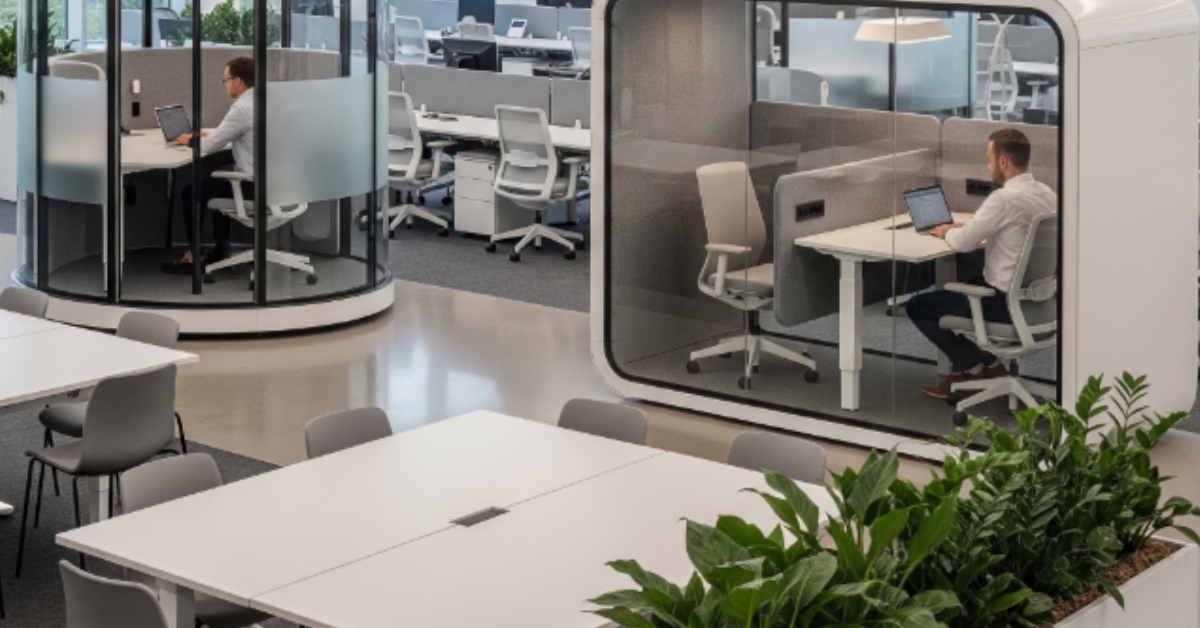
Getting the ratio right is the first step. Getting the specs right for each zone is where most Gurgaon procurement projects stall. The table below gives you the furniture types, spec requirements, and key notes for each zone in a standard hybrid office fit-out.
Zone | Furniture Required | Key Spec Requirements |
Fixed Workstation Zone | Adjustable workstations, BIFMA-rated task chairs, and under-desk pedestals | HPL or scratch-resistant laminate tops; commercial-grade upholstery; powder-coated steel frames; integrated cable management |
Hot-Desk Zone | Lightweight adjustable desks, stackable task chairs | Clean-desk policy compatible; no personal storage; easy surface wipe-down; castors or glides for reconfiguration |
Collaboration Tables | Large round or oval tables, soft seating clusters | Modular configuration; durable fabric upholstery; easy cleanability; scratch-resistant table surfaces |
Focus Pods / Phone Booths | Acoustic pod units (single and 2-person) | NRC (Noise Reduction Coefficient) ≥ 0.7; active ventilation; power and USB access; acoustic panel dividers for open-plan buffer |
Breakout / Lounge | Lounge chairs, ottomans, low tables, modular sofas | High-traffic upholstery rated for commercial use; scratch-resistant frame finishes; easy reconfiguration for different group sizes |
Informal Café Corner | High tables, bar stools, soft seating | Stain-resistant surfaces; F&B-adjacent durability; anodised or powder-coated metal frames; easy floor clean access |
Definition
Note on HPL: High-pressure laminate is a commercial-grade surfacing material commonly used on workstation tops due to its resistance to scratches, stains, and daily wear. In a hot-desk environment where a surface gets touched by 3–4 users per day, HPL is the standard, not an upgrade. Specify finish codes from laminate manufacturers rather than colour names.
Key Takeaway
Lead Time and Procurement: What to Expect When Sourcing Hybrid Office Furniture in Gurgaon
The typical assumption for office furniture procurement is 4–6 weeks. The actual cycle for a custom hybrid office fit-out runs closer to 14–18 weeks from BOQ sign-off to installation. That gap has real consequences. A Cyber City refurbishment that plans to be operational in Q2 but only starts procurement in February will run 6–8 weeks short. The same phased approach applies to hybrid workspace furniture across NCR and Bangalore offices, where multi-city rollouts need unified BOQ management to stay on schedule.
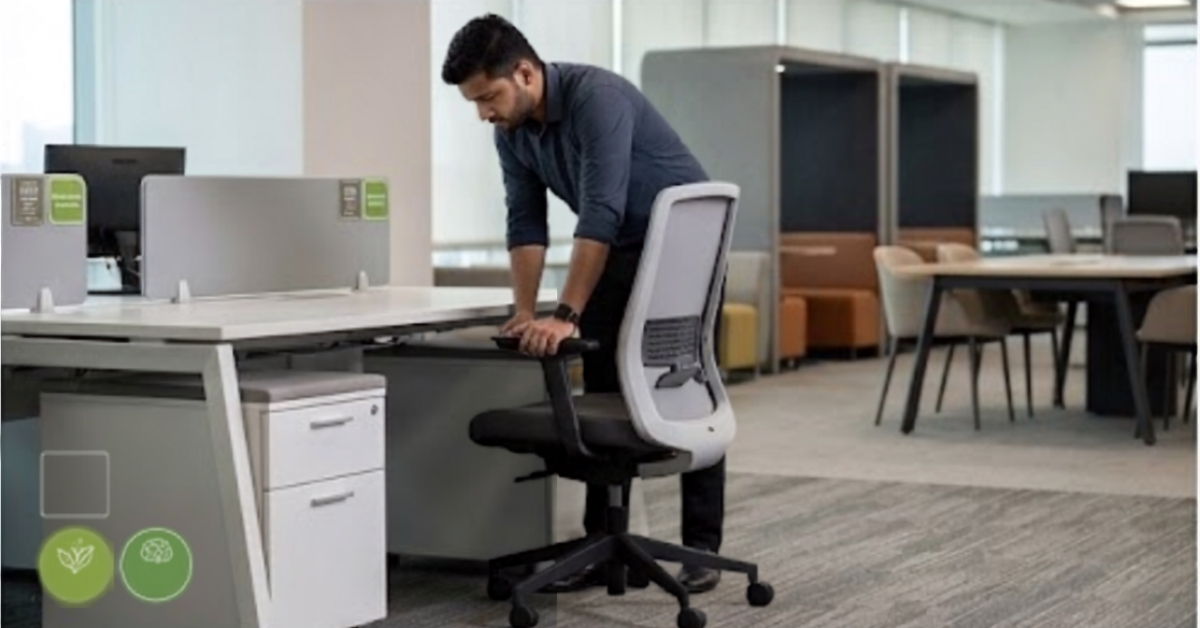
Procurement Timeline: Custom Hybrid Office Furniture in Gurgaon
BOQ Review and Sourcing Route Confirmation: 3–5 working days
Sourcing partner reviews your BOQ, maps items to production routes (standard vs. custom), and confirms MOQ thresholds per category.
Sample Submission and Approval: 10–15 working days
Physical samples submitted for finish, shade, upholstery, and hardware approval. Complex custom specs (veneer, acoustic pods) may extend this window.
Bulk Production: 5–8 weeks (standard) / 8–12 weeks (custom)
Standard HPL workstations, powder-coated frames, and commercial chairs run 5–8 weeks. Custom finishes, upholstered panels, and acoustic pods require 8–12 weeks.
Pre-Dispatch QC Inspection: 4–7 working days
Factory-level QC against approved samples, BOQ dimensions, hardware function, surface condition, and packing quality. Photo and video documentation shared before dispatch sign-off.
Shipping and Delivery to the Gurgaon Site: 3–10 working days
Depends on origin, transport mode, and site access. Bulk deliveries to Cyber City and Udyog Vihar need loading dock scheduling 48–72 hours in advance.
Installation Coordination: Based on site readiness and phasing plan
Installation is phased around the floor handover. A sourcing partner aligns delivery batches with the main contractor's schedule, not just production completion dates.
For activity-based workspace furniture procurement across NCR and Bangalore offices, the same phased approach applies. A BOQ-based furniture sourcing process that accounts for zone priority (workstations first, collaborative zones second) keeps the critical path on track even when floors don't hand over simultaneously.
QC Checklist Before Office Furniture Is Delivered to Your Gurgaon Office
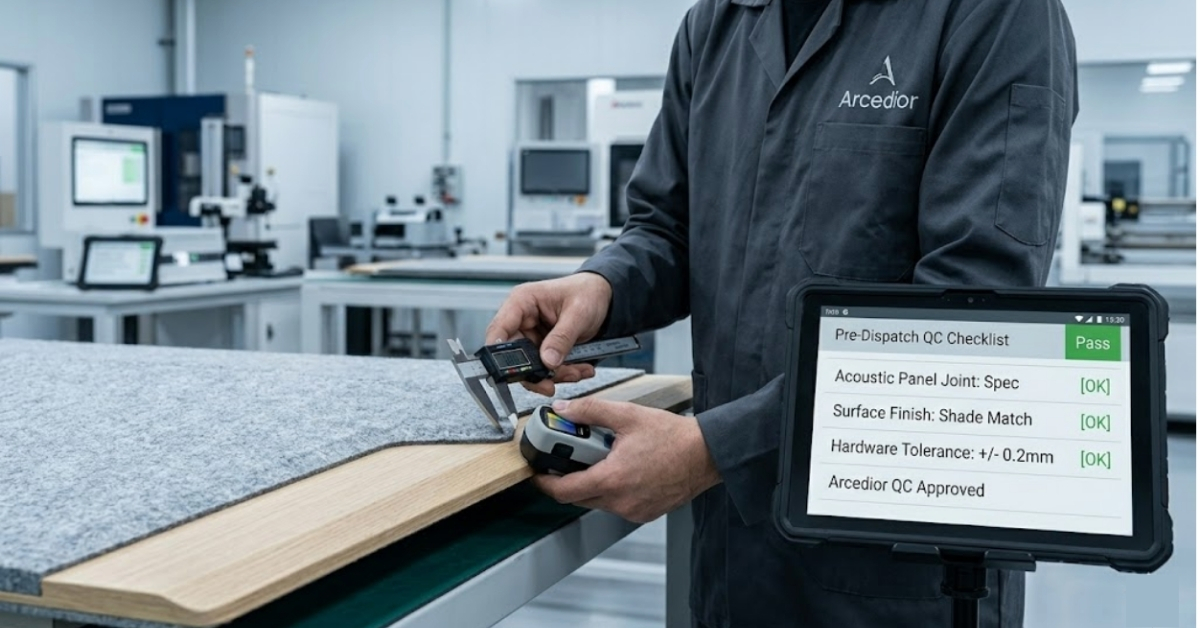
The most expensive QC failure in office furniture procurement isn't a damaged item. It's a bulk shipment of 80 workstation tops in the wrong shade of walnut, or 40 chairs with lumbar adjustment mechanisms that bind under normal use. By the time those arrive on site, production is complete, the vendor has been paid, and the project timeline is 3 weeks from handover.
Pre-dispatch QC inspection is the checkpoint that catches those problems before they become site problems. It's not an added service. It's what a sourcing and procurement partner does before signing off on any bulk office furniture shipment.
Pre-Dispatch QC Checklist: Hybrid Office Furniture
Documents to Prepare Before Furniture Procurement Starts New Section
This is the section most Gurgaon fit-out managers skip, then regret. Starting procurement without the right documents in place is why sample rounds get extended, production gets delayed, and delivery doesn't align with site handover. A sourcing partner can only move as fast as the information they have to work with.
Pre-Procurement Document Checklist
- Approved floor plan
- Bill of Quantities (BOQ)
- Finish schedule
- Upholstery references
- Delivery constraints
- Lift dimensions
- Loading dock rules and booking window
- Target handover date by floor or phase
- IT and power requirements per zone
With zone annotations showing workstation areas, collaboration zones, pod locations, and café corners. Dimensioned drawings preferred. Indicates column grid, fire exits, and server/IT room positions.
Item-by-item list with descriptions, dimensions, quantities, and finish requirements. Vague BOQs produce vague quotes. The more specific the BOQ, the fewer the revision rounds and the more accurate the lead time estimate.
Laminate codes (not colour names), upholstery fabric references with grade and colour, metal finish specifications (RAL codes or powder-coat references), and veneer species where applicable.
Fabric swatches or spec sheets for all upholstered items: task chairs, lounge seating, acoustic panels. Include grade (contract or residential), abrasion rating, and whether antimicrobial treatment is required.
Building access hours, lift dimensions (critical for acoustic pod delivery), loading dock availability, and advance booking requirements, and floor load limits for large deliveries.
Some Cyber City and Udyog Vihar towers have passenger lifts that cannot accommodate standard acoustic pod dimensions (typically 1.0m x 1.0m x 2.4m). Confirm lift internal dimensions before pod procurement begins, not after.
Most Grade A towers in Gurgaon require 48–72 hours advance notice for bulk furniture deliveries. Some buildings restrict delivery hours to before 9 am or after 7 pm to avoid lobby congestion.
Not just the final handover date. The date each floor or zone becomes available for installation. Multi-floor fit-outs almost never hand over simultaneously, so phased delivery scheduling requires phase-by-phase handover dates.
Workstations need a cable management design to match the power and data outlet positions on the floor. Hot-desk zones need USB and power access at every surface. Acoustic pods need dedicated power circuits. Share this with your sourcing partner before production starts, not during installation.
Pro Tip
What Procurement Managers Check Before Approving Any Office Furniture PO.
The 47-point hybrid office furniture checklist. Free. Fillable. Saves you from the mistakes that show up on site.
Specifications Arcedior Coordinates for Corporate Office Projects
Arcedior coordinates sourcing and procurement for corporate office fit-outs across Gurgaon's Cyber City corridor, Golf Course Road, and Udyog Vihar, working from client BOQs and coordinating directly with contract manufacturers. The specs below reflect standard execution capability for hybrid workspace procurement.

Getting Hybrid Workspace Furniture in Gurgaon Right: What It Actually Takes
A hybrid workspace isn't a smaller traditional office. It's a different configuration entirely. The furniture mix that works for a 100-seat Gurgaon team on a 40% WFH ratio looks nothing like the layout that team had in 2019.
Getting it right starts with the ratio: how many people are actually on-site at peak. That number, not your total headcount, drives how many desks you need. From there, the zone split determines what types of furniture go where. And the specs, lead times, and QC process determine whether what arrives on site matches what you ordered.
Across Gurgaon, Gurugram, and the broader NCR market, the offices that get this right tend to have one thing in common: they planned procurement from a BOQ, not from a furniture catalogue. They knew their WFH ratio before they briefed any vendor. And they had someone managing sourcing, QC, and logistics coordination rather than handling each of those separately.
That's the gap hybrid workspace furniture in Gurgaon has been missing. Not more product options. A better procurement process.
Ready to Plan Your Hybrid Office Procurement?
Share your floor area (sq ft), total headcount, WFH ratio, and target handover date. Arcedior will review your BOQ or workspace plan and recommend sourcing routes, a realistic procurement timeline, and QC checkpoints for each zone.