Meeting Room Furniture Specification London | 2026 Guide
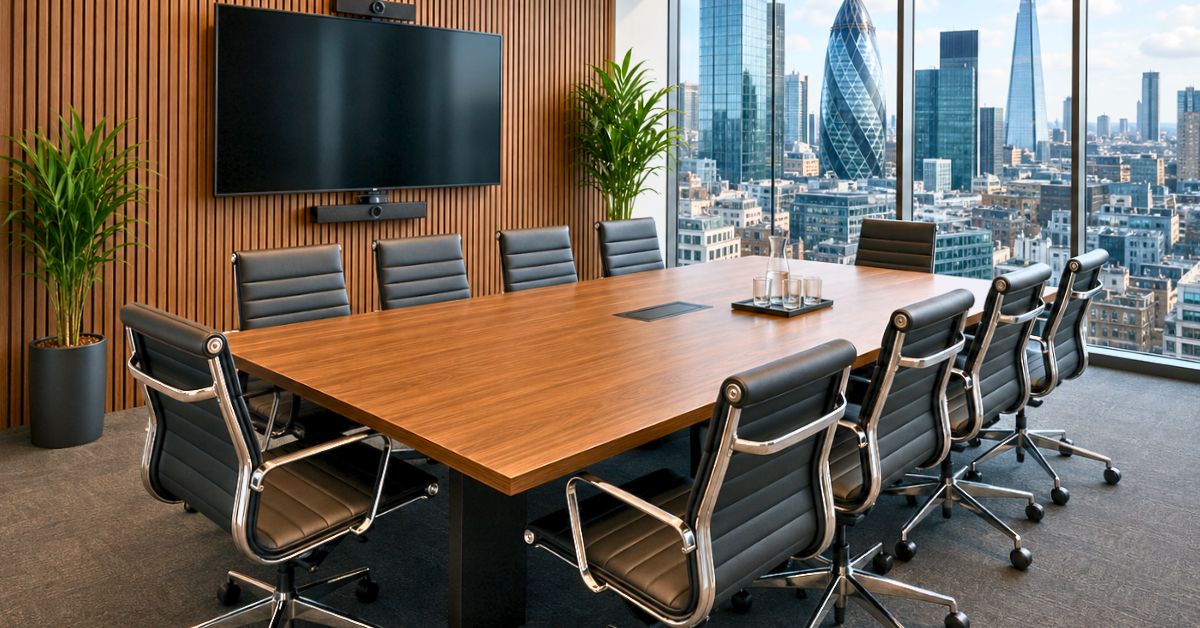
Meeting Room Furniture Specification London: The Complete Guide for Corporate Offices (2026)
Most London meeting room fit-outs get the look right and the specification wrong. The table dimensions are guessed. The chair fabric is selected from a swatch with no Martindale reference. The cable management is left to the contractor. Then, the delivery day arrives, and three things don't match the approved sample.
This guide is for office managers, corporate real estate leads, workplace consultants, and project managers handling fit-outs across the City of London, Canary Wharf, Mayfair, the West End, and beyond. It covers the actual meeting room furniture specification for London corporate offices, table sizes, chair standards, fire compliance, cable routing, acoustic ratings, and what sample approvals most commonly miss.
Quick Answer:
Why Meeting Room Furniture Specification Matters in London Corporate Offices
A furniture specification is a document that defines every measurable and testable property of a piece of furniture before it is made. It is not a mood board, a product link, or a verbal brief. For corporate office furniture procurement in London, it is the only document that protects the buyer when the delivery does not match expectations.
London adds specific pressure. Grade A landlords in buildings across the City and Canary Wharf routinely require BS 5852 Crib 5 fire compliance as a lease condition, not just a regulation. Fit-out timelines in London average 6 to 10 weeks for a meeting room refurb, which leaves very little time to fix a specification error after production has started. And London floor plates do not follow standard dimensions: column positions, lift lobbies, and room geometry regularly require non-standard table sizes that only custom manufacturing can address.
Without a written specification, you are relying on a supplier to guess what you mean. Most of the time, they will guess wrong on at least two things.
Based on office furniture procurement enquiries handled by Arcedior across London, GCC, and India projects during 2025 to 2026, the three most commonly missed specification items are cable management routing, fire compliance certification, and veneer grain direction. These three gaps account for a large share of furniture approval revisions and production restarts. Getting them in writing before the BOQ is issued saves more time than any other single step in the process.
Conference Table Sizing Matrix, 4, 6, 8, and 12-Seater Rooms
Conference table dimensions for London corporate offices follow a straightforward formula: 600mm of table length per seated person, 900mm circulation clearance at each end. Standard table height is 730mm to 740mm across all configurations.
The BCO (British Council for Offices) 2024 fit-out guide recommends a minimum 1,800mm table width for collaborative boardrooms designed for hybrid participation. London office floor plates, particularly in the City and Mayfair, often require custom table dimensions because standard sizes do not fit around existing columns or glazed partitions. Custom manufacturing to exact dimensions is the standard solution, not a premium add-on.
One missing specification can turn into a costly variation order.
The London Corporate Meeting Room Furniture Specification Sheet gives you the exact fields procurement teams often forget: Martindale ratings, Crib 5 compliance, cable management requirements, AV specifications, sustainability criteria, and approval sign-offs.
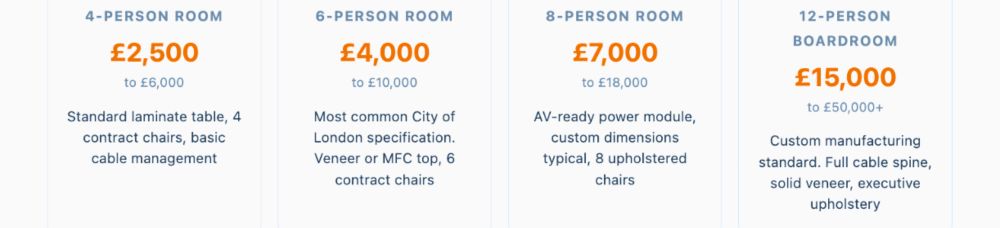
Typical Meeting Room Furniture Budget Ranges in London (2026)
This is the question most specification guides skip. People searching for specification guidance often need a cost anchor before they can take the brief to a budget holder. These ranges reflect fully specified contract-grade furniture, including tables, chairs, and standard cable management, but excluding AV integration hardware and installation.
What Drives Cost Up at Each Tier
The biggest variables are surface material, upholstery grade, and AV integration complexity. A 6-seater table in a standard MFC finish costs roughly half of the same footprint in book-matched veneer. Chair cost follows the same logic: a BIFMA-certified task-style meeting chair with basic fabric sits at around £180 to £350 per unit, while an executive upholstered chair with Crib 5 fabric and high-load certification runs £450 to £1,200.
Post-Brexit material sourcing from continental mills adds 5 to 10% to project costs where European laminates or technical fabrics are specified. This is now a fixed part of the cost model, not an anomaly.
Chair Specification for Meeting Rooms: What the Martindale Number Actually Means
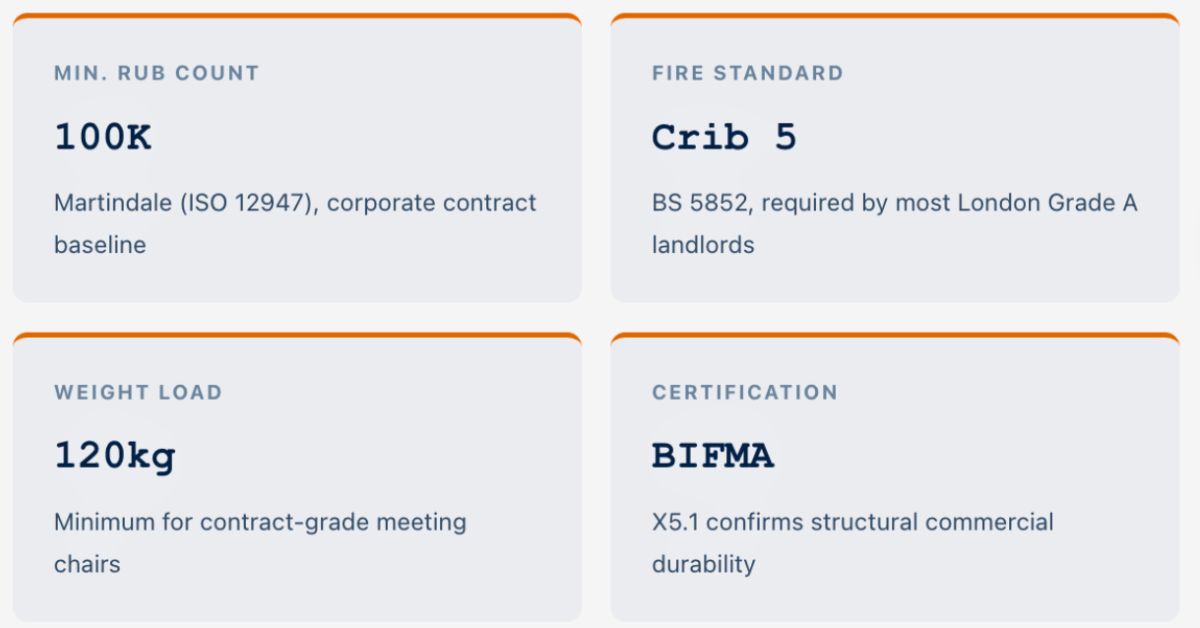
The Martindale rub test (ISO 12947) is the standard measure for upholstery durability in commercial environments. A fabric is rubbed against a standard abrasive under a set pressure until it shows visible wear. The number is how many rubs it survives.
Martindale Rub Count Requirements
For meeting room chairs specifically, the minimum for any London Grade A office is 100,000 rubs under ISO 12947. High-traffic boardrooms specify 150,000 rubs or above for fabric that sees continuous daily use. A fabric rated at 50,000 rubs is sold as "commercial grade" by some suppliers, but it is not appropriate for a meeting room chair used 8 hours a day. That distinction is not always clear on a product sheet.
Seat Dimensions
Meeting room chair seat depth typically runs 460mm to 500mm, seat height 440mm to 500mm, and is adjustable. Lumbar support is relevant for rooms where sessions run over 90 minutes. Frame spec should be powder-coated steel or solid aluminium with a 25-year commercial durability expectation.
BIFMA X5.1 Certification
BIFMA X5.1 certification confirms that a chair meets load and durability standards for commercial use. When procuring Grade A offices in Canary Wharf or similar, ask for the test certificate, not just a checkbox on the product sheet. A 120kg static load rating is the minimum for contract environments.
Fire Compliance for Chairs
BS 5852 Crib 5 applies to both seating and upholstered panels. Request the test certificate number and the independent testing body. Certificates issued by the manufacturer's own lab carry less weight than those from accredited third parties such as Warrington Fire or FIRA.
Not sure if your specification is complete? Send your BOQ or floor plan on WhatsApp. We'll highlight missing requirements before they become procurement problems.
Cable Management Specification for AV-Enabled Conference Tables
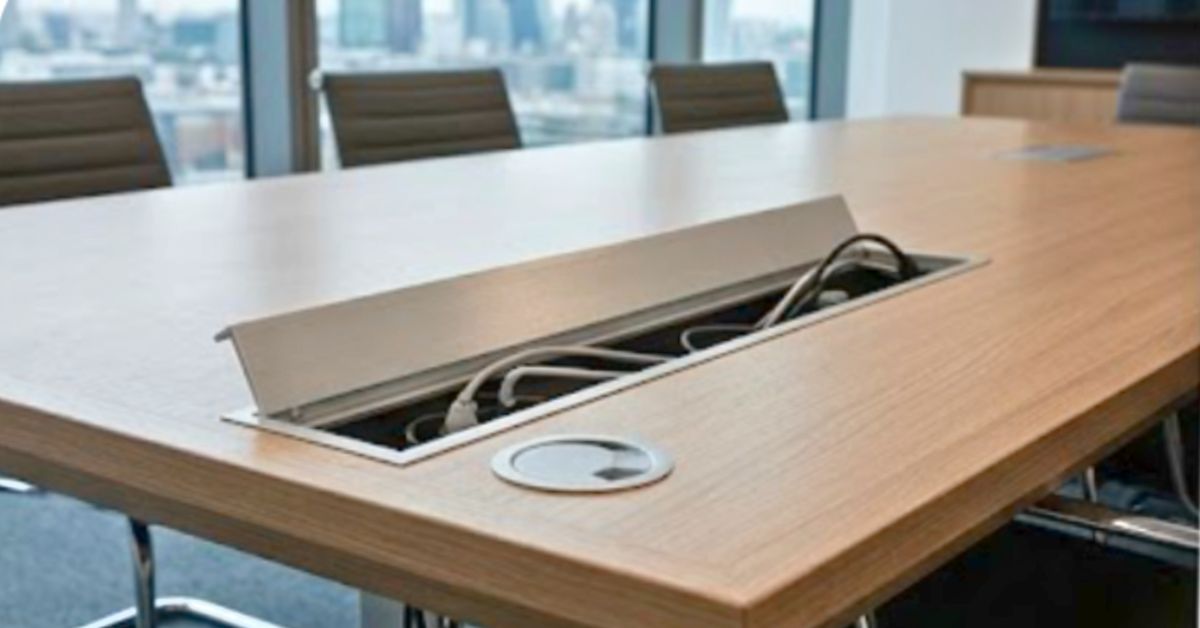
Cable management is the part of the meeting room furniture specification that gets agreed verbally, forgotten in production, and argued about on installation day. Specify it in writing before the table is made.
- Flush grommet: 60mm diameter, standard. Use 80mm where a higher data port density is required.
- Surface-mounted cable spine: Used on tables wider than 1,100mm where under-table routing is not practical.
- Power module per 2 seats: 1x 13A socket, 2x USB-A, 1x USB-C, 1x HDMI minimum. Specify the module brand for compatibility with the AV integrator's kit.
- Screen sightlines: Table width must stay under 1,100mm for clear sightlines across a 75-inch display. Wider tables need a confirmed AV layout before the table dimension is locked.
- Underframe cable channel: Minimum 50mm x 30mm routed channel for clean power cord management to the floor socket.
- Wireless charging: Specify Qi-standard pads at 15W minimum if the brief includes wireless charging. This must be confirmed with the AV integrator before the table goes to production, as pod positioning affects both the surface material spec and the underframe cable routing.
Note for AV integration:
Acoustic Specification: What the Furniture Has to Do
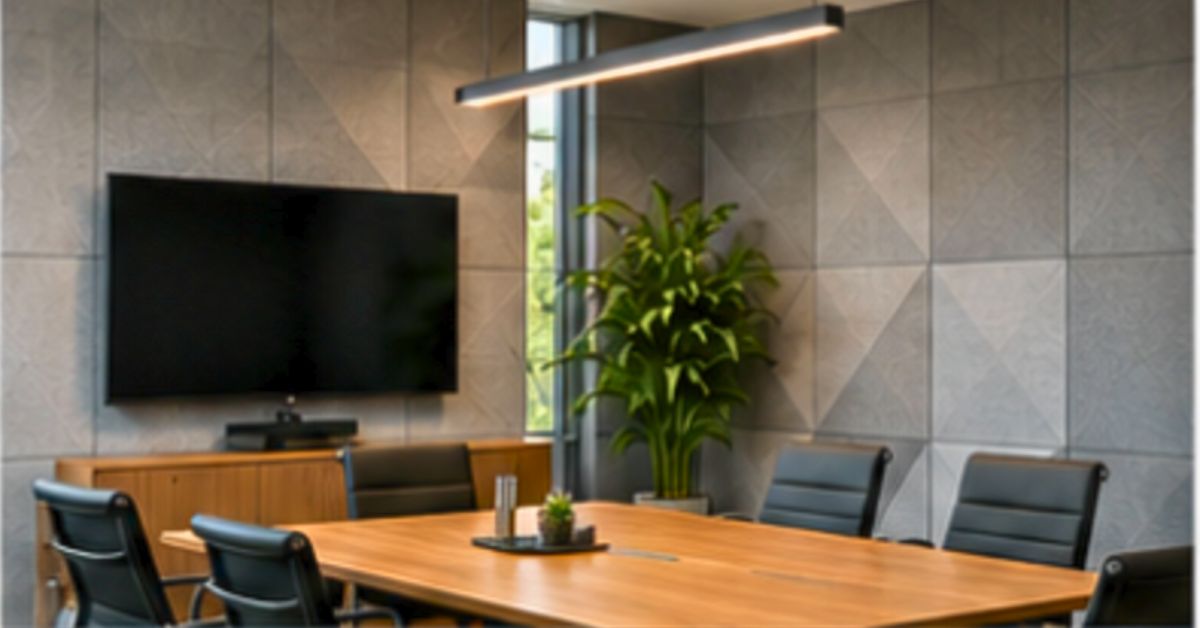
Acoustic furniture specification covers what the furniture itself contributes to the room's sound absorption. It does not replace acoustic treatment on walls and ceilings, but it is part of the total NRC equation.
Closed meeting rooms in London offices typically require NRC 0.65 or above, aligned with BCO 2024 acoustic guidelines. Upholstered chair backs contribute measurably to room absorption. Specify a minimum fabric weight of 400g/m for panels to be acoustically effective. Open-weave and lightweight fabrics add little to the room's actual acoustic performance, whatever they look like in the sample room.
Acoustic test certificates (ASTM C423 method) should be requested from the manufacturer if the furniture is being used to meet a specific NRC target. Manufacturer claims alone are not sufficient when the NRC figure is written into a lease or workplace standard.
With hybrid working now standard across London offices, 4 and 6-seater rooms with higher acoustic requirements have replaced large boardrooms in many Mayfair and West End fit-outs. This shift has pushed acoustic panel upholstery from a nice-to-have into a base specification item.
Fire Compliance for Meeting Room Furniture in UK Offices
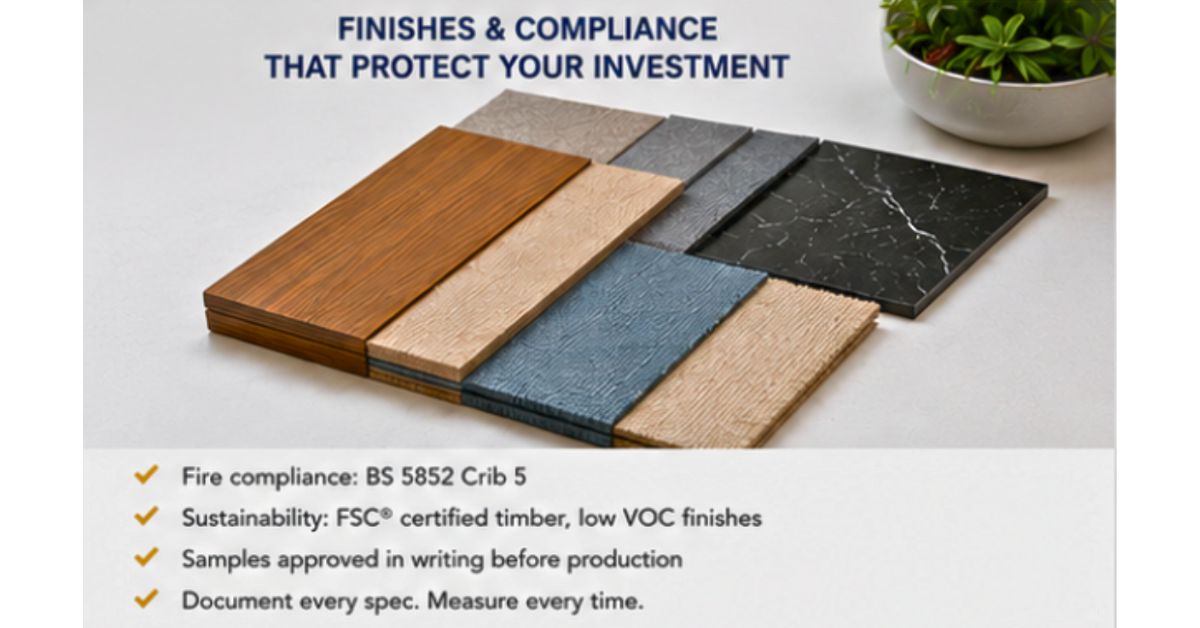
BS 5852 Crib 5 is the UK standard for fire resistance in contract upholstered seating. It tests resistance to both smouldering ignition (a cigarette equivalent) and flaming ignition (a wood crib of defined weight and construction). Crib 5 is the commercial standard; Crib 7 applies to high-risk environments such as prisons and psychiatric facilities.
Most London landlords, particularly in Grade A buildings across the City and Canary Wharf, require Crib 5 as a base lease condition, separate from building regulations. This means you need to specify it in your supplier brief as a non-negotiable, not assume it is included in the product.
Ask for the test certificate number and the independent testing body. FIRA, Warrington Fire, and BM TRADA are among the recognised UK testing bodies. A certificate from one of these carries more weight than an in-house lab result from the manufacturer.
Sustainable Meeting Room Furniture Specifications
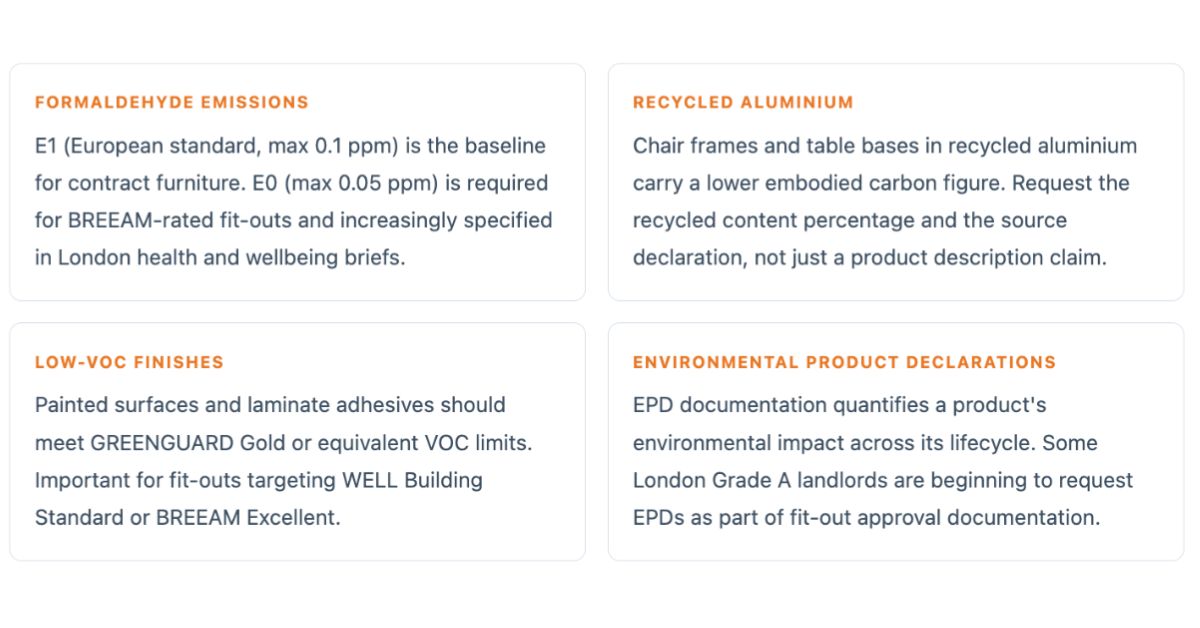
In 2026, sustainability documentation is moving from an optional add-on to a baseline procurement requirement for many London corporate occupiers. ESG-aligned fit-out briefs from financial services, legal, and professional services firms in the City and Canary Wharf now routinely ask suppliers for certificates they previously never requested. Most suppliers are not ready for this, which means buyers who know what to ask for have an advantage.
Timber and Board Materials
FSC (Forest Stewardship Council) certification applies to solid timber components and veneers. For MFC and MDF substrates, PEFC certification is equally accepted. If neither is available from the proposed supplier, that is a sourcing problem to address before production, not after.
Procurement Note:
Meeting Room Furniture Procurement Checklist
Before issuing an RFQ to any supplier, confirm each item below in writing. This list covers the points where most London fit-out furniture briefs break down.
Common Meeting Room Requirements Across London Office Locations
London is not a single market. The specification requirements that come up in a Canary Wharf financial services brief look different from those in a Mayfair private equity office or a West End media company. These distinctions matter for sourcing decisions because lead time, material availability, and compliance priority differ by location and sector.
Canary Wharf: Financial & professional services
- Larger boardrooms at 10 to 14 seats are common, often the primary client-facing space in the building
- AV-heavy briefs with full cable spines, wireless presentation, and video conferencing integration standard
- Grade A landlord compliance requirements are stricter than most other London submarkets
- High load-rated chairs (120kg minimum BIFMA X5.1) are specified across all meeting rooms, not just boardrooms
- 150,000 Martindale rub count is increasingly specified at this tier
Typical table size: 3,600mm to 5,400mm. Custom manufacturing standard at boardroom scale.
City of London: Legal, financial & insurance
- Fire compliance documentation is reviewed more strictly here than in most other submarkets due to older building stock and more active facilities management teams
- BS 5852 Crib 5 certificate from an independent testing body (not manufacturer self-declaration) is commonly required as a condition of fit-out sign-off
- Solid veneer and premium laminate finishes favoured over standard MFC in client-facing rooms
- Column positions in older City buildings frequently require fully custom table dimensions
Lead time note:
Mayfair: Private equity, luxury & professional
- Smaller executive meeting rooms at 4 to 6 seats are the dominant format, often adjoining a principal office
- Premium veneer finishes (book-matched walnut, oak, and smoked oak) are specified more often here than anywhere else in London
- Grain direction, edge profile detail, and veneer matching are frequently the subject of extended sample approval rounds
- Upholstered panels and acoustic chair backs specified to meet NRC targets in rooms with hard surfaces and glazed partitions
Typical table size: 1,400mm to 1,800mm. Floor plate constraints often require custom leg positioning.
West End: Media, tech & creative
- Flexible hybrid meeting spaces replacing fixed boardrooms in many 2025 to 2026 West End fit-outs
- 4 and 6-seater rooms with strong acoustic ratings are now the most common brief, driven by open-plan office layouts
- Laptop-first cable management (USB-C power delivery, wireless charging) is more frequently specified than in City or Canary Wharf briefs
- Lighter material palettes with painted finishes and fabric acoustic panels are preferred over heavy veneer
Acoustic note:
These patterns are not absolute. A fintech firm in the West End may specify to the same standard as a Canary Wharf bank. But knowing the typical brief profile for each area helps with early-stage budget scoping, supplier selection, and lead time planning before a full BOQ is issued.
The 7 Things Sample Approvals Most Commonly Miss

Sample approval is where most meeting room furniture problems originate. The sample looks right. Production ships 30 pieces that look different. These are the seven things that consistently fail sign-off.
1. Fabric Shade Under Office Lighting
Showroom lighting is warm. Open-plan office lighting is cool, fluorescent or LED. Sign off on the sample under the actual office lighting, not in the supplier's sample room.
2. Grain Direction on Veneer Tops
The approved sample often shows one grain orientation. Production ships with the grain running the other way because it reduces material waste. Specify grain direction in writing.
3. Cable Grommet Placement
The production piece rarely matches the approved drawing exactly. Measure the grommet position on the sample and confirm it against the drawing before approving.
4. Edge Profile Detail
Rounded vs chamfered varies batch to batch when different operators are running the machinery. The approved sample should specify the edge profile by name or dimension diagram.
5. Glide or Castor Spec
Hard castors on carpet trap chair legs and damage the carpet within weeks. Soft castors on hard floors slip and damage the surface. Specify the floor type and confirm the correct spec on the purchase order.
6. Hardware Torque
The approved sample is hand-fitted and individually checked. Production pieces are assembled on a line. Ask for a spot check of the drawer and hinge torque on two or three production units before full dispatch.
7. Finish Durability on Aged Samples
A fresh sample always looks good. If the timeline allows, request a 30-day-aged version of the finished panel before approving the batch.
The Costliest Furniture Mistakes Start on the Specification Sheet
Missing cable management. Missing Crib 5 compliance. Missing chair certifications. Most procurement issues begin long before manufacturing starts. Download the London Corporate Meeting Room Furniture Specification Sheet and make sure nothing critical gets missed.
Lead Time Breakdown for Meeting Room Furniture in the UK (2026 Realistic Timeline)
As of mid-2026, post-Brexit lead times on certain European laminates and technical fabrics have stabilised, but still add 5 to 10 working days on materials sourced from continental mills. Confirm material availability before fixing your production schedule.
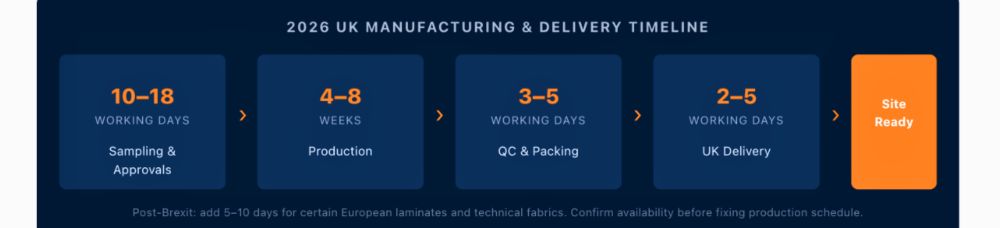
Stage | Typical Duration | Notes |
Sampling and approvals | 10–18 working days | Longer for custom veneers or upholstery |
Production | 4–8 weeks | Varies with finish complexity and MOQ |
QC and packing | 3–5 working days | Pre-dispatch check with photo evidence |
UK domestic delivery | 2–5 working days | Confirm site access restrictions in London buildings |
Installation coordination | Based on site readiness | Coordinate with the on-site team for London access windows |
Standards Referenced in This Guide
The following standards are referenced throughout this guide. Each is an independently verifiable document. When a supplier claims compliance, ask for the certificate reference number and the testing body, not a self-declaration.
Standard | Purpose | Who Issues / Tests |
BCO Fit-Out Guide 2024 | Workspace planning benchmarks for UK offices. Referenced by most London Grade A landlords. | British Council for Offices |
BS 5852 Crib 5 | Fire resistance for contract upholstered seating. Required in most Grade A lease agreements. | FIRA, Warrington Fire, BM TRADA (independent testing) |
ISO 12947 | Martindale rub test for upholstery fabric durability. | Accredited textile testing labs |
BIFMA X5.1 | Chair structural and durability performance for commercial environments. | Business and Institutional Furniture Manufacturers Association |
ASTM C423 | Sound absorption coefficient (NRC) measurement for furniture panels. | ASTM International-accredited labs |
FSC / PEFC | Timber and board material sourcing certification. | Forest Stewardship Council / PEFC Council |
GREENGUARD Gold | VOC emission limits for furniture finishes and adhesives. | UL Environment |
E1 / E0 Formaldehyde | Formaldehyde emission limits for board substrates (MDF, MFC). | European Standards body / EN 13986 |
How to Write a Meeting Room Furniture Specification You Can Actually Send to a Supplier
A furniture specification document is a checklist with measurements. It does not need to be long. It needs to be complete. Here are the seven steps.
- Define room capacity and circulation requirements. Confirm the number of seated users, room dimensions, and any fixed constraints: columns, door swings, and ceiling drops that affect table size.
- Confirm table dimensions from the sizing matrix. Use the capacity table above. For non-standard London floor plates, custom dimensions are normal. State length, width, height, and leg position.
- Specify material, finish, and fire compliance standard. Name the laminate, veneer, or painted finish by product code. State BS 5852 Crib 5 as non-negotiable. Specify edge profile and grain direction on veneers.
- List cable management and power module requirements. State grommet diameter, power module brand, port configuration, underframe routing channel dimensions, and cable spine position for wide tables.
- Confirm chair spec. State 100,000 Martindale minimum, BS 5852 Crib 5, 120kg load rating, and BIFMA X5.1 certification. Include seat depth and height range.
- Add sustainability requirements. State FSC/PEFC requirement, formaldehyde rating (E1 or E0), and VOC compliance standard. Request documentation at a brief stage.
- State the sample approval process and sign-off method. Name the approver, list what gets checked using the 7-point list above, and confirm that a written sign-off is required before production begins.
- Confirm lead time, delivery, and installation notes. State the required delivery date and work backward from the timeline above. Include London-specific access restrictions: lift dimensions, lobby clearance, and building access hours.
You Have the Specification Framework. Now Put It to Work.
Share your meeting room dimensions, chair count, finish preferences, and handover date. Arcedior will confirm sourcing options, realistic lead time, QC checkpoints, and packaging for London delivery.
FAQs
Related Resources from Arcedior
If you are managing a broader FF&E procurement programme alongside your meeting room specification, these resources cover related areas of the sourcing and QC process:
- FF&E Submittals: What They Are and Why They Matter in Contract Projects - the document set that sits alongside your furniture specification during the approval process
- Office Furniture Sourcing for Corporate Projects - vendor selection, QC inspection frameworks, and logistics coordination for multi-item procurement
- Sintered Stone vs Quartz for Hospitality and Corporate Surfaces - relevant for conference table tops where stone finish is specified
- Arcedior Project Portfolio - corporate, hospitality, and residential projects handled through sourcing and custom manufacturing