Palm Jumeirah Villa Furniture Layout – Room-by-Room Guide
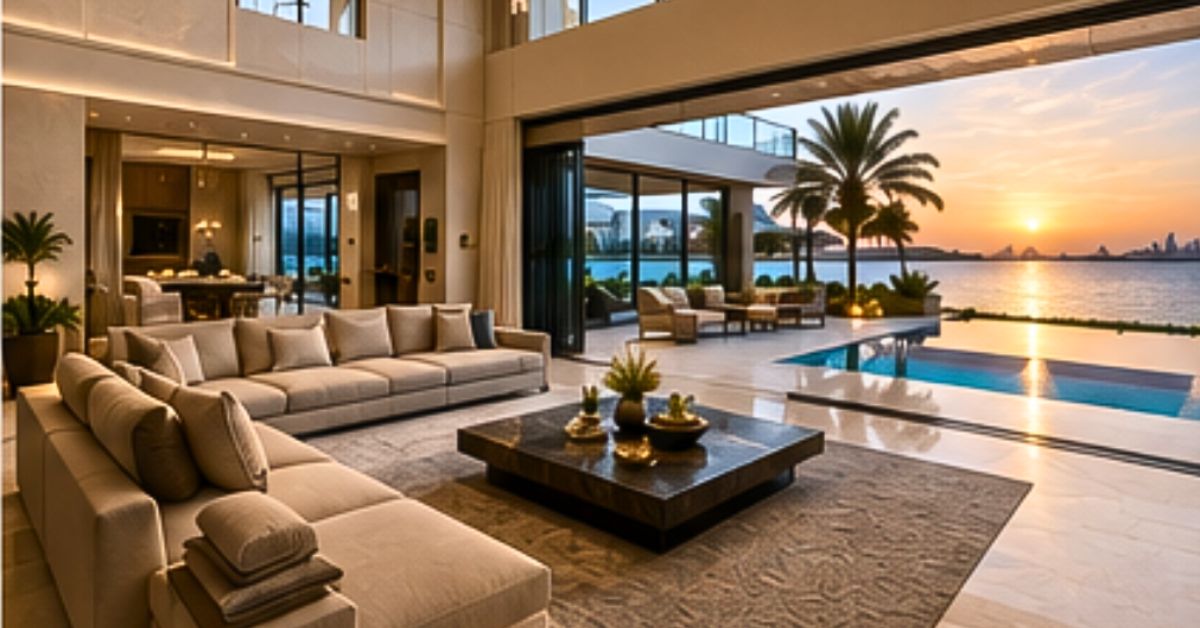
Palm Jumeirah Villa Furniture Layout: A Room-by-Room Blueprint for 5–6 Bedroom Villas
Quick Answer:
If you have walked into a Palm Jumeirah villa with furniture that felt wrong the moment you stepped inside, you already know the problem. The ceilings sit at 4 to 5.5 metres. The room footprints are generous in every direction. The whole property is designed to flow from an air-conditioned interior toward a beach or canal view. Standard furniture rules – the ones that work well in a Jumeirah apartment or a Nad Al Sheba villa – do not carry over.
According to Knight Frank's 2024 Wealth Report, prime Dubai villa prices rose 15–20% year-on-year, with Palm Jumeirah recording some of the highest transaction values in the region. More active villa sales mean more active furnishing projects, and more projects where layout planning gets compressed into the final weeks before handover.
This guide covers Palm Jumeirah villa furniture layout, room by room: sizing rules, clearance standards, villa-type differences, 2026 material trends, cost expectations, and the sourcing timelines that actually apply to custom pieces at this scale.
Why Furniture Layout Differs Across Palm Jumeirah Villa Types
Most furniture layout guides treat Palm villas as a single category. They are not. Palm Jumeirah has several distinct villa types, developed at different points in time, with different room proportions and layout challenges. Furniture that fits a Garden Home does not automatically read correctly in a Signature Villa.
Many Palm Jumeirah villas were originally developed by Nakheel, although a significant number of front plots have since been redeveloped into custom residences with different room proportions and furnishing requirements.
Villa Type | Key Layout Challenge |
Garden Home | Narrower room widths, longer floor plates – oversized sofas can block the central circulation path |
Signature Villa | Larger majlis and foyer footprints require genuinely oversized anchor pieces, not just "large" showroom selections |
Canal Cove Villa | Smaller outdoor terraces mean pool deck furniture needs tighter zoning to avoid a cluttered feel |
Custom Frond Villa | Highly variable room proportions – standard sizing guides are almost useless here; dimensions must come from the actual drawing set |
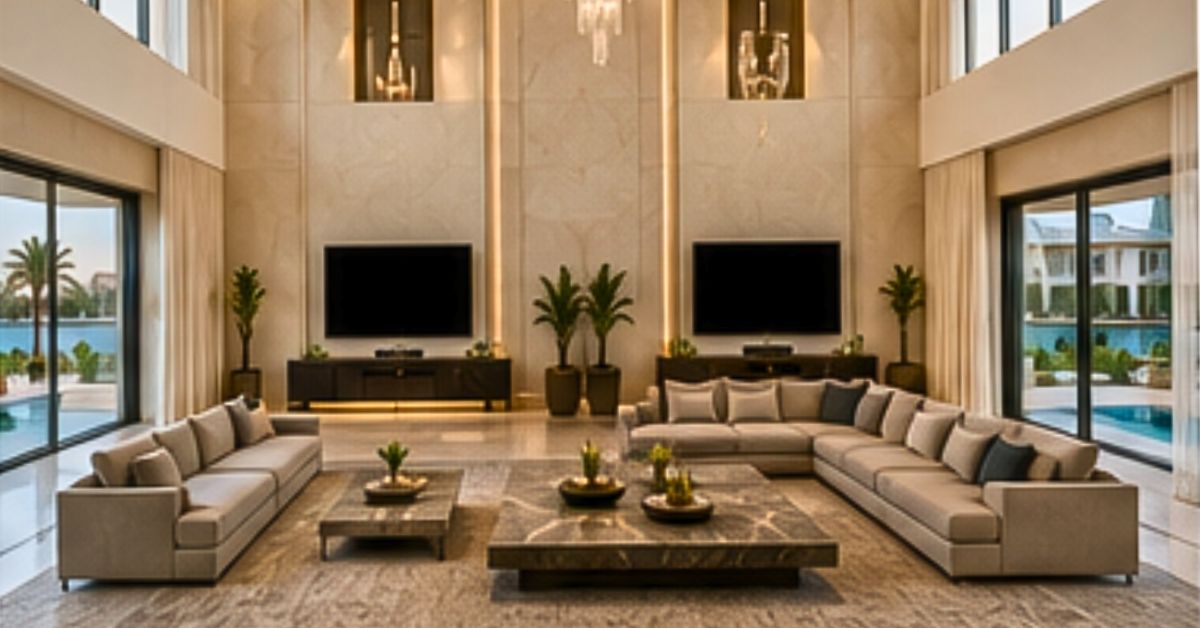
Palm Mansion | Double-height living rooms require oversized pieces and vertical layering with tall artwork, pendant fixtures, and full-height drapery |
The differences matter most in the foyer, the main living room, and the outdoor sequence. A Garden Home with a foyer that is 35 square metres needs different furniture than a Signature Villa foyer at 60 square metres, even if both are described as "large entrance halls."
Free Download: Palm Jumeirah Villa Pre-Procurement Validation Checklist + Timeline Calculator
Before approving a single furniture order, verify the 27 checkpoints that regularly cause delays, substitutions, budget overruns, and installation issues in large villa projects. Get Arcedior's pre-procurement validation checklist, Furniture lead time timeline calculator, BOQ cross-check framework, Outdoor specification review checklist, and Installation readiness tracker.
Why Standard Furniture Rules Fail in Palm Jumeirah Villas
Four architectural facts change everything about furniture planning in these properties.
Ceiling heights of 4 to 5.5 metres make standard furniture look undersized. A sofa with a 0.8-metre back looks like a garden bench in a room with 4.5-metre ceilings. Furniture needs more visual weight – taller backs, heavier frames, layered pieces. Large room floor plates make the same problem worse: a standard 2.4-metre three-seater reads as a loveseat in these spaces.
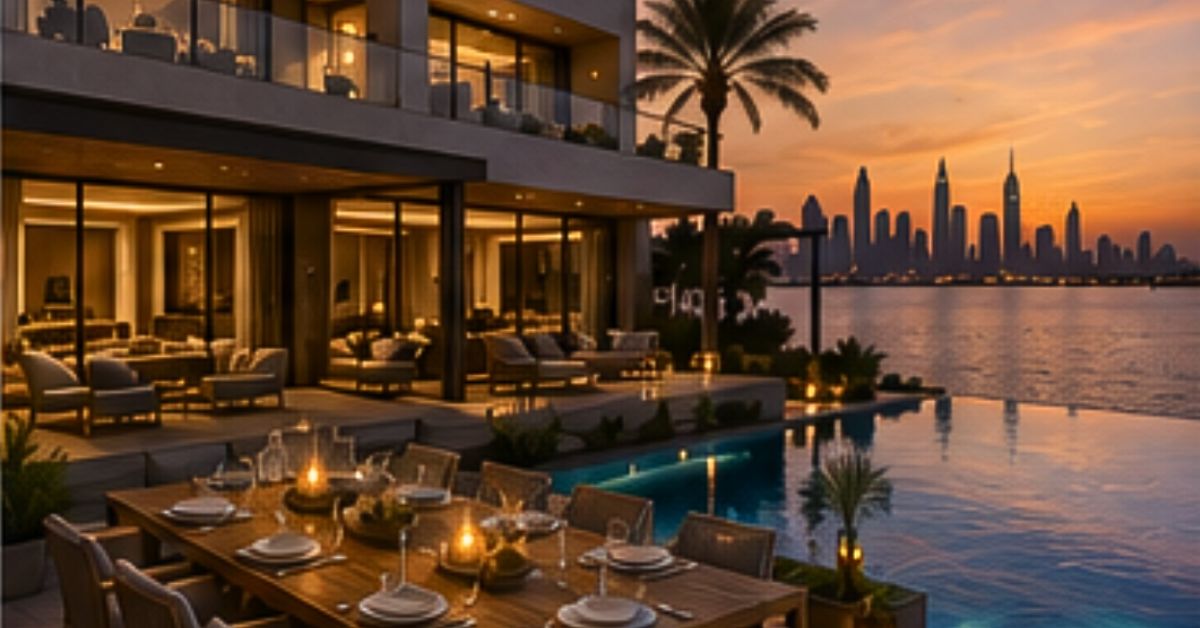
Front plot orientation matters too – beach-facing and canal-facing plots get different light at different times of day, which affects where furniture is placed and how outdoor areas are orientated. And the indoor-outdoor flow is built into the property's purpose. The covered terrace and pool area are primary living zones, not a bonus. The furniture plan has to treat them as a continuous sequence.
Space | Standard Sizing | Palm Villa Sizing |
Living room sofa | 2.4m–2.8m | 3.2m–3.8m or L-shape |
Dining table (8 pax) | 2.0m x 1.0m | 2.8m–3.2m x 1.1m–1.2m |
Master bed frame | Standard king 1.8m wide | Custom 2.0m–2.2m wide |
Outdoor lounge | 3-seater standard | 5 to 7-seater sectional min |
Pool terrace dining | 6-seater | 10 to 12-seater |
Furniture Scale Comparison – Standard vs. Palm Villa
Room-by-Room Furniture Layout Guide for a Palm Jumeirah Villa
Room 01: Grand Foyer and Entrance Hall
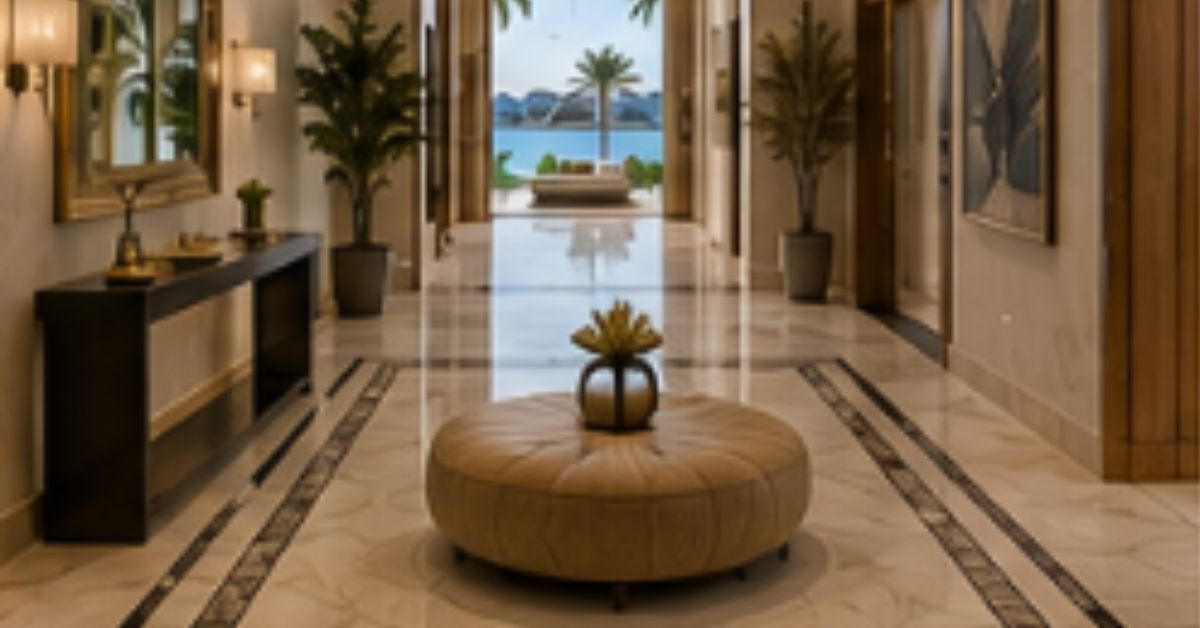
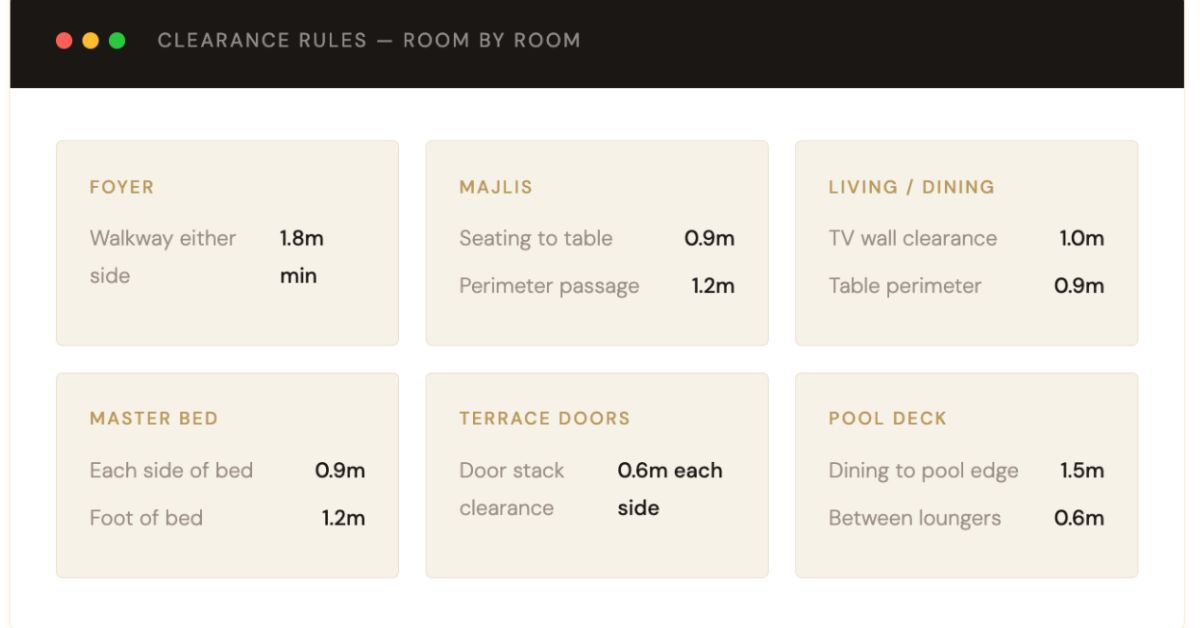
The foyer sets the tone for the whole property. In a 5 to 6-bedroom Palm villa, the entrance hall is typically 40 to 60 square metres – large enough that under-furnishing it makes it feel like a lobby. Key pieces: an oversized console at least 1.8 metres wide, a statement mirror at least 1.4 metres tall, and a bench for convenience and arrival seating. Maintain a minimum 1.8-metre walkway on either side of any central piece. Nothing should interrupt the sightline from the front door toward the main living area.
Use tall artwork, floor-to-ceiling drapery on side walls, and vertical lighting to visually connect the furniture to the ceiling height – rather than leaving empty air above every piece.
Room 02: Majlis or Formal Sitting Room
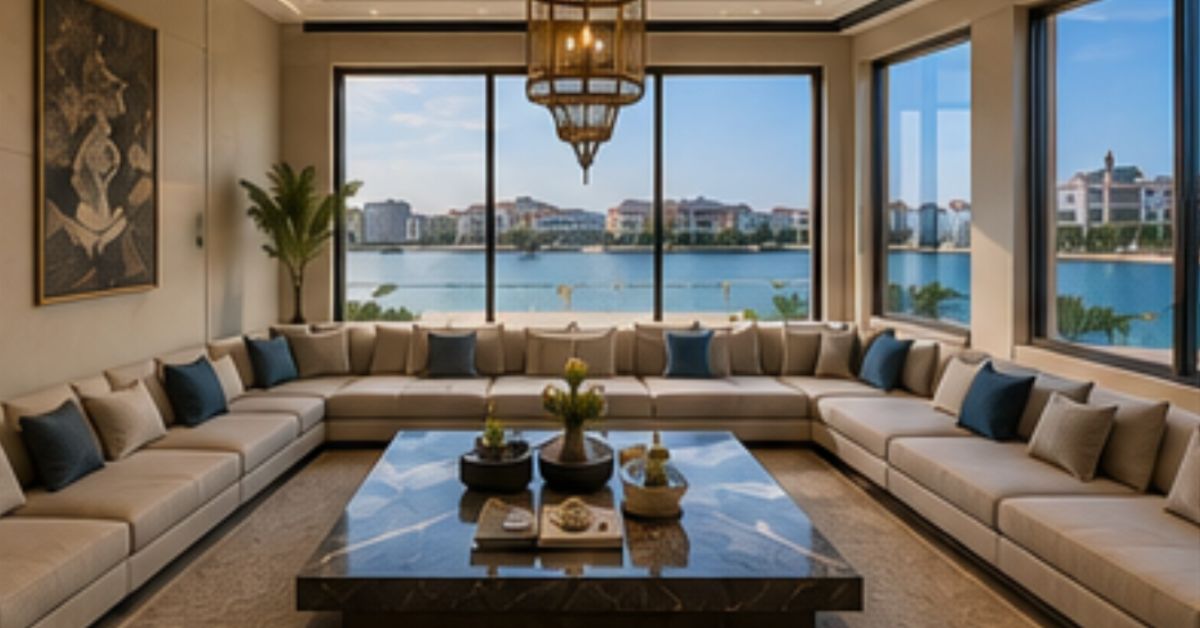
The majlis in a Palm villa is a proper reception room. An L-shape or U-shape seating arrangement with 8 to 10 seaters is the functional minimum for a room at this scale – not a generous option. Clearance rules: 0.9 metres between the seating and the central coffee table, 1.2 metres of clear passage around the perimeter. Orient the seating toward the front garden or pool view. Seating that faces inward, away from the outdoor view, misses what the property is about.
Pro Tip
Room 03: Open-Plan Living and Dining
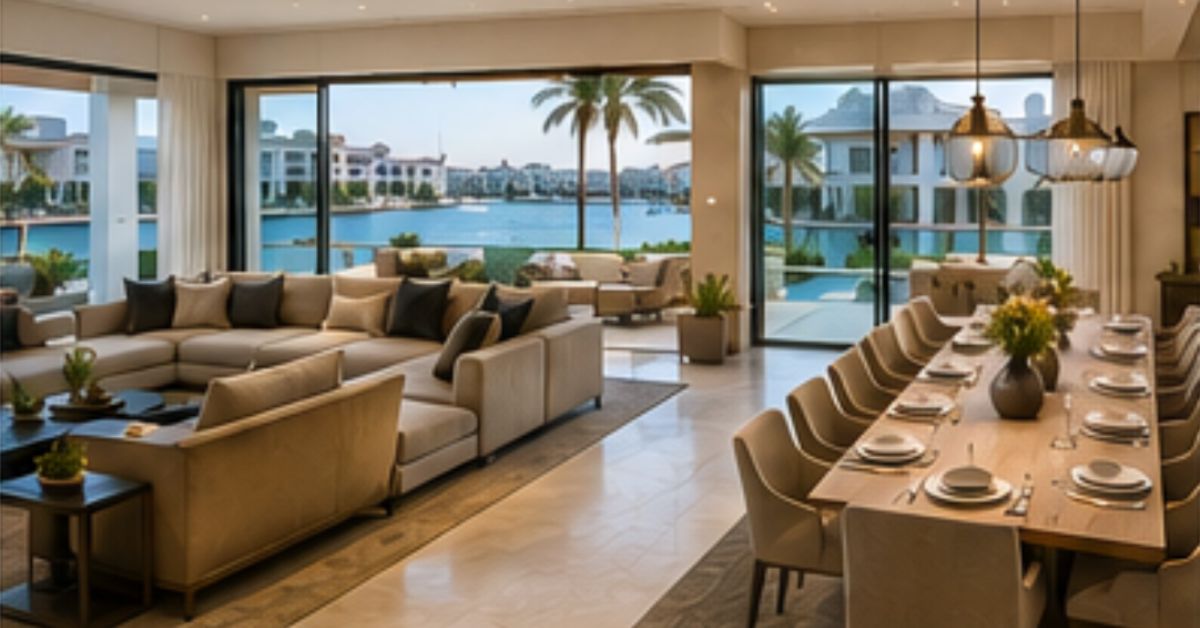
This is the most common room where Palm villa furnishing goes wrong. The room feels generous, which leads buyers to assume standard sizing will work. It will not.
For the living zone: a sectional sofa of at least 3.5 metres combined, with 1.0 metres of clearance from the TV wall. The rug under the seating area should extend at least 0.5 metres beyond the sofa on each side – typically a 4.0 x 3.0-metre or larger rug.
For the dining zone: a 10 to 12-seater table in the 2.8 to 3.4-metre length range, with 0.9-metre clearance on all sides.
In open-plan rooms, furniture arrangement defines zones without walls. Rugs establish the living area boundary. A console table behind the sofa defines the separation from the dining area without blocking sightlines. The most common mistake: buying a living room set and dining set from different suppliers without checking how they read together from across the room.
Quick Rule:
Room 04: Master Bedroom Suite
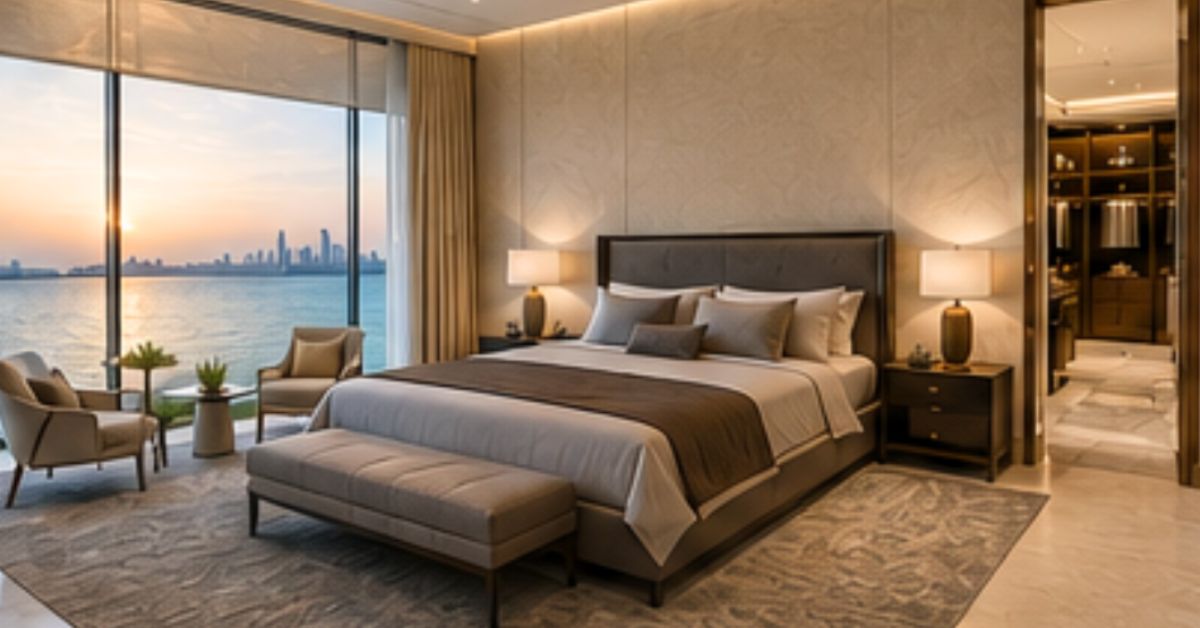
The master suite typically includes a sleeping area, a seating area, a walk-in wardrobe, and an en suite. The bed is the anchor, but not the only piece that needs proper sizing. A custom oversized bed frame at 2.0 to 2.2 metres wide by 2.2 metres long reads correctly in a room built for it – standard kings at 1.8 metres wide sit awkwardly. Clearance: 0.9 metres minimum on either side of the bed, 1.2 metres at the foot. Floating bedside tables over floor-standing ones keep the floor clear and scale better with wide bed frames. The seating area within the master – a pair of chairs with a side table at minimum – should be placed near the window or balcony access, not tucked in a corner.
Walk-in wardrobe: custom casegoods with full-height cabinetry using the full ceiling height. Stopping cabinetry at 2.4 metres in a room with 4-metre ceilings wastes both space and the architectural opportunity.
Room 05: Guest and Family Bedrooms
A 5 to 6-bedroom Palm villa typically has 3 to 4 guest or family bedrooms beyond the master. The temptation is to scale down significantly. The result is rooms that feel like they belong to a different property. Queen or king beds with proper bedside tables are the minimum. Keep a consistent material palette across the villa – different from the master suite is fine, clashing is not. On every balcony with a bedroom, add outdoor armchairs or a small side table. Bare balconies are a detail that guests notice and remember.
Room 06: Family Lounge or Informal Living Room
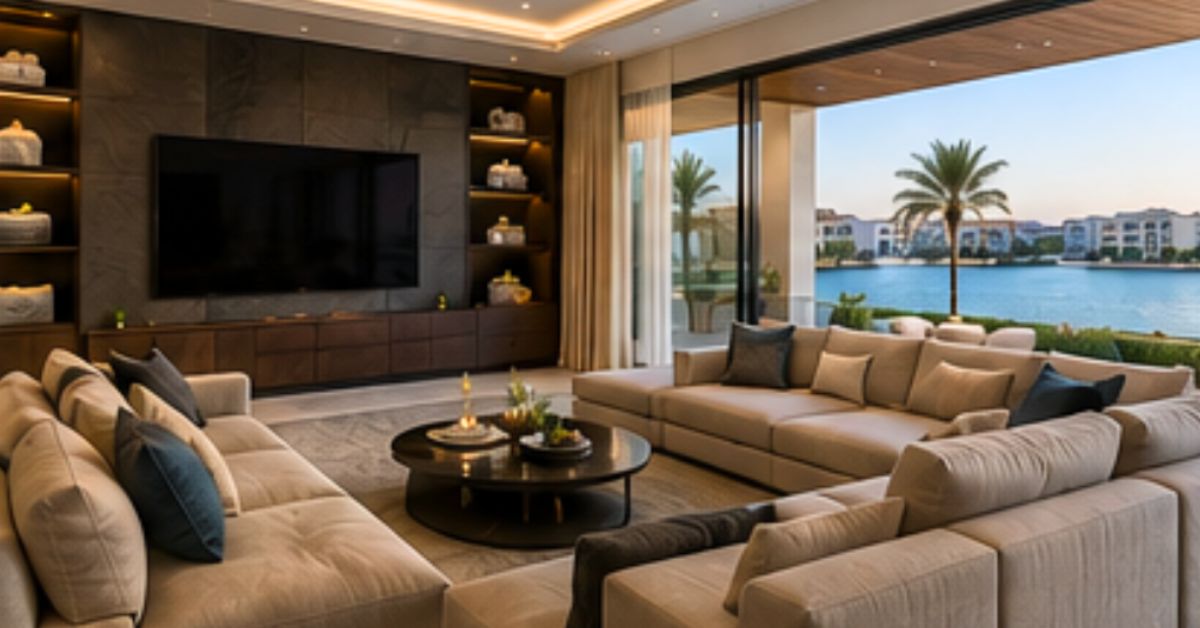
Most Palm villas have a secondary living space upstairs or off the kitchen – a relaxed family lounge distinct from the formal reception. This room takes modular, deep sofas and a more flexible layout. The AV unit or entertainment wall is usually the starting point for the rest of the arrangement. Confirm TV size and wall width before ordering the sofa – not the other way around.
The Indoor-Outdoor Transition Zone
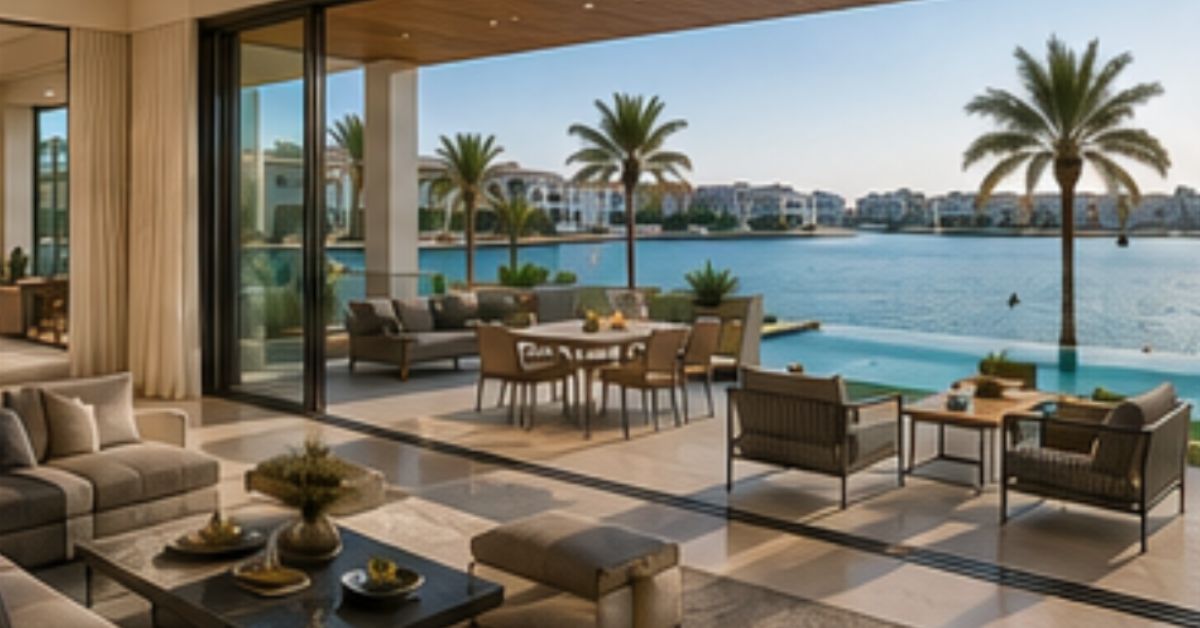
This is where most Palm Jumeirah villa furniture projects have a visible gap. The covered terrace – the area between the air-conditioned living room and the open pool deck – is either left bare, furnished with leftover indoor pieces that will deteriorate, or treated as an afterthought after the interior budget runs out. It should be planned as a third room.
When the sliding or folding doors between the living room and covered terrace are fully open, you need a minimum of 0.6 metres of clearance on each side so the door stack does not block furniture access or sightlines.
Quick Rule:
The floor material change from interior to exterior often drives the furniture frame material choice – teak, powder-coated aluminium, and wicker read differently against tile, stone, or timber decking. And the sight line test matters: stand in the living room and look outward through the open doors. Whatever furniture arrangement is on the covered terrace reads as part of the interior view. It needs to be intentional from that perspective.
Key Takeaway
Pool Terrace and Outdoor Furniture Layout for Palm Jumeirah Villas
The pool terrace outdoor furniture layout for a Palm Jumeirah villa has three distinct zones, each with its own sizing and material logic.
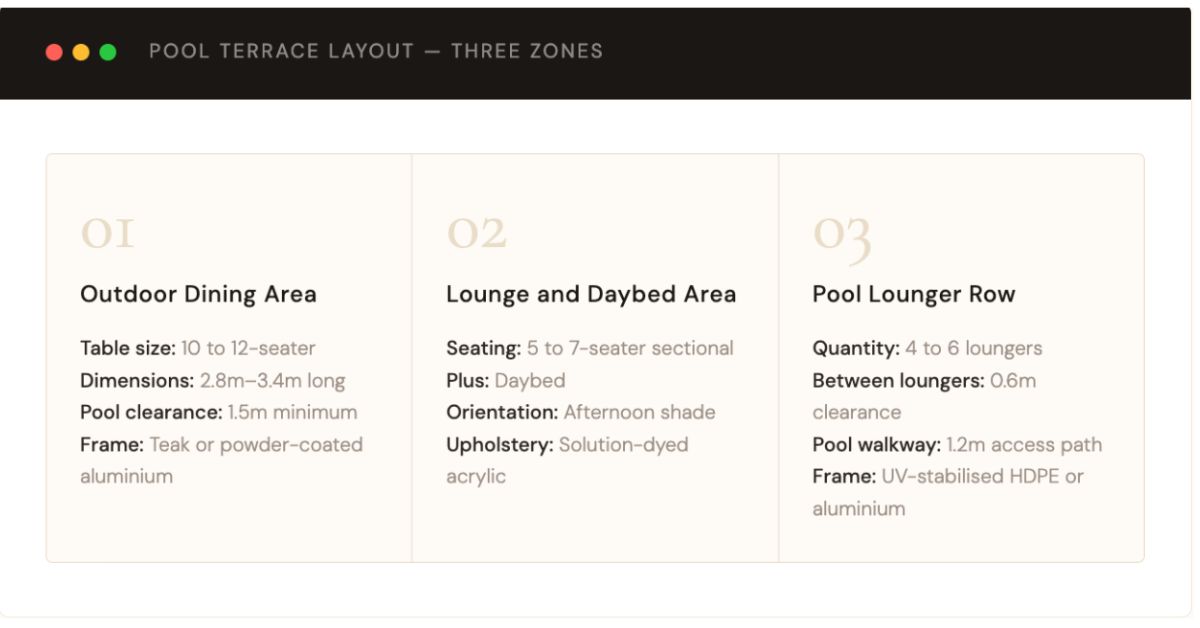
The Palm Jumeirah waterfront environment – salt air, high humidity, intense UV – degrades non-specification outdoor materials within one to two seasons. Saving on outdoor furniture here is not a cost reduction. It is a replacement cost deferred by 12 to 18 months.
Furniture Type | Recommended | Avoid |
Dining chairs and table | Teak, powder-coated aluminium | Wrought iron, untreated steel |
Lounge and sofa upholstery | Solution-dyed acrylic (Sunbrella grade) | Standard polyester (fades, mildews) |
Pool loungers | UV-stabilised HDPE, aluminium frame | Standard resin, untreated wood |
Outdoor rugs | Polypropylene (waterproof weave) | Natural fibre (jute, sisal) |
Outdoor Furniture Material Specification – Palm Jumeirah
Quick Rule:
What Does It Cost to Furnish a Palm Jumeirah Villa?
This is one of the most searched questions in this space and one that gets answered vaguely. Here are realistic ranges based on project scope.
Scope | Typical Range |
Furniture only (interior rooms) | AED 500,000–1.5M+ |
Furniture + full outdoor | AED 800,000–2M+ |
Fully custom furnishing (bespoke pieces, custom casegoods, full outdoor) | AED 2M–5M+ |
Costs vary based on the level of customisation, imported brand specifications, material selection, and overall project scope. These ranges reflect typical procurement budgets, not design fees or installation costs.
The wide ranges reflect real variation. A Garden Home furnished with high-quality production pieces from established European brands sits in a different cost band than a custom front villa with bespoke casegoods, imported stone dining tables, and a fully specified pool terrace. Both projects are "Palm villa furnishing," but they are not the same exercise.
The most common budget mistake: allocating the full furniture budget to interior rooms and discovering the outdoor specification cannot be funded from what remains. For a property at this scale, plan the outdoor budget alongside the interior from the start.
Need Quick Input on Lead Times or Custom Furniture?
Send your floor plan, BOQ, room list, or target handover date via WhatsApp, and our team can provide initial guidance on sourcing routes, production timelines, and QC checkpoints.
2026 Palm Jumeirah Villa Furniture Trends
01. Quiet luxury has replaced statement luxury.
In 2026, Palm Jumeirah villa interiors are moving away from highly decorative gold-and-marble-heavy styling toward quieter, material-driven luxury. Furniture is becoming larger, softer, and more architectural, with emphasis on craftsmanship, texture, and proportion rather than visual excess. Travertine, smoked oak, brushed limestone, bouclé upholstery, and warm neutral palettes are appearing more frequently across luxury villa projects in place of the high-contrast jewel tones and gilded finishes that dominated briefs three to four years ago. The rooms remain richly layered and comfortable, but with less visual clutter.
02. Indoor and outdoor living spaces are being planned together.
Outdoor areas are no longer treated as secondary entertaining zones. Covered terraces, pool lounges, outdoor dining spaces, and garden majlis areas are increasingly planned as extensions of the interior furniture layout. Furniture selections, materials, and circulation routes are being coordinated across both environments from the start of the project rather than treated as two separate briefs with two separate budgets. Outdoor kitchens in particular have shifted from premium add-on to baseline expectation at the 5 to 6-bedroom level – which means the outdoor dining zone needs to be positioned around the kitchen workflow from the layout stage, not connected afterward.
03. Biophilic furniture planning is influencing layout decisions.
Furniture layouts increasingly incorporate indoor planting zones, natural stone surfaces, textured woods, and stronger visual connections to outdoor landscaping. Rather than adding plants after a room is complete, villa layouts are being planned around them as spatial anchors. Large-format indoor plants – olive trees, ficus, indoor palms in oversized planters – are appearing as furniture-scale elements that fill vertical space in high-ceilinged foyers and living rooms where standard objects fall short. This affects the layout plan because planting zones need circulation clearance and access for maintenance.
04. Custom oversized furniture is becoming standard.
Large Palm Jumeirah villas increasingly use custom bed frames, oversized sectionals, and full-height casegoods designed around actual room proportions rather than catalogue sizing. As ceiling heights continue to exceed 4 metres in many custom villas, standard furniture dimensions read as visually undersized regardless of quality. This makes confirmed room dimensions and approved BOQs the prerequisite for any custom production order – not a formality, but the actual starting condition for work that cannot be revised once it is in production.
05. Material performance matters more alongside aesthetics.
In waterfront properties, buyers are paying greater attention to durability alongside visual quality. Marine-grade aluminium, UV-stabilised outdoor fabrics, high-performance upholstery, and humidity-resistant finishes are increasingly specified to reduce maintenance and replacement cycles. This has a sourcing implication: performance-specification materials have longer lead times and fewer available suppliers than standard alternatives, and they need to be locked into the BOQ early.
Why Your Furniture Layout Should Match the BOQ
Most villa furnishing projects at this level have a Bill of Quantities. The BOQ is not just a cost document. It is the reference that controls procurement, production tracking, vendor coordination, and installation sequencing.
A furniture layout that does not match the BOQ creates problems in four areas:
Quantity validation. If the layout shows a dining table for 12 but the BOQ specifies 10 chairs, someone will discover the gap at delivery – not at the planning stage.
Budget control. The BOQ is the document against which purchase orders are raised. Layout changes that are not reflected in the BOQ create informal procurement outside the approved budget.
Procurement planning. For custom pieces with 14–20 week lead times, the BOQ drives the purchase order schedule. A layout that is not finalized before the BOQ is approved will either delay production or force substitutions with in-stock alternatives that do not fit the space.
Installation sequencing. In a 5 to 6-bedroom villa with multiple vendors, the installation sequence matters. The BOQ, when cross-referenced with the layout, shows which pieces need to be on-site first. Casegoods before loose furniture. Heavy stone dining tables before chairs. Outdoor structures before soft furnishings.
If you are working with a project manager or developer, share the final approved furniture layout alongside the BOQ update. Treating them as separate documents is the source of most late-stage coordination failures.
Before Ordering Furniture, Create These Three Layout Drawings
Most Palm villa projects arrive at procurement with one document: the interior design layout plan. Two others are needed before any order is placed.
Furniture layout plan. This is the standard floor plan with all furniture pieces positioned, dimensioned, and labeled. It should include clearance annotations for all primary passages.
Electrical coordination plan. Oversized furniture on Palm villa projects regularly conflicts with floor socket positions, wall-mounted AV points, and bedside lighting circuits that were specified before the final furniture layout was confirmed. An electrical coordination drawing cross-references the furniture plan against the MEP drawings. Finding a floor socket under a 3.5-metre sectional at delivery is a fixable problem. Finding it three days before handover is not.
Outdoor furniture layout plan. The pool deck and covered terrace need their own scaled drawing, including the sun path. On Palm Jumeirah, the orientation of the frond determines when the pool deck receives direct afternoon sun. Lounge areas placed in the wrong zone will be in full sun during peak afternoon hours, which changes how the space is actually used.
Common Furniture Layout Mistakes in Palm Jumeirah Villas
01 Undersizing across every room
A sofa that looks large in a showroom reads like a bench in a room with 4.5-metre ceilings. This applies everywhere – beds, dining tables, outdoor dining sets, and consoles. The single most frequent error in Palm villa furnishing projects.
02 No plan for the transition zone
Leaving the covered terrace bare or with leftover indoor pieces breaks the indoor-outdoor flow at exactly the point the villa is designed around.
03 Wrong outdoor materials
Standard patio furniture near saltwater and humidity degrades quickly. The cost difference between specification-grade and standard outdoor furniture is small compared to a full replacement after two seasons.
04 Skipping clearance planning in large rooms
The 0.9-metre passage rule gets ignored in large rooms because they feel forgiving. They are more forgiving, but the rules still apply, and more furniture creates more collision points to manage.
05 Buying rooms in isolation
Living room, dining room, and outdoor terrace furnished through different vendors with no visual coordination. The result is a villa that feels assembled rather than considered.
Want the Complete 27-Point Validation Checklist?
The Pre-Procurement Validation Checklist + Timeline Calculator contains 27 project-critical checkpoints covering layout validation, BOQ approval, production planning, QC, logistics, outdoor specification, and installation readiness.
It was created for large villa furnishing projects where a single missed detail can affect budgets, timelines, and handover dates. Before you release purchase orders, before production starts, and before furniture goes into a container, run your project through the checklist.
Practical Planning Issues Often Missed in Large Villa Furniture Projects
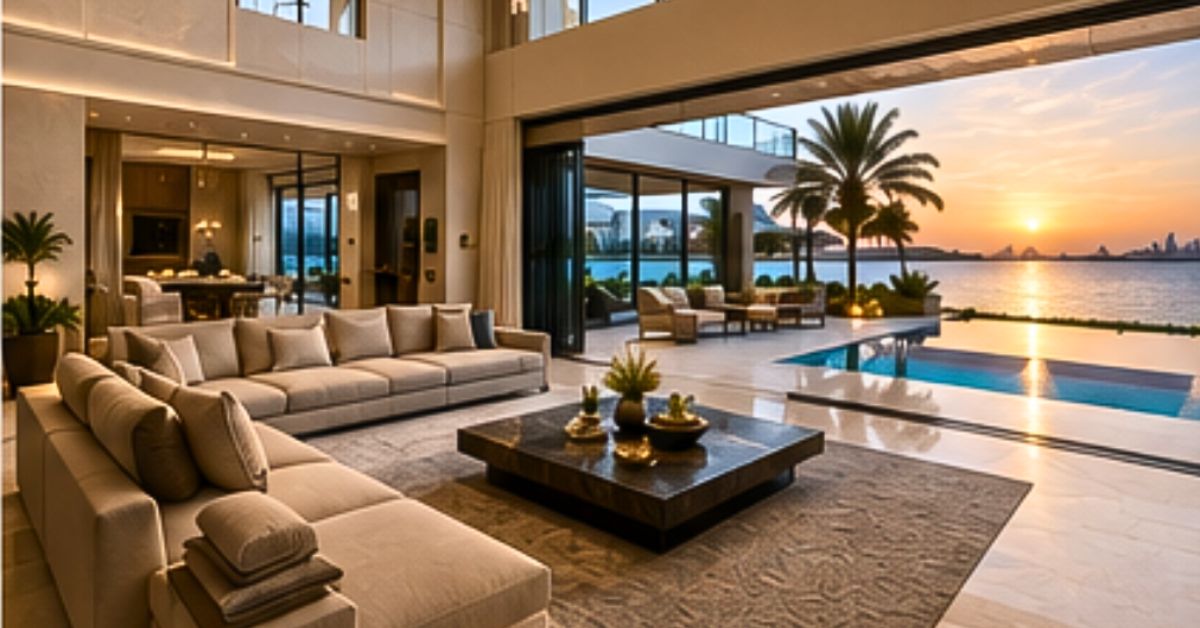
These are patterns that come up consistently in sourcing conversations with project managers, developers, and designers working on large Palm villa briefs. The problems are predictable enough that they can be planned around if you know how to look for them.
Custom oversized furniture and access routes. A 3.2-metre dining table or a 2.2-metre-wide custom bed frame cannot always pass through internal corridors, stairwells, or entrance doors that were dimensioned for standard-sized pieces. This gets discovered at delivery if nobody checked during planning. The fix – partial disassembly, modified frames, or in the worst cases replacement – costs more in time than money, and time is usually what villa projects do not have near handover. The access route check needs to happen when the piece is being designed, not when it is arriving in a container.
Floor socket and AV point conflicts. MEP drawings and furniture layouts are often finalized by different teams at different times. The result is floor sockets positioned under where a 3.5-metre sectional will sit, or bedside lighting circuits that do not align with where the bed will be placed. Catching this before production is a one-hour drawing review. Catching it after delivery is a MEP contractor callout and a delay.
The late-start substitution pattern. Projects that begin sourcing conversations eight to ten weeks before handover consistently end up substituting custom-specified pieces with whatever is in stock in Dubai that is close enough. "Close enough" means wrong scale in most cases. The in-stock sofa is 2.8 metres, whereas the room needs 3.5 metres. The in-stock dining table seats eight, when the room needs twelve. The substitution is visible in the finished property and sometimes reverses itself in a second round of sourcing six months after handover. Starting four to six months out, with confirmed dimensions and an approved BOQ, is the only reliable way to avoid this.
Outdoor budget was allocated last. The outdoor specification is often built from what remains after the interior rooms are costed. On a 5 to 6-bedroom Palm villa with a full pool terrace, covered terrace kitchen, and beach or canal frontage, the outdoor furniture and built-in elements can represent 25–35% of the total furniture spend. Treating it as a remainder category rather than a planned line item leads to a compromised outdoor area on a property whose entire design logic is built around outdoor living.
Palm Jumeirah Villa Furniture Layout Checklist
Before approving the furniture for production or purchase, confirm the following:
- Room dimensions verified against as-built drawings, not the design set
- Ceiling heights confirmed for each room
- Folding and sliding door clearances checked and annotated on the layout
- Dining capacity confirmed against the BOQ specification
- Pool terrace zones planned with sun path confirmed
- Outdoor material specification reviewed against Palm Jumeirah environmental requirements
- Lead times confirmed against the handover date
- Factory QC inspection scheduled before shipment
- Site readiness confirmed for installation start date
- Installation sequence documented and shared with all vendors
Palm Jumeirah Villa Furniture Layout Planning Timeline
This is the timeline question that comes up most in sourcing conversations. What is realistic for a project with a fixed handover date?
Timeline Before Move-In | Action Required |
6 months | Finalise furniture layout plan. Approve BOQ. Confirm all room dimensions against as-built drawings. |
5 months | Approve all material and finish samples. Confirm custom piece specifications. Place production orders. |
4 months | Production begins. Confirm the electrical coordination drawing is cross-referenced with the layout. |
2 months | Factory QC inspections for completed pieces. Approve packaging and export documentation. |
1 month | Shipping, freight forwarding, and customs clearance. Confirm site readiness for installation. |
Move-in month | On-site installation in the agreed sequence. Snagging and final QC on site. |
For custom furniture projects, production orders should ideally be placed 5–6 months before the target handover date.
Have a Palm Jumeirah villa project underway?
If you have a floor plan, BOQ, or a list of key rooms with target materials, the Arcedior sourcing team can outline realistic lead times, sourcing routes, and QC checkpoints for your specific brief.
How to Source Custom and Oversized Furniture for a Palm Jumeirah Villa
When furniture needs to be custom-sized – which is almost always the case for Palm villa projects – the process has several steps that need to be managed in sequence.
Confirm final dimensions against the approved floor plan before any production order is placed. Sample approvals for materials and finishes come next, because colour and texture references shift considerably between a swatch and a finished piece at full scale. Confirm lead times with the supplier early. For a Palm villa project, custom pieces typically take 12 to 20 weeks from order to delivery in Dubai.
Factory QC before shipment is not optional at this level. A QC checkpoint confirms dimensions, finish quality, and packaging before the container is loaded. Finding a problem at the factory with a two-week window is a very different situation from finding it at delivery in Dubai with a handover date three days away.
Arcedior works in this capacity for villa and hospitality projects across the region, handling sourcing across manufacturers, custom sizing approvals, QC inspections before shipment, export packaging, and installation coordination on site. The design direction comes from the client or their designer. The sourcing and production execution are handled by the Arcedior team.
Lead Time Reality for Palm Jumeirah Villa Projects
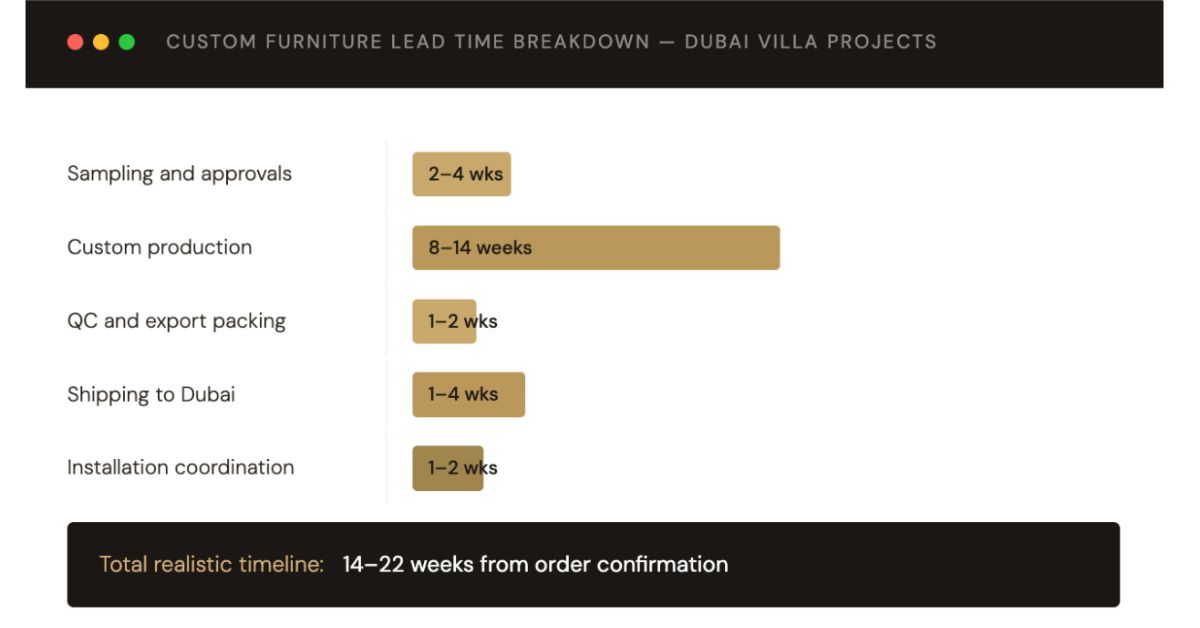
According to Savills Dubai Luxury Residential Market data (2024), villa handover timelines on Palm Jumeirah are compressing as buyer demand for fast-moving projects increases. Custom furniture lead times have not compressed at the same rate.
Key Takeaway
Planning a Palm Jumeirah Villa Furnishing Project?
Whether you're furnishing a Garden Home, Signature Villa, Canal Cove Villa, or a custom beachfront residence, procurement planning starts long before production begins.
If you already have a floor plan, BOQ, furniture schedule, or target handover date, our team can help you with sourcing options, realistic lead times, and QC steps for your specific project.