Sintered Stone vs Quartz Tabletops for Hospitality
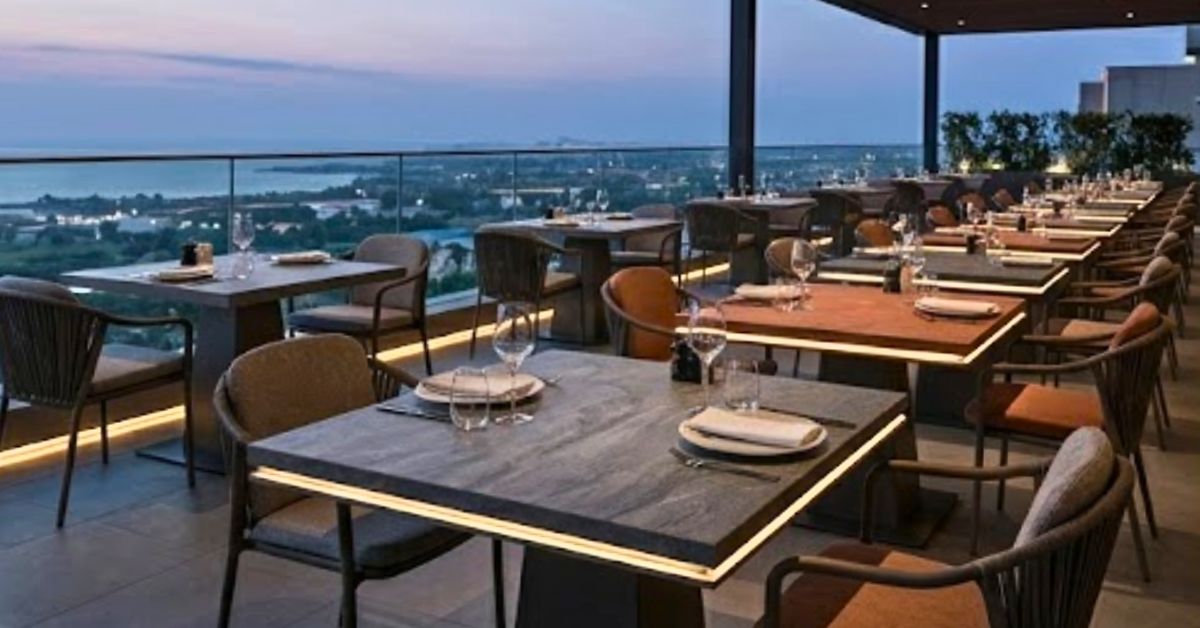
Sintered Stone vs Quartz for Tabletops: Which Wins in Hospitality?
Last Updated: May 2026 | This guide reflects current 2026 sourcing conditions, including updated hospitality procurement lead times, outdoor dining specification trends, and commercial tabletop manufacturing availability across India, the UAE, and the GCC region.
Most hotel tabletop failures are not about the wrong finish. They are about the wrong material specified for the wrong use case.
Hotel owners and F&B project managers often pick tabletop surfaces at the sample stage, based on appearance, texture, and cost. Then, within 12 to 18 months of opening, the problems show up – dull patches from chemical cleaning, chipped edges near service areas, discolouration on terrace tables, or bases that were not designed to carry the slab weight ordered.
This guide cuts through the generic countertop comparisons you will find elsewhere. If you are choosing between sintered stone vs quartz tabletops for hospitality, the decision is about durability under daily hotel conditions, chemical compatibility with housekeeping products, outdoor stability, total weight, and a sourcing lead time that fits your project schedule.
Quick Answer:
What Is the Actual Difference Between Sintered Stone and Quartz?
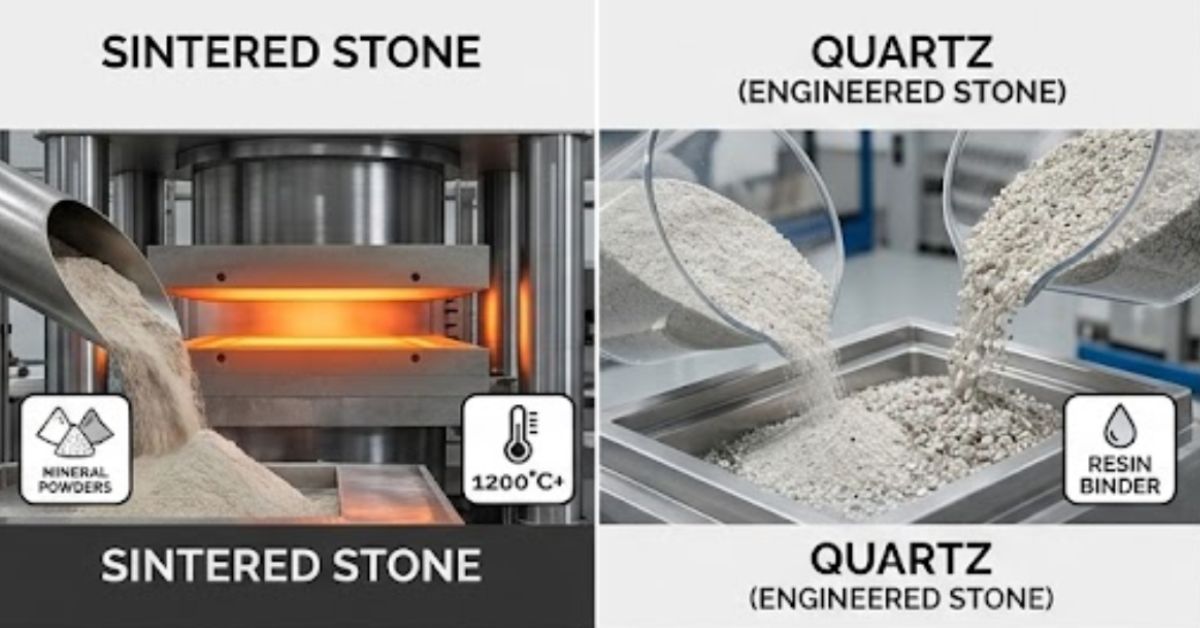
Definition: Sintered Stone
Definition: Quartz (Engineered Stone)
The manufacturing difference is not just technical trivia. It is the reason sintered stone handles a bleach wipe-down better than quartz, and why quartz handles a corner knock better than sintered stone. For hospitality, where both situations happen daily, the use context determines which material is correct.
Tabletop Specification & Procurement Checklist
The costliest tabletop mistakes are usually invisible at the sample stage. Wrong slab weight. Outdoor material failures. QC gaps hidden inside bulk production. This hospitality tabletop checklist was built around the exact failures that show up months after opening.
Hospitality Performance Comparison: Sintered Stone vs Quartz vs Alternatives
Property | Laminate | Sintered Stone | Quartz | Solid Wood |
Scratch Resistance | ★★☆☆☆ | ★★★★☆ | ★★★★☆ | ★★☆☆☆ |
Heat Tolerance | ★★☆☆☆ | ★★★★★ | ★★★☆☆ | ★★☆☆☆ |
Stain Resistance | ★★★☆☆ | ★★★★★ | ★★★★☆ | ★★☆☆☆ |
Chemical Resistance | ★★☆☆☆ | ★★★★★ | ★★★☆☆ | ★☆☆☆☆ |
UV / Outdoor Stable | ★★☆☆☆ | ★★★★★ | ★★☆☆☆ | ★★☆☆☆ |
Impact Resistance | ★★★☆☆ | ★★★☆☆ | ★★★★☆ | ★★★★☆ |
Relative Weight | Light | Heavy | Medium | Medium |
Relative Cost | $ | $$$ | $$ | $$–$$$ |
4-material comparison card for hospitality tabletops
Ratings relative to hospitality-grade performance benchmarks, not residential use. Source references: Cosentino Dekton Technical Datasheet (2024), Silestone HybriQ Technical File, BS EN 14617-4 (agglomerated stone standards).
Chemical Resistance: The Factor Most Hotel Tabletop Specs Get Wrong
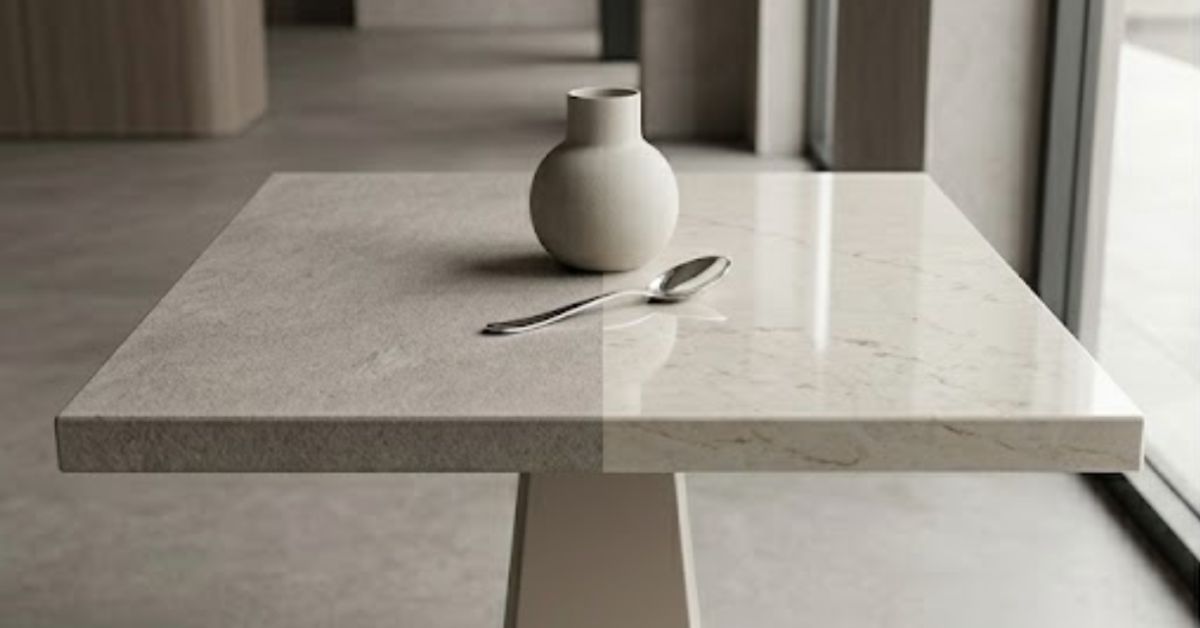
Hotel housekeeping operates on a rotation of bleach-based cleaners, disinfectant solutions, and acidic descalers. A full-service hotel restaurant can see tabletop surfaces sanitised 20 to 40 times per day, depending on occupancy and table turnover. Staff apply these products daily, sometimes across multiple shifts. The cleaning frequency on tabletops is relentless.
Quartz contains 6 to 10 percent polymer resin binders. Per Silestone's published technical data, prolonged exposure to strong alkaline or acidic cleaners can degrade these binders over time. The surface does not fail all at once. It loses its polish gradually, develops a dull or yellowish appearance in high-cleaning zones, and becomes harder to match against a fresh sample when touch-ups or replacements are needed.
Sintered stone is fully vitrified with no binders. Dekton's technical datasheet (2025) confirms resistance to bleach, disinfectants, and pH-extreme cleaning agents without surface degradation. There is no resin to break down. The surface you install is the surface that stays.
The practical implication: For any high-cleaning hospitality environment – hotel restaurants, spa lounges, healthcare-adjacent hospitality – sintered stone's chemical resistance profile is not a nice-to-have. It is the reason it was specified.
Pro Tip
Specifying tabletops for a hospitality project, and are not sure which material works for your exact use case?
Share your tabletop dimensions, material preference, thickness, edge profile, quantity, and project city with Arcedior. We will map the sourcing route, confirm the MOQ and realistic lead time, and outline the QC checkpoints before anything moves.
Outdoor Tabletops: Why the Right Material Changes Completely
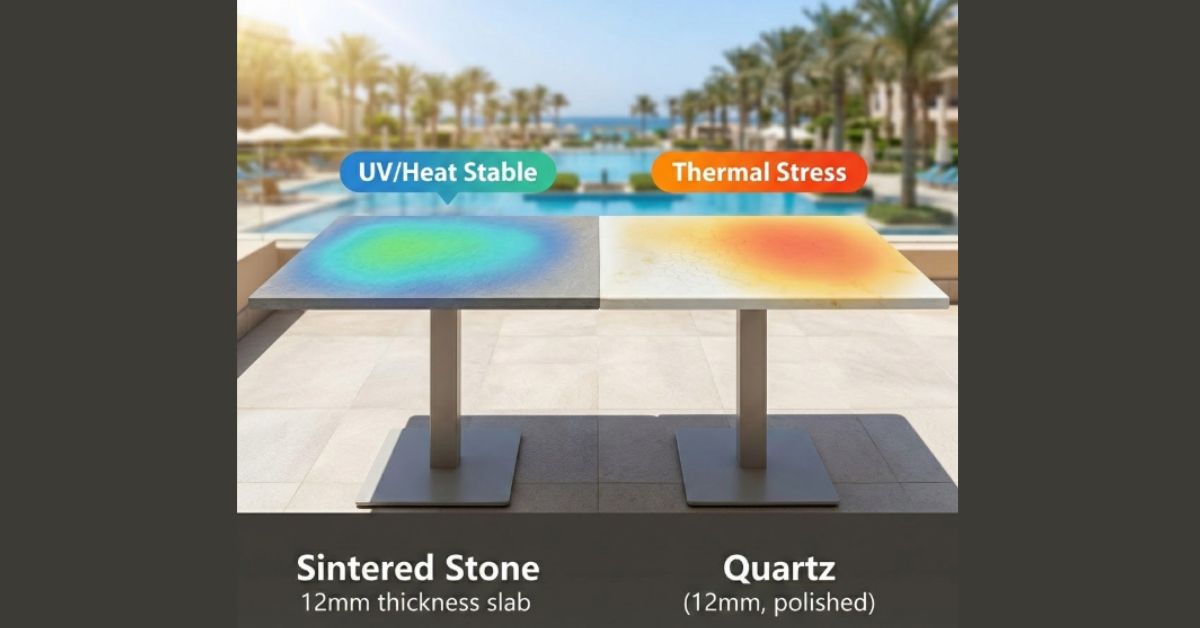
Quartz for outdoor use is a specification error that shows up six months later.
The polymer resins in engineered quartz absorb heat and UV radiation over time. In climates with high solar exposure and temperature cycling, the binders degrade. The surface discolours, develops micro-crazing, and the finish shifts. This is not a manufacturing defect. It is a material limitation that outdoor specs should account for.
Sintered stone is UV-stable and thermal-shock resistant. Per Dekton's published specifications, it maintains colour and surface integrity under direct sunlight and temperature extremes. In GCC summer conditions, exposed outdoor surfaces can exceed 60°C surface temperature during peak sunlight hours. Sintered stone handles this. Quartz does not.
As outdoor dining has grown post-2023 across the UAE and the wider GCC region, outdoor tabletop specification failures have become more visible. Projects in Dubai, Abu Dhabi, and Riyadh increasingly specify sintered stone for exposed terraces precisely because quartz warranty claims on outdoor installations are complicated to pursue.
Key Takeaway
Weight, Thickness, and Table Base Compatibility: What Nobody Tells You
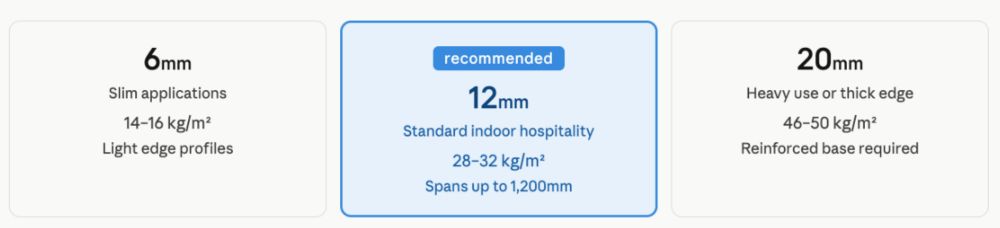
This section rarely appears in material comparison content. It shows up in your project when the base supplier tells you the specified slab is 40% heavier than the base they designed for.
Here are the numbers:
Sintered stone:
- 6mm thickness: approximately 14 to 16 kg/m²
- 12mm thickness: approximately 28 to 32 kg/m²
- 20mm thickness: approximately 46 to 50 kg/m²
Quartz:
- 20mm (standard hospitality thickness): approximately 50 to 55 kg/m²
- 30mm: approximately 75 to 80 kg/m²
Sintered stone's weight advantage comes at thinner gauges. A 12mm sintered stone tabletop, which is sufficient for most indoor restaurant use, weighs roughly 40% less than a 20mm quartz slab. This affects pedestal base spec, freight cost, and site handling.
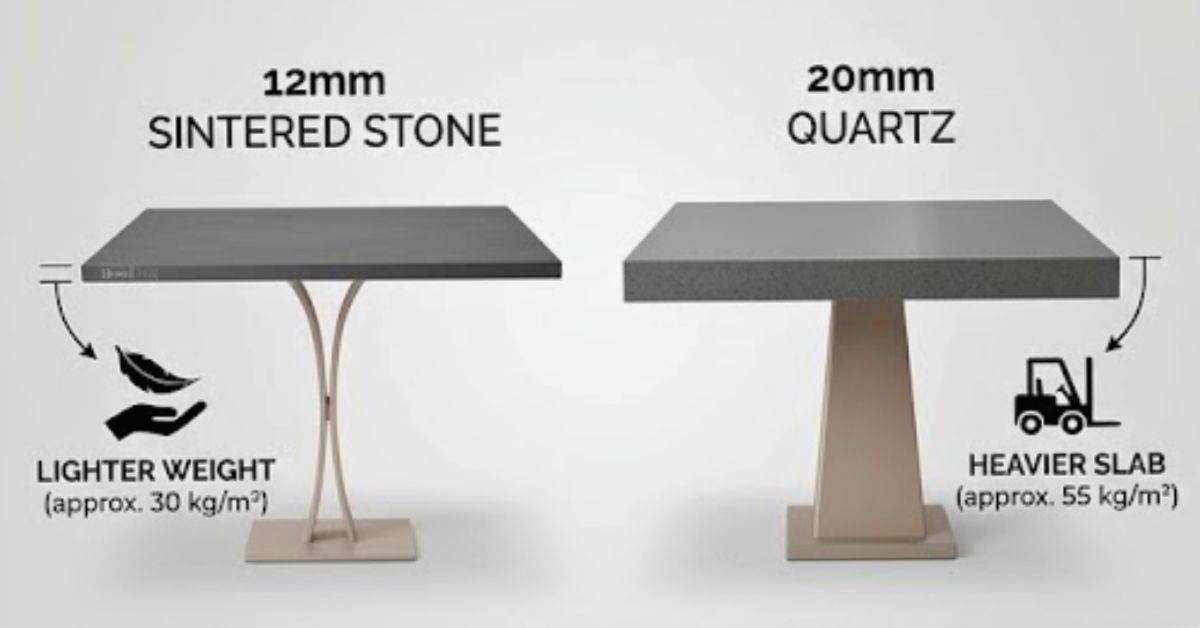
For a 100-table hospitality order, a shipment of sintered stone versus quartz at the same table size can differ by 3 to 5 tonnes, depending on thickness and substrate. That difference is not abstract once you are costing freight.
Thickness also affects edge profile options. Sintered stone is available at 6mm, 12mm, and 20mm, allowing for waterfall, mitre-joined double-layer, eased, or laminated edges. Quartz is typically supplied at 20mm or 30mm for commercial applications, which gives more inherent edge bulk but fewer slim-profile options.
Always specify base load capacity before finalising slab thickness, and confirm the base supplier's maximum tabletop weight before ordering. These two steps prevent one of the most common and expensive procurement errors on large table counts.
Free Download: Hotel Tabletop Procurement Checklist: Specification, QC & Dispatch
Most tabletop failures are already locked in before production even starts. Wrong slab thickness. Outdoor quartz approvals. Edge profiles that chip in transit. Bases are unable to handle the final load. QC checks were missed because nobody knew what to inspect.
This checklist was built around the exact mistakes hospitality projects keep repeating. Inside are 38 procurement, QC, packaging, and dispatch checkpoints used before tabletop orders move into production and shipment.
Common Tabletop Specification Mistakes in Hospitality Projects
Most procurement problems on tabletop orders do not come from manufacturing defects. They come from decisions made at the sample and specification stage, before production begins. These are the ones that show up after opening.
Specifying quartz outdoors. This is the most common and most expensive mistake. Quartz is not rated for direct UV exposure. The resin binders degrade under sustained sunlight and temperature cycling. By the time the damage is visible, the warranty conversation is already difficult.
Ignoring slab weight against base load capacity. A tabletop specification signed off without confirming the base's maximum load rating is a project risk. This comes up most often when the base supplier and tabletop supplier are different vendors.
Approving samples under showroom lighting only. Finishes, particularly matte sintered stone finishes, read differently under showroom halogen versus natural daylight or the warm ambient lighting of a hotel restaurant. Always view approved samples under the actual lighting conditions of the installation space.
Missing edge protection requirements in export packaging. Chipped edges on sintered stone are the most common QC failure point on arrival. Foam edge protection, correct crating, and moisture barrier packaging are not optional for international shipments.
Selecting a finish without testing against housekeeping chemicals. A polished finish that passes a generic scratch test may still show micro-etching from the acidic descalers or bleach products your housekeeping team uses. Test against the actual products.
No spare slab allocation in the order. For custom-cut orders at commercial scale, a 3 to 5 percent slab allowance for future repairs or replacements is worth building into the initial BOQ. Finding matching material 18 months after installation, from the same production batch, is often not possible.
Which Material Should You Choose for Your Hospitality Project?
Use Case | Recommended Material | Reason |
Outdoor dining terrace | Sintered stone | UV and thermal stability |
Poolside restaurant | Sintered stone | UV stability, no resin degradation |
Heavy chemical cleaning | Sintered stone | No binder to degrade |
Budget indoor café | Quartz | Lower cost, adequate for moderate use |
Luxury fine-dining tables | Sintered stone | Long-term finish retention |
High-impact fast-casual dining | Quartz | Better edge impact resistance |
Slim-profile tabletop design | Sintered stone | Available at 6mm and 12mm |
Quick-turn local sourcing | Quartz | Wider local manufacturing base in India |
Live cooking table formats | Sintered stone | Direct heat contact rated |
Healthcare-adjacent hospitality | Sintered stone | Fire Class A1, no VOCs |
Sintered Stone vs Quartz: Sourcing and Lead Time for a Bulk Hotel Project
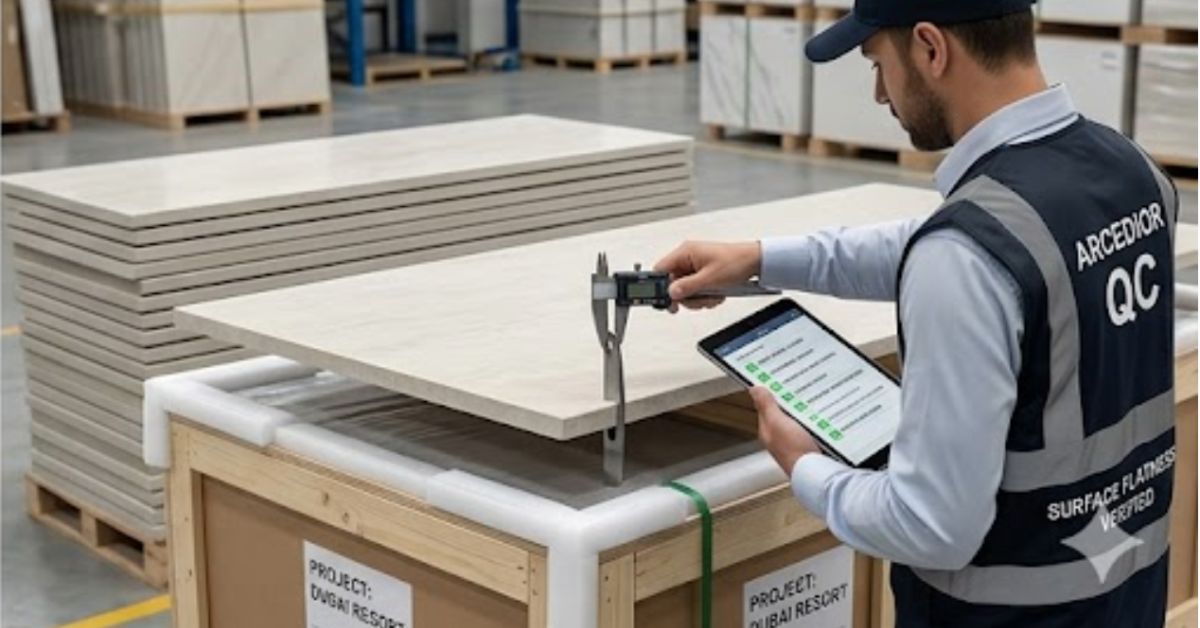
Hotel tabletop material specification: lead time is not a footnote. It is a project risk.
Where these materials are made:
Sintered stone at commercial grade is primarily manufactured in Spain (Dekton/Cosentino, Neolith) and increasingly in India and China, where cost-competitive alternatives are growing in specification volume. Ceramics of Italy also documents Italian sintered stone output for hospitality use.
Quartz slabs are widely manufactured in India, China, and Italy. For projects in India where large hospitality fit-out orders involve bulk tabletop requirements, Indian-manufactured quartz offers shorter lead times and lower freight costs.
Typical lead time breakdown for a custom-cut tabletop order:
Stage | Timeline |
Sample approval | 10 to 15 days |
Custom cut production (depending on MOQ and complexity) | 3 to 5 weeks |
QC inspection and packing | 3 to 5 days |
Shipping to the UAE, India, or KSA | 10 to 25 days (varies by origin and mode) |
Most custom-cut tabletop orders at a commercial scale are viable from 20 pieces upward. Larger hotel projects – 50+ tables – open up more competitive manufacturing options, especially for sintered stone.
Export-ready tabletops shipped to UAE ports require correct crating, foam edge protection, and moisture barrier packaging. These are not optional. Damaged edge profiles on arrival are one of the most common QC failure points on slab tabletop orders.
Arcedior handles custom/contract manufacturing coordination, QC inspections, and logistics for hospitality tabletop orders across these markets. If you are sourcing tabletops for a hospitality project, confirming material, thickness, edge profile, and quantity upfront allows us to map the sourcing route and realistic lead time before you lock your project schedule.
Working on a multi-table hospitality project?
Share your tabletop dimensions, preferred material, thickness, edge profile, quantity, and project city with Arcedior. We will evaluate slab weight, base compatibility, sourcing route, MOQ, lead time, and QC checkpoints before production begins.
QC Checklist for Tabletop Slabs Before Dispatch
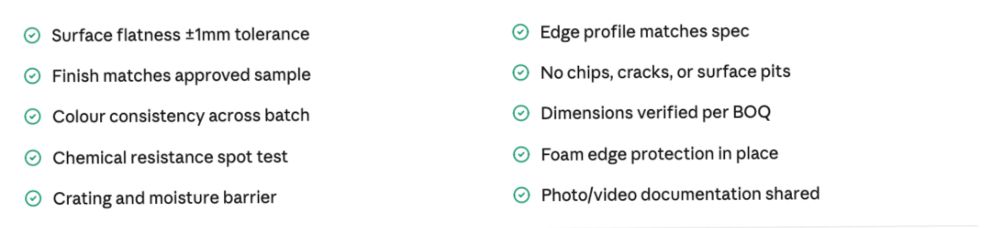
A QC inspection before dispatch is not optional on custom slab orders. Once the material leaves the factory, defects become a negotiation, not a replacement. Here is what to check:
- Surface flatness verified against approved sample (max tolerance ±1mm)
- Edge profile matches specification: eased, bevelled, waterfall, or mitre
- Finish confirmed against approved sample: matte, polished, or textured
- No hairline cracks, chips, or surface pits on any piece
- Colour consistency checked across all pieces in the batch
- Dimensions verified against BOQ ±tolerance
- Chemical resistance spot test on batch samples if required
- Export packaging: foam edge protection, crating, and a moisture barrier in place
- Photo and video documentation shared with the client before dispatch
Pro Tip
Third-party QC inspection on tabletop slab orders is advisable when manufacturer relationships are new or order values are above a defined threshold. Arcedior coordinates third-party QC inspection as part of its sourcing and QC services for hospitality projects.
Compliance Notes: Fire Rating and Safety Standards
For hospitality projects in the UAE and GCC, surface materials used indoors near heat sources or in enclosed dining spaces may require compliance with local fire codes.
BS EN 13501-1 classifies building products and construction products for fire performance. Sintered stone, as a fully mineral-based surface, typically achieves Class A1 fire classification (non-combustible) under this standard. Quartz, due to its resin content, generally falls in a lower fire class.
For projects in the UAE where indoor hospitality fit-outs require fire authority sign-off, specifying sintered stone with documented fire classification simplifies the compliance file. Always verify with the material supplier that their specific product carries a current test certificate.
Similarly, GREENGUARD or equivalent indoor air quality certification is increasingly referenced in hospitality project briefs, particularly for healthcare-adjacent or family resort properties. Sintered stone, with no VOC-emitting binders, is easier to certify in this category than resin-bound quartz.
Conclusion: Which One Is Right for Your Project?
The sintered stone vs quartz tabletops decision for hospitality is not a close call when you factor in real-use conditions.
If your application is outdoor dining, pool-side, or any space with direct UV exposure, specify sintered stone. If your operation runs daily chemical cleaning with bleach-based or acidic products, sintered stone is the lower-risk specification. If your project is a budget-sensitive indoor restaurant with moderate foot traffic and no outdoor exposure, quartz delivers reasonable performance at a lower cost.
The one mistake worth avoiding in either case: specifying material and thickness without confirming base compatibility, confirming the sourcing lead time against your project schedule, and building a QC checkpoint before dispatch into the procurement plan.
These three steps prevent the majority of tabletop procurement failures that show up six months after opening.
Working on a hotel or restaurant tabletop specification?
Share your tabletop dimensions, material preference, thickness, edge profile, quantity, and project city. Arcedior will map the sourcing route through its global sourcing and custom manufacturing network, confirm MOQ and lead time, and outline the QC checkpoints before anything moves.