FF&E Procurement Partner for Architects India | QC + Lead Time

FF&E Procurement Partner for Architects in India: How the Backend Model Works
This guide is specifically for architecture firms handling multi-category BOQs. It is not about general furniture sourcing.
Managing a multi-category BOQ across twelve vendors is a full-time job nobody hired you for. You write detailed specs, share finish codes, sign off on samples, and still end up on WhatsApp at 10 pm chasing a confirmation from a factory in Rajasthan.
This is not a rare situation. It is how most architecture firms in India run FF&E procurement today, because the backend work grows faster than the team tracking it.
An FF&E procurement partner takes that coordination load off the project team. Not design. Not turnkey delivery. Specifically, the sourcing, vendor shortlisting, RFQs, purchase orders, QC checks, and delivery sequencing that keep a project on schedule without pulling senior people into daily fire-fighting.
Quick Answer: What is an FF&E procurement partner?
What an FF&E Procurement Partner Does (and Clearly Doesn't Do)
This distinction matters because the confusion costs firms real money and time.
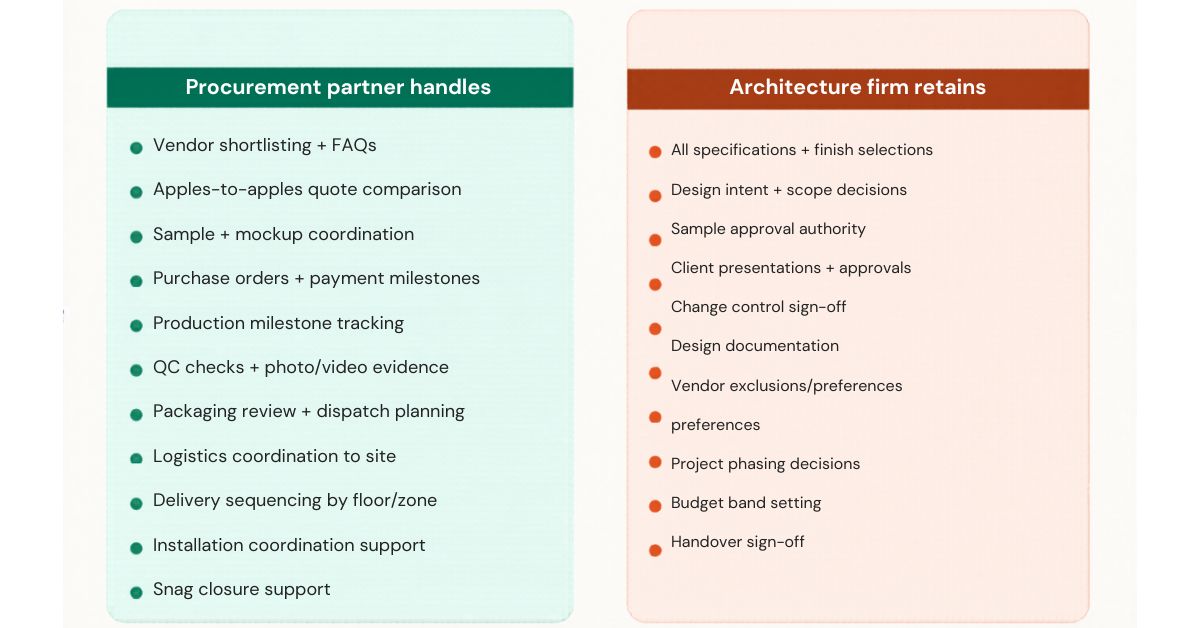
What a procurement partner manages:
- BOQ review and category-wise supplier shortlisting
- RFQs to vetted vendors, with structured apples-to-apples quote comparison
- Sample and mockup coordination, with finish and hardware approvals
- Purchase orders, payment milestone tracking, and production planning
- QC checkpoints at production and pre-dispatch stage, with photo and video evidence packs
- Packaging review and dispatch planning
- Logistics coordination from the factory to the site
- Delivery sequencing by floor or zone
- Installation coordination, support, and snag closure support
What stays entirely with the architecture firm:
- All specifications, finish selections, and design intent
- Client approvals, presentations, and scope decisions
- Any design development or documentation
Not design. Not a turnkey contractor. The procurement partner's job is to execute your specs accurately and get the right product to the site on time, within the structure you have defined.
Definition
FF&E Procurement Challenges Specific to Indian Projects
India is not a single market when it comes to FF&E execution. Each project has its own geography problem, and the firms that miss handover dates almost always underestimate the ground-level complexity.
Multi-city vendor coordination: Most BOQs pull from vendors in different states. Jodhpur for solid wood. Bangalore for upholstery. Morbi for tiles. Surat for fabrics. Coordinating production timelines across these clusters, with different lead times and payment norms per region, needs a dedicated layer of management that most project teams are not staffed for.
Site access constraints: Deliveries to high-rise residential or hospitality projects in Indian cities regularly run into lift dimension limits, restricted delivery hours, and no-vehicle zones. These details need to be confirmed before dispatch, not after the truck arrives.
Regional manufacturing clusters: India's furniture and fixtures manufacturing is concentrated in specific regions. A procurement partner with active vendor relationships across these clusters shortlists faster, catches capacity issues earlier, and negotiates from a position of actual volume.
Transport delays on long-haul routes: A consignment moving from Rajasthan to a project site in Mumbai during the festival season or monsoon can add 5 to 10 days to an already tight schedule. Buffer planning is not optional on Indian projects. It has to be built into the delivery sequencing from day one.
These are not edge cases. They come up on almost every multi-category, multi-city project. A procurement partner who has worked in India accounts for them by default. One who has not will ask you to absorb the delay.
The 8-Step Backend Procurement Workflow
This is how a structured FF&E procurement engagement runs from BOQ to site delivery.
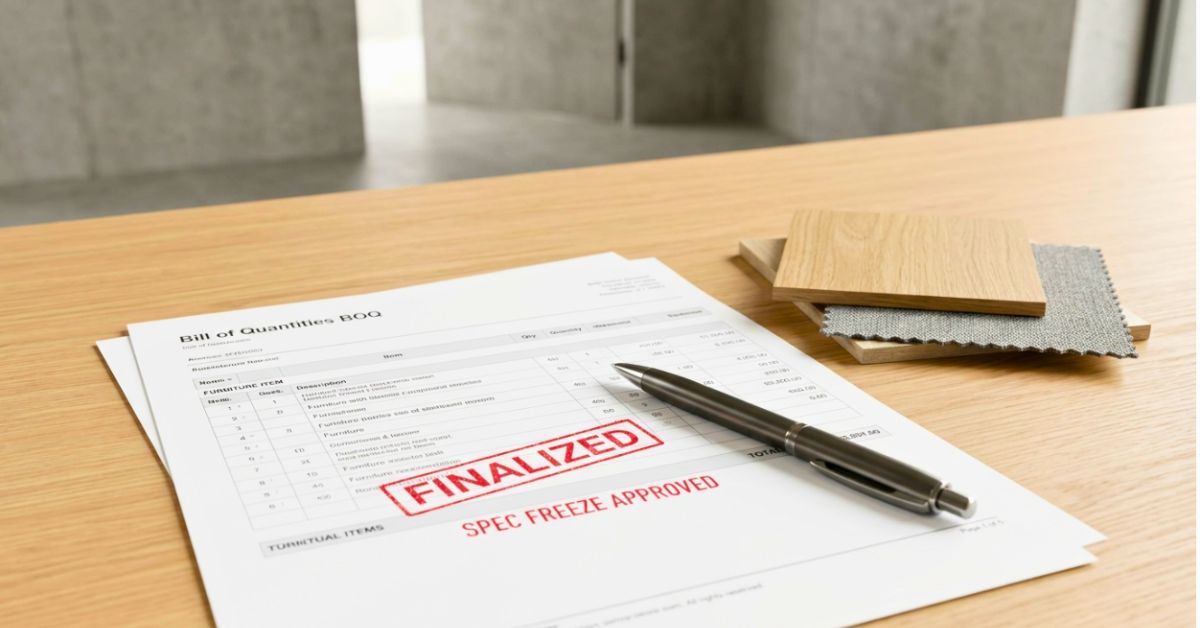
Step 1: BOQ and Spec Freeze
Final quantities, materials, finish codes, dimensions, and budget bands confirmed before vendor outreach begins. Changes after this point cost time and money.
Step 2: Supplier Shortlist and Alternates
Vendors shortlisted by category based on spec, production capacity, and lead time requirements. Alternates are identified upfront, so there is no single point of failure.
Step 3: RFQs and Quote Comparison
Requests for quotation sent to shortlisted vendors. Responses are structured into a line-by-line comparison covering price, lead time, payment terms, and spec compliance.
Step 4: Sample and Mockup Approvals
Physical samples coordinated for review by the architect. Finish, hardware, tolerances, and dimensions are checked against spec before production approval is issued.
Step 5: Purchase Orders and Production Plan
POs raised post-approval. A production milestone tracker is set up across all vendors, with key dates mapped against the site handover schedule.
Step 6: QC Checkpoints with Evidence
Quality checks at the production stage and before dispatch. Each item gets photo and video documentation. Hardware is tested. Finishes are compared directly against the approved physical sample.
Step 7: Packing, Dispatch, and Logistics
Packaging reviewed for corner protection, edge guards, and moisture barriers. Logistics are coordinated from the factory to the site based on item category and delivery city.
Step 8: Delivery Sequencing and Snag Closure
Items delivered by floor or zone in line with site readiness. Snag list documented on arrival. Items replaced or repaired before handover sign-off.
For a detailed backend execution workflow, see our FF&E procurement process for architects.
Pro Tip
What to Share to Get Accurate Quotes Fast
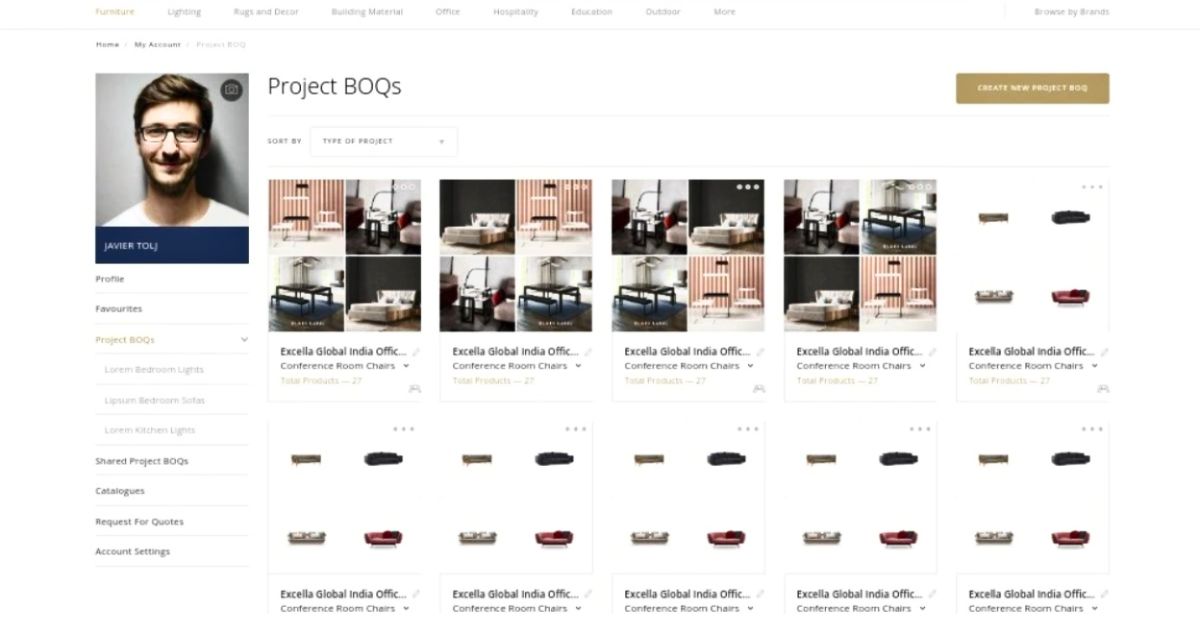
Vague briefs produce vague quotes. To get accurate sourcing routes and realistic lead-time plans, share the following with any procurement partner at the start:
- Full BOQ with item descriptions, quantities, and dimensions
- Finish codes or reference samples per category
- Room-wise or zone-wise split if the project has phased delivery
- Site city and delivery address, including site access notes
- Target handover date, and phased dates if applicable
- Budget bands per category
- Any existing vendor preferences or exclusions
The more specific the brief, the faster the RFQ round and the fewer revision cycles on quotes.
Running a live BOQ right now?
Share your BOQ, specs, site city, and target handover date. We'll revert with sourcing routes, a lead-time risk map, QC checkpoint plan, and delivery sequencing approach for your specific project.
Lead Time Breakdown for FF&E Procurement in India
The most consistent reason architecture firms miss handover dates is treating procurement as a late-stage activity. These numbers explain why.
Stage | Typical Duration |
Supplier shortlisting and RFQs | 5 to 10 days |
Sample and mockup approvals | 2 to 4 weeks |
Production (standard items) | 4 to 8 weeks |
Production (custom casegoods) | 8 to 14 weeks |
QC and pre-dispatch checks | 3 to 7 days |
Domestic logistics to the site | 3 to 10 days |
Delivery sequencing buffer | 5 to 14 days |
For a hospitality or commercial project with custom furniture, the minimum realistic timeline from spec freeze to site delivery is 14 to 18 weeks. Residential projects move faster in production, but sampling and approval rounds add time regardless of project type.
Key Takeaway
What a Real FF&E Quote Comparison Looks Like
Most procurement processes produce a summary comparison, not a real one. A summary tells you the headline price. A real comparison tells you where the risk is. Here is what a structured, line-by-line quote comparison covers.
Parameter | Vendor A | Vendor B | Vendor C |
Unit price (per BOQ line) | Rs 18,400 | Rs 16,200 | Rs 19,800 |
Total cost (qty x unit) | Rs 9.2 L | Rs 8.1 L | Rs 9.9 L |
Lead time (weeks) | 7 | 10 | 6 |
Payment terms | 50% advance, 50% on dispatch | 40% advance, 60% on delivery | 60% advance, 40% on dispatch |
Packing included | Yes | No | Yes |
Freight to site | Included | Extra | Extra |
Spec compliance | Full | Alternate timber proposed | Full |
Warranty (years) | 1 | 1 | 2 |
Risk flag | None | Timber change. Lead time high. | High advance. Verify capacity. |
In this example, Vendor B looks cheapest but has a spec deviation, no packing, and freight excluded. The actual cost and risk are higher, not lower. A comparison that does not flag these differences is not a comparison. It is a shortlist with the hard work left undone.
What to Expect from a QC Evidence Pack
A site visit without documentation is not a quality check. If a vendor cannot produce a structured evidence pack before dispatch, that is a problem to address before production approval, not after delivery.
A proper QC evidence pack covers:
- Photographs: Item front, sides, back, close-up of finish, hardware, joinery, and packaging. Shot under consistent lighting and compared side-by-side with the approved physical sample.
- Video walkthrough: Full item review, drawer and door operation under load, hardware test, and packaging seal-up. Short clip per item category, filed by PO line.
- QC checklist: Signed and dated document covering dimensional tolerance, finish match, surface defects, structural stability, hardware performance, and packaging integrity. Non-conformances listed with resolution status.
This pack is created item-category by item-category before dispatch is confirmed. If anything fails the check, it is held back, not shipped, and handled later. Later almost always means a delayed project and a difficult conversation with the client.
Competitors who describe QC as a site visit or a WhatsApp photo are describing a check that does not protect the architect or the project. The architecture firm deserves documented evidence, not a verbal confirmation from the vendor.
QC Checklist Before Dispatch
A visual inspection without documentation is not a quality check. Here is what a structured pre-dispatch review should cover:
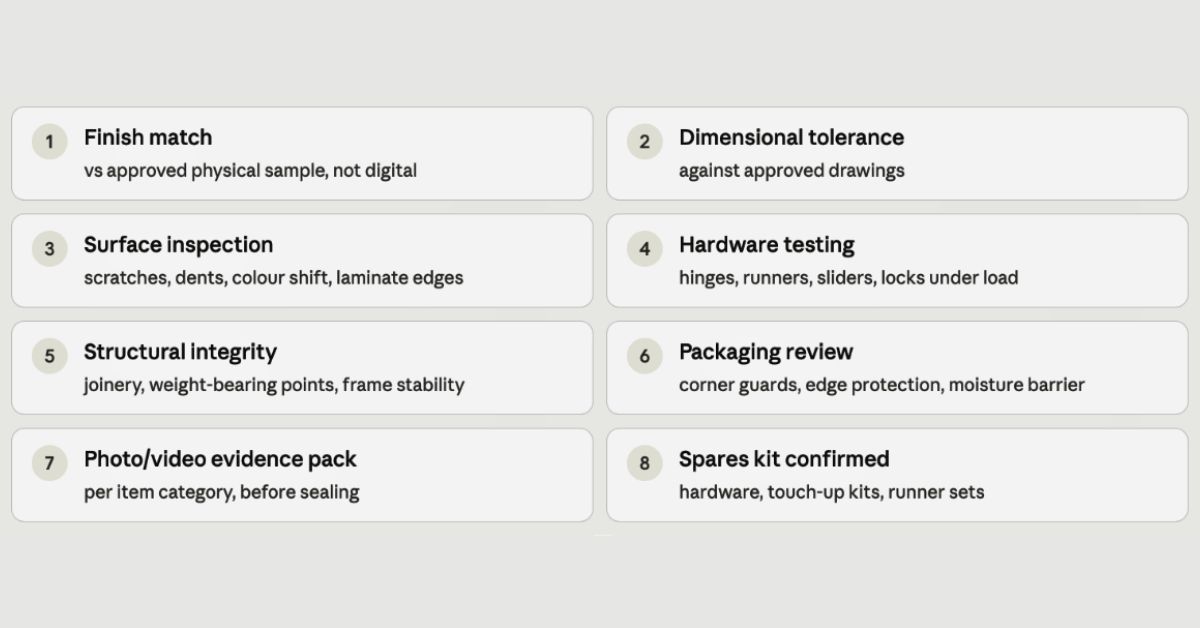
- Finish match against the approved physical sample (not a digital reference)
- Dimensional tolerance check against approved drawings
- Surface inspection for scratches, dents, colour shift, and laminate edge quality
- Hardware testing: hinges under load, drawer runners, sliders, locks
- Structural integrity: joinery, weight-bearing points, frame stability
- Packaging review: corner guards, edge protection, moisture barrier
- Photo and video evidence pack created per item category
- Spares kit confirmed: replacement hardware, touch-up kits, runner sets, chair parts
If a vendor cannot produce a documented QC pack, treat that as a risk signal before production approval, not after delivery.

Managing Multiple Vendors Without Daily Follow-Ups
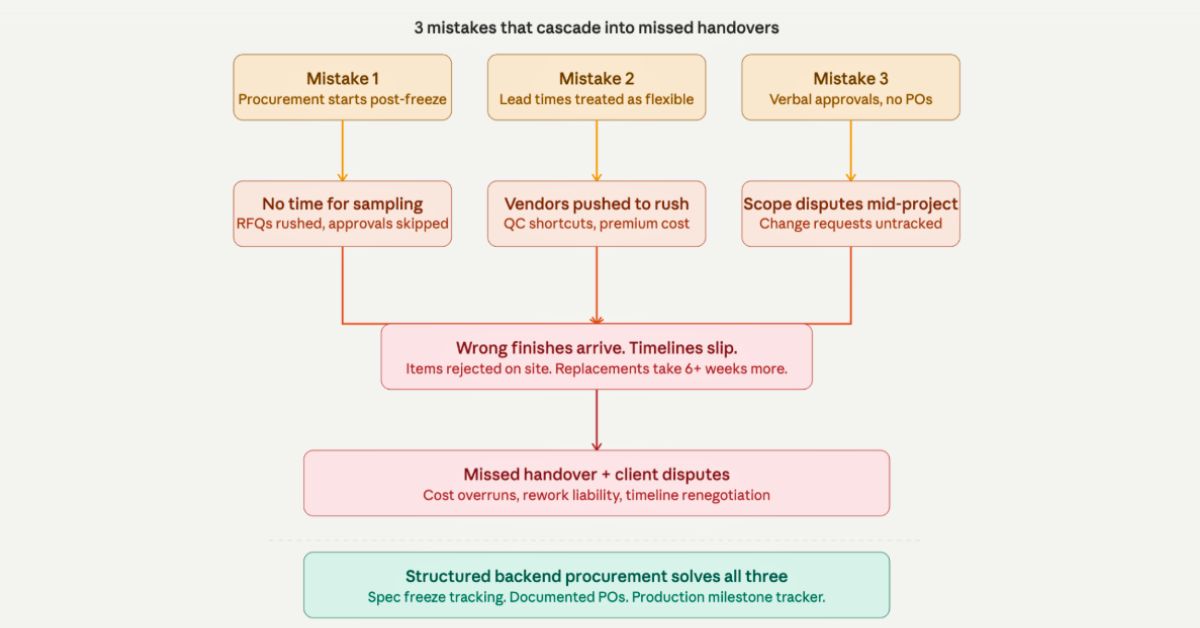
The solution is one tracking layer across all vendors, with escalation rules built in from day one.
A good procurement partner maintains a single production milestone tracker accessible to the project team. It shows vendor-wise status, current production stage, QC dates, and dispatch schedule. The project lead gets a structured weekly update with attached evidence instead of chasing eleven separate WhatsApp threads.
Change control is part of this structure. When specs change mid-production (and they will), every change gets documented, a revised PO or amendment is raised, and the impact on lead time is flagged in writing. No verbal agreements. Everything on record.
Replacement and damage planning is set up at the start: what happens if an item arrives damaged, how replacements are sourced, and whether a spares order runs alongside the main production batch.
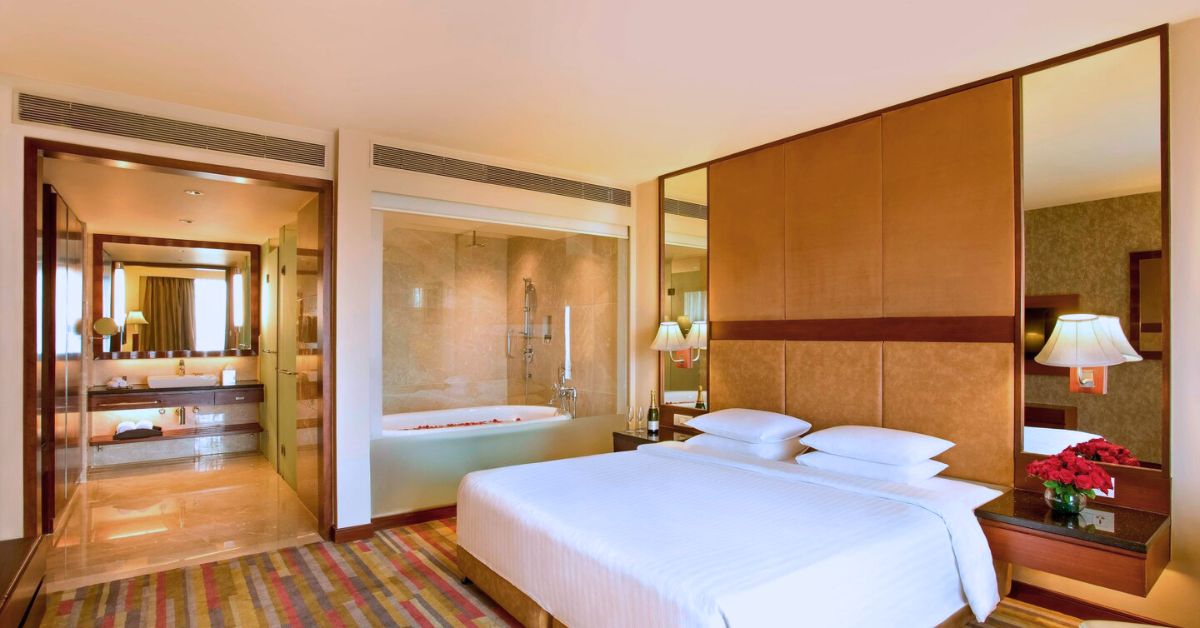
How This Works on a Real Project: Courtyard by Marriott, Ahmedabad
The Courtyard by Marriott in Ahmedabad required sourcing and supply of loose furniture, lighting, and hotel accessories across 164 guest rooms. The project involved multiple product categories, tight brand compliance standards, and a delivery requirement that could not slip without affecting the hotel's opening date.
Arcedior handled vendor shortlisting, RFQs, and quote comparison across categories. Each vendor was evaluated on spec compliance, lead time, and finish capability before a PO was raised. Samples were physically reviewed and approved before production started. QC checks were conducted at the production stage and again before dispatch, with a documented evidence pack per category.
Delivery sequencing was coordinated with the site team to align with room readiness, so items arrived in usable order rather than creating storage and handling problems on-site.
The architecture and design team retained full approval authority throughout. Every finish, every sample, every change went through them. Arcedior managed the supply chain between spec approval and site delivery. That division is what makes the backend model work on projects of this scale and complexity.
Get a Free Backend Sourcing Audit for Your Live Project
Share your BOQ, specs, site city, and target handover date. Arcedior will revert with sourcing routes, a lead-time risk map, a QC checkpoint plan, and a delivery sequencing approach based on your project specifics.
No design. No turnkey. Clean procurement execution from RFQ to site delivery.
Conclusion
The backend side of FF&E procurement is where most project timelines quietly fall apart. Vendor confirmations take two weeks. Finishes that arrive slightly off. Items dispatched without a QC check. Deliveries that land on the wrong floor.
None of that is inevitable. It is what happens when procurement runs as an afterthought rather than a parallel workstream with its own structure, tracking, and documentation.
If your firm is handling multi-category BOQs for hospitality, commercial, or premium residential projects, the question is not whether a procurement partner adds value. It is whether running without one is already showing up in your timelines and your team's bandwidth.
The backend model exists to solve a real operational problem. Not to replace the architect. To give the architect's team the bandwidth to stay focused on what they were hired to do.