Why Furniture Sourcing Fails for Interior Designers (Issues + Fix)

Why Furniture Sourcing Fails for Interior Designers (Before You Even Start Procurement)
Quick Answer
Most furniture sourcing problems are not random. They follow a pattern. The same issues show up on project after project: a vendor who confirms lead time verbally but misses dispatch by three weeks, a finish that looks different across two suppliers because neither had the same reference sample, a marble console that arrives with a cracked edge because it was packed in standard cardboard.
If you have been through any of these, you are not alone. And the frustrating part is that most of these problems were preventable. They started with a gap in the process, not a stroke of bad luck.
This blog breaks down where furniture sourcing actually goes wrong for interior designers in India, what each failure costs in real terms, and what a structured approach looks like. Interior project execution issues tend to cluster at the same steps every time. Once you know where the furniture supply chain delays come from, the procurement bottlenecks become much easier to close before a PO goes out. If you want to understand how a sourcing partner handles execution once the process is fixed, see how a sourcing and custom manufacturing partner works.
The Real Problem Starts After Design Approval
There is a specific kind of pressure that builds between design sign-off and site delivery. The creative work is done. The client is happy. And then the backend starts to fall apart.
This is not a design problem. It is an execution problem. Most interior studios are not set up to manage it internally, especially when running two or three projects at once.
India's furniture supply chain is fragmented by nature. A single project might pull from a woodwork manufacturer in Rajasthan, a fabric supplier in Surat, a metal fabricator in Pune, and an import-cleared vendor in Mumbai. Each has a different production calendar. Each defines "ready to dispatch" differently. None of them is talking to each other.
Multi-city projects make this worse. Coordinating vendor timelines with site access windows across different states needs dedicated bandwidth, not part-time attention from a studio coordinator already buried in email.
Where Furniture Sourcing Breaks Down in Real Projects

BOQ not vendor-ready
What is a vendor-ready BOQ?
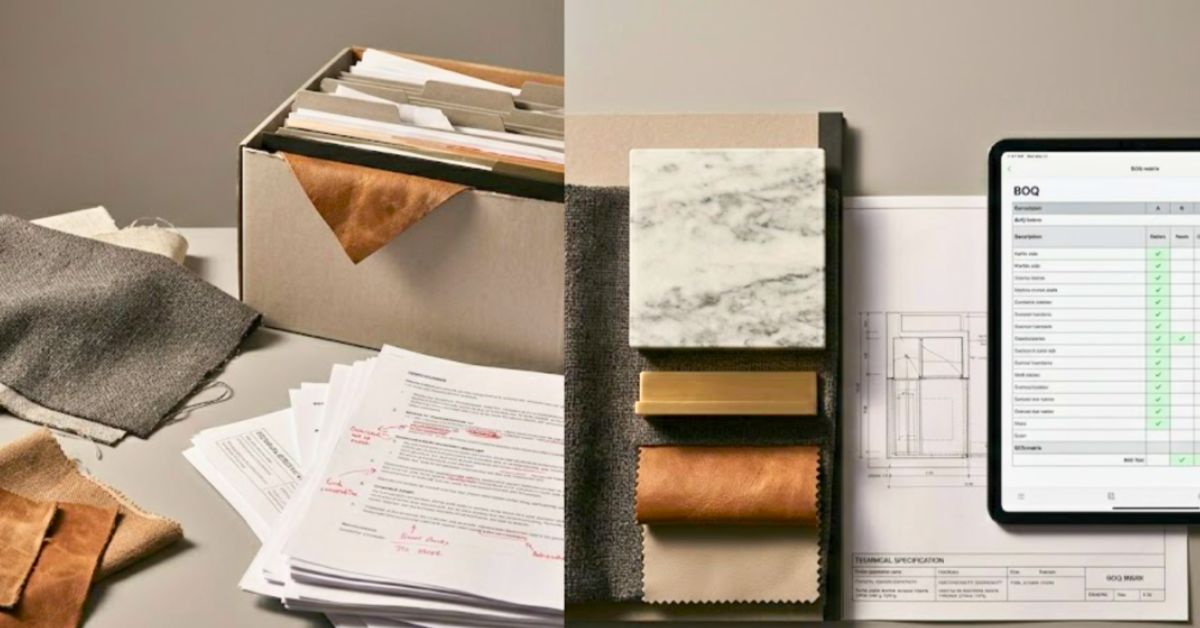
A BOQ that looks complete to a designer is often not ready for a vendor. Dimensions might be listed without tolerances. Finish references might say "warm grey" without a RAL code or a sample. Hardware specs might be missing entirely. When these gaps surface after a PO is placed, the vendor stops production and waits. That wait does not show up in the original lead time estimate.
Vendor quotes that cannot be compared
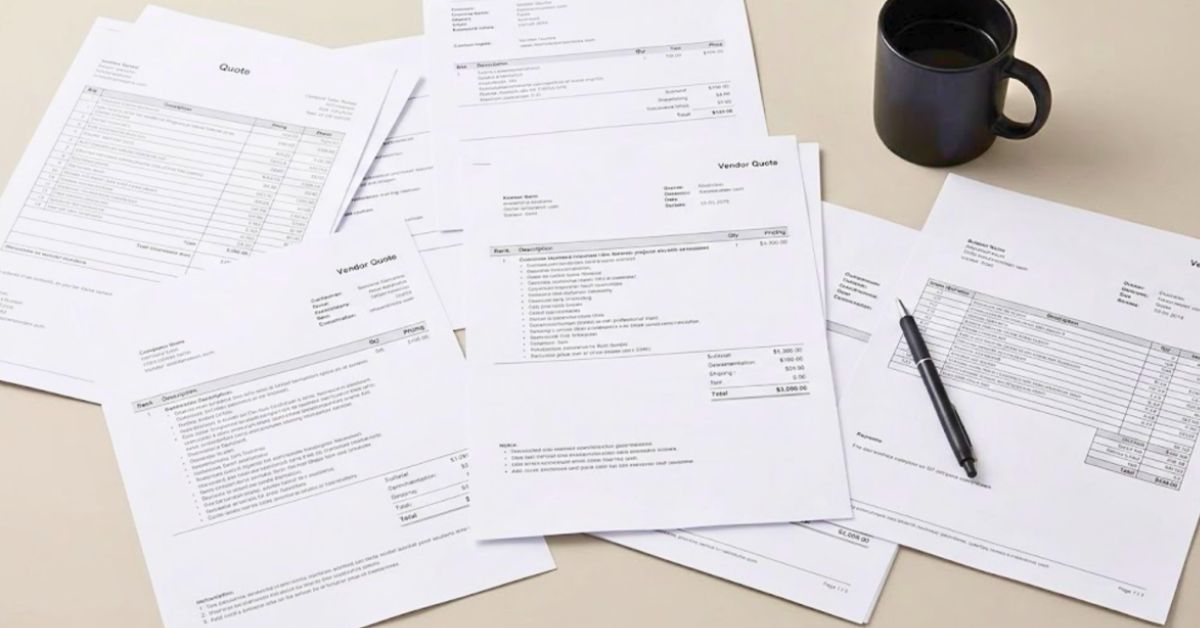
What is a structured RFQ format? A structured RFQ gives every vendor the same brief: item dimensions, material spec, finish reference, quantity, packaging requirements, and delivery point. Quotes come back in a standardised matrix covering unit price, lead time, MOQ, and logistics. You can compare them directly.
Send the same brief to three vendors, and you will get three quotes in completely different formats. One quote per unit. Another quote for a minimum batch. A third includes logistics in the price, while the others do not. Without a structured RFQ format, you cannot actually compare these. You end up making decisions on incomplete information.
No finish reference standard

If two vendors are producing pieces with the same finish and neither has been given the same physical reference sample, you will almost certainly end up with two slightly different results on site. Clients notice. And fixing it after installation is expensive.
Sampling gaps and no sign-off record
Why does sample sign-off documentation matter? A formal sample sign-off record is the only document that lets you hold a vendor accountable if full production deviates from what was approved. Without it, the vendor can argue that the production matches their interpretation of the brief.
Samples approved verbally, or over WhatsApp without a formal record, create problems later. A formal sign-off process is not bureaucracy. It is the only thing that gives you leverage when production goes off-spec.

QC that happens on-site instead of at the factory
When should pre-shipment QC happen in furniture procurement? Pre-shipment QC should happen at the factory before dispatch, not at the site after delivery. A factory inspection checks dimensions, finish accuracy, structural integrity, hardware, upholstery, and packaging. Catching a problem here takes one day. Catching it on site takes four to eight weeks to resolve.
This is the most expensive mistake in furniture procurement. When a piece arrives damaged or off-spec, the damage is already done. The vendor has to reproduce it. You lose four to eight weeks minimum.
Catch Delays Before Your First PO Goes Out
Most projects lose two to four weeks at the BOQ stage. A spec gap that takes ten minutes to fix before sourcing starts takes four weeks to fix after production begins.
Arcedior reviews your BOQ, flags spec gaps, maps supplier route options, and gives you a lead time plan with QC checkpoints in 48 hours. No commitment needed.
Real Project: What a Finish Specification Gap Actually Costs
Project: Taj Gandhinagar Resort and Spa, Gandhinagar, Gujarat
Designer: Ar. Reza Kabul, ARK Reza Kabul Architects
Scope: FF&E sourcing across 115 rooms, including 2 presidential suites, restaurants, spa, banquet, and public areas. Products sourced from India (custom furniture), China (lighting), and Bali (decor).

The core problem:
The client brief specified luxury-style furniture in a golden tone for deluxe rooms, including carved wooden moldings for headboards and TV panels. The finished description was clear to the design team. It was not clear enough for the vendors. "Golden" reads differently across manufacturers, finish processes, and wood species. Without a physical reference locked in before production, each vendor interpreted it independently.
What that actually meant in production:
Arcedior ran more than 40 sampling iterations on the gold finish alone before a standard was approved and locked. That is not a vendor failure. It is what happens when a finish like this is specified by name rather than by physical reference. Each iteration had to be produced, reviewed, and either rejected or refined. The clock ran through every round.
How the process was corrected:
Process Step | What Was Done | Why It Mattered |
Finish reference | Physical sample locked before any production approval | Every vendor benchmarked against one standard |
Mock-up workflow | Full guest room mock-ups built at the factory before bulk production | Client and designer approved the complete room, not just individual pieces |
Factory QC | Every batch is inspected against the approved sample before dispatch | Zero finish mismatches across 1,000+ pieces delivered |
Phased delivery | Deliveries sequenced floor by floor around ongoing construction | No storage bottlenecks; site access confirmed before dispatch |
Result: Phase 1 (74 rooms) completed in 15 months. Phase 2 (41 rooms) in 5 months. No finish mismatches. No quality rejections. Both phases were delivered on time.
What this tells you about your own project:
If your BOQ describes a finish by name only, "brushed brass," "matte black," "warm gold," you are starting a sampling cycle, not a production timeline. The number of iterations you run before locking a standard is directly proportional to how vague the original spec was. A physical reference agreed before the first RFQ goes out is not an extra step. It is the step that determines whether sampling takes one round or forty.
The Furniture Sourcing Workflow (And Where It Breaks)

Most interior designers see sourcing as a straight line. It is not.
The actual flow:
Design approval → BOQ finalisation → RFQ preparation → Vendor shortlisting → Quote comparison → Sample request → Sample sign-off → Production start → Production tracking → Pre-shipment QC → Dispatch → Logistics tracking → Site delivery
Where it breaks, and how often:
Stage | Common Break Point | How Often It Happens |
BOQ finalisation | Missing specs, no finish reference | Very common |
RFQ preparation | No standard format, vendors quote differently | Common |
Sample sign-off | Verbal approval, no documentation | Very common |
Production tracking | No milestone plan, vendor goes silent | Common |
Pre-shipment QC | Skipped entirely or done after dispatch | Very common |
Logistics tracking | No buffer milestones, site access not confirmed | Common |
The FF&E procurement process has six stages where things reliably go wrong. Knowing the stages is not the same as having a system to manage them.
The 5 Failure Points Framework
Interior sourcing projects do not fail randomly. They fail at the same five points, in roughly the same order.
Point 1: BOQ gaps. Specifications are incomplete at the brief stage. Vendors fill gaps with assumptions. Production starts on the wrong spec.
Point 2: RFQ inconsistency. No standard format. Quotes come back in different structures. Comparison is impossible. The decision goes to the cheapest quote, not the most accurate one.
Point 3: Finish mismatch. No shared physical reference. Two vendors produce the same finish name with different results. The difference is visible on site.
Point 4: Sampling errors. No formal sign-off record. Verbal approvals. Production deviates from the approved sample. No documentation to dispute it.
Point 5: No pre-dispatch QC Inspection happens at the site, not at the factory. Damaged or off-spec goods arrive. Reproduction and re-delivery cost four to eight weeks.
If your current sourcing process does not have a specific fix for each of these five points, the risk is still in your project. The 5 Failure Points Framework is the checklist to run before any PO goes out.
India vs Global Sourcing: Why the Challenges Are Different
Interior designers working with international procurement standards often assume the same system applies in India. It does not.
Challenge Area | India Sourcing | Global Sourcing |
Vendor structure | Fragmented across production clusters (Rajasthan, Surat, Pune, Mumbai) | More consolidated; fewer, larger vendors |
RFQ process | Informal; vendors often quote verbally or over WhatsApp | Standardised RFQ formats; structured quote responses |
Communication trail | WhatsApp approvals; no formal documentation trail | Email and contract-based approvals |
QC standards | Inconsistent across vendors; self-certified by most | Third-party QC common; contract-specified standards |
Lead time reliability | Festival shutdowns, city-specific delays, and no buffer milestones | More predictable; contract-backed timelines |
Logistics | Uncoordinated across vendor cities; site access not pre-confirmed | Structured freight and last-mile planning |
These differences matter for furniture supply chain delays in Indian projects. The procurement bottlenecks are structural, not vendor-specific. A designer who has managed sourcing in Europe or the Gulf will run into very different problems in India, and the standard fixes do not transfer directly.
Post-2023, longer lead times and freight unpredictability have made pre-dispatch QC and milestone planning even more important. Production clusters affected by rising raw material costs and freight volatility have less buffer to absorb spec changes mid-production.
What These Problems Actually Cost You

The real cost of sourcing failures is not just financial. It is time, client trust, and your own bandwidth.
- Delays of 2 to 6 weeks on individual items are common when specs are incomplete at the BOQ stage or when sampling rounds need to be repeated.
- Rework costs on a single damaged piece can run higher than the original item cost when you factor in freight, reproduction, and re-delivery.
- Budget escalation happens when vendor quotes are accepted without proper comparison, and you discover cheaper or faster alternatives only after the PO is placed.
- Client pressure accumulates when delivery dates slip and the designer becomes the communication point between an unhappy client and an unreliable vendor.
Key Takeaway
Problem → Cause → Impact → Fix
Problem | Cause | Impact | Fix |
Vendor pauses production | BOQ missing finish spec or tolerance | 2 to 4 week delay per item | BOQ sanity check before RFQ goes out |
Quotes cannot be compared | No standard RFQ format | Wrong vendor selected; hidden cost risk | Structured RFQ matrix for all vendors |
Finish mismatch on the site | No shared physical reference standard | Visible quality issue; client dispute | Physical reference agreed before production |
Production deviates from the sample | No formal sign-off record | Vendor disputes; no accountability | Documented sample approval with photo record |
Damaged goods on site | Pre-shipment QC skipped | 4 to 8 week reorder cycle | Factory inspection before dispatch |
Delivery sequencing failure | No site access confirmation in advance | Items arrive out of order; storage cost | Milestone-based logistics plan from day one |
Early Signs Your Project Will Face Sourcing Issues
These warning signs usually appear in the first two weeks of sourcing. If you spot more than two or three, the project needs a process review before any POs go out.
- The BOQ was sent to vendors before all finishes and hardware specs were confirmed
- Vendor quotes arrived in different formats, and you cannot compare them directly
- Lead times were accepted verbally without a written milestone plan
- No physical sample reference was agreed upon before production was scheduled
- Sample approvals happened over WhatsApp with no documentation
- There is no QC plan for any item in the BOQ
- Multiple vendors are producing similar finishes with no shared reference standard
- The project coordinator is managing all vendor follow-ups in addition to other responsibilities
Pro Tip
Why Common Fixes Do Not Work
DIY sourcing
Managing vendors yourself works at low volume. On a project with a BOQ above 20 items across four vendor cities, the coordination load overtakes your capacity. You end up doing follow-ups instead of design work, and the quality of both suffers.
Contractor-led sourcing
Letting a site contractor manage sourcing is a common workaround. The problem is that contractors optimise for price and site convenience, not for spec accuracy or your finish requirements. They are not sourcing partners. They are site managers filling in a gap.
Going with the cheapest vendor
Low price and hidden risk tend to arrive together. A vendor who is 15 percent cheaper may be cutting corners on material, finish process, or packaging. Pre-shipment inspection is the only reliable way to verify quality regardless of price, and most studios are not running formal inspections on every item.
Submit Your BOQ Before Vendors Start Production
Not sure if your BOQ is vendor-ready? If vendors are asking too many questions after receiving your brief, it usually is not.
Arcedior runs a Backend Sourcing Audit in 48 hours: BOQ sanity check, supplier route options, lead time plan with milestones, QC checkpoint recommendations, and logistics notes. No commitment needed.
Where a Structured Sourcing Partner Fits In

A sourcing partner is not a designer. It does not take over client relationships. It does not offer turnkey interior services. What it does is take the backend execution load, vendor coordination, RFQ management, QC, and logistics, and runs it as a structured operation while the designer keeps full creative control.
Furniture Sourcing Partner
The design is handled by the designer. Arcedior makes that design real through global sourcing, custom manufacturing, QC, logistics, and installation coordination.
For a detailed breakdown of the full execution process, see how a sourcing partner works end-to-end.
Sourcing Partner vs Managing Vendors Yourself
Area | Managing Vendors Yourself | Structured Sourcing Partner |
BOQ Review | Sent out as-is, gaps found after PO | Sanity check run before any RFQ goes out |
Quote Comparison | Raw vendor quotes, inconsistent format | Structured matrix: price, lead time, MOQ, packaging |
Finish Reference | Verbal or WhatsApp confirmation | Physical reference standard shared across all vendors |
Sample Approval | Informal, no documentation | Formal sign-off record with accountability trail |
Production Tracking | Ad-hoc vendor follow-up by the coordinator | Milestone-based tracking with consolidated reports |
QC | Happens at the site when goods arrive | Pre-shipment inspection with photo and video evidence |
Delivery Delays | Discovered late, no buffer plan | Buffer milestones built into the timeline from the start |
Damage Claims | Designer chases vendor resolution | Sourcing partner manages claim through resolution |
Conclusion
Furniture sourcing problems are not mysterious. They are predictable. They happen at the same points in the same order on project after project: the BOQ, the quote stage, the finish reference, the sample sign-off, and the pre-shipment inspection. Missing any one of these creates the kind of delays and rework that erode both your margin and your client relationship.
The fix is not finding better vendors. It is fixing the process before the first PO goes out. A BOQ sanity check, a standardised RFQ format, a physical finish reference, documented sample approvals, and pre-shipment QC are not optional steps. They are the baseline for a sourcing workflow that does not fall apart mid-project.
If you have a live project where the BOQ is ready and sourcing is about to start, this is the right time to run an audit before any PO is placed. Catching a spec gap now costs nothing. Catching it on site costs weeks and real money.
Free Backend Sourcing Audit | 48 Hours | No Commitment
Most projects lose two to four weeks here. Fix it before the first PO goes out.
Submit your BOQ and project brief. Arcedior delivers: BOQ sanity check, supplier route options, lead time plan with milestones, QC checkpoint recommendations, and logistics notes.