FF&E Submittal Checklist for Hotel Projects | Complete Guide

FF&E Submittals: What to Include in a Complete Submittal Package
Last Updated: June 2026. One missing document is usually all it takes. An FF&E submittal comes back marked "Revise and Resubmit." The approval cycle resets, procurement holds, and a hotel opening that was on schedule starts to slip. If you have been through one bad submittal round, you know how quickly a small gap turns into a three-week delay.
This guide covers everything a complete FF&E submittal package needs: every document, sample, certification, and QC record required to move from design approval to production without multiple revision rounds. It also covers what most guides leave out – tracking logs, international export documentation, who actually builds the package, and what hospitality brand standards teams check beyond the standard design review.
The checklist format below maps directly to the specification, so every item in your package traces back to a project requirement. That traceability is what gets submittals approved on the first or second pass instead of the fourth.
Quick Answer:
What Is an FF&E Submittal?
Definition
Submittals exist because they protect all three parties involved. The client gets confirmation that what was specified is what will be delivered. The designer gets a documented approval record. The manufacturer gets a confirmed brief before committing to a production run.
One point that causes confusion on almost every project: shop drawings and submittals are not the same thing. Shop drawings are one component within the FF&E submittal package. The submittal is the full package – shop drawings, plus product data sheets, samples, certifications, and sign-off records.
On large hospitality projects, submittal review often begins before all finish samples arrive so long-lead items can move into approval earlier. Casegoods and custom upholstery typically go first; accessories and artwork follow once the primary FF&E is under review. Getting this sequencing right at the start of the project is usually the difference between one revision round and three.
Download the FF&E Submittal Risk & Approval Tracker
Track approvals, revision rounds, certification expiry dates, QC checkpoints, mockup sign-offs, and production release timelines in one place. Built for hospitality procurement teams handling live FF&E packages across casegoods, seating, lighting, and export shipments.
Who Creates an FF&E Submittal?
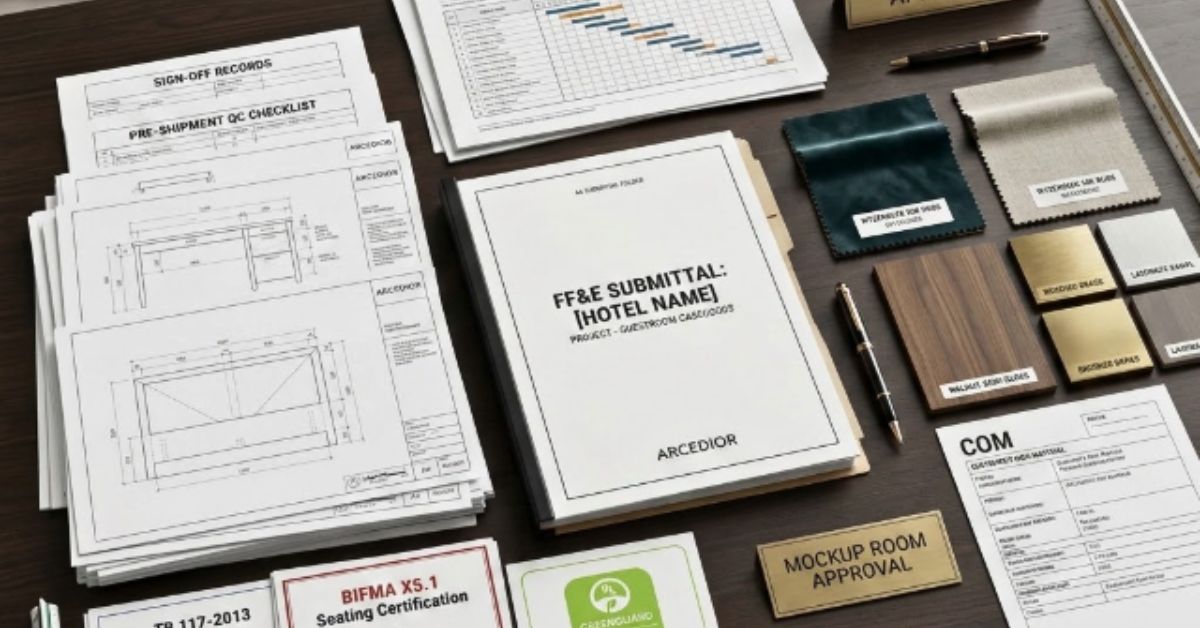
This question comes up on most projects, and the answer is more specific than most guides suggest. The submittal package is prepared by the manufacturer, supplier, or procurement partner – not the designer.
- The manufacturer or fabricator prepares shop drawings, product data sheets, and compliance certifications.
- The procurement or sourcing partner coordinates the full package and tracks revision status across all line items.
- The supplier provides physical samples with correct labeling and specification references.
- For COM items, the fabric house or the client's procurement team supplies the COM documentation.
The designer of record reviews and approves the package. They do not build it. This distinction matters when a submittal arrives incomplete – the designer cannot approve what is not there, and the manufacturer owns the gap.
On projects with a general contractor, the GC usually manages the submittal log and acts as the submission coordinator between the manufacturer and the review team. On direct-buy hospitality furniture sourcing projects, the procurement or sourcing partner takes that role.
The Complete FF&E Submittal Checklist
For a 200-room hotel, an FF&E submittal log typically tracks between 80 and 150 individual item submittals across casegoods, soft seating, lighting, artwork, and accessories. Managing that at scale requires a structured, complete package – not a folder of scattered PDFs.
Here is what every FF&E submittal package must include.
1. Shop Drawings and Technical Drawings
Shop drawings show exactly how an item will be built. They must include:
- Full dimensions, elevation views, and section details
- Hardware callouts and material specifications
- Revision history on each sheet
Format requirements: scaled drawings in PDF, with a clear revision number on every sheet. A missing dimension or an unlabeled hardware callout is one of the most common reasons a submittal comes back.
2. Product Data Sheets
These are the manufacturer's specification sheets for each item. They must state material composition, weight, available finish options, durability ratings, and performance data. For hospitality projects, commercial-grade or contract-grade classification must be clearly stated. A product data sheet from a residential furniture catalogue does not meet FF&E submittal requirements for a hotel specification.
3. Material and Finish Samples
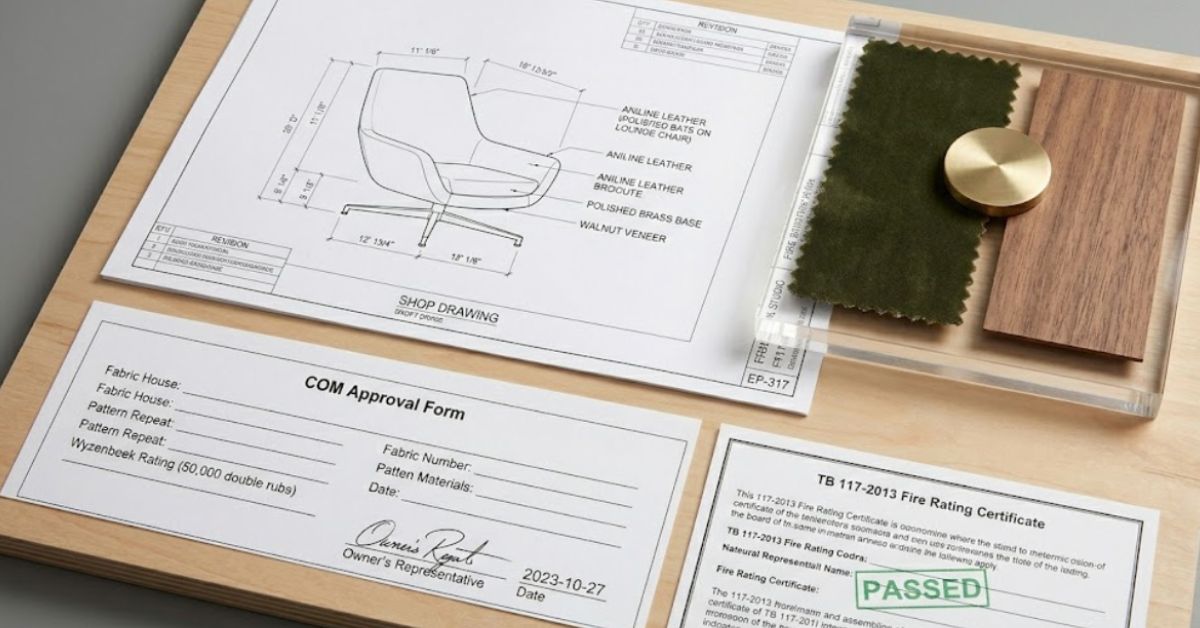
Physical samples must be labeled, dated, and referenced back to the specification line item. This section covers:
- Fabric swatches, wood veneer, laminate, and metal finish chips
- Finish boards showing all approved colorways, labeled by spec reference
For COM (Customer's Own Material) submittals, the documentation must include the fabric house name, fiber content, width, pattern repeat, cleaning code, Wyzenbeek or Martindale abrasion rating, and fire rating. A COM submittal missing the abrasion rating is almost always returned.
4. Compliance and Certification Documents
This is where most submittals have gaps. Required certifications depend on item type and project location. The table below covers the standards applicable to hospitality FF&E projects across the main markets.
Certification | Applies To | Typical Requirement | Region |
Upholstery, cushioning | Fire-retardant compliance | US (internationally accepted) | |
BS 5852 | Upholstery | Fire-retardant compliance | UK, Gulf projects |
Seating and soft furnishings | Cigarette-ignition resistance | US code | |
BIFMA X5.1-2017 | Contract seating | Structural durability | US and international |
BIFMA X5.5 | Desks and casegoods | Structural testing | US and international |
Hospitality furniture | Structural and safety testing | US hospitality projects | |
Wyzenbeek 30,000+ DR | Contract upholstery seating | Abrasion resistance (minimum) | All markets |
Wyzenbeek 50,000+ DR | F&B / lobby seating | Abrasion resistance (high-traffic) | All markets |
Martindale 25,000+ | Hospitality upholstery | Abrasion baseline | UK, Europe, Gulf |
GREENGUARD Gold | Furniture and finishes | VOC emissions | If specified in brief |
FSC Chain of Custody | Wood-based products | Responsible sourcing | If required by client |
Gulf Standard (GSO) | All FF&E categories | Local authority compliance | UAE, KSA, Gulf |
Table 1 – FF&E Compliance Standards Reference Important
Pro Tip
5. Lead Time Declaration
No standard commercial submittal checklist covers this, and it directly affects project timelines more than any other single item.
A lead time declaration must state:
- Sampling time and first article production
- Production lead time from the approval date
- QC and packing duration
- Shipping mode and estimated transit time
- Estimated site-delivery date
This information lets the procurement team back-plan from the hotel handover date to the approval date they need to hit. Without it, the submittal gets approved, and no one knows when the goods will arrive.
For imported FF&E packages, production release usually happens in phases rather than all at once. Long-lead custom casegoods release first; standard accessories are held until the approval window is confirmed closer to the handover date. A lead time declaration showing all items releasing simultaneously is usually a signal that the timeline has not been properly planned at the manufacturing level.

6. Sample Approval Records and Sign-Off Forms
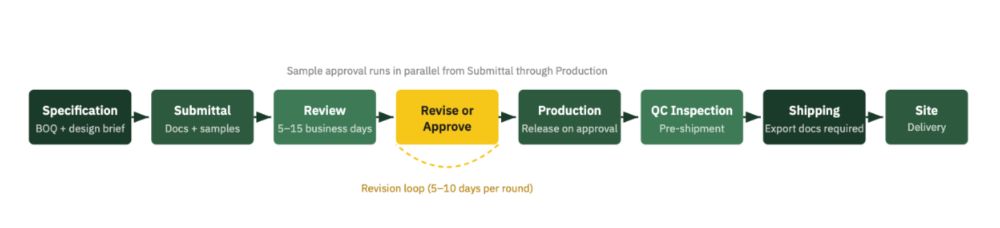
Sample approval runs in parallel with the document review. The package must include:
- First article sample approval form with item reference, approval date, approver name, and revision status
- Finish and texture sign-off record
- COM fabric approval with the client's or designer's signature
- For hotel guestroom projects: mockup room approval records before bulk production is released
7. QC and Inspection Documentation
The approved submittal becomes the QC benchmark for everything that follows. This section should include or reference:
- Pre-production checklist confirming all materials and components are available before production starts
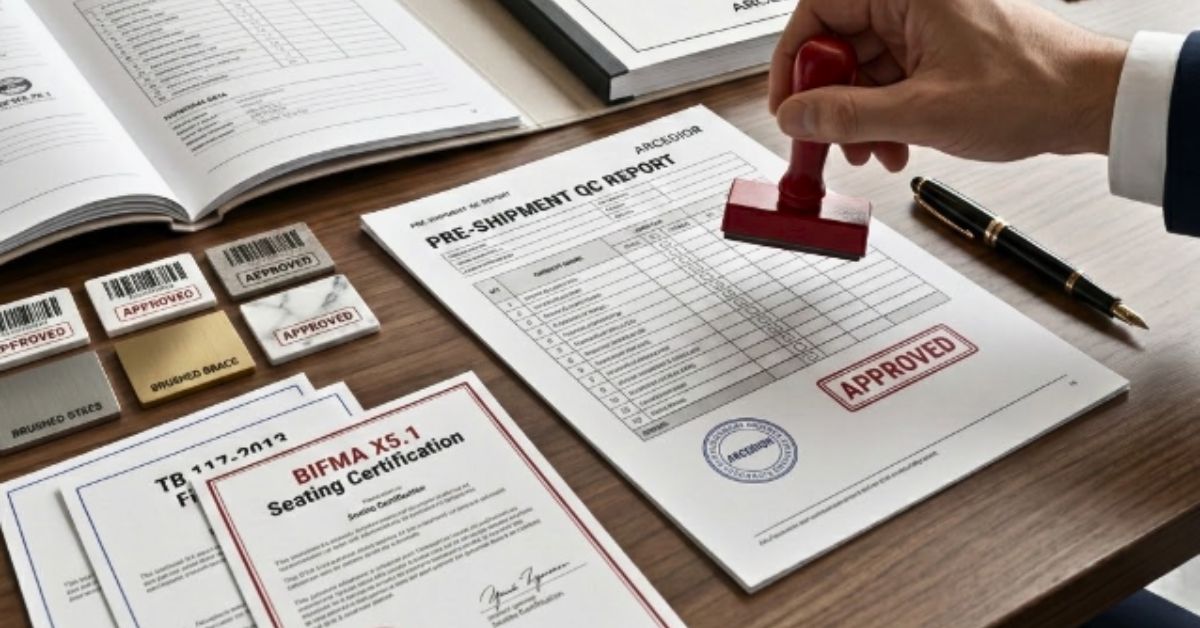
- Pre-shipment inspection report (third-party or internal) confirming finished goods match the approved sample
- Photo and video evidence of the packing condition and goods before loading
Catch FF&E Submittal Risks Before Production Release
If you are managing a hotel or hospitality FF&E package, send your BOQ, handover target, or specification set to Arcedior. We can help confirm sourcing routes, production readiness, QC checkpoints, certification alignment, and export planning from the manufacturing side.
How to Track FF&E Submittals on Large Hotel Projects
A 300-room hotel can easily have 120 to 150 active submittal line items at the same time. Tracking that manually in email threads does not work. The submittal log is its own deliverable, and it needs its own structure.
A properly maintained FF&E submittal log covers the following:
Submittal numbering. Each item gets a unique reference tied to the specification section (for example, GR-CG-001 for guestroom casegood item 001). That numbering must stay consistent across all revisions. Renaming items mid-project is one of the fastest ways to create confusion at the approval stage.
Revision tracking. Every revision round gets a revision letter (Rev A, Rev B). The log shows the current revision status for each item. When three items are at Rev C, and the rest are at Rev A, that is useful information for the procurement schedule.
Status columns. Current status, date submitted, review deadline, approval date, and who holds approval authority. These are four different fields, not one.
Sample tracking. Physical sample status is tracked separately from document review status. Both need to be approved before production releases. A submittal can be document-approved and sample-pending at the same time, which is a common source of missed production release dates.
Tools used in practice: Procore for GC-managed submittal logs, Smartsheet for owner-side tracking, Bluebeam for document markups and sign-off workflows, and Excel for smaller projects where stakeholder access is straightforward. None of these tools solves a disorganised process – they just make a structured one easier to maintain.
Pro Tip
Status | What It Means | Can Production Start? | Next Action |
Approved | Item matches the specification in full | Yes | Release manufacturing |
Approved as Noted | Minor documentation gaps, production can proceed | Yes, with conditions | Update records before shipment |
Revise and Resubmit | Significant issues found | No | Correct and resubmit the full package |
Rejected | Non-compliant or fundamentally wrong item | No | Stop, restart review from the specification |
Void | Item removed from scope or specification changed | N/A | Update BOQ and submittal log |
Table 2 – FF&E Submittal Status Definitions
Export Documentation for International FF&E Projects
Most submittal guides cover the design-approval side and stop there. For international FF&E procurement – particularly from manufacturers in Asia and the Middle East supplying into Europe, the Gulf, and the Americas – the documentation requirements extend well beyond the submittal package itself.
What the manufacturing side needs to provide before goods ship:
Fumigation certificates.
Required for any timber-based products shipping internationally. ISPM-15 compliance applies to all wood packaging materials, including crates and pallets. Without it, goods can be held at customs on arrival, regardless of how clean the submittal approval is.
Export packing declarations.
A formal document from the manufacturer or freight agent confirming packing method, carton construction, and load integrity for the specific shipping mode used (groupage, full container, air freight).
Country-of-origin documentation.
Required for customs clearance in most destination markets. Also relevant for projects where brand standards or client specifications require a specific manufacturing country declaration.
Shipping marks and carton labeling.
Each carton should carry the project name, item reference, spec line number, gross and net weight, dimensions, and destination contact. Unmarked or inconsistently marked cartons create receiving problems when a 500-piece delivery arrives, and the site team cannot match items to the specification without opening everything.
Certificate of conformance.
Some owners and hotel flags require a signed document from the manufacturer confirming that the goods shipped match the approved submittal exactly. This is separate from the pre-shipment inspection report.
Phytosanitary certificates.
Required for natural materials such as rattan, seagrass, and solid timber, depending on the destination country's requirements. This is one of the most commonly missed documents on projects that specify natural materials.
Key Takeaway: How does this connect to the submittal
Hospitality FF&E Submittals: What Hotels Need That Other Projects Do Not
A standard commercial project and a 300-room hotel project are not the same when it comes to FF&E submittal requirements. No generic contractor checklist accounts for what a hotel flag or brand standards team will apply.
Tolerance specs matter at scale. If guestroom furniture varies by 2mm unit to unit, you will see it when 200 rooms are fitted out. Hospitality casegoods submittals must confirm production tolerance specs in writing.
F&B upholstery has stricter thresholds. Lobby and restaurant seating takes more abuse. COM submittals for F&B areas typically require a Wyzenbeek rating of 50,000 double rubs minimum, plus a cleaning code that meets hospitality-grade maintenance standards.

Mockup room approval is not optional for flagged hotels. Projects operating under Marriott, Hilton, IHG, and most other major flags require a fully fitted mockup room sign-off before bulk guestroom production is released. That approval record becomes part of the submittal package.
Brand standards add another review layer. A submittal that passes the designer's review may still come back with brand compliance comments. Flag representatives review submittals against their own standards documentation independently of the designer's approval.
Bulk production confirmation must be in writing. Hotel projects often run 100 to 500 units per line item. The submittal must confirm the manufacturer can maintain approved quality at that production volume, not just at sample stage. This is not a bureaucratic note – factories that produce excellent single samples sometimes have different processes for bulk runs. Confirming the QC process for bulk production at the submittal stage is standard practice on well-managed hotel FF&E projects.
What Happens When a Submittal Is Incomplete or Rejected
The approval cycle resets. Each revision round adds 5 to 10 business days. For a large hotel FF&E package, two or three revision rounds on a single item can push the production release date out by three to four weeks.
If manufacturing started before approval – a mistake that still happens – rework costs fall on whoever the contract assigns responsibility to. On custom pieces with long lead times, starting over is not always possible without a cost impact.
The most common reasons FF&E submittals get rejected:
- Missing or expired compliance certificates
- Wrong abrasion standard was cited for the upholstery spec
- Shop drawings with insufficient detail or unlabeled hardware
- Sample shade variance from the approved finish board
- COM documentation is missing fiber content or cleaning code
The pattern in most rejected submittals is not one large problem. It is three or four small omissions that collectively add up to a resubmit.
If your project involves international manufacturing, confirm early what documentation the production side must provide as part of the submittal process. Arcedior supports hospitality FF&E projects through sourcing, custom manufacturing, compliance certification, sample approvals, and pre-shipment QC. Share your BOQ or specification list, and we will confirm exactly what the manufacturing side needs to deliver.

The FF&E Submittal Approval Process: Step by Step
- The FF&E coordinator compiles the submittal package against the specification
- The package is submitted to the owner's representative or project manager
- The reviewer checks against the approved specification and design intent
- Status is marked: Approved / Approved as Noted / Revise and Resubmit / Rejected
- If revision is required, the manufacturer makes corrections and resubmits
- The review cycle repeats until final approval is received
- Final approval triggers the production release
- Sample approval runs in parallel: physical sample sent and signed off
- Pre-shipment QC inspection is scheduled before dispatch
- The QC report is added to the submittal record before goods leave the factory
A first submittal review takes 5 to 15 business days, depending on the completeness of the package and the project's review schedule.
How Many Rounds of FF&E Submittal Revisions Are Normal?
For most FF&E projects, one to two rounds of revisions are normal. Complex custom items, particularly casegoods with detailed hardware or COM upholstery with specific abrasion requirements, may need three rounds. More than three rounds usually point to gaps in the original specification, not the submittal.
What typically drives extra rounds: ambiguous or conflicting specs, wrong compliance standard cited for the project region, shade variance on physical samples, and shop drawings that do not reflect the design intent clearly.
Key Takeaway
What an Approved Submittal Enables on the Sourcing Side
Once submittals are approved, the package becomes the production brief. A sourcing and manufacturing partner working from your approved submittal should be able to confirm:
- MOQ and bulk production capability at approved quality
- Sampling timeline for the first article and finish confirmation
- Compliance certifications aligned to project spec (fire rating, BIFMA, ASTM)
- Pre-shipment QC process against the approved sample
- Export packaging specifications for international shipping
- Shipping mode, transit time, and delivery coordination plan
Arcedior works from the approved design to handle the product side: sourcing, custom manufacturing, QC, logistics, and installation coordination.
Need a quick review of your FF&E submittal package?
Arcedior supports hospitality FF&E projects through sourcing, custom manufacturing, compliance certification, sample approvals, and pre-shipment QC.
Conclusion
A well-prepared FF&E submittal package does more than satisfy the approval process. It locks the production brief, sets the QC benchmark, and gives the procurement team the lead time data needed to plan handover. The projects that move from design approval to installation without major disruptions are the ones where the submittal was built properly from the start.
The checklist above covers every component the package needs: shop drawings, product data sheets, material and finish samples, compliance certifications, COM documentation, lead time declarations, sample approvals, QC records, and export documentation for international shipments. For hospitality projects, add mockup room sign-off and brand standards review to that list.
Getting submittals right on the first or second pass is not procedural caution. It is what keeps the installation window intact.